I sank two hundred and ten thousand dollars—every cent from my divorce settlement and twenty years of emergency clinic shifts in Phoenix—into the Verbena Creek Veterinary Clinic.
"You’re not just buying equipment, Dr. Petrova," Desmond Langdon told me that scorching April morning, handing over the brass ring of keys across the counter. "You’re inheriting forty years of trust. In this valley, a man’s horse is his livelihood, and a man’s word is his bond."
At seventy-eight, Desmond was an icon in Calder County.
Advertisements
He had silver hair, gentle blue eyes, and a grandfatherly warmth that made local ranchers take off their hats when he walked into the feed store. The town council had named the county fair pavilion after him.
I thought I was buying sanctuary.
At forty-seven, with my daughter off at college and a bitter marriage finally behind me, all I wanted was quiet work. I wanted to treat colic in quarter horses, vaccinate cattle, and sleep through the night without hearing city sirens.
Verbena, Arizona was supposed to be my fresh start.
Then, three weeks after the transfer closed, Harlan Vance pulled his horse trailer into my gravel yard at six in the morning.
***
Harlan didn't come inside. He banged on the clinic’s storm door with the flat of his palm.
"Doc! Get out here! Sundown is down again."
Sundown was a four-year-old thoroughbred stallion worth $140,000. He was the pride of Vance Creek Ranch, a bloodline Harlan had spent a decade refining.
Advertisements
When I stepped into the trailer, the smell hit me first.
It wasn't colic. It was the sickly sweet, metallic reek of organ failure.
The stallion was lying on his side, his dark coat soaked in cold sweat, his breath rattling in shallow, desperate gasps. His gums were an unnatural, chalky gray with petechial bleeding around the teeth.
"How long has he been like this, Harlan?" I asked, dropping to my knees in the sawdust.
"Started trembling at dawn," Harlan said, his weathered knuckles white against the trailer rail. "Old Doc Langdon treated Sundown’s mother five years back for the same thing. Said it was toxic locoweed from the high pasture. Prescribed mineral oil and charcoal."
I checked the horse’s heart rate. It was galloping at ninety beats a minute, fluttering erratically.
"Locoweed doesn't cause acute pulmonary edema like this, Harlan," I said, sliding an eighteen-gauge needle into the jugular to draw blood. "Has he had access to standing water?"
"Just the creek tank below the ridge. Same water the herd's drunk for fifty years."
Sundown didn't make it to noon.
He seized on the clinic hoist, his massive legs thrashing against the mats before his heart gave out completely. Harlan stood in the corner of the stall with his Stetson pressed against his chest, staring at the floor in stone-cold silence.
"I need to run a full toxicological necropsy," I told him gently.
Harlan shook his head. "Old Doc never needed to cut open a horse to tell us what killed it. He’d write the certificate for the insurance, shake our hand, and let the beast rest."
He paused, looking at me with narrow, suspicious eyes.
“Desmond never asked questions that cost a rancher his payout.”
That was the first time I felt the chill.
***
I didn't send the blood sample to the county agriculture lab. I paid six hundred dollars out of my own pocket to send it via overnight courier to the state toxicology institute in Tucson.
Three days later, the report landed in my email.
It wasn't locoweed.
The blood contained lethal concentrations of arsenic trioxide and industrial trichloroethylene—chemicals used in commercial groundwater drilling and mining solvent stripping.
The report noted: *Concentrations consistent with acute environmental leaching, not plant ingestion.*
I walked back into the clinic's records room—a converted storage shed behind the operating suite where forty years of Desmond Langdon’s carbon-copy patient files were stored in metal army footlockers.
I pulled the death certificates for the past ten years.
Between 2014 and 2026, thirty-two registered horses, sixteen breeding bulls, and eighty head of yearling cattle along Verbena Creek had died under identical circumstances: *Sudden respiratory collapse, attributed to native alkaloid toxicosis.*
Every single certificate was signed in Desmond Langdon’s shaky, elegant cursive.
And on every single file, the insurance adjuster listed was the same private underwriting firm in Scottsdale: Sonoran Land & Asset Trust.
I opened the Arizona corporate commission website and typed in the LLC number.
The managing director of Sonoran Land & Asset Trust wasn't an insurance executive.
It was Miles Langdon.
Desmond’s fifty-year-old son.
***
Everyone in Verbena knew Miles.
He drove a hundred-thousand-dollar black Porsche Cayenne that looked absurd on our washboard dirt roads. He wore pristine designer polos, played racquetball in Scottsdale on weekends, and had spent the last five years buying up foreclosed ranch parcels along the dry creek basin.
His proposal to the county board was grand: *The Verde Valley Oasis*—a luxury golf resort, gated equestrian villas, and an artificial lake.
The only obstacle in Miles’s way had been the historic water rights of the multi-generation ranching families along the lower creek. Families like the Vances, who refused to sell their land.
Unless their livestock kept dying.
Unless the insurance payouts couldn't cover the losses.
Unless the ranches went bankrupt.
I sat alone in the dark records room until midnight, cross-referencing parcel maps with Desmond's ledger.
Every ranch that suffered a livestock die-off between 2016 and 2024 had sold its water rights to Miles Langdon’s LLC within twelve months of the loss.
And Desmond had signed the death certificates that triggered the insurance money.
The father diagnosed the poison as "locoweed."
The son bought the ruined land for pennies on the dollar.
***
The next morning, I drove out to Desmond’s sprawling adobe home on the mesa.
His car was gone, but the garage was open. Sitting on the front porch in a rocking chair, wearing an expensive navy golf shirt and aviator sunglasses, was Miles.
"Morning, Doc," Miles said, not bothering to stand up. He smiled that polished, empty smile that never reached his eyes. "Looking for the old man? He’s playing nine holes in Sedona."
"I know what happened to Sundown, Miles," I said, staying at the bottom of the porch steps.
Miles took a slow sip from an insulated tumbler. "Tragic loss. Harlan took it hard. But horses die out here. That’s why we have insurance."
"Sundown was poisoned with industrial solvent."
Miles paused, his glass hovering halfway to his mouth. Then he set it down with a soft click.
"I’d be careful tossing words like that around Calder County, Dr. Petrova," he said smoothly. "You’re an outsider. You bought a practice on a reputation my father spent forty years building. You start telling ranchers their water is poisoned, you won't just kill my development project. You’ll destroy this entire town's property values."
He leaned forward, resting his elbows on his knees.
“Nobody likes a woman who comes from the city to tell them their home is rotten.”
"Your father knew," I said. "He signed thirty-two fraudulent certificates. He covered up the runoff from your exploratory drill sites on the north mesa."
Miles chuckled. It was a cold, hollow sound.
"My father is a local saint, Lena. Who do you think the county sheriff is going to believe? A revered pioneer who delivered half the babies in this valley, or a divorced vet who couldn't keep her own clinic afloat in Phoenix?"
He stood up and adjusted his collar.
"Take my advice. Sign Harlan’s insurance claim. Collect your five-hundred-dollar consultation fee. And let the past stay buried."
***
I didn't sign the claim.
At dawn on Thursday, Harlan called me again. His prize broodmare, a gentle six-year-old named Willow, was convulsing in the back stall of his main barn.
When I arrived, the barn was suffocatingly hot.
Willow was down on the straw, thrashing weakly, her eyes rolling in terror.
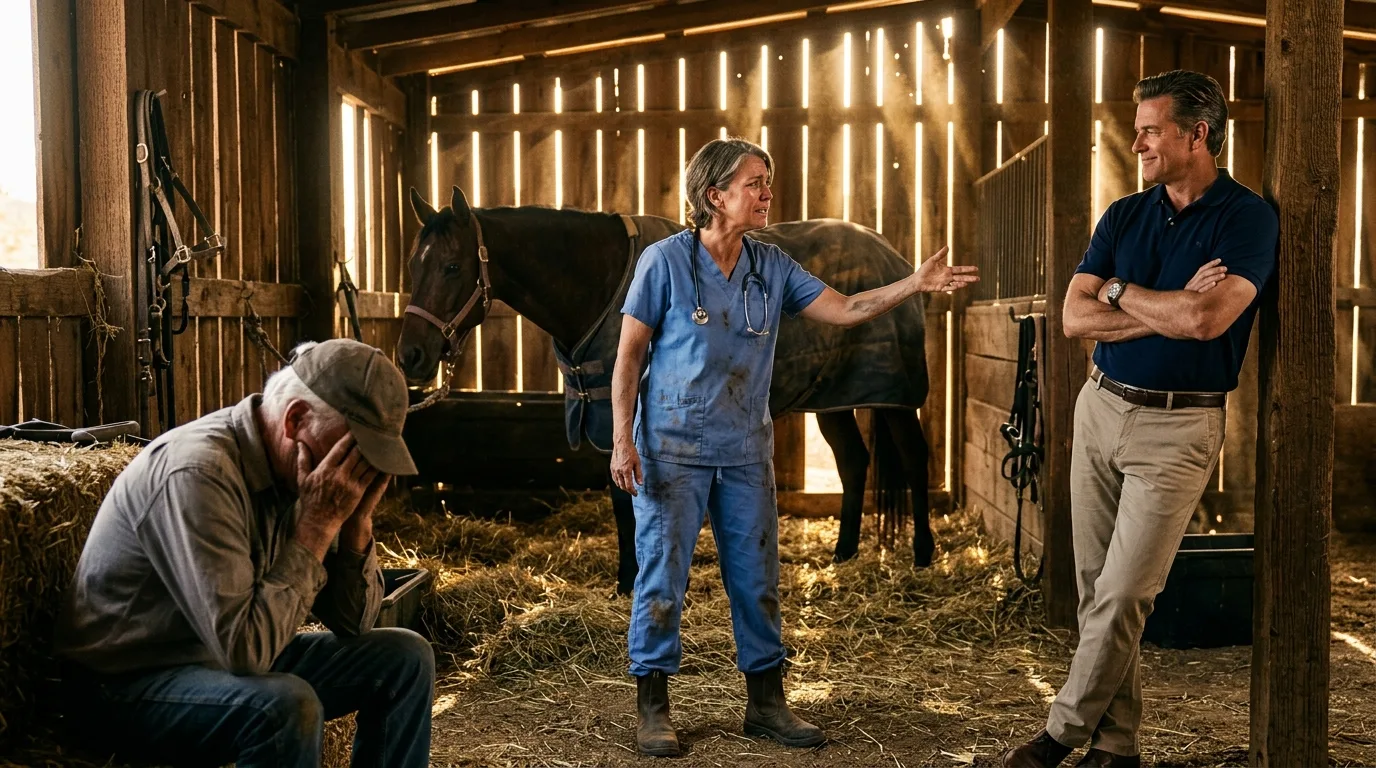
And standing in the shadows by the stall door, wearing an old canvas chore coat and trembling from head to toe, was Desmond Langdon.
Miles had driven him there to "smooth things over." Miles was leaning casually against a cedar support post, arms crossed, watching me with that same smug, arrogant smirk.
"Desmond," I said, dropping my medical bag into the dirt. "Look at her."
The old man flinched. He looked at the dying mare, then looked down at his trembling hands.
"Lena..." Desmond whispered, his voice cracking. "You don't understand the pressures. Ten years ago, the bank was calling the ranch notes. Miles... Miles said the drilling runoff would dissipate in the aquifer. He said it was temporary."
"Shut up, Dad!" Miles snapped, his voice sharp and vicious.
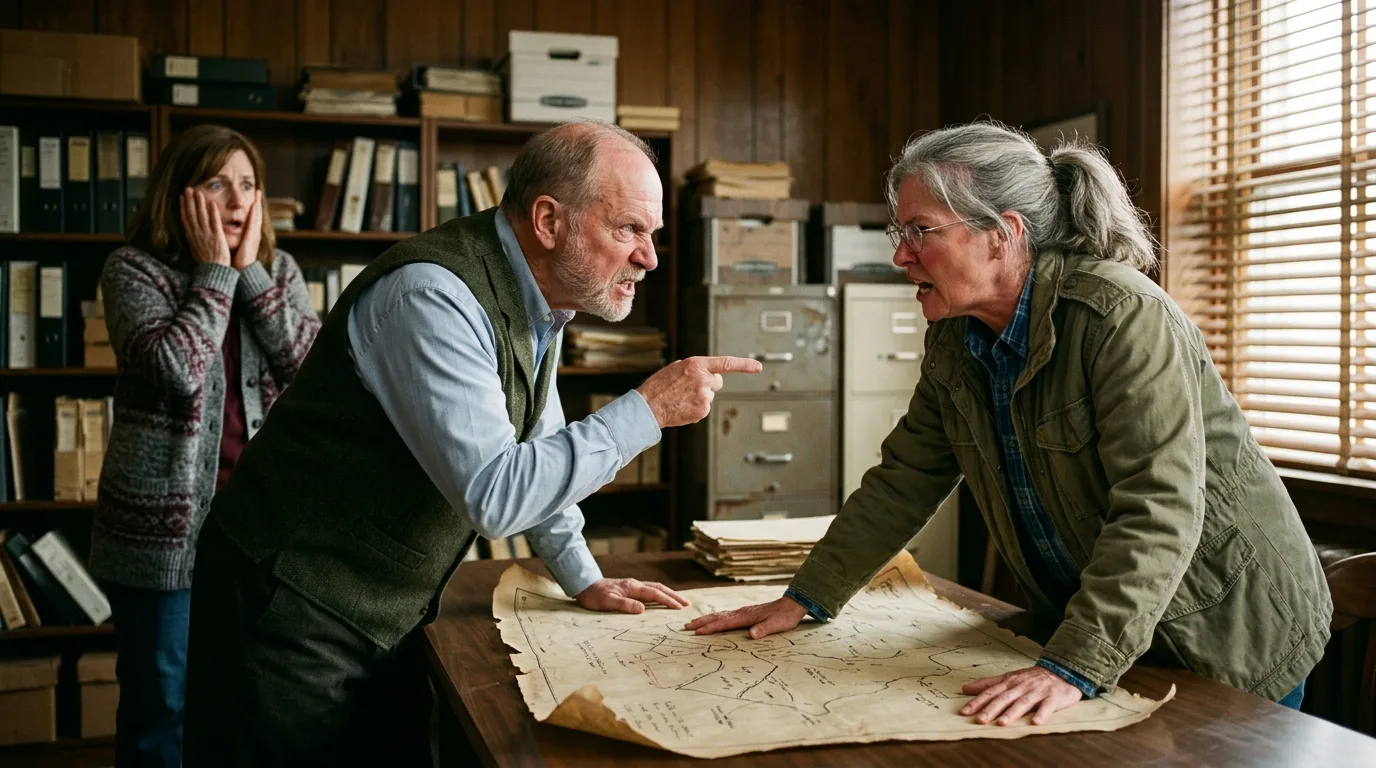
"No, Miles!" I screamed, standing up and pointing directly at the dying horse. "You poisoned this valley! You dumped drilling solvent into the creek basin, and when the animals started dying, you had your own father lie to his lifelong friends so you could steal their water!"
Harlan Vance stepped out of the tack room, a heavy steel crescent wrench clutched in his fist.
He had been standing behind the partition the whole time.
He had heard every single word.
Miles’s face drained of color. He looked from Harlan to me, his smirk vanishing into raw panic.
"Harlan, listen," Miles stammered, backing toward the barn doors. "It’s a misunderstanding. The testing was inconclusive—"
"Get off my land," Harlan said. His voice was lower than a desert growl, shaking with thirty years of betrayed brotherhood. "Get off my land before I forget that your daddy delivered my firstborn daughter."
Desmond sank down onto a hay bale.
He didn't make an excuse. He didn't look at his son.
He buried his face in his weathered, calloused hands and began to weep like a broken child.
***
I spent four hours pumping Willow’s stomach with activated charcoal, running intravenous atropine, and flushing her kidneys with saline.
She survived.
By Friday afternoon, two investigators from the Arizona Department of Environmental Quality and a state prosecutor from Phoenix were parked outside the Langdon Development office in downtown Verbena.
The state seized the north mesa drilling logs. They found three illegal injection wells, eighteen thousand gallons of unpermitted solvent storage, and proof of wire transfers linking Miles’s holding company to offshore accounts in the Bahamas.
Miles was indicted on fourteen federal counts of environmental endangerment, wire fraud, and grand larceny.
Desmond surrendered his veterinary license to the state board on Monday morning. He didn't fight it. He signed the revocation papers in a silent, empty hearing room, walked out to his truck, and hasn't shown his face in Verbena since.
On Tuesday morning, Harlan Vance walked into my clinic.
He didn't say much. Ranchers in Arizona don't use words when a handshake will do.
He laid an envelope on my counter. Inside was a certified check for the full medical balance, plus a handwritten deed granting the clinic permanent, deeded access to the sweet-water spring in Vance Canyon.
"We were wrong about you, Doc," Harlan said, touching the brim of his hat.
I looked out the clinic window.
The high desert sky was that fierce, brilliant turquoise you only see after a summer storm. The creek was dry, but the spring was running sweet and cold.
My name is on the sign outside.
And for the first time since I left Phoenix, I am finally home.
Comments
Loading the conversation…