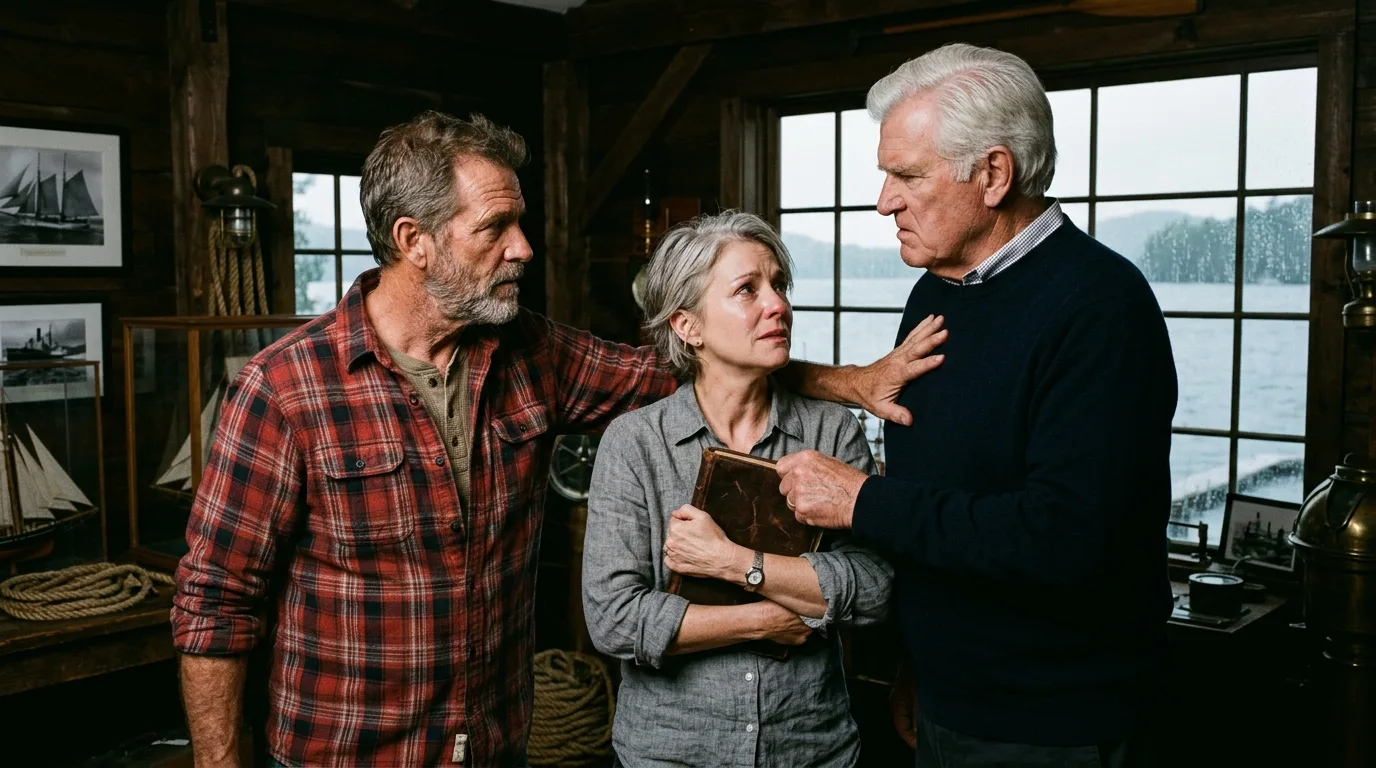
On the windswept granite crags of Cape Sorrow, Lake Superior doesn't forgive mistakes, and it never forgets a lie.
For one hundred years, our town worshiped a bronze statue on the harbor green.
The statue depicted Captain Arthur Shaw—jaw squared against the gale, an iron oar in his hand, immortalized as the savior who pulled twenty-eight passengers from the freezing hull of the *SS Pendleton* during the Great Ice Hurricane of November 1924.
Advertisements
His grandson, Harrison Shaw, was our current Mayor.
Harrison had Arthur’s square jaw, his piercing gray eyes, and a nine-million-dollar real estate redevelopment contract with a Chicago casino conglomerate.
"Cape Sorrow Light is a condemned fiscal liability," Mayor Shaw announced on the steps of the Maritime Museum in July. "The masonry is spalling, the cast-iron lantern deck is rusted through, and the museum operates at a forty-thousand-dollar annual deficit. In ninety days, we break ground on the Cape Sorrow Harbor Yacht Club and Marina."
I had been hired on a ninety-day probationary contract as the museum’s head curator.
I had seventy-two hours left before the bulldozers rolled in.
And on my last inspection of the lantern room, seventy feet above the freezing black water of Lake Superior, I dropped my brass flashlight into the counterweight shaft.
***
The shaft was a four-foot vertical conduit made of riveted boilerplate iron, designed in 1878 to house the heavy lead weights that rotated the two-ton Fresnel lens.
Advertisements
When I lowered an inspection camera on a tether down the dark shaft, the lens didn't hit bedrock.
It hit an old canvas sailcloth sea bag, wedged beneath the rusted cast-iron pulleys.
I crawled through the narrow service hatch at the base of the tower with an electric rotary cutter.
Twenty minutes later, I hauled the canvas bag out onto the cold concrete floor.
Inside, wrapped in oiled sheepskin and tied with tarred marline twine, lay a thick leather-bound logbook:
"OFFICIAL JOURNAL OF THE CAPE SORROW LIGHT STATION — 5TH DISTRICT U.S. LIGHTHOUSE SERVICE — VOL. IV (1922–1926)."
The town historical society had always claimed this volume had been destroyed in the 1935 station fire.
It hadn't burned.
It had been hidden.
And as I opened the yellowed linen pages to the night of November 18, 1924, my blood turned to slush.
***
The handwriting for the first ten months of 1924 was Arthur Shaw’s erratic, slanting scrawl, smelling of pipe tobacco and stale rum.
But at 21:00 hours on November 18th—the night the gale hit eighty miles an hour—the handwriting changed.
The scrawl was replaced by the neat, disciplined cursive of a boy:
"21:30 HOURS: SS PENDLETON BROACHED ON SOUTH REEF. ROCKET FLARES OBSERVED. KEEPER ARTHUR SHAW INTOXICATED IN QUARTERS. SHAW HAS BARRED THE STATION BOATHOUSE DOOR FROM THE INSIDE AND REFUSES TO LAUNCH THE SURFBOAT, SWEARING NO BOAT CAN LIVE IN THIS SEA."
The log continued, written in haste with ink thinned by melting snow:
"22:15 HOURS: I HAVE TAKEN THE RESERVE 16-FOOT DORY FROM THE NORTH SLIP. KEEPER SHAW THREATENED TO SHOOT ME WITH THE STATION CARBINE IF I ATTEMPTED RESCUE. I CANNOT WATCH WOMEN AND CHILDREN DROWN IN SIGHT OF THE LIGHT. MAY THE LORD FORGIVE MY DISOBEDIENCE."
The signature at the bottom was not Captain Arthur Shaw.
It was signed:
"Caleb Thorne — Age 16 — Assistant Wicker and Coal Boy."
***
My breath stopped.
Caleb Thorne.
I knew that name.
Every local in Cape Sorrow knew old Joseph Thorne—an eighty-two-year-old retired gillnet fisherman who lived in a leaking tar-paper shack by the fish docks, whom Mayor Shaw was currently evicting for unpaid boat harbor fees.
Joseph had always claimed his father, Caleb, was the real hero of the *Pendleton*.
The town council had laughed at him for fifty years. They called him a jealous old crank whose father was nothing more than an illiterate coal boy who died of pneumonia after the storm.
I turned the page.
Pasted to the rear inside cover of the logbook was an official telegram from the Department of Commerce Lighthouse Service in Washington, D.C., dated November 25, 1924:
*“To Keeper Arthur Shaw: Acknowledging telegraphic report of rescue. Congress to award Gold Lifesaving Medal and $5,000 national gratuity. Keep minor Thorne off official casualty manifests to prevent investigation into unauthorized minor vessel operation.”*
Attached to the telegram was a handwritten letter from Arthur Shaw to Caleb’s widowed mother, Mary Thorne:
"Your boy died of hypothermia because he was reckless. If you ever claim he rowed that dory, I will have your parish relief revoked and evict you from the harbor cottage within twenty-four hours. Sign the enclosed nondisclosure release or starve."
Arthur Shaw had barricaded himself in the warm station with a bottle of whiskey while a sixteen-year-old boy made five separate trips across freezing four-foot waves in an open rowing skiff.
Caleb had pulled twenty-eight screaming passengers from the icy rigging of the broken steamer.
He had dragged the last woman ashore at dawn.
And then his heart stopped from hypothermia on the gravel beach.
Shaw had dragged the frozen boy's body into the woodshed, took the oars, rowed thirty yards out into the surf where the newspapermen were arriving, and waved for the cameras.
***
The final town council meeting before the demolition permit took effect was scheduled for Thursday evening.
The Cape Sorrow Municipal Auditorium was packed with three hundred residents.
Mayor Harrison Shaw sat at the center of the dais beneath an oil painting of his grandfather wearing the Gold Lifesaving Medal.
"Fellow citizens," Harrison announced, tapping his ivory gavel. "Tonight we approve the final sale of Cape Sorrow Point to Apex Grand Resorts for $4,500,000. This project will revitalize our tax base and honor our maritime heritage with a world-class nautical pavilion."
Joseph Thorne sat in the front row, his weathered, arthritic hands resting on an old wooden cane, tears leaking from his rheumy eyes.
"Mayor Shaw," the old fisherman croaked, standing on trembling legs. "That light belonged to the men who died in the lake. My father died on that beach. You can't pave over his blood."
Harrison Shaw’s lip curled into a sneer.
"Mr. Thorne, your father was a low-wage laborer who swept coal. This council is not guided by folklore and family delusions. Officer, please help Mr. Thorne to his seat."
"Sit down, Harrison," I shouted from the center aisle.
The entire auditorium went silent.
I walked up the aisle carrying the leather-bound logbook in one hand and the Department of Commerce telegram in the other.
Harrison’s eyes narrowed into slits. "Ms. Sterling, your temporary employment contract expires at midnight. You have no standing to speak."
"I am the custodian of the United States Lighthouse Service Historical Archives," I said, placing the heavy whale-skin logbook directly in front of the town clerk’s microphone.
"And under 36 Code of Federal Regulations, altering or concealing an official federal maritime register is a federal felony with no statute of limitations."
I turned the logbook toward the crowd and adjusted the microphone.
I read Caleb Thorne’s entries from November 18, 1924.
Word for word.
Every line about the intoxicated Captain barricaded in the station.
Every line about the sixteen-year-old boy taking the open rowing skiff into eighty-mile-an-hour snow.
And then I projected the high-resolution scan of Arthur Shaw’s extortion letter to Caleb’s mother onto the forty-foot projection screen behind the dais.
The auditorium erupted into absolute fury.
People stood up on the benches, screaming at the council.
Three elderly women—descendants of the passengers rescued from the *Pendleton*—began to weep openly.
Harrison Shaw jumped to his feet, knocking his oak chair backward onto the stage.
"This is an unsubstantiated fake!" Harrison roared into his microphone. "She stole that book from the archives! Security, arrest her!"
The town police chief, Thomas Miller, stepped onto the stage.
He didn't look at me.
He walked straight up to Mayor Shaw, pulled the microphone from the podium, and turned off the PA system.
"The book is an authentic federal artifact, Harrison," Chief Miller said, his voice carrying through the hushed hall. "The State Historic Preservation Office verified the government watermark this morning."
Miller placed his hand on Harrison Shaw’s shoulder.
"The state auditor’s office has also frozen the resort development funds. Step down, Mayor. You’re done."
Harrison stood frozen on the stage, the sweat dripping from his chin onto his crisp silk tie, as three hundred of his own neighbors booed him out of the building.
I walked over to the front row.
I knelt down in front of Joseph Thorne and placed Caleb’s 1924 logbook into the old fisherman’s trembling, calloused hands.
The old man pressed the worn leather to his chest, his shoulders shaking with silent sobs.
"He wasn't a liar, was he, miss?" Joseph whispered through his tears.
I took his weathered hand in mine and smiled.
"No, Joseph. Your father was the bravest man this lake has ever known."
***
One month later, the town council voted unanimously to designate Cape Sorrow Light Station a National Historic Landmark.
The resort project was permanently cancelled.
Harrison Shaw resigned from office in disgrace and moved to Chicago.
And on the harbor green where the bronze statue of Arthur Shaw once stood, a new monument was unveiled on November 18th—exactly one hundred years to the day after the storm.
It was cast in solid bronze: a sixteen-year-old boy in a wool cap, pulling an open wooden oar through towering waves.
The inscription at the base reads:
*CALEB THORNE (1908–1924)* *He rowed out into the dark so others could see the dawn.*
Comments
Loading the conversation…