I have handled antique books and rare manuscripts for thirty-four years in Merrow Harbor, Maine, and there is one rule every antiquarian knows by heart:
You never wear your reading glasses down a flight of stairs.
Reading lenses magnify objects at twelve inches. If you try to walk down stairs while wearing plus-three-point-five diopters, the steps bend into nauseating waves. You will lose your balance on the very first riser.
Advertisements
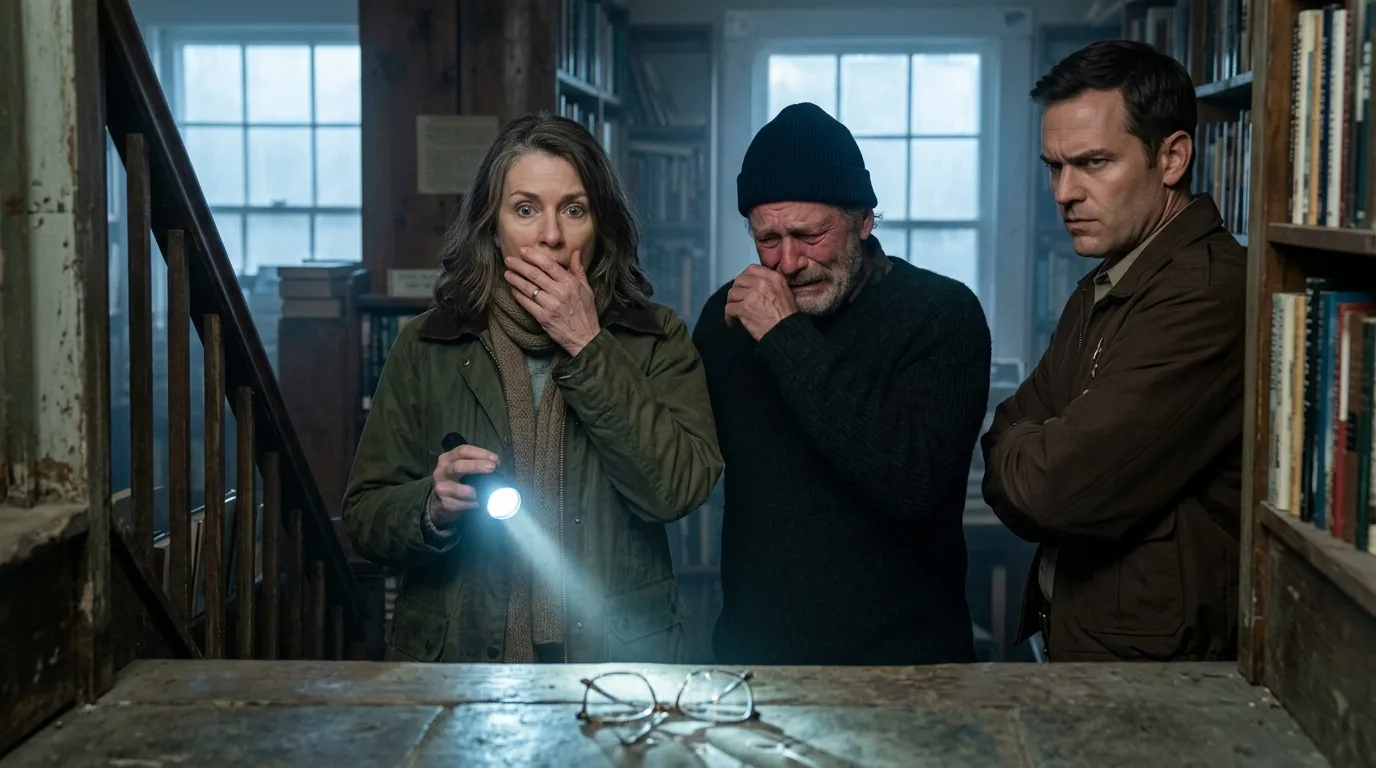
Yet when they found seventy-eight-year-old Edwin Ross crumpled at the bottom of the cellar stairs inside the historic Thistle & Vine estate, his tortoiseshell reading glasses were still sitting squarely on the bridge of his nose.
Not shattered. Not dislodged.
Carefully positioned on a dead man's face.
***
"It was an open-and-shut accident, Nell," Sheriff Roy Vance told me as we stood inside the dim front parlor of the estate.
Rain lashed against the leaded glass windows overlooking the Atlantic surf.
"Edwin was seventy-eight. The cellar stairs are steep, unvarnished spruce from 1840. He lost his footing in the dark and broke his cervical spine on the flagstones. We closed the file this morning."
"Edwin wouldn't walk down those stairs in the dark, Roy," I said, my voice low and tight. "And he certainly wouldn't do it wearing close-up magnification glasses."
Roy sighed, rubbing his tired eyes. "The man was appraising forty boxes of damp estate papers for the Finch family. He probably forgot to take them off. Let it go, Nell."
Advertisements
I didn't let it go.
Because Edwin Ross hadn't just been my colleague. He had taught me the craft of paper preservation when I was twenty-two years old.
And Edwin was the most methodical, cautious human being who had ever walked the coast of Maine.
***
Twenty-four hours later, a black Lincoln Navigator with commercial plates backed into the crushed-shell driveway of Thistle & Vine.
Out stepped Carter Sterling.
Carter was forty-four, the owner of Sterling Fine Arts & Antiquities in Portland.
He was dressed in an Italian charcoal cashmere topcoat, wearing crocodile-skin loafers, his hair slicked back with pomade.
Behind him came two hired movers carrying professional archival transport crates.
"Mrs. Whitcomb," Carter greeted me with a patronizing tilt of his head as I stood in the doorway. "Terrible tragedy about poor Edwin. But the estate appraisal must proceed. Mrs. Finch has contracted my firm to liquidate the library."
"Mrs. Finch is eighty-two years old and grieving in an assisted-living facility in Bangor," I said, blocking the threshold. "What exactly are you removing, Carter?"
"General ephemera. Early nineteenth-century maritime ledgers, shipping receipts, family Bibles. Nothing that concerns a village bookshop."
He signaled his movers to push past me.
As the men carried out the heavy oak crates, Carter lingered by the hallway table, checking his gold Rolex.
In his breast pocket, tucked inside a leather portfolio, was a brass-bound folio covered in dark green morocco leather.
I recognized that tooling immediately.
It was the 1782 Maine Coastal Land Commission Manuscript—signed by Governor John Hancock and Massachusetts Surveyor General Rufus Putnam, detailing the original colonial land grants from Casco Bay to the Canadian border.
It was one of only two copies known to exist in the United States.
Estimated auction value: $680,000.
"Where did you get that folio, Carter?" I demanded.
Carter smiled, patting his coat. "Edwin negotiated the acquisition from the Finch family last Thursday, hours before his unfortunate stumble. He sold the entire lot to me for twenty thousand dollars cash. The bill of sale is signed and filed."
Twenty thousand dollars for a $680,000 national treasure.
Edwin Ross would have cut off his own right hand before cheating an eighty-two-year-old widow out of her family inheritance.
***
That evening, I drove out to Edwin’s modest cottage on Harbor Road.
The police tape across the front porch had already begun to peel in the salt wind.
I let myself in using the spare brass key Edwin had kept hidden in the hollow iron owl on his porch railing for thirty years.
His study was immaculate, smelling of beeswax and dried lavender.
On his drafting table lay his personal daily desk ledger—a hardbound black notebook where he logged every single client phone call, every appraisal valuation, and every incoming parcel.
I turned to the page for Thursday, October 14th—the day he died.
Written at 2:15 p.m. in Edwin’s precise, copperplate handwriting:
"Carter Sterling arrived unannounced at Thistle & Vine. Demanded I certify the Hancock 1782 folio as an anonymous colonial reproduction so he could buy it from Margaret Finch for $20,000. I refused. I informed him I will present the authentic provenance to the Maine Historical Society on Monday. He became highly agitated."
Beneath that note, Edwin had scrawled a line in shaky, rushed pencil:
"He followed me to the cellar. He says if I don't sign the transfer, nobody leaves this house."
My heart hammered against my ribs like a trapped bird.
I looked down at the drafting table.
Beside the desk ledger lay Edwin’s forensic magnifier—a 30x illuminated stereoscopic loupe.
Next to the loupe was a clear glass specimen dish.
Inside the dish were three strands of fine charcoal-gray fiber.
Edwin had labeled the specimen slide in pencil: *Recovered from my lapel during argument.*
Charcoal cashmere.
The exact weave of Carter Sterling’s Italian designer overcoat.
***
I didn't take the notebook to Sheriff Vance.
Vance was Carter Sterling’s second cousin by marriage, and Carter had donated thirty thousand dollars to the County Police Athletic League two months ago.
Instead, I called Inspector Thomas Burke of the Maine State Police Major Crimes Unit in Augusta.
"Inspector Burke," I said, holding Edwin's notebook tightly in my hand. "Are you familiar with the upcoming Rare Americana Auction at the Portland Grand Ballroom this Saturday?"
"Sterling’s auction?" Burke asked. "Every major collector in New England is flying in."
"Then you’d better book a front-row seat," I said. "Because Carter Sterling is about to sell a stolen state treasure—and I have the forensic evidence that proves he murdered Edwin Ross to get it."
***
Saturday evening, the grand ballroom of the Portland Harbor Hotel was bathed in crystal chandelier light.
Three hundred wealthy bidders in tuxedos and evening gowns sat with auction paddles in hand.
Carter Sterling stood on the elevated stage behind a polished mahogany podium.
On a velvet-draped pedestal beside him rested the 1782 Hancock Folio under bulletproof museum acrylic.
"Lot 47," Carter announced, his voice reverberating through the sound system. "The crown jewel of tonight's collection. The 1782 Maine Land Commission Manuscript, signed by John Hancock. We open bidding at $400,000."
A bidder in the third row raised paddle 84: "$400,000."
"I have $400,000! Do I hear $450,000?"
"Fifty thousand!" paddle 112 signaled.
"Five hundred thousand!" paddle 29 called out.
"Five hundred thousand going once..." Carter smiled, raising the ivory gavel. "Going twice..."
"The lot is withdrawn," a woman's voice cut through the room like shattered glass.
I walked down the grand carpeted center aisle wearing my black wool mourning suit, holding Edwin’s black desk ledger in one hand and a high-resolution forensic tablet in the other.
Carter’s smile vanished. "Security, remove this trespasser immediately!"
"Don't move, Mr. Sterling," Inspector Burke called out from the back entrance, flanked by four plainclothes state detectives. "Everyone remain seated."
The room erupted into shocked whispers.
I stepped up onto the stage, directly beside the velvet pedestal.
I tapped the screen of the tablet, and Edwin’s final handwritten log entry appeared on the two ten-foot projector screens flanking the stage.
The words filled the room:
"Carter Sterling arrived unannounced... He followed me to the cellar. He says if I don't sign the transfer, nobody leaves this house."
"This is a pathetic forgery!" Carter shouted, his voice cracking. "Edwin was an old man who had an accident! You have no proof of anything!"
"We have the physical proof you left on his body, Carter," I said, pointing to the secondary slide on the screen.
"When you shoved Edwin down those cellar stairs, he fought back. He clutched your lapel. The state crime lab ran a mass spectrometry test on the cashmere fibers Edwin secured in his watch pocket before he fell. They match your Italian coat—dye lot 409, imported from Milan."
The room fell into stunned silence.
"And you made one fatal mistake, Carter," I continued, stepping directly in front of him.
"You thought placing his reading glasses on his face made it look like a tragic accident. But Edwin had cataracts. He couldn't see four feet in front of him with those glasses on. No man walks into a dark basement with plus-three reading lenses—unless someone staged the body after breaking his neck."
Carter’s face went completely gray.
He lunged toward the stage exit, but two state detectives grabbed him by the arms, slamming him against the mahogany wall and snapping the handcuffs onto his wrists.
"Carter Sterling," Inspector Burke recited, reading his Miranda rights into the microphone. "You are under arrest for first-degree murder, felony theft of cultural property, and falsifying legal deeds."
As Carter was dragged through the stunned crowd of millionaires, the room remained dead quiet.
I walked over to the velvet pedestal.
I gently lifted the acrylic case and touched the green morocco leather of the 1782 folio.
The leather was cool, smelling of dried oak bark and colonial ink.
"Rest easy, Edwin," I whispered, closing my eyes against the stinging tears.
"Your ledger is closed. And your honor is clean."
***
Six weeks later, the Hancock Folio was officially presented to the Maine State Archives in Augusta in honor of Edwin Ross.
The Finch family estate received the full valuation funds, ensuring eighty-two-year-old Margaret Finch’s medical care for the rest of her life.
Carter Sterling was convicted of second-degree murder and sentenced to twenty-five years to life at the Maine State Prison in Thomaston.
My little shop, Thistle & Vine, still smells of beeswax, leather balm, and old paper.
On the shelf behind my counter sits Edwin’s brass-rimmed loupe and his black desk ledger.
Whenever an appraiser tries to cut corners, I point to the black book.
Because in our trade, the truth is always written down—if you only know where to look.

Comments
Loading the conversation…