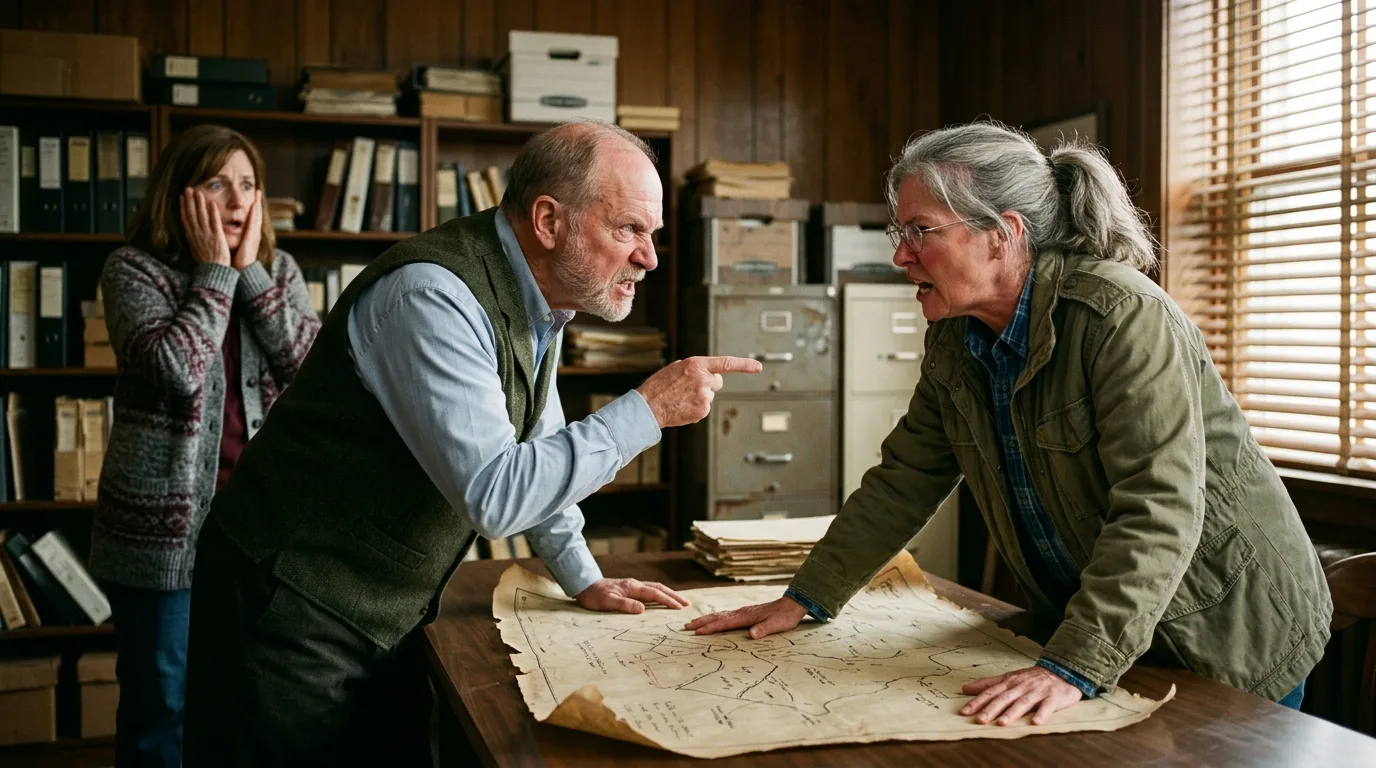
For thirty-two years, I worked in the basement map room of the Blackwood County Courthouse, surrounded by the smell of ammonia, decaying vellum, and damp stone.
I was sixty-two years old, and I thought I knew every inch of this valley.
"Paper doesn't lie, Eleanor," my father used to tell me when he surveyed these hills in the 1970s. "Fences rot. People die. But ink on linen holds the truth until the world ends."
Advertisements
He was right.
Until the morning Julian Blackwood walked into my office holding an eviction summons and a brand-new digital survey map.
***
Julian Blackwood was forty-one, with teeth so white they looked painted on and a wool trench coat that cost more than my annual pension contribution.
His great-grandfather had founded Blackwood Valley.
His family owned the timber mill, the commercial bank, and two of the three seats on the County Board of Commissioners.
"Eleanor," Julian said, offering a tight, patronizing smile as he unrolled a glossy blueprint across my counter. "I need your official clerk stamp on this revised plat boundary. The Board votes on the new industrial timber zoning at four o’clock."
I looked down at the map.
It was a boundary redraw for Section 14 along the Blackwood Creek basin.
According to Julian's new satellite-verified map, the eighty-acre farm belonging to Martha Higgins was actually twenty-six acres smaller than she claimed.
Advertisements
The survey line had been dragged straight through Martha’s apple orchard, her historic 1880 barn, and her natural mountain spring.
"Martha’s family has paid taxes on those eighty acres since 1912, Julian," I said calmly, peering over the top of my wire-rim reading glasses.
"Martha’s grandfather built his fence on Blackwood land," Julian countered smoothly, resting his manicured fingertips on the glass desk. "Old paper surveys were sloppy, Eleanor. Our GPS laser scans proved the boundary error. We’re exercising our right of reclamation to build the new haul road. She has thirty days to vacate the western half of the property."
"She’s seventy-six years old. That spring is her only source of drinking water."
Julian’s smile hardened into something cold and sharp.
"The law doesn't run on sentiment, Mrs. Vance. Just stamp the plat so we can both go home on time."
***
I didn't stamp it.
"The county by-laws allow the archivist forty-eight hours to cross-reference historical field notes," I said, sliding the map back toward him.
Julian didn't blink. He leaned in close enough that I could smell his expensive clove cologne.
"My father sits on the budget committee, Eleanor. Your archive funding is up for review in three weeks. It would be a tragedy if the county decided a sixty-two-year-old clerk was a redundant expense."
He turned and walked out, his leather oxfords clicking rhythmically against the terrazzo floor.
My hands were shaking, but not from fear.
They were shaking with the cold, quiet fury that only forty years of dealing with entitled men can breed.
***
At five-thirty, the courthouse emptied out.
The fluorescent bulbs hummed in the subterranean silence. I locked the front security grate, turned off the hallway lights, and walked to the far corner of the vault.
Blackwood County’s official records had been digitized in 2018.
Julian’s father, Senator Arthur Blackwood, had personally funded the $350,000 scanning project. He had been hailed as a civic visionary.
But when you scan records, you choose what to scan.
And you choose what gets left in the damp corners to turn to mildew.
I pulled out my brass key ring and unlocked the heavy iron door of Storage Cage C—the uncatalogued repository of nineteenth- and twentieth-century surveyor field notebooks.
I knew exactly what I was looking for.
In the summer of 1993, the State of Washington announced the construction of Highway 12 Bypass.
The state had paid Blackwood County millions in eminent domain compensation to purchase right-of-way timberland.
My father, Robert Vance, had been the Chief County Surveyor that year.
He died of a stroke three months before the bypass broke ground.
I knelt before the gray metal filing cabinets labeled *State Highway Division 1990–1995*.
Drawer three was jammed.
I took a crowbar from the maintenance toolbox, wedged the tip into the lip of the steel drawer, and hauled back with all my weight.
With a screech of rusted metal, the drawer popped open.
Inside, beneath a layer of dead silverfish and dried mouse droppings, sat a thick, canvas-bound binder with brass corner brackets:
*FIELD LOG BOOK NO. 44 — BLACKWOOD VALLEY BASIN — JULY 1993.*
***
My fingers trembled as I opened the cover.
The handwriting inside was unmistakable. It was my father’s tight, disciplined drafting print, written in waterproof India ink.
I flipped past the first thirty pages of elevation lines and benchmark coordinates until I reached the entry for July 28, 1993.
A folded linen parchment sheet fell out into my lap.
It was an original hand-drawn plat survey, stamped with the red wax seal of the Washington State Board of Professional Land Surveyors.
Across Section 14, my father had drawn a bright red surveyor’s line.
Next to it, written in bold capital letters, was a note that stopped my breath:
"BOUNDARY ALTERATION DEMANDED BY ARTHUR BLACKWOOD REJECTED. HIGGINS DEED IS IRONCLAD. BLACKWOOD TIMBER CORP HAS ENCROACHED 42 ACRES INTO PUBLIC TRUST AND PRIVATE CITIZEN LAND TO DIVERT $1,400,000 IN HIGHWAY CONDEMNATION FUNDS."
Pasted to the facing page was a yellowed slip of paper.
It was a personal cashier's check from the Blackwood Bank, dated August 3, 1993, made out to Robert Vance in the amount of $50,000.
Written in Arthur Blackwood’s bold signature across the memo line were three words:
*For Boundary Correction.*
My father had never cashed it.
Instead, he had stapled the check directly to the field book and written beneath it:
"A surveyor’s honor is not for sale. Filed under oath."
Two weeks later, my father had suffered his fatal stroke on the courthouse steps.
Arthur Blackwood had taken personal custody of the highway file that same afternoon.
The field book had never been digitized.
They thought it had been lost in the courthouse flood of 1996.
***
I didn't sleep that night.
I took the field log to an independent high-resolution scanning laboratory in Spokane at dawn. I had certified notarized duplicates made of every page, the surveyor's seal, and the uncashed bribe check.
Then I called Special Agent Marcus Reynolds of the State Attorney General’s Public Integrity Division.
"Agent Reynolds," I said into the payphone outside the diner. "How much do you know about the Highway 12 Bypass right-of-way acquisitions from thirty years ago?"
There was a five-second silence on the line.
"Mrs. Vance," Reynolds said slowly. "We opened an audit on that project in 1994, but the key survey documents vanished. Are you telling me you found them?"
"I have the originals," I said. "And Julian Blackwood is using the fraudulent lines right now to seize an old woman's farm."
***
At three-forty-five that afternoon, the County Board of Commissioners room was packed.
Julian Blackwood stood at the podium in front of the three commissioners.
He was holding a laser pointer, gesturing toward a large digital monitor displaying his sanitized GPS boundary map.
"As you can see, Commissioners," Julian said in his smooth, practiced baritone, "the Higgins property line was an archaic approximation. Approving this timber right-of-way today brings sixty new logging jobs and $3 million in timber revenue to our county."
Commissioner Vance Evans—Julian’s second cousin—cleared his throat. "I move that we approve the boundary certification and authorize the Sheriff’s eviction warrant."
"I second the motion," Commissioner Hoyt added instantly.
"Before you call the vote," I called out from the back of the chamber.
Every head in the room turned.
I walked down the center aisle wearing my everyday wool cardigan, carrying a heavy leather briefcase.
Julian’s face tightened. "Mrs. Vance, this public hearing is for registered landowners and board members. Archivists do not have standing to interrupt."
"I’m not here as an archivist, Julian," I said, setting the briefcase squarely on the speaker's lectern. "I’m here as the daughter of the man your father tried to bribe."
A murmur rippled across the benches.
I opened the briefcase and took out the certified enlargements of Field Log No. 44.
I placed the first photograph onto the projector bed: the hand-drawn survey from July 1993, clearly showing the red boundaries and my father's official state seal.
"Thirty years ago, Arthur Blackwood bribed officials to shift the highway right-of-way forty-two acres west, pocketing $1,400,000 in state highway funds," I said, my voice echoing across the high-ceilinged room.
"When my father refused to certify the lie, your father wrote him a $50,000 personal bribe check."
I dropped the enlarged photograph of the cashier's check onto the projector.
Arthur Blackwood’s distinctive cursive signature filled the two-story screen behind the commissioners.
Julian’s skin turned the color of damp chalk.
"This is ancient, unverified garbage!" Julian barked, stepping toward the podium. "My father is eighty-two years old and in hospice care! This is defamation!"
"Your father’s signature was verified at eight o’clock this morning by the State Crime Lab," a deep voice announced from the double doors at the back of the room.
Two state troopers in brown uniforms walked in, followed by Special Agent Reynolds carrying a federal subpoena.
"Julian Blackwood," Agent Reynolds said, walking up to the podium. "Under RCW Title 40, falsifying public records and utilizing altered cadastral surveys to unlawfully seize private land constitutes grand larceny and public corruption."
The room went dead silent.
"We have a warrant to seize all digital survey records from Blackwood Timber Corp and the County Planning Office," Reynolds continued, handing a copy of the warrant to Commissioner Evans, whose hands were shaking so violently the paper fluttered like an autumn leaf.
Julian looked around the room.
Not one of his father’s friends on the board would meet his eyes.
"Eleanor," Julian hissed under his breath as the state trooper stepped behind him and produced a pair of chrome handcuffs. "You just destroyed this town."
I looked him dead in the eyes.
"No, Julian. I just returned it to the people who built it."
***
Two weeks later, the County Board voted unanimously to revoke the timber easement.
Martha Higgins’ eighty acres were re-certified under the original 1912 boundary, protected forever by an agricultural conservation easement.
Julian Blackwood was indicted on four counts of felony fraud and tampering with official instruments.
The Blackwood Timber Corporation was ordered to repay the state $2.8 million in restitution and accrued penalties.
On a warm Saturday in October, I drove out to Martha’s farm.
The old woman was sitting on her front porch, peeling heirloom McIntosh apples into an enamel basin.
Her barn stood tall against the timbered hillside, the afternoon sun catching the silver weathered wood.
Beside her rocking chair sat a wooden crate filled with twelve jars of homemade apple butter, tied with red ribbons.
"I don't have money to pay a fancy lawyer, Eleanor," Martha said softly, her eyes glistening as she reached out and took my weathered hand in hers.
"You don't owe me a dime, Martha," I said, smiling as I looked across the quiet valley where the creek ran crystal clear.
"My father already balanced this ledger thirty years ago."
Comments
Loading the conversation…