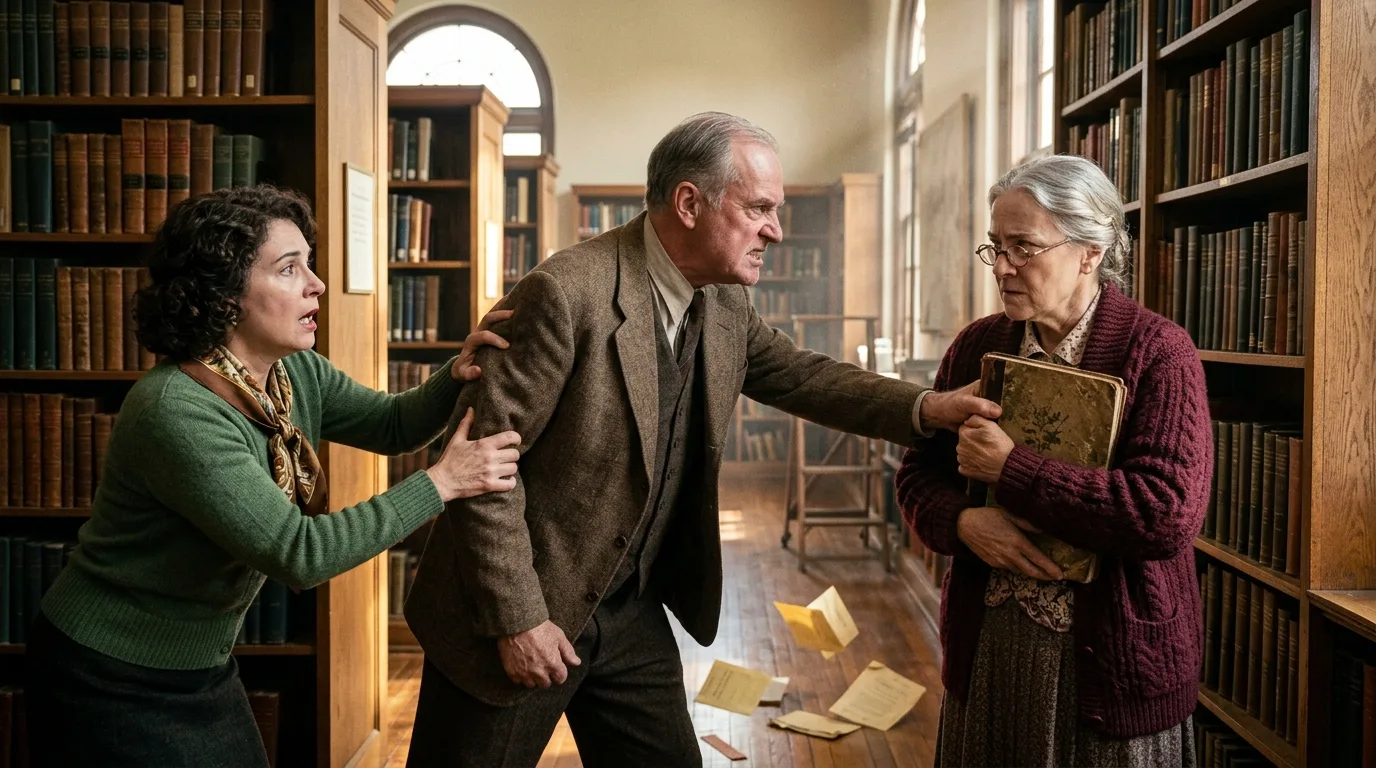
For fourteen years, I managed the Special Collections archive at the Havenwood Athenaeum, and I learned one universal truth about powerful families:
The more charities they fund in public, the deeper they bury their paper in private.
I was forty-eight, surrounded by the scent of aged rag paper, Spanish leather bindings, and cedar shavings.
Advertisements
I loved the quiet.
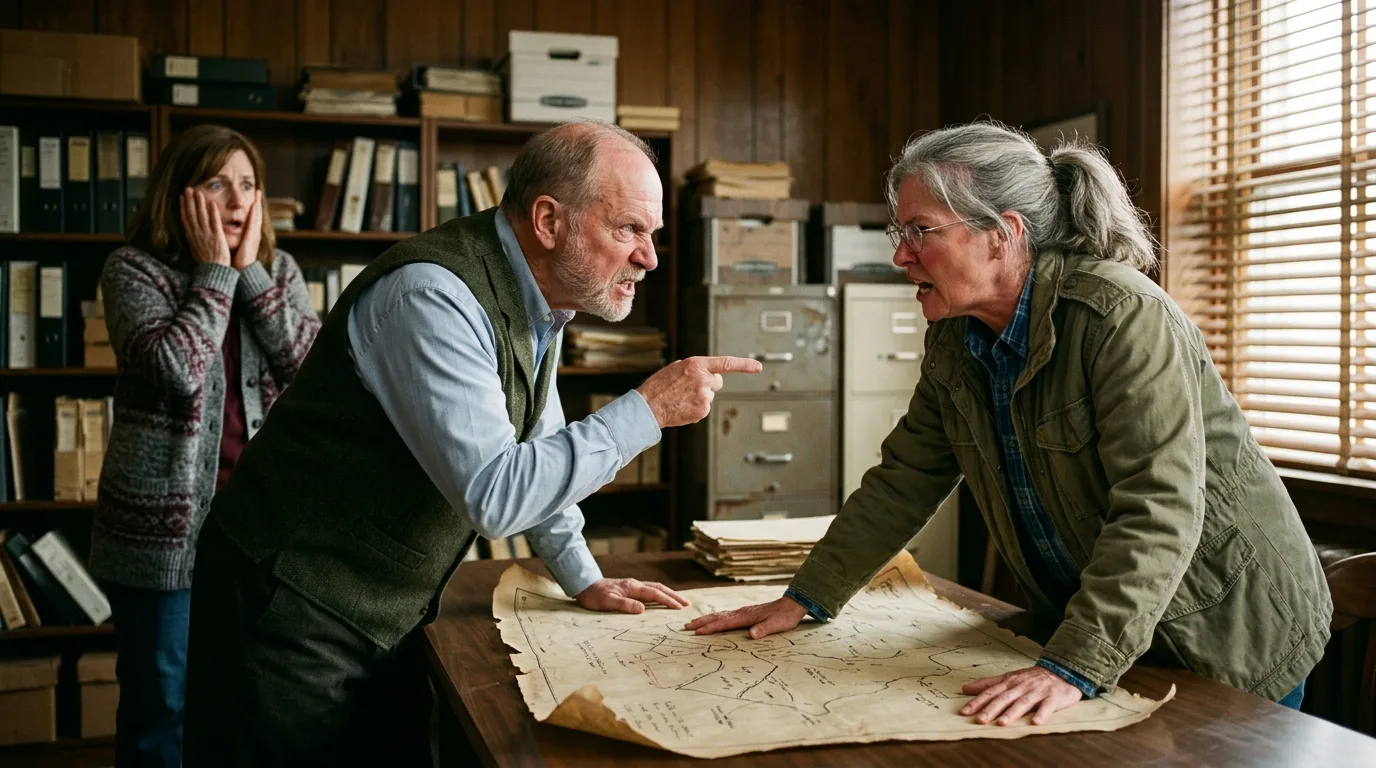
Until the Tuesday morning Owen Pritchard walked through the mahogany doors with two shredding technicians and a termination notice with my name on it.
***
Owen Pritchard was sixty-two years old, the senior partner at Pritchard, Sterling & Vance, and the undisputed legal kingmaker of the valley.
His family name was carved in granite over the public high school, the regional hospital wing, and the county courthouse portico.
"Marianne," Owen said, flashing the polished, reassuring smile he used when convincing widows to sign over agricultural timber rights. "The Board of Trustees conducted an emergency budget review last night. The physical archive has become an unsustainable fiscal and fire hazard."
Behind him, two men in gray industrial coveralls wheeled in three heavy plastic commercial shredding bins.
"We have contracted an industrial disposal firm to pulp the pre-1900 county registers this afternoon," Owen continued smoothly. "Digital scans are being prepared. Hand over the keys to Vault 4."
Advertisements
I stood up slowly from behind my desk, holding a brass bone folder.
"The pre-1900 registers are irreplaceable historic property, Mr. Pritchard," I said. "State public records law prohibits the destruction of primary municipal ledgers without a sixty-day public notice."
Owen stepped forward, his eyes turning cold and hard beneath his silver eyebrows.
"The Athenaeum is an endowment-funded private institution, Marianne. And I am the chairman of the endowment. Sign the deaccession log, or the board will dismiss you for gross insubordination by five o’clock. You will lose your pension, your healthcare, and your professional license."
He tossed the master deaccession clipboard onto my blotter.
At the top of the inventory list, highlighted in yellow marker, was a single item:
"COLLECTION NO. 1888-B: THE SPARROW INDEX & WATER RIGHTS TRANSCRIPTS."
***
Owen left to attend a zoning hearing at Town Hall, giving me until 4:00 p.m. to wheel the archives into the loading dock.
The second the street door clicked shut, my assistant Sofia bolted the deadbolt.
"Marianne," Sofia whispered, her eyes wide with fear. "If he fires you, you won't work in another research library in New England. Just let them pulp the boxes."
"People don't pay five thousand dollars for emergency industrial pulp trucks just to clean house, Sofia," I said.
I took my brass vault key, unlocked the steel gate of Vault 4, and pulled down Box 1888-B.
Inside lay a heavy sheepskin-bound ledger titled:
*THE SPARROW INDEX — GEOLOGICAL & SPRING HEAD SURVEY OF HAVENWOOD BASIN — 1888.*
The book had been compiled by Dr. Walter Sparrow, Havenwood’s first municipal health commissioner and surveyor.
I sat at the inspection table and opened the cracked leather cover.
Pages one through forty-six were standard water flow logs, well-depth calculations, and irrigation easements.
Then I reached Page 47.
The parchment was slightly discolored, stained with a dark, oily residue along the upper binding.
Pinned to the page with a rusted steel straight pin was a handwritten coroner’s inquest report dated September 14, 1888.
It was signed by Judge Silas Pritchard—Owen Pritchard’s great-grandfather.
I read the copperplate script beneath the magnifying lamp:
"INQUEST INTO THE ELEVEN CHILD FATALITIES AT THE HAVENWOOD VALLEY ORPHANAGE: CAUSE OF DEATH CONFIRMED AS MASSIVE ARSENIC POISONING VIA MUNICIPAL SPARROW SPRING."
Beneath the coroner's finding was a handwritten settlement agreement between Judge Silas Pritchard and the Atlantic Zinc & Silver Smelting Syndicate:
"IN CONSIDERATION OF $120,000 CASH ($3,800,000 ADJUSTED VALUE), PRITCHARD ESTATE AGREES TO SEAL ALL GEOLOGICAL WATER TEST REPORTS, REDRAW THE BASIN PROPERTY BOUNDARY, AND IMPOSE A WATER MONOPOLY ON THE TOWN RESIDENTS FOR 140 YEARS."
Stapled to the back of Page 47 was the smoking gun:
An active, 140-year covenant that expired in December of this year.
If the covenant expired without the original documents, the Pritchard Corporation would automatically forfeit their subterranean mineral rights back to the town of Havenwood.
And next week, a federal environmental class-action lawsuit filed by forty-two valley farming families whose wells had been contaminated with heavy metals was scheduled for preliminary discovery before the District Court.
If Owen pulped Page 47, the farmers would have no legal proof that the Pritchard family had known about the subterranean toxic plume for over a century.
***
At three-thirty, the heavy rumble of the shredding truck rattled the Athenaeum's stained-glass windows.
Owen Pritchard strode through the front doors, accompanied by two private security guards.
"Time's up, Marianne," Owen announced, checking his diamond-encrusted watch. "Wheel the boxes out."
I sat calmly behind my oak desk.
On the blotter in front of me sat Box 1888-B.
Empty.
Owen’s eyes snapped to the empty container, then to my face.
"Where is the Sparrow Index, Marianne?" he barked, his voice echoing off the vaulted rafters.
"It’s no longer in this building, Owen," I replied quietly.
Owen slammed both hands onto my desk, knocking over a brass pen stand.
"You insolent, meddling fool! You took private corporate property! I will have you arrested before sunset!"
"It isn't corporate property, Owen," I said, looking him dead in the eye.
"Under the 1884 Town Charter, any health report commissioned with municipal tax dollars belongs forever to the citizens of Havenwood."
The double doors of the library banged open.
Walking through the entryway wasn't the local town police.
It was Federal Judge Rebecca Campbell, flanked by two United States Marshals and the lead attorney for the Valley Agricultural Cooperative.
Owen spun around, his jaw slackening in shock.
"Judge Campbell?" Owen stammered, his face blanching. "What is the meaning of this intrusion?"
"The meaning, Mr. Pritchard," Judge Campbell said, her voice like cracking ice, "is that twenty minutes ago, Ms. Abbott filed an emergency ex parte petition under the Federal Toxic Substances and Preservation of Public Records Acts."
A U.S. Marshal stepped forward, holding a steel evidence transport case.
Inside the case, resting on velvet under sealed tamper-evident forensic film, was the Sparrow Index.
Open to Page 47.
"Judge, this document is a piece of unverified antique folklore!" Owen argued frantically, sweat drenching his stiff white collar. "It has no evidentiary bearing on modern litigation!"
"The State Environmental Protection Agency just completed mass spectrometry on the arsenic tailings map on Page 47," Judge Campbell declared. "The underground runoff channels drawn by Dr. Sparrow in 1888 match the current toxic plume beneath thirty-eight farms with ninety-nine percent accuracy."
Judge Campbell looked at the two marshals.
"Under federal court order, all assets, real property, and legal archives of Pritchard Holding Corp are frozen pending federal grand jury review for historic environmental fraud, destruction of public evidence, and racketeering."
The marshals unclipped their handcuffs.
"Hands behind your back, Mr. Pritchard," the lead marshal ordered.
Owen looked around the grand room his grandfather had built, the gold-leaf chandeliers reflecting the tears of rage streaming down his cheeks.
"You had no right!" Owen snarled at me as the handcuffs bit into his wrists. "That book was our family's private history!"
I stood up, smoothed my cardigan, and looked down at him.
"History doesn't belong to the people who buy the paper, Owen," I said softly.
"It belongs to the people who survived your ink."
***
Six months later, the federal court finalized a $48 million environmental remediation settlement funded entirely by the liquidation of the Pritchard real estate trust.
Clean municipal water pipelines were installed across the entire valley, bringing pure mountain water to hundreds of families who had suffered for generations.
Owen Pritchard was disbarred and sentenced to seven years in federal prison for felony obstruction of justice and falsification of subpoenaed records.
The Havenwood Athenaeum was transferred to a community public trust.
I am still the head archivist.
And on a pedestal in the center of the reading room, illuminated beneath climate-controlled museum glass, sits the Sparrow Index.
Page 47 is turned open for every visitor to read.
Because a library isn't a tomb for secrets.
It’s where the truth finally learns to breathe.
Comments
Loading the conversation…