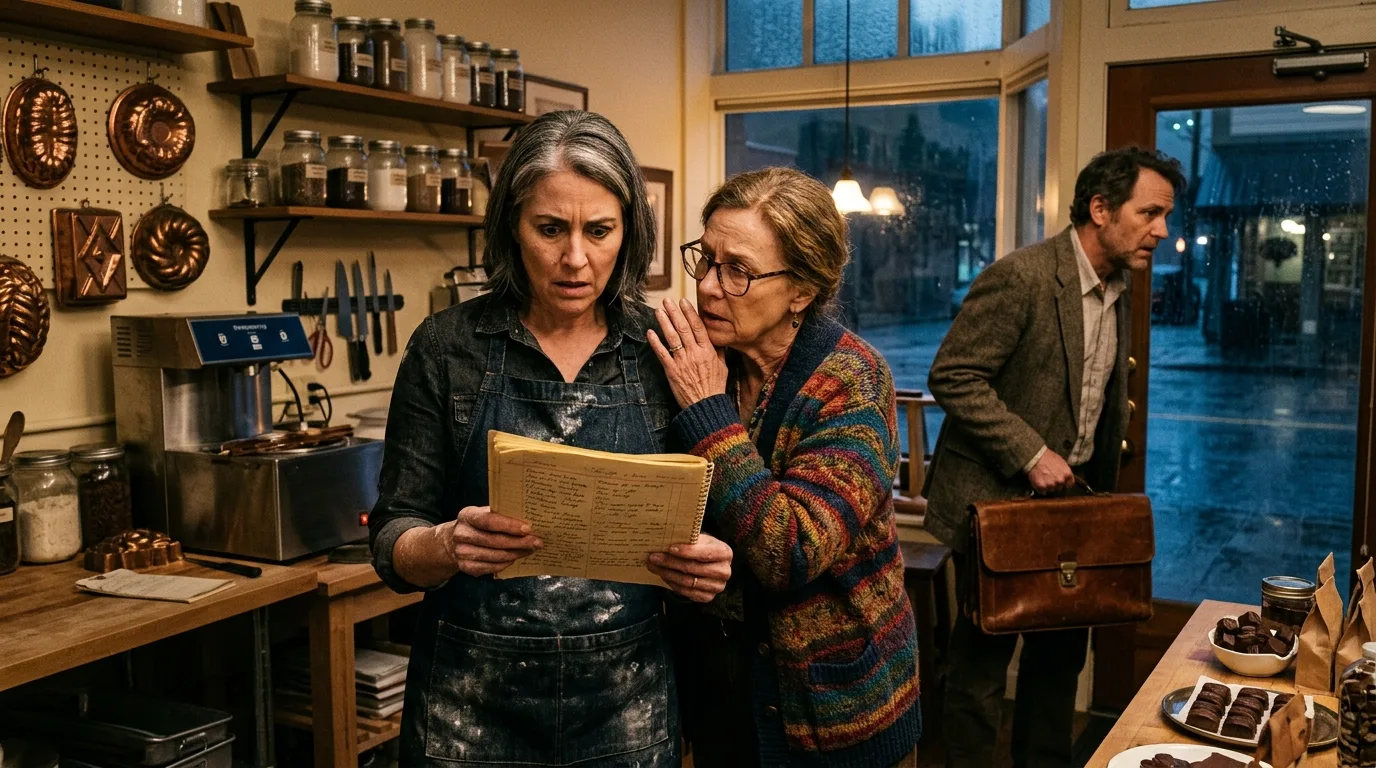
I spent twelve years sleeping on a fold-out cot behind an industrial tempering machine, breathing in the scent of roasted cacao, vanilla beans, and failure.
At thirty-four, my boutique chocolate business in Seattle was bankrupt.
I was forty thousand dollars in credit card debt, my mixer was broken, and I was seventy-two hours away from an eviction notice.
Advertisements
Then a registered letter arrived from an estate probate attorney in Cascade Ridge, Washington.
An elderly woman named Greta Mercier—whom I had never met in my life—had died and left me a shuttered chocolate shop called *The Black Forest*, along with three years of back property taxes and an unserviced walk-in refrigeration cooler.
Attached to the deed was a single handwritten line:
*"Claude always said you were the only one with his hands."*
Claude.
My breath stopped in my throat.
Claude Mercier had been the greatest master chocolatier of our generation.
Twenty-five years ago, in the autumn of 1999, Claude was the toast of the culinary world. His wild-fermented single-origin truffles were hailed by French critics as black gold.
Then, on a rainy night in November 1999, Claude walked out of his Seattle workshop and vanished off the face of the earth.
No body. No ransom note. No goodbye.
Just twenty-five years of silence.
Advertisements
Until I unlocked the basement cooler of that decaying shop in the Cascade Mountains.
***
Forty-eight hours after I moved my two suitcases into the apartment above the shop, a midnight-blue Bentley Bentayga pulled onto the rain-slicked gravel apron outside.
The man who stepped out wore an eight-thousand-dollar vicuña wool coat and handmade Italian suede boots.
Julian Vane.
At fifty-five, Julian was the billionaire CEO of Vane Luxury Chocolatier, an international confectionery empire with ninety flagship boutiques from Fifth Avenue to Tokyo.
In 1999, Julian had been Claude Mercier’s junior apprentice and business manager.
After Claude disappeared, Julian miraculously "discovered" the secret recipe for the *Midnight Orchid Truffle*—the signature ganache that launched his forty-five-million-dollar fortune.
"Thea, my dear girl," Julian purred, his smile polished to a blinding porcelain sheen as he stepped across my sawdust-covered floorboards. "When my lawyers told me Greta left this dump to you, my heart broke. You shouldn't be scrubbing mold off grease traps."
He pulled a gold Montblanc pen and a cashier's check from his breast pocket.
He slid the check across the zinc counter.
$350,000.
"Take it," Julian said warmly. "Pay off your debts. Move to Paris. My crews will come in on Monday with industrial dumpsters and level this entire rotting structure."
I looked down at the check.
Then I looked up at Julian’s eyes.
His pupils were dilated. His fingers were tapping an erratic, nervous rhythm against the zinc counter.
And his gaze kept darting to the locked heavy steel hatch in the corner of the prep kitchen: the entrance to the walk-in subterranean cooler.
"Why do you care about a condemned shack in Cascade Ridge, Julian?" I asked quietly.
Julian’s patrician smile flickered for a fraction of a second, revealing a predator's snarl.
"Greta was a hoarder, Thea. The building is a biohazard. Take the money by Friday, or the county health inspector will condemn the premises anyway and you won't see a single dime."
He turned and strode out, the Bentley’s twin-turbo engine rumbling into the mountain fog.
***
The second his car cleared the ridge, I grabbed an iron pry bar and an industrial battery lantern and headed down into the sub-basement cooler.
The air smelled of seventy-year-old freon, dried cork, and cold damp earth.
The cooler floor was made of heavy pine planks laid over concrete footings.
Near the back wall, where the old brine cooling coils hung like rusted serpents, three floorboards were slightly raised.
I wedged the pry bar beneath the planks and hauled back.
The nails groaned and popped free.
Beneath the boards was a recessed hollow cut into the solid foundation bedrock.
Inside the hollow lay an olive-drab steel tool chest, sealed with heavy beeswax along the gasket to keep out humidity.
I sliced through the wax seal with my paring knife and threw back the lid.
Resting on a bed of dried cocoa leaves was a calfskin-bound ledger, stained with grease, bitter chocolate, and dark reddish-brown splashes.
I turned the cover.
The handwriting made tears sting my eyes.
It was Claude’s unmistakable, flowing French cursive, written in dark sepia fountain pen:
"LE CARNET DU MAÎTRE — CLAUDE MERCIER — AUTOMNE 1999."
I flipped through forty pages of temper curves, humidity ratios, and emulsion formulas until I hit the entry for November 3, 1999:
"Julian discovered my secret fermentation culture. He came tonight demanding I assign 100% of the patent rights to his dummy shell company in Delaware. When I refused, he poured liquid potassium cyanide into my evening coffee thermos. I am paralyzed from the waist down. He is bringing a cement truck at 3:00 a.m. to bury my body under the new foundation of his Spokane distribution center."
Pasted beneath that horrifying entry with surgical tape was a small glass insulin vial containing two milliliters of dark, oily brown liquid.
Labelled in Claude’s failing, dying hand:
"The poisoned coffee. Julian’s fingerprints are on the thermos lid. Avenge my work, Thea. Do not let the thief steal our art."
Attached to the back cover was an original legal patent application dated October 1999 for the *Midnight Orchid Wild-Fermentation Ganache*—signed by Claude Mercier, with full chromatographic lab assays proving it was stolen word-for-word by Julian Vane.
Julian hadn't just built an empire on stolen chocolate.
He had murdered the greatest chocolatier in the world and paved over his bones.
***
I didn't run to the local sheriff.
Julian Vane was the largest taxpayer in three Washington counties.
Instead, I waited until Saturday night: the Grand Finale of the Northwest Chocolate Masters Gala at the Seattle Convention Center.
The event was broadcast live on national food television.
Six hundred celebrity chefs, international food critics, and high-society patrons sat at white-clothed banquet tables.
Julian Vane sat at the center of the grand judging dais as the Guest of Honor and Head Judge, wearing a midnight-blue tuxedo with a gold lapel pin.
At eight-forty-five, it was time for the wild-card artisanal presentation.
"Our final entrant tonight," the master of ceremonies announced, "is Thea Quinn of Black Forest Confections."
I walked onto the illuminated stage wearing my simple white chef's coat, carrying a polished silver service cloche in one hand and a black velvet presentation case in the other.
Julian’s face tightened in instant recognition.
His smile became a frozen mask of dread.
"Ms. Quinn," Julian said into his judging microphone, attempting to regain control. "This competition is for established master artisans. I'm afraid amateur confectionery belongs at county fairs."
"This isn't an amateur recipe, Julian," I said, my voice projecting clearly across the auditorium.
I lifted the silver cloche.
Resting on the porcelain plate were six hand-rolled truffles, dusted with dark, wild Venezuelan cocoa powder, shimmering with faint violet iridescence.
The aroma of wild mountain honey, smoked wood, and rich dark chocolate filled the front rows.
"Try one, Julian," I said. "You should recognize the temper curve. It's the 1999 batch you killed for."
A ripple of confusion ran through the audience.
"What is the meaning of this insolence?" Julian hissed, pushing his chair back. "Security! Remove this woman!"
"Nobody moves," a crisp, commanding voice echoed from the hall speakers.
Special Agent David Vance of the Washington State Attorney General’s Criminal Division walked onto the stage, flanked by three detectives and an FBI forensic examiner carrying a federal evidence briefcase.
I opened the black velvet case on the center table.
I projected Claude’s handwritten calfskin ledger and the sealed vial of cyanide-laced coffee onto the sixty-foot main auditorium screen.
Claude’s final words filled the screen:
"Julian poured liquid potassium cyanide into my coffee... He is bringing a cement truck to bury my body under the Spokane foundation."
The entire banquet hall gasped in horror.
"The Spokane County Sheriff’s Department began ground-penetrating radar scans at your Spokane warehouse at noon today, Julian," Agent Vance announced, stepping directly in front of the judge's table.
"They located human remains wrapped in burlap beneath the primary concrete slab. The dental records matched Claude Mercier two hours ago."
Julian Vane stumbled backward, knocking over his silver water goblet.
The crystal shattered across the hardwood stage.
His face turned an ashen, sickly gray.
"It was an accident!" Julian screamed, his voice cracking into high-pitched hysteria as the television cameras zoomed in on his sweating, contorted face. "He wouldn't listen to reason! He was going to ruin everything!"
"Julian Vane," Agent Vance recited, snapping the steel cuffs onto the billionaire's wrists. "You are under arrest for aggravated first-degree murder, federal trade-secret theft, and corporate racketeering."
As the federal marshals dragged the sobbing billionaire off the stage in front of six million live viewers, the auditorium was dead silent.
I turned back to the center table.
I picked up one of the wild truffles Claude had taught me to roll when I was just a girl with flour on my apron.
I placed it gently on the porcelain plate next to Claude's ledger.
"The recipe is safe, Master Claude," I whispered, closing my eyes against the stinging tears.
"Your name is on the box again."
***
One year later, the federal courts awarded the entire patent library and $32 million in restitution from the liquidated Vane estate to Claude Mercier's posthumous foundation.
Julian Vane was sentenced to life without parole at the Washington State Penitentiary.
I used my share of the restitution to restore *The Black Forest* in Cascade Ridge.
The old shop has solid copper fixtures now, three modern tempering kettles, and big glass bay windows overlooking the pine mountains.
Every morning at dawn, the sweet, earthy aroma of roasting cacao curls up into the mountain air.
Above our mahogany counter hangs Claude’s calfskin ledger, displayed behind bulletproof museum glass.
And beneath his photo, carved into solid Washington cedar, are the words that started it all:
*Chocolate is not an industry. It is the truth of the earth.*
Comments
Loading the conversation…