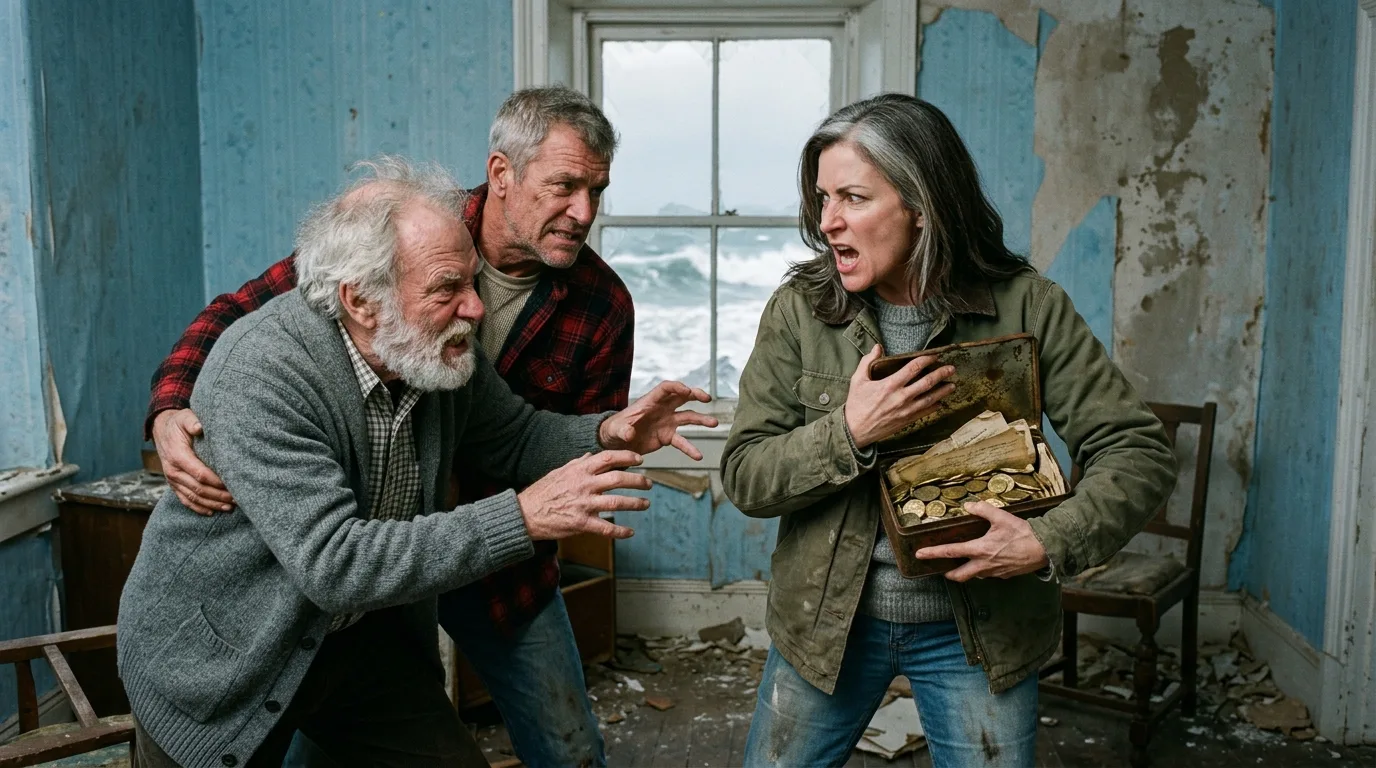
At fifty-two years old, with my twenty-eight-year marriage ended and half my life packed into six cardboard boxes, I put every cent of my savings into a ruined stone cottage on the windswept cliffs of Salt Spray Point, Maine.
I paid $85,000 at the county tax auction.
The roof leaked seawater. The cedar shingles were black with Atlantic mildew, and the local townspeople called it a ghost house.
Advertisements
"The place has been rotting since 1944, Mrs. Vance," the town tax collector told me when he handed over the rusted brass ring of keys. "Nothing out there but gulls, salt fog, and twenty tons of granite that should have been bulldozed forty years ago."
I didn't care.
The stone foundation was solid Maine granite, quarry-cut in 1918.
And from the broken bay window, you could watch the Atlantic rollers crash against the black rocks like white thunder.
I thought I had bought a quiet sanctuary to mend my broken heart.
I was wrong.
Because forty-eight hours after I signed the deed, a black Mercedes Maybach crawled up my rutted gravel driveway.
***
The man who stepped out wore a tailored cashmere overcoat and carried a gold-tipped malacca cane.
Victor Sterling was seventy-five years old, with ice-blue eyes, white hair combed back like an eagle’s crest, and the ruthless posture of a man who owned half the commercial wharves in the county.
Advertisements
Beside him walked his family attorney, Kenneth Gray, clutching an embossed leather portfolio.
"Mrs. Vance," Victor said, his baritone voice cultured, cold, and entirely devoid of warmth. "Welcome to Salt Spray Point. I'm afraid the county made a grave administrative error at the auction."
"What kind of error, Mr. Sterling?" I asked, wiping sawdust from my canvas overalls.
"This parcel sits within the Sterling Family Maritime Trust’s historical buffer zone," Attorney Gray interjected smoothly. "The tax forfeiture was clouded by an unresolved 1945 lien. To save you the expense of prolonged litigation, Mr. Sterling is prepared to offer you $250,000 cash today. Nearly triple what you paid."
A three-hundred-percent profit in forty-eight hours.
Any rational person would have taken the check and run.
But I had spent twenty-five years as an intensive care nurse. You don't survive a quarter-century in trauma wards without developing an instinct for desperation.
Victor Sterling’s knuckles were white around the head of his cane.
And his eyes weren't looking at me.
They were darting past my shoulder, fixated on the massive floor-to-ceiling granite fireplace inside my damp living room.
"The cottage isn't for sale, gentlemen," I said.
Victor’s patrician smile vanished.
"Do not test my patience, Mrs. Vance," he whispered, stepping uncomfortably close. "Old stone houses on these cliffs have a tendency to catch fire during winter gales. It would be a profound misfortune if you were inside when it happened."
They got back into the Maybach and drove down the hill, leaving the smell of burned high-octane fuel in the sea mist.
***
My hands were shaking, but my mind was laser-focused.
Why would a billionaire developer offer a quarter of a million dollars for an eighty-five-thousand-dollar pile of leaking granite?
It wasn't the land. Victor Sterling owned six hundred acres of oceanfront north of the harbor.
It was inside this house.
Specifically, it was inside that monstrous fireplace.
The hearth was built of massive, unpolished blue-gray granite boulders, five feet wide and seven feet tall, with a solid oak mantel salvaged from an old schooner.
I went out to my pickup truck, grabbed a four-pound mason's sledgehammer and a cold chisel, and walked back into the living room.
I began tapping the stones.
*Thud. Thud. Thud.* Solid granite.
Then, three feet up the right flank of the chimney breast, beneath a patch of crumbling lime mortar, the sound changed.
*Clack.*
Hollow.
I jammed the chisel into the mortar seam and struck it with the hammer.
A chunk of lime plaster fell away, followed by three small granite facing stones that had been cemented together with maritime pitch.
Behind them lay a dark, rectangular cavity.
I shone my flashlight into the darkness.
Resting on a bed of dry cedar shavings was a heavy olive-drab steel ammunition chest, stenciled in yellow military paint:
"US NAVY BUREAU OF ORDNANCE — CLASSIFIED CARGO — OCT 1944."
***
The chest was secured with a lead customs seal and an iron padlock.
I brought the sledgehammer down once, shearing the rusted hasp clean off.
I threw back the steel lid.
Inside were four heavy canvas pouches, tied with hemp twine and sealed with red wax.
I untied the first pouch and dumped the contents onto the pine floorboards.
Five heavy, rectangular bars tumbled out.
They gleamed under the beam of my flashlight with the deep, unmistakable luster of pure, unrefined twenty-four-karat gold.
Each bar was stamped with the Royal Crown of the United Kingdom, the hallmark of the Bank of England, and the serial number prefix *HM-TREASURY-1943*.
There were eighteen bars in total.
Total weight: seventy-two pounds.
At current market rates: over $2,100,000.
Beneath the last pouch lay an oilcloth-wrapped journal and an unsealed envelope containing Western Union telegrams dated November 1944.
I opened the journal.
It belonged to Lieutenant Thomas Vance—the original owner of the cottage, who had served as the Coastal Watch Commander at Salt Spray Point during World War II.
On the night of November 12, 1944, a British auxiliary supply ship, the *HMS Cavalier*, ran aground on the offshore shoals in a blinding nor’easter while transporting emergency gold reserves for the Bretton Woods monetary conference.
Thirty-two British sailors drowned.
Lieutenant Vance had recorded the incident in frantic, trembling ink:
"The lighthouse beacon was deliberately extinguished at 2200 hours by Ensign Victor Sterling. Sterling boarded the grounded wreck with two armed accomplices, removed the treasury bullion chest, and concealed it inside my hearth under threat of court-martial and execution. He claimed the ship was torpedoed by a German U-boat to cover the salvage theft."
Pasted to the last page was an original military dispatch from the First Naval District, ordering Lieutenant Vance to maintain silence under penalty of treason.
Vance had hidden the gold behind the stones and died of stomach cancer three years later, taking the secret to his grave.
And for eighty years, the Sterling family had tried to acquire the cottage through foreclosure, waiting for the right moment to reclaim their grandfather's blood-soaked fortune without alerting the federal government.
***
Three days later, on a stormy Friday night, the electricity to the point went out.
The wind wailed against the cliffside like a dying animal.
Through the rain-streaked window, I saw two sets of high-beam headlights bounce across the cliff road.
A heavy flatbed commercial truck and Victor Sterling’s Maybach pulled up right onto my front lawn.
Four men in heavy rain slickers climbed out of the truck carrying hydraulic demolition jacks, industrial rotary saws, and sledgehammers.
Victor Sterling stepped out of the car, flanked by Kenneth Gray.
They didn't knock.
Victor used his heavy cane to push the unlatched front door wide open.
"Evening, Mrs. Vance," Victor said, his eyes glinting in the beam of his halogen work light. "The time for polite negotiations has expired. You see, this house has been condemned by the town building inspector due to immediate structural collapse hazards."
"I see no inspector with you, Victor," I said, standing calmly by the center worktable, wearing my wool sweater.
"I am the town inspector when I choose to be," Victor sneered, nodding to his four hired thugs. "Gentlemen, knock that fireplace down to the bedrock. Load everything of weight onto the truck. If Mrs. Vance interferes, restrain her."
The men stepped forward, raising their sledgehammers.
"I wouldn't swing that hammer if I were you, boys," I said quietly.
"And why is that, Mrs. Vance?" Victor laughed coldly. "Who are you going to call? The local sheriff is at my dinner table right now."
"I didn't call the sheriff, Victor," I said.
I reached under the table and flipped the switch of an industrial battery-powered floodlight.
Blinding white light flooded the room.
And from the shadows of the open pantry, the dining alcove, and the kitchen doorway stepped six armed officers wearing tactical jackets with gold lettering:
"UNITED STATES COAST GUARD INVESTIGATIVE SERVICE" and "FBI ART CRIME & HISTORIC RECOVERY TEAM."
"Federal agents! Drop your weapons! Hands on your heads!" Commander Sarah Jenkins shouted, her service pistol leveled directly at Victor Sterling’s chest.
The four hired laborers immediately dropped their sledgehammers onto the floorboards with a thunderous clatter and threw their hands in the air.
Victor’s cane slipped from his fingers, clattering against the stone floor.
His patrician composure cracked into pure panic.
"This is private property!" Kenneth Gray stammered, raising his leather briefcase defensively. "We have an emergency demolition permit!"
"Mr. Gray," Special Agent Miller of the FBI said, stepping forward with an arrest warrant. "You are trespassing on a federal crime scene involving stolen sovereign maritime assets and seventy-two pounds of Bank of England gold bullion."
Commander Jenkins looked at Victor Sterling, whose jaw was trembling.
"Victor Sterling," Jenkins said, clicking heavy stainless steel handcuffs around the billionaire’s wrists. "Under the Sovereign Immunity and Stolen Property Acts, you are charged with grand conspiracy to conceal stolen sovereign wartime property, witness intimidation, and felony burglary. The British Admiralty and the U.S. Navy have also reopened the 1944 sinking of the *HMS Cavalier* as an act of treasonous piracy."
Victor looked at me, his eyes bloodshot, his face contorted in helpless, spitting rage.
"You ruined eighty years of my family's legacy for a pile of worthless rock!" he screamed as the federal agents pushed his head down into the back of a Coast Guard patrol SUV.
I walked onto the rain-swept porch, smelling the clean, cold Atlantic wind.
"The rocks aren't worthless, Victor," I called out into the rain.
"They're the only things on this coast that couldn't be bought."
***
One year later, the British Treasury Department awarded me a formal statutory maritime salvage reward of $315,000 for the safe recovery of the wartime bullion.
Victor Sterling was convicted of federal conspiracy and obstruction of justice, his offshore accounts frozen and his empire dismantled by forensic auditors.
I used the reward money to restore Salt Spray Cottage.
The roof is copper now, glowing like a newly minted penny in the morning sun.
The cedar shingles are painted crisp maritime white, and the windows are three-layer hurricane glass that keeps out the fiercest winter gales.
And that granite fireplace?
I had the cavity sealed with polished Maine slate, inscribed with the thirty-two names of the sailors who drowned on the *HMS Cavalier*.
Every evening when the sun sinks into the western hills, I light a fire in that hearth.
The flames dance against the old granite, warm and steady, keeping watch over the sea.

Comments
Loading the conversation…