I spent thirty-five years sitting in the quiet basement office of the Havenwood Town Hall, and I knew where every body in this valley was buried.
"Paper doesn't lie, Harriet," old Walter Miller told me in 1989 when he hired me as Deputy Town Clerk. "People get greedy, politicians get elected, and outsiders come with promises. But if it happened in Havenwood, it’s written down in black ink."
Havenwood, Vermont is a town of twenty-one hundred souls tucked into the granite folds of the Green Mountains.
Advertisements
We have one traffic light, one volunteer fire station, and a Town Green surrounded by ancient sugar maples that turn the color of burning embers every October.
For thirty-five years, I kept the records.
I recorded every birth, every deed transfer, every dog license, and every contentious fence dispute between neighbors. I knew who owned every foot of timberland in the county.
When the Town Manager retired in June, I applied for the job.
I was fifty-eight. I had managed the municipal budget without a deficit for twelve years.
Instead, the three-member selectboard gave the job to Marcus Thorne.
***
Marcus was forty-five, with a slick corporate haircut, a tailored charcoal suit, and a polished, condescending smile that smelled of Boston consultancies.
He didn't call Havenwood a community. He called it an "underperforming municipal asset."
Within forty-eight hours of taking his corner office, Marcus announced his "Optimization Initiative."
His primary target was the Havenwood Historical Society.
Advertisements
The Historical Society was housed in the Old Schoolhouse—a sturdy, two-story granite building constructed in 1824 that sat directly on the southern edge of the Town Green.
It was operated by Beatrice Chandler, seventy-two, our retired librarian, and filled with Revolutionary War musket balls, family quilts, and oral history recordings of valley farmers.
Marcus called a press conference on the steps of Town Hall.
"In today's fiscal climate, prime real estate cannot be dedicated to dusty relics," Marcus declared, tapping a glossy architectural rendering. "The Old Schoolhouse requires $420,000 in deferred maintenance. We have received an unsolicited offer of $1.6 million from a regional retail developer to demolish the structure and construct a commercial pharmacy and convenience center."
He gave Beatrice Chandler thirty days to vacate the building.
If she didn't clear the archives, the town would send bulldozers.
***
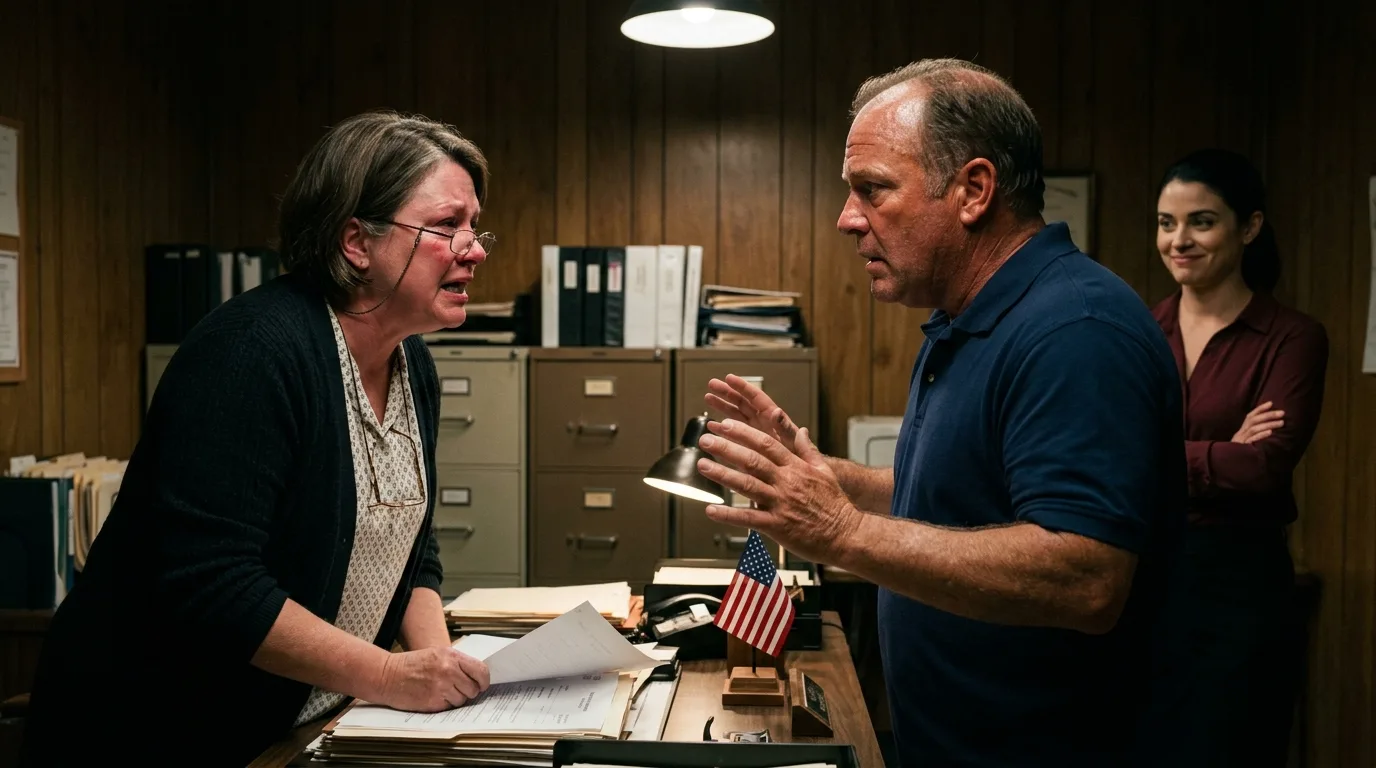
Beatrice came into my basement office that evening, her eyes red, her hands trembling as she set down her canvas tote bag.
"Harriet," she whispered, her voice breaking. "My great-great-grandfather helped quarry the granite for that schoolhouse. It survived the flood of 1927. It survived the Great Depression. And now this outsider is going to tear it down for a parking lot?"
"Sit down, Beatrice," I said, handing her a glass of cold water. "Nobody tears down a granite building in Vermont without a deed."
At 6:00 p.m., after Marcus had driven his BMW back to his rented condo in Burlington, I took my brass skeleton keys and unlocked the fireproof archival vault.
I didn't search the digitized computer records. Marcus had already scrubbed those.
I went to the back shelves, where the heavy, sheepskin-bound ledgers from the nineteenth century were stored in cedar boxes.
I pulled down the ledger for the year 1824: *Minutes of the Havenwood Proprietors and Selectmen.*
The handwriting was iron-gall ink, faded to a deep, dark walnut brown on vellum rag paper.
I turned to the entry for October 14, 1824—the special town meeting called by Captain Jedediah O’Connell before the granite blocks were laid.
I read the three handwritten pages under the desk lamp.
And right there, in Article IV, paragraph two, I found the landmine.
***
The deed to the southern parcel of the Town Green was not a standard municipal grant.
It was a restricted conditional conveyance, executed by seven founding farming families.
The terms were brutal and absolute:
*The land herein granted, and the granite schoolhouse erected upon it, shall forever remain dedicated to the free education, historical enlightenment, and public gathering of the citizens of Havenwood.*
*Should the town or its officers ever attempt to sell, lease, alienate, or convert said property for private commercial profit, all title and possession shall instantly revert in undivided seventh-shares to the living direct heirs of the original grantors.*
I checked the names of the seven grantors:
*O’Connell. Chandler. Miller. Ainsworth. Higgins. Vance. Thistle.*
Beatrice Chandler was a direct heir.
I was a direct heir.
And half the dairy farmers sitting on the volunteer fire department were direct heirs.
If Marcus signed the commercial lease, the town didn't get $1.6 million.
The town lost the land entirely.
***
The final town council vote was scheduled for Thursday evening at 7:00 p.m. in the high school gymnasium.
Over four hundred residents packed the bleachers. The air was thick with the scent of wet wool coats, cedar wood, and simmering mountain anger.
Marcus Thorne stood behind a wooden podium on the basketball court, looking relaxed, confident, and utterly dismissive.
"Ladies and gentlemen," Marcus announced through the microphone, his voice echoing off the rafters. "We respect your nostalgia. But municipal government is not a museum. The schoolhouse maintenance deficit will increase property taxes by eight percent if we do not act. The commercial development represents progress."
He turned to the three selectmen sitting at the table.
"I call for the question. We move to authorize the immediate condemnation and demolition of the Old Schoolhouse parcel."
Board chairman Carl Miller reached for his wooden gavel.
"Wait!"
My voice cut through the gymnasium like a rifle crack.
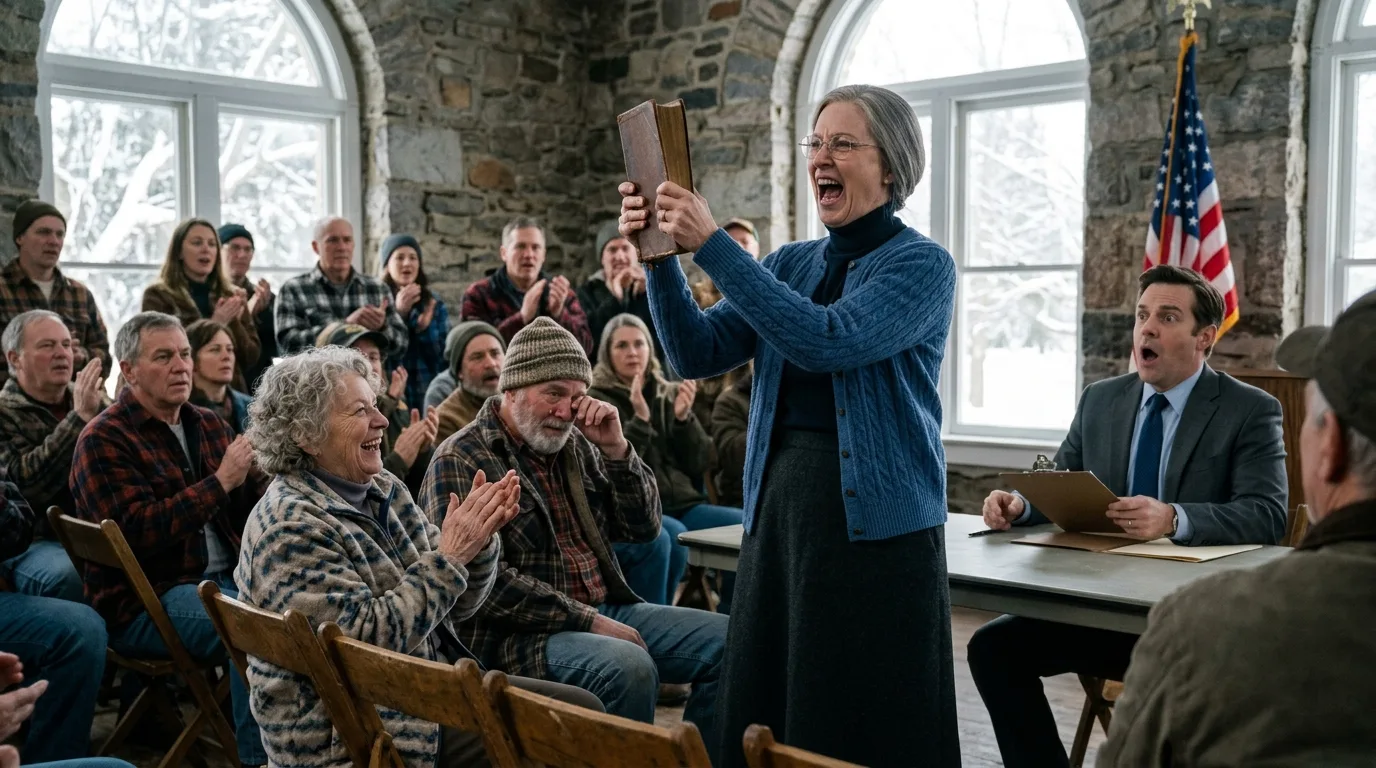
I stood up from the front row.
I wasn't wearing my office cardigan. I was wearing my pressed Sunday blazer.
Under my arm, I carried the 1824 sheepskin ledger, its red leather spine glowing under the gymnasium halogen lights.
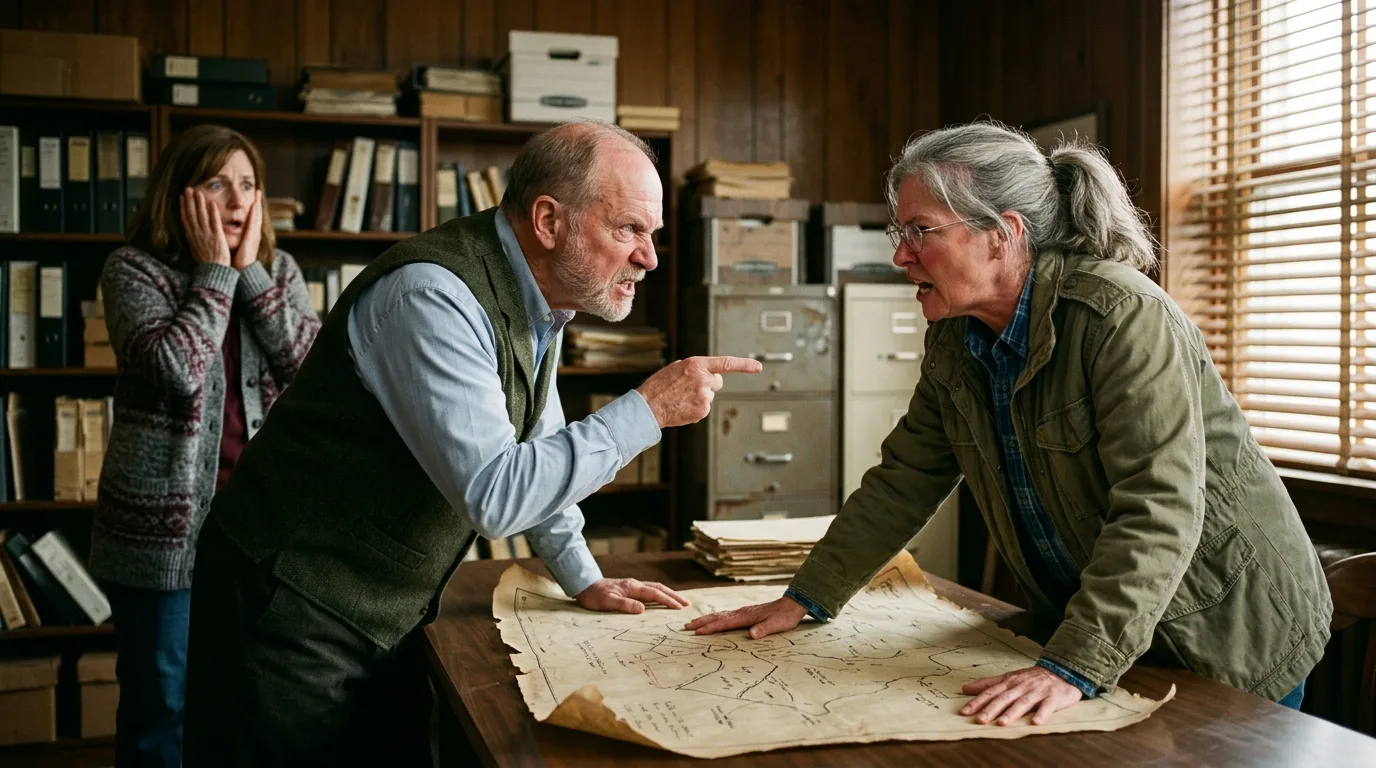
Marcus frowned, tapping his microphone. "Harriet, this is a formal board meeting. Public comment was closed at six-thirty."
"I am not speaking as a member of the public, Marcus," I said, stepping onto the court, my boots clicking firmly on the hardwood. "I am speaking as the Deputy Town Clerk of Havenwood. And I am presenting the official minutes of October 14, 1824."
Marcus let out an audible sigh, shaking his head. "Harriet, we have consulted the county title registry. Ancient bylaws are pre-empted by state municipal consolidation statutes—"
"This is not a bylaw, Marcus," I said, slamming the heavy nineteen-pound ledger down onto the board's table right in front of him.
*THUD.*
The sound echoed through the silent gymnasium.
"This is a conditional deed restriction with an automatic right of reverter," I said, opening the book to page 112 and pointing directly at Captain O’Connell’s iron-gall signature.
“Read Article Four out loud, Marcus.”
Marcus didn't move.
"Read it," I demanded, leaning forward until I was six inches from his face. "Or I will read it for you."
Marcus’s eyes flicked to the parchment.
He read the first two lines. His smug, polished expression began to crumble.
"If this board signs a commercial lease with your retail developer," I announced, turning to face the four hundred residents in the bleachers, "the Town Green parcel does not get sold. The town loses title immediately! The land reverts to seven valley families—and every dollar of your developer’s contract becomes actionable fraud against the municipal corporation!"
The gymnasium was so quiet you could hear the wind rattling the high roof ventilators.
Then Beatrice Chandler stood up in the third row, her voice trembling with righteous pride:
"My great-great-grandfather signed that deed, Marcus! And I am not selling my share to a drugstore!"
Carl Miller dropped his gavel onto the table.
He didn't strike the block. He pushed his chair back and looked at Marcus with cold disgust.
"You told us the title was clear, Thorne," Carl said.
"It... it was an oversight by the preliminary title search firm," Marcus stammered, his face turning an ugly, mottled gray as he tugged at his silk tie. "We can negotiate a settlement with the heirs—"
"We are the heirs, Marcus," I said quietly. “And we’re not negotiating.”
***
The vote was unanimous: 3 to 0 to reject the commercial development and place a permanent historic preservation easement on the Old Schoolhouse.
The gymnasium erupted into a roar of cheers, stomping boots, and tears.
Marcus Thorne didn't wait for the meeting to adjourn. He stuffed his glossy renderings into his leather briefcase and practically sprinted toward the side exits while the crowd sang the valley harvest hymn.
He submitted his resignation by certified mail forty-eight hours later.
On Monday morning, the selectboard held an emergency meeting in Town Hall.
They abolished the outside Town Manager position.
They restored the historic governance structure of the Town Clerk as Chief Administrative Officer.
And they handed me the keys to the corner office.
I didn't move my desk upstairs. I stayed in the basement, where the air smells of old paper, cedar boxes, and two hundred years of truth.
The Old Schoolhouse is still standing on the Town Green.
Every October, when the sugar maples turn to fire, the children of Havenwood sit on the granite steps and learn the names of the seven families who saved their town.
And on the front door, next to the original brass knocker, is a bronze plaque that will never come down:
Protected by the people, 1824.

Comments
Loading the conversation…