"He doesn't exist, Mom," my son said, his voice tight with the certainty he usually saved for bad investments.
Graham had driven ninety minutes from Wichita on a Sunday afternoon to tell me so, and he'd brought a folder. He set it on my kitchen table between the sugar bowl and a swatch of green velvet I'd meant to put away. "No credit history before a few years ago. No old addresses. Nobody named Miles Corbin from his age with a wife named Eleanor. Stop seeing him before he gets to your savings or your house."
I looked at the printouts without touching them. Graham's firm had a logo, and it sat at the bottom of every page like a stamp on a verdict.
Advertisements
"You ran a check on a man who bought me a cinnamon roll," I said.
"I ran a check on a man who showed up in Prairie Ridge out of nowhere and found the one widow in town with paid-off property."
"That widow has a name."
"Mom."
"Caroline Hemlock. I answered to it for fifty-eight years and I'm not about to let a spreadsheet rename me."
He rubbed his forehead, the way his father used to. "I'm not trying to manage you."
"You brought a folder."
He had no answer for that. He closed it anyway and left it on my table when he went, and I stood at the window watching his taillights go down Alder Street, feeling like a seam somebody had pulled too tight.
I did not read the folder. I put it in the drawer with the warranty cards.
Here is what I knew about Miles Corbin without any printouts. He was fifty-six and walked with a small hitch in his left leg that he never mentioned. He sold antique maps over the internet from a rented house on Cottonwood, and he talked about them the way I talk about a good frame, as if the bones were the point. He had come into the café on Main one morning in April, asked Dottie for a table by the window, and then asked me, a stranger eating eggs alone, whether the light was always that good.
Advertisements
He was put together like a solid chair. Square joints, nothing glued where it should be pegged.
He asked about Graham more than most men would. Every visit, somewhere between the coffee and the goodbye, he'd say, "How's Graham getting on?" I took it for kindness. I had gone ten years without anybody asking.
On a Tuesday he came to my shop with his pickup backed up to the loading door. "I have a favor, and I'd understand if you said no," he said.
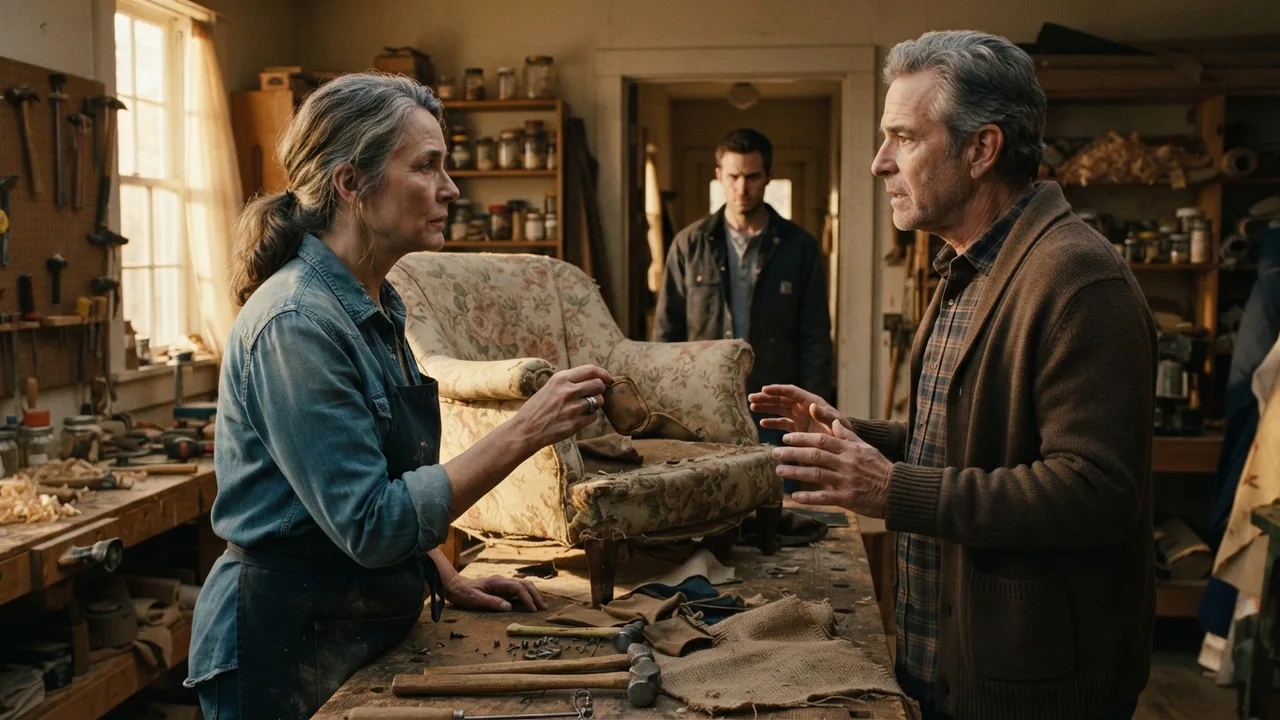
Under a moving blanket was a wingback chair, its wooden legs dark with age, its fabric faded to the gray of an old dishrag. I pulled the blanket off and ran my palm along the wing. The frame was hardwood and hand-doweled, the kind nobody built after the sixties.
"It was Eleanor's," Miles said. "She loved it more than she loved me, I think. I haven't let anyone touch it."
"And you want me to."
"Made right. By someone who'd know what right is."
I should have asked why a man who'd moved to Kansas with a rented house and a laptop had kept a chair that size. I asked him what color instead.
The two of us carried it in together. At the threshold he said, "Mind the left arm, the dowel's loose," and I said, "How'd you know that?" and he laughed and said a husband learns where the furniture complains.
That, I let go. A good upholsterer lets a lot go before she gets to the springs.
Graham called that night. Bethany Gallo had told him, because Bethany tells everyone everything and calls it friendship.
"He gave you a chair, Mom. That's a hook. It's a ten-dollar sentimental object that makes you feel chosen."
"It's a hand-tied frame that would cost four thousand dollars to build today."
"That's not the point."
I pulled out a kitchen chair and didn't sit in it.
"It's exactly the point. You wouldn't know a frame from a footstool." I was standing in the dark of my own kitchen, holding the phone so hard my thumb ached. "I'm fifty-eight years old. I get to pick who I trust."
"You get to pick. I get to worry."
"Worry from Wichita."
He breathed out slowly. "Fine. But when it goes wrong, call me first, not last."
He hung up, and I stood there with the refrigerator humming at me. I didn't sleep. At three I got up, went out to the shop in my robe, and laid my hand on the chair's faded back as if it might tell me whose side it was on. Then I went back to the house and was angrier at Graham than I'd been in years, and angrier still that his folder had made me look for flaws in Miles at all.
I gave it a week of defending. I defended Miles to Bethany over coffee, to Dottie over pie, and to myself over a bowl of soup at midnight. By the end of it, I was sure.
The chair came apart slowly. That's the job.
First the gray top fabric came off, then a layer of green brocade tacked over it, then burlap, then padding so old it had turned to felt. Somebody had recovered this chair more than once, which didn't sound like a chair a wife had kept for one marriage. I'd found a cigarette burn under the brocade and a child's crayon mark on the back rail, and I put both in my notes.
The night I pulled the last layer, Prairie Ridge was quiet except for wind pushing against the shop door. I had the radio low and a cup of coffee going cold. I worked my fingers into the coil springs, feeling for a loose knot, and found something stiff, tucked deep between two coils where nobody would think to look.
It was a bus ticket.
Soft as flannel from age, folded in half and then in half again. I opened it under the work lamp. Prairie Ridge to Omaha. August 1996. The passenger name had been smudged by a thumb or by time, but I could read it fine.
M. Corbin.
I sat down on my stool. I put my hand over my mouth the way you do when you've swallowed something wrong.
Miles had told me, over that first plate of eggs, that he'd never set foot in Prairie Ridge before April. He'd said it was why the light struck him. And here was his name in a chair that had been through this town thirty years ago.
My fingers weren't steady when I folded it back up. I slid it into the pocket of my apron, where I keep my tack hammer and my chalk, and for a long while I just stood in the middle of the shop, listening to the wind and to myself breathing.
I could call Graham. He'd be here in ninety minutes and be right and be unbearable. I could call Miles, who would have an answer, because Miles always did. I did neither. I finished the springs, set the frame on its side, and turned off the lamp.
Founders' Day fell on the last Saturday in May, and the whole town came to the park pavilion with folding chairs and covered dishes. The trestle tables sagged under potato salad, deviled eggs, and Marge Pruitt's famous pickled beets, a dish I've never trusted. Wind lifted the paper tablecloths and the kids pinned them down with plastic cups of lemonade.
I sat with Miles near the end of the long table, the ticket folded into my jeans pocket. I'd carried it for four days. It had worn a damp spot into the denim.
"You're quiet today," Miles said, passing me a roll.
"The chair's down to the frame. That's a lot to think about."
"I have faith in it," he said, and smiled, and the smile was warm and sincere and I couldn't make it match the ticket.
Bethany had a seat across from us, phone beside her plate, and she was telling a story about a flooded basement. Then I saw Graham come across the grass in his pressed polo shirt, and I knew before he opened his mouth.
"Mom. Mr. Corbin." He didn't sit. "I need to say something, and I'd rather say it here than behind closed doors."
"Graham," I said, "not now."
"He's a con man." He said it loud enough that Marge Pruitt turned around with a spoon in her hand, and Bethany's story trailed off. "He has no history. The name's fake. I have the records."
Miles set down his roll. He folded his napkin and looked at my son with such patient sorrow that I wanted to slap him for it.
"Graham, I understand why you'd think so," he said. "You love your mother. That's exactly what I'd want for her. Why don't we sit down and talk like adults?"
"Don't patronize me."
"I wouldn't dream of it. You're upset, and you've worked yourself up, and that's a kind of loyalty."
It was beautifully done. Every word was gentle, and every word made my son look like a boy having a tantrum at a church supper. I watched the faces around us shift, Marge's and Dottie's and a dozen others, and I saw what was in them. Pity. Not for Miles.
For me, and for Graham, the poor suspicious widow's son.
My hand went to my pocket before I'd decided anything. It shook so hard that the paper rattled when I drew it out, and I held it up between my fingers where the whole table could see.
I didn't look at Graham. I looked at Miles.
"Then maybe you can explain this," I said, quiet but clear. "I found it in the chair. It's from Prairie Ridge. Thirty years ago."
Nobody said anything. A cup rolled off a tablecloth somewhere and nobody went after it.
Miles looked at the ticket and I watched the warmth leave his face, plank by plank, until what was left was just a tired man with a hitch in his leg.
"May I?" he asked.
I handed it across. He unfolded it with his thumbs and read the name, and his mouth moved around it.
"Miles Corbin was my friend," he said. "He's the one who died. My name is Mark Jensen."
Graham sat down heavily on the bench.
"I lived on Alder Street in a rented room, in 1996, with that chair and nothing else." He turned the ticket over. "I was in love with a girl named Ruth Hemlock. I promised her a house. A real one, with a porch. I told her I'd make money in Omaha and be back by Christmas."
"Ruth was my mother," Graham said. It came out thin. He had been raised by Walt and me after she died when he was small, and her name to him was the back of a snapshot on my refrigerator.
"I know." Mark didn't look away from him. "Miles and I were to leave on the bus, and the night before, he said buses were for people without a plan. We drove his car instead. I'd hidden both tickets in the chair springs with my savings and forgotten them when we left in a hurry. The accident was on the highway outside Omaha. I woke up in a hospital with his wallet in my coat and a nurse calling me Miles."
"You let them," I said.
"I let them. And then every month I was too ashamed to come back as nothing, and then every year I was too ashamed to come back at all." He pressed the ticket flat on the table. "I learned last winter that Ruth had died. I came here to do the one thing I could. There's a house on Cottonwood, the one she used to point at. I've been buying it through a trust."
Bethany's face had gone pale. "He's my client," she said. "A blind trust. Beneficiary to be named at closing. I never knew who."
"Graham," Mark said. "It was always going to be you."
My son opened his mouth and nothing came out of it. He looked at his hands. I looked at the ticket, small and brown on the paper tablecloth, and understood that I had been the least important person at this table the entire time.
Mark Jensen came to the shop the next afternoon to collect the chair.
I'd left it stripped to the frame, springs retied, no fabric. I hadn't had the heart to do more, and I wouldn't have had the right. He stood in the doorway for a moment, holding his hat.
"I owe you the labor," he said.
"You owe me nothing. I'd already done the stripping when I found it."
"Then I owe you the truth, which I haven't paid in full." He stepped inside. The wind caught the door behind him and I let it bang. "I wasn't lying about everything, Caroline. I did like the eggs. I did like the light."
"But the chair was the reason."
"The chair was an excuse to get my old frame into a good pair of hands." He turned his hat once. "And you were the person in Prairie Ridge closest to Ruth's boy. I asked about Graham every time we sat down. I think you noticed."
"I thought you were being kind."
"I was being thorough." He said it so softly I almost missed it. "I'm sorry. Not for the name, though that was wrong too. For using you as a doorway. I was so busy making amends to a woman who couldn't hear me that I never once looked at the one in front of me."
I picked up a scrap of burlap and put it down again. "You never asked me a single question I'd have to think about."
"No."
"I'd have liked to be asked."
"I know." He looked at his hands, and I saw him decide not to say the next thing. "I'm leaving. The house closes Monday, and Graham will do with it what he wants. There's nothing left here that's mine to do."
"I accept the apology," I said. I meant it, and it didn't fix anything, and we both stood there knowing it.
He wrapped the frame in the moving blanket and I helped him carry it to the pickup. At the tailgate he held out his hand, and I shook it, once, the way you close a deal. It was a good hand. It had never really been reaching for mine.
I watched the truck go down Alder Street until the dust settled back onto the road.
The shop felt larger with the chair gone. There was a pale square on the concrete floor where it had stood, and cold came up from it through the soles of my boots.
I had thought I was starting something. What I had been was a woman standing at the edge of somebody else's old story, handing him coffee, and he had thanked me politely and kept looking past my shoulder.
On the worktable sat the next job, dropped off Friday by a young mother from the Methodist church. A child's rocking horse, painted maple, its leather saddle cracked through and worn smooth where small legs had gripped it. A note was taped to its ear. *Please fix, he cries without it.*
I tied my apron on. The tack hammer was in the pocket where the ticket had been, and I took it out and felt the old familiar weight settle across my palm. Then I set the first tack against the leather and drove it home.
Comments