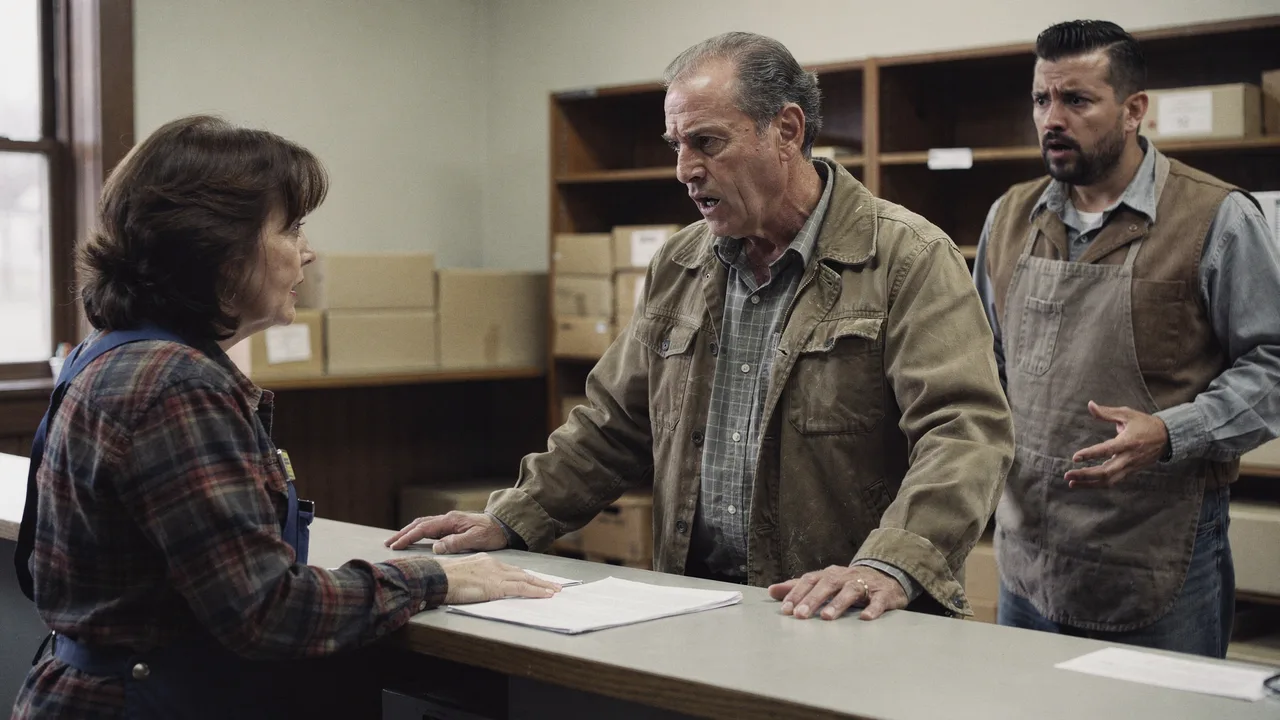
"The tracking says you had it last, Connie," Byron Sinclair said, his voice slick with false sympathy.
He set a printed sheet on the counter and slid it toward me with one finger. A music box insured for five thousand dollars and thirty-five years of my name sat on that paper, in front of Joanne's window and two customers waiting on stamps.
"Good morning, Byron," I said. "Joanne, would you take those folks at the next window?"
Advertisements
"Oh, let them stay." He turned to the lobby with his toothy smile. "Nothing to hide here, right, folks?"
I read the sheet. Mailed November fourth from the Alpena branch, sender Kevin Doherty, addressed to Doherty Lawn & Garden on Rural Route 2, which is my route. Last scan: out for delivery, my unit.
"Kevin's grandmother's music box," Byron said. "Gone. I'm filing the complaint this afternoon, and I'd hate for it to come to that. If you'd just tell me where it is."
"I never carried it."
"The scan says you did."
I looked at the scan line again. Under the time it said *manual entry*. A scanner beeps and a hand types, and I can tell the two apart the way I can tell my own handwriting from a stranger's.
"I'll want a copy of that," I said.
"Keep it. I printed extra." He tapped the counter twice and left, and the door sighed shut behind him across the whole lobby.
Advertisements
The district office sent a supervisor on Monday. Troy Pruitt was young enough that his tie still had the fold marks from the package, and he sat in my break room with a laptop and a legal pad.
"Mrs. Gresham, I have to ask these in order."
"Ask them."
"Did you handle a parcel for Doherty Lawn & Garden between the fourth and the seventh?"
"No."
"Do you ever carry a parcel without scanning it?"
"Never. In thirty-five years I have not once."
He wrote something, and I watched how he held the pen, tight and close to the nib, like a man afraid of the paper. "Your retirement is the end of the month."
"Two weeks from Friday."
"It's just that people in your position sometimes get, well, comfortable."
"Mr. Pruitt, I've signed for every dollar on this route since before you could drive." I kept my hands folded. "Look at the entry. It was typed, not scanned."
"I saw. That can happen when a barcode is damaged."
"Then there would be a damaged label somewhere, and a parcel behind it."
He wrote that down too, and the look he gave the page was the look people give a liability. I knew it from the other side of the desk.
That night I lay in bed and walked the route in my head, every box and gate and dog from the lake road to the county line, replaying each scan as if I could hear it chirp. The furnace ticked. At some hour I got up and made toast I didn't eat.
The date kept catching on me. November fourth. A Wednesday, with a hard wind off Huron, and I had stopped at the Hartleys' mailbox and read a post aloud to Mrs. Hartley from the Port Allister Neighbors page because she couldn't find her glasses.
I got my laptop. It took me a while to scroll back, because I am not a quick hand at that page.
There it was. Eliza Sinclair, posting at breakfast time: *Please keep Kevin in your prayers, his work truck died on the Mackinac Bridge and he's been stuck all day!* Underneath, Kevin himself had commented with a photo of a tow receipt, the bridge towers gray behind the truck.
Alpena sits a hundred miles from that bridge. A man can't mail a box in one place while standing in the other.
I closed the laptop. If I carried this to Pruitt that morning, Byron would simply amend the date, and Kevin would remember a different Wednesday. A date can be fixed with a pen. A box in a person's hands can't be.
I needed the box. I did not yet know where it was.
By Thursday the story had gone through town ahead of me. I bought my Christmas stamps at the Family Fare service desk instead of from my own clerk, which tells you where my head was, and the girl at the register went quiet when I gave her my name.
Two women in the cereal aisle did not lower their voices enough. "Thirty-five years, and look. You never really know."
On my route, Dolores Hanratty, who has taken her mail from my hand since her husband's stroke, stood at her box holding a padded envelope. She did not give it to me. She held it a moment too long.
"I think I'll bring it to the counter myself, Connie."
"It's no trouble, Dolores."
"No, I'd rather."
I nodded and drove on. It was sleeting by then, small hard grains against the windshield. I knew every house on that road and every dog, and for the first time I felt like someone driving through a town she'd read about.
The flyer went up on the community board at Family Fare on Friday. *LOST IN THE MAIL. Family heirloom music box. Reward.* Kevin's phone number sat at the bottom, and above it was a photograph of the box on a bedspread.
I stood in front of it a long while with my cart.
The lid held an inlay, a compass rose in walnut and pale maple, with the north point drawn a little long. I had seen that long north point on a jewelry chest in the Lutheran church basement. Harlan Voss made it. He built furniture on Lake Street until he died, and the whole town knew he made only three music boxes in his life.
Kevin's grandmother, I thought, did not own a Voss. Nobody's grandmother in Port Allister did. The three had gone to a bank, a church, and a family I'd never heard named.
I took a picture of the flyer with my phone and bought nothing.
Eliza Sinclair was in the produce section on Saturday, choosing pears by pressing her thumb near the stem. She wore a floral scarf the shade of a ripe peach and looked, as she always does, as if she were apologizing to the fruit.
"Connie! Oh, I've been meaning to say how sorry I am about all this. Byron gets so, well, he just feels things."
"I understand, Eliza." I picked up a pear I didn't want. "Your Byron has an eye for old things, doesn't he? That Lake Street furniture."
"Oh, he loves an auction."
"Harlan Voss made the best of it. Do you remember his music boxes? He made only three, and a collector in Traverse City paid more than five thousand dollars for one last spring."
Her thumb stopped on the pear. "Five thousand?"
"Maybe more. They say the inlay is a compass rose. You'd know one anywhere. They're meant to be heard, though, not kept in a drawer."
"A compass," Eliza said, softly. Something moved behind her face, a flicker of pride, then curiosity. "Byron gave me a little music box a few weeks ago. For our anniversary. He didn't say who made it."
"Well, you should have a look at the bottom," I said, and I put the pear in her cart for her, and I left.
In the parking lot I sat with my hands on the wheel. I had never in my life led a person anywhere by a nudge. I had told Eliza only true things, and still I felt like a woman with a letter steamed open.
If she told Byron, the box would vanish by dark. If she did not, she might carry it into the first room that wanted to hear it, because that is the kind of woman Eliza is. I was betting a good woman's pride against a bad man's caution, and I did not like what that said about me.
The Port Allister VFW Hall has wood paneling and a drop ceiling and a flag in the corner older than I am. On the Saturday of my last week they'd set out folding tables with white paper, a coffee urn, and a sheet cake from Family Fare, nineteen ninety-nine, with CONGRATULATIONS CONNIE in blue frosting and a little mail truck drawn on the corner. Beside it stood my framed service certificate.
Thirty-some neighbors came. I counted heads the way I count addresses. Pruitt stood by the doors with a paper cup. Byron Sinclair arrived in a golf shirt with his shop's logo and shook hands like a man at his own fundraiser. Kevin came behind him in a clean flannel, looking at his boots.
Eliza came last, with a quilted tote over her arm that she held against her ribs.
The speeches ran long and gentle. The postmaster told the story about the Christmas I delivered through a blizzard on snowshoes. Our librarian, Ruth Ellery, said I'd once found a lost library card inside a snowbank and returned it with the due date still valid. People laughed in the places where laughing was correct, and nobody looked at me for more than a second.
When the speeches lulled and people drifted toward the cake, I saw Eliza take Ruth aside by the coat rack.
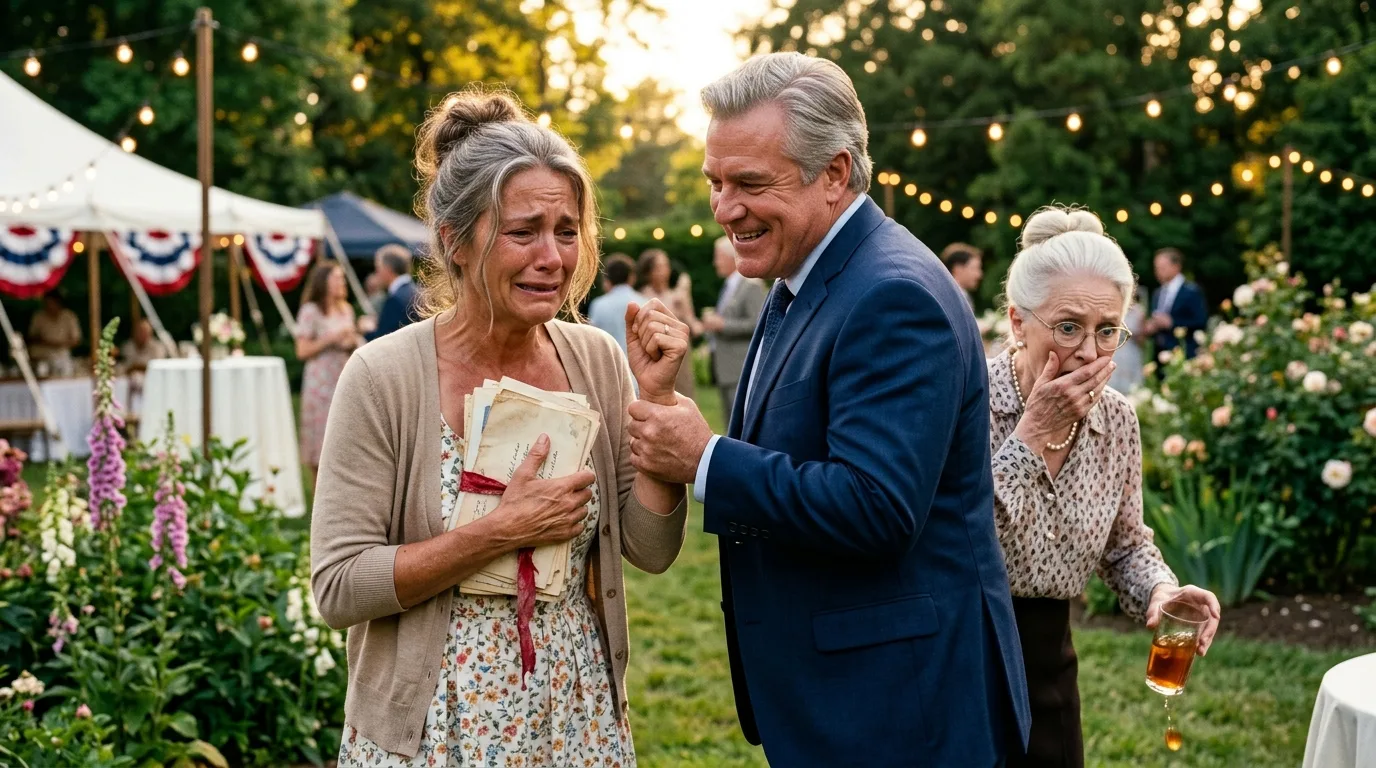
"Ruth, look. I wanted you to see this."
She lifted a small wooden box out of the tote with both hands. I walked toward them, slowly, as if for coffee.
"Byron found it for me," Eliza was saying, her voice trailing into pleasure. "For our anniversary. Isn't it a treasure?"
"It's beautiful," Ruth said. "Is that a compass?"
"Open it, Eliza," I said.
She started, then smiled. "Oh, Connie. Of course."
She raised the lid. The melody came out thin and bright, a slow waltz with a catch in the fourth bar, and a few people nearby turned their heads.
"That's a lovely tune, Eliza," I said, loud enough to reach the doorway. "It sounds just like the one Kevin was searching for."
The music went on a few notes by itself. Then Byron was across the floor, his face flushed to the collar of the golf shirt.
"Constance, that's enough. You're making a scene at your own party."
"I only said it was a lovely tune."
"You know what you said." He turned to the room with his hands open. "I'm sorry, folks. She's been under terrible strain. Anyone would be." He swung back to me, and the smile was gone. "Are you actually accusing my wife of having your lost package? That's harassment, Connie, plain and simple."
I held his gaze for exactly as long as it took to steady myself, then I looked past him.
"Mr. Pruitt, the claim in your file says this box was mailed by Kevin Doherty from the Alpena branch on November fourth."
"It does," Pruitt said, and he set down his cup.
I turned to the paneled wall, where Kevin had backed up until his shoulder blades touched it. "That's funny, Kevin. Because Eliza posted on the neighbors' page that morning that your truck died on the Mackinac Bridge. You put up a picture of the tow receipt yourself. You were a hundred miles from Alpena all day."
Somebody behind me drew in a breath, and then the whole room did.
"That's, uh," Kevin said. He looked at his father-in-law. "I went back up after. Or the tow—"
"Kevin," Byron said.
"Byron?" Eliza had not moved. The box stayed open in her hands, still ticking out its tune, and she held it as if it had gained weight in the last minute. "Byron, you said you found it at an estate sale in Rogers City."
"Eliza, honey, not here."
"You said a woman was clearing out her mother's house."
Kevin's face had gone the color of the frosting on the cake. He slid down an inch against the paneling and caught himself.
Pruitt crossed the floor without hurrying. "Mr. Sinclair, Mr. Doherty, I'd like a word outside, please."
"This is ridiculous," Byron said. But he went, and Kevin followed with his eyes on the linoleum, and the door swung shut on the cold.
Nobody spoke. The coffee urn ticked. Someone's chair scraped, and Ruth Ellery looked down at her shoes as if she had found them interesting.
Eliza closed the lid. The tune cut off in the middle of a bar. She crossed the hall toward me with the box held out in front of her, her eyes full and her scarf crooked, and I braced myself for whatever she meant to say.
She said nothing. She set the music box on the cake table, beside my framed certificate and the little frosted truck, and turned and walked out the side door. I heard her car start in the gravel and fade down Main Street.
I stood with my hands at my sides.
The party did not recover. People found their coats in twos and threes and said *good luck, Connie* and *we always knew* with their eyes on the floor. A woman I'd delivered to for twenty years squeezed my elbow and looked relieved to be leaving.
Pruitt came back in after a while with snow in his hair. He stopped in front of me, and for the first time he looked me in the eye.
"Connie, I am so sorry. The investigation is closed."
"Thank you, Mr. Pruitt."
"That keyed scan was entered at the unit. I'll be asking about who had access." He swallowed. "I should have listened to you on Monday."
"You followed protocol," I said. "It's what you're for."
He nodded, and I could not tell whether it comforted him. He took a slice of cake he did not eat, and left.
I cleaned up myself, because there was no one else left. I peeled the white paper off the tables and wrapped the cake in foil. The box I carried to the front desk and left with the VFW steward to hold until someone came for it.
I had won. I wanted to be plain with myself about that. But I'd worked thirty-five years toward one soft afternoon of coffee and a certificate, and I'd spent it pulling a curtain down on my neighbors. Port Allister would talk about my retirement party for a long time, and not one word of it would be about me delivering the mail.
The next morning I sat on my porch in my husband's old barn coat with a cup of coffee going cold. The frost lay thick on the lawn. I had nowhere to be, which was a feeling I hadn't learned yet.
The mail truck turned in at the end of my drive. The new carrier was a young woman named Marcy with a braid under her cap, and she hopped down with a package tucked under one arm.
"Morning, Mrs. Gresham. This one's for you. Looks like it's from family."
"My cousins in Ohio," I said. "They'd said something was coming."
"Well, congratulations." She hesitated. "Everybody's talking about last night. I wanted to say, I'm glad it's sorted."
"Thank you, Marcy."
She handed me the box. My fingers went straight to the label before I could stop them, finding the smooth, papery edge of it, the way they had for thirty-five years. I held it near the light and looked at the barcode, a plain row of black lines that meant nothing until a person decided it did.
A pattern of bars had nearly taken everything from me. I set the box on the porch boards beside my chair, unopened.
Marcy climbed back into the truck, waved once, and pulled out onto the lake road. I watched the white roof go down toward the Hartleys' mailbox without me. When it had gone around the bend, I picked the package up again and ran my thumb along the edge of the tracking label, slowly, from one end to the other.
Comments