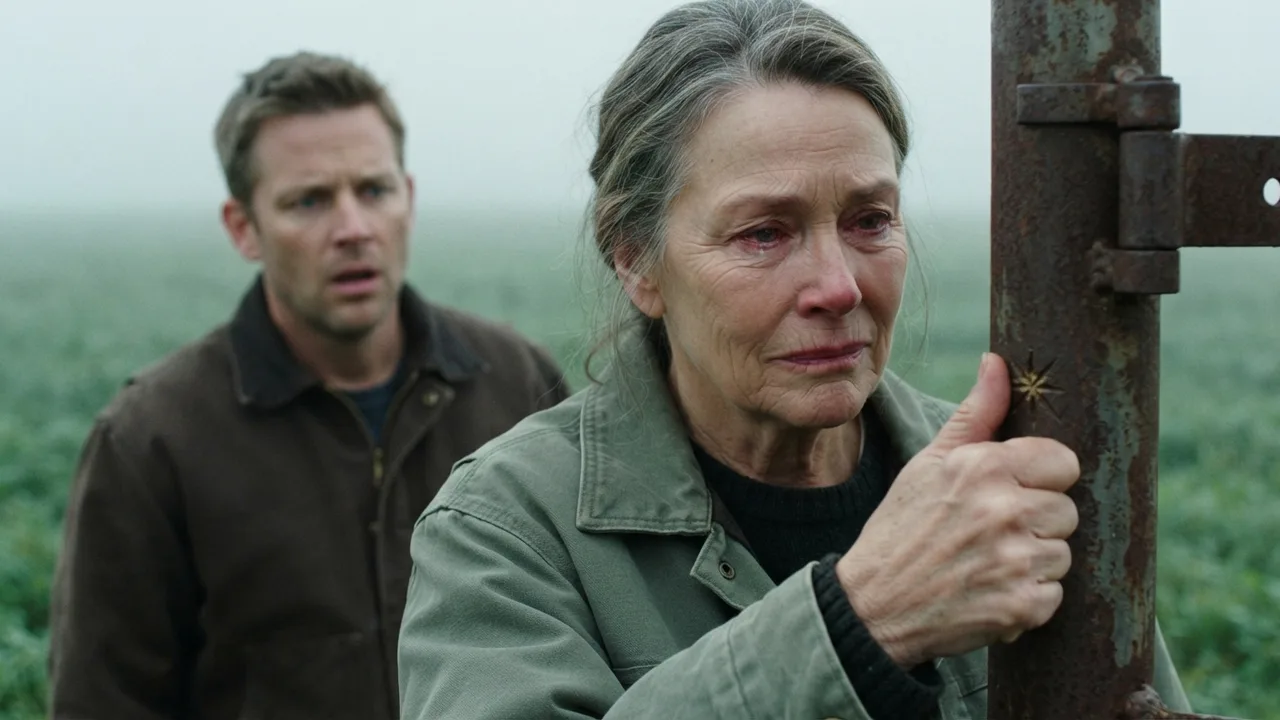
My son told me we had to sell the North Forty to save his father's legacy; the first lie was the field, the second was the man. Six hundred thousand dollars from a developer would cover the debts Josef had hidden from me, Dwight said, and keep the rest of our farm afloat.
He said it at my kitchen table on a Tuesday, with a stranger sitting beside him.
The stranger was named Ostrander. He wore a quilted vest that had never seen a hay bale, and he laid a survey map across my oilcloth and pinned the corners with my own salt shaker and sugar bowl.
"Forty acres, Mrs. Hollenbeck," he said, "with good road frontage. We'd put in homes, and nice ones."
"On Josef's field," I said.
Advertisements
"On a parcel," Ostrander said gently, and looked at Dwight.
Dwight pulled the map an inch toward me and tapped the number. "Mom, it's just arithmetic. Dad borrowed against things you never saw. I've been paying it down since the funeral, and I can't do it much longer."
"Which things?"
"Equipment notes. Some other paper." He rubbed the back of his neck. "I didn't want to put this on you. Mr. Ostrander needs an answer by Friday."
"Friday is three days off."
"That's why I'm telling you now." He said it slowly, the way you talk to a heifer you don't want to spook. "You don't have to understand every line of it. You just have to trust me."
I poured Ostrander a cup of coffee he didn't touch. When they left, the wind took the storm door out of Dwight's hand and slammed it against the siding, and he stood there and fixed the latch before he went, a good son to the last.
I did not sleep. I sat in the kitchen with the furnace ticking and the harvested fields black beyond the window, and I told myself Dwight was a grown man of forty-five who had never given me cause. Then I thought about the Friday nights Dwight had driven off to machinery auctions in Council Bluffs and come home with nothing in the truck bed, and about the day Josef died, and about how he'd told me, in that last good week, that the books were square.
Advertisements
Josef did not say a thing he didn't mean.
---
Wednesday morning I went out to the farm office. Dwight had gone to the elevator with a load of beans, and I had the place to myself.
The office is a plain room off the back porch with a steel desk and a four-drawer cabinet, and for forty-eight years I had kept its books in pencil. I opened every drawer. I found seed invoices, the crop insurance, receipts from Fleet Farm for a new set of tire chains. I did not find a single note, a single letter from a lender, a single past-due stamp.
What I did find was that the last year of statements was gone. The folder was there, with its label in my own hand, and it was empty.
I was kneeling at the bottom drawer when his boots hit the porch step.
Dwight stood in the doorway with his cap in his hand. He looked at the open drawers and at me on the floor. For the length of a breath his face had nothing arranged on it at all.
"Looking for something, Mom?"
"The bank statements," I said, getting up by the edge of the desk. "I'd like to see where the money went."
"I told you where it went."
"Then it won't take you long to show me."
"Don't you trust me?" His voice cracked a little on it, and it was a fine performance, and I almost felt sorry. "I'm out here every day, Mom. I'm doing this so you don't have to."
"I'm not asking you to stop. I'm asking for the statements."
"I'll bring them by." He put his cap back on. "Not today."
From the window I watched him cross the yard to his truck, where he stood with his phone to his ear and his shoulders curled around it. I could not hear much through the glass. I heard enough. *She's getting confused, Jo. She's tearing the place apart.*
Jolene called that evening from Des Moines. She spoke softly, the way she does with students who've had bad news.
"Mom, Dwight says you were in the office going through drawers."
"I was. He walked in on me."
"He's worried. We both are." She hesitated. "Why not let him handle it? You've had such a hard year."
"I kept those books before you were born."
"I know you did. Nobody's saying you can't." Her voice went gentler still, and that was the part that stung. "Just let him carry it, Mom. For now."
I said I'd think on it and hung up. My coffee had gone cold in the cup, and I sat there, sixty-eight years old, being handled by my own children.
---
Thursday I went looking for old tax files in Josef's workshop, because he had kept some papers out there that never made it to the office. The machine shed is fifty yards from the house, and the walk across the gravel took the wind right through my flannel.
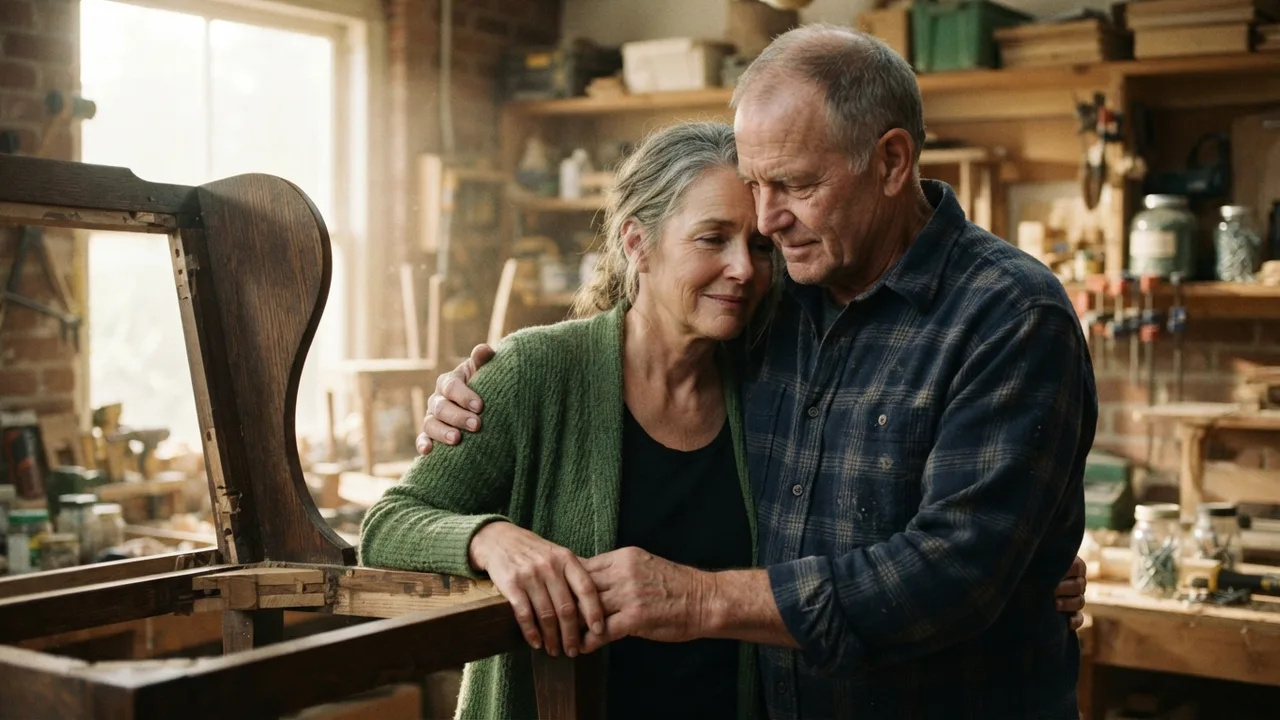
His shop smelled of cold iron and machine oil, and nothing had moved since the spring he died. His gloves lay on the vise. His coffee can of bolts sat under the bench.
The anvil stood where it had always stood, on its oak stump by the window.
I put my hand on it. I'd heard the story the first winter we were married, when Josef was still shy enough to tell me things sideways. His father had owned that anvil, a good Hay-Budden that came over with his grandfather, and his father had lost it to a bad debt before Josef was ever grown. A man in town took it for what was owed. Josef had found it years later in a dealer's yard and paid more than he could spare, and carried it home in the bed of his pickup with a blanket over it.
No deck ever came into our house, not at Christmas, not for the kids on a rainy day, and I had always thought Josef was only being stern.
He had cut a small mark into the waist of the anvil, a starburst, eight little rays no longer than a thumbnail. I'd asked him what it meant.
"Means what was lost is found," he said, and changed the subject.
I stood with my thumb in that mark and found no tax files. I found only a man I'd loved for nearly five decades, and the first small suspicion that I had not been told everything.
Thursday afternoon I walked the fence line of the North Forty. It is a half mile up the county road from the house, and Josef's steel gate closes it off, a heavy thing he welded himself the year he put up the new fence. I'd walked that field a hundred times in my life and never once asked myself why a man who bought a neighbor's ground would build a gate that could stop a tank.
The hinge on the gatepost side was rusted at the edges. I ran my hand along the underside of it, the way you check a hitch, and my thumb found a notch.
I got down on one knee in the stubble and looked.
Eight rays, cut into the steel, still sharp. The same starburst.
He had put it there fifteen years ago. He had stood out here with a cold chisel and a hammer, alone, and marked this ground the way he'd marked his father's anvil, and then he had come home and eaten supper across from me and said nothing for fifteen years.
I knelt there until my knee ached. The wind moved the dead cornstalks along the fence, and I thought: Josef kept a secret about this land. And Dwight is lying to my face about the same land.
I did not yet know what ran between the two.
---
Friday morning I called the bank before the sun cleared the machine shed. I asked for Lorna Fenske, who had handled our operating loan since Josef first sat down with her, and I wrote what she told me on the back of an electric bill envelope, because I meant to say it right.
Then I put on my good wool coat and walked up the county road. Dwight had said the final walkthrough was at the gate, with the papers in his truck.
It was cold and the wind came hard out of the northwest. Ostrander's white SUV was already pulled onto the shoulder, and Dwight's truck sat behind it with an agreement on the hood, held down by a pen. Jolene's little gray car sat behind that. She'd driven the two hours.
She came to me and hugged me, and I let her.
"Mom, I'm sorry. I just want to be here with you."
"I know you do."
Dwight picked up the pen and walked it over to me. His eyes were red at the rims. "Right here, Mom. It's the last page. Then it's done and we can all go home."
I didn't take the pen. "I'm not signing."
"Mom."
"I'm not signing it, Dwight."
Ostrander cleared his throat and looked at the sky as if it might offer him a way out. Jolene stepped closer.
"Dwight, let's slow down," she said.
"Slow down?" His voice came up. "Jo, Dad's debts are crushing us. Every month I'm robbing one account to cover another, and she wants to stand in a field and be sentimental."
"Dwight." I said it quietly, and he stopped. "Mr. Ostrander, would you read me the last page? The part about where the money goes."
Ostrander looked at the agreement on the hood as if it might bite him. "Mrs. Hollenbeck, that's standard language—"
"Read it, please."
He picked it up and found the line with his finger. "'Proceeds payable to Dwight J. Hollenbeck.'" He cleared his throat. "That's all it says."
"Not the bank. Not a single creditor."
"It doesn't name one."
"Mom, it's cleaner this way," Dwight said. "I'm the one paying them. I don't want checks flying all over the county."
"Paying whom?"
"People Dad borrowed from. Private people. They don't want their names on paper."
"Your father wouldn't buy a sack of seed corn without going through the fine print, and you want me to believe he borrowed from men with no names."
I took the envelope from my coat pocket. My fingers were stiff with cold, and I held it steady anyway.
"I called Lorna Fenske this morning, and I wrote down what she said. The operating loan is current. It has never once been past due. Since the week of the funeral, the only big money out of the farm accounts went out as cashier's checks, every one on a single signature, every one made out to a casino in Council Bluffs."
I looked up. "That signature is yours."
His mouth worked. Then he rallied, and I'll give him that.
"Lorna's mixed up two accounts."
"Lorna Fenske doesn't mix up accounts."
"You called a bank behind my back?" He turned to his sister and spread his hands. "Jo, she's checking up on me like I'm a hired hand. She tore the office apart Wednesday. She isn't herself."
"She's reading figures off an envelope, Dwight," Jolene said slowly. "That doesn't sound confused to me."
"Every one on a Friday," I said. "The nights you drove to the machinery auctions. Ask him what he bought."
Jolene didn't move. A truck went by on the county road, and none of us watched it.
"A planter," Dwight said, too fast. "A used one, in August."
"Where is it?" Jolene asked.
"At the dealer's. They're fixing it up."
"Which dealer?"
He didn't answer. The wind lifted the corner of the agreement and set it down again.
He pulled off his cap and turned it in his hands. "All right. Some of it went where it shouldn't have, Mom. I'll make it good. Let the sale go through and I'll clear every cent and put the rest in your name. Nobody ever has to know."
"Nobody," I said. "There are three people standing in this field who know."
Ostrander took a step backward. "I believe I'll wait in my vehicle."
Dwight's face changed then. The pleading went out of it.
"Fine. You want to talk about Dad's debts? Ask Dad, if you think he was so clean. Dad had it in him too, he just hid it better, and I won't be the only one blamed."
"Your father never held a hand of cards in his life," I said. "You grew up in a house with no deck in it, not at Christmas, not on a rainy day when you begged. I thought he was being stern. He'd watched cards take his father's anvil, and he spent his years buying back what they took."
I walked to the gate and knelt in my good coat and put my fingers under the hinge. "Jolene. Feel here."
She crouched beside me and found it. "There's a star cut in the steel."
"He made it the year he built this gate, the same mark he put on that anvil. What was lost is found, he told me. A man doesn't mark ground he means to borrow against, Dwight. He marks what he's finished paying for."
I got up, and my knee complained.
"So it skipped Dad and landed on me." His voice had gone low.
"I think your grandfather's weakness skipped your father," I said, "and found you."
He sat down on the bumper of his truck. Behind us a car door shut, and the white SUV pulled onto the road and went around the bend.
"It's half mine, Mom," he said, not looking up. "Dad would have wanted it kept in the family."
"The deed has your father's name and mine. It does not have yours."
I held out my hand to him, palm up. "The checkbook. And the passwords to every farm account."
"And if I won't?"
"Then I walk home, call Lorna from my kitchen, and have your name off every one of them before supper. You can hear it from a teller instead of from me."
He looked at Jolene. She had her arms wrapped around herself and her face was wet.
"Give it to her, Dwight," she said.
He got up, went to the cab, and came back with the checkbook from behind the seat. He set it in my hand. It was heavier than it should have been.
He turned the agreement over on the hood and, in a hand that shook, wrote out the passwords, one under another, on the blank back of the page. I tore the front half in two, then in two again, and put the pieces in my coat pocket so the wind wouldn't have them. The piece with the passwords I folded and kept.
"You've got your field," he said. "I hope it keeps you company."
That landed, and I let it. I did not take one word of mine back.
"I'm not going to sleep on anybody's couch," he said.
"Then you ride home with me and sleep on my couch," Jolene said, "and we'll see how long you hold out."
He got into the passenger seat of the gray car without answering. I stood at the gate and watched it turn around in the road, his face a pale shape in the window that never turned toward me.
The checkbook pulled at my coat pocket. I had my field, and I had the passwords, and I did not have my son at my table.
I put my palm on the cold steel of the gatepost. Under the hinge, my thumb found the rough edges of the starburst and traced them, one ray at a time.
Comments