"We're meeting with the lawyer on Friday to sign the papers, Mom," my son said, his voice full of calm reason. "It's for his own good."
The papers would make Connor the one who spoke for his father in every matter that counted. After that, he meant to sell the ranch Will and I had worked since the week we married.
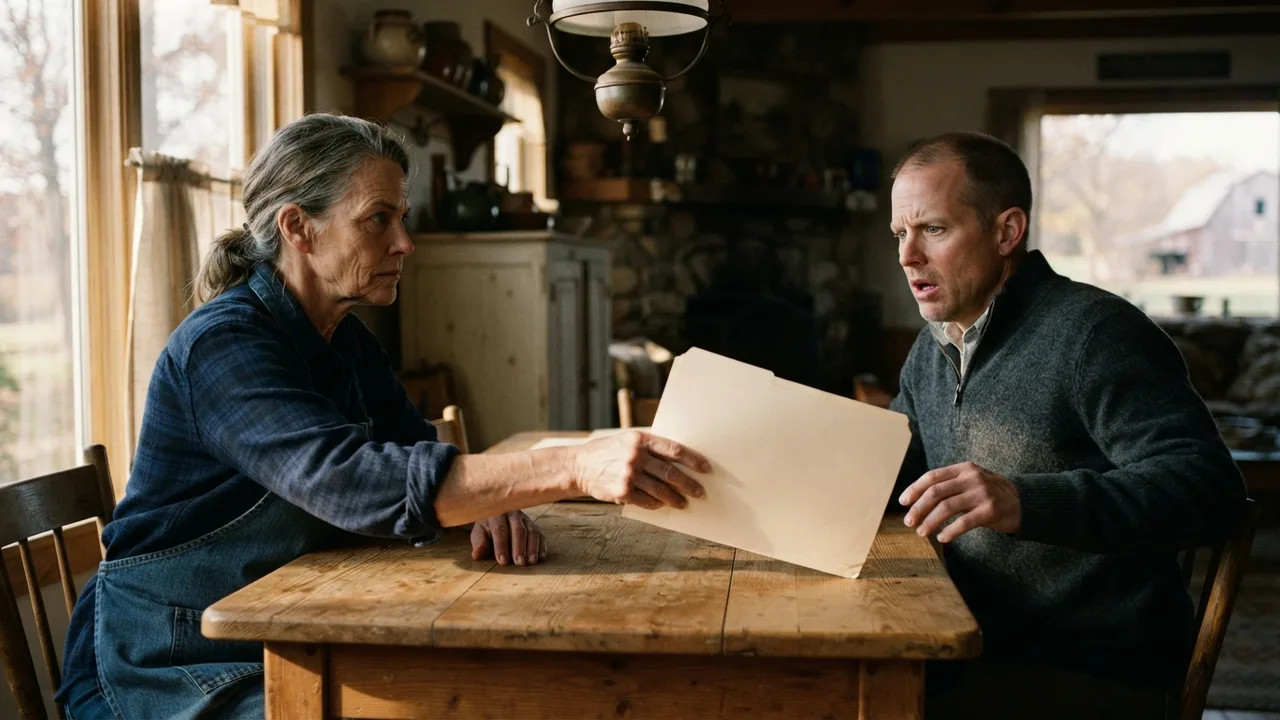
He had driven up from Denver that morning in a car too clean for our road. By noon he had fanned out brochures across my kitchen table: Pine Ridge Senior Living, Sage Meadow Commons, a place in Fort Collins with a photograph of two silver-haired people laughing over a salad. Under the Sage Meadow brochure the corner of an envelope showed, a bank in Denver in the return address, and when he saw me look he squared the stack over it.
Advertisements
"Connor, your father is down checking the heifers," I said. "He's not on a ledge."
"Mom. Look at this."
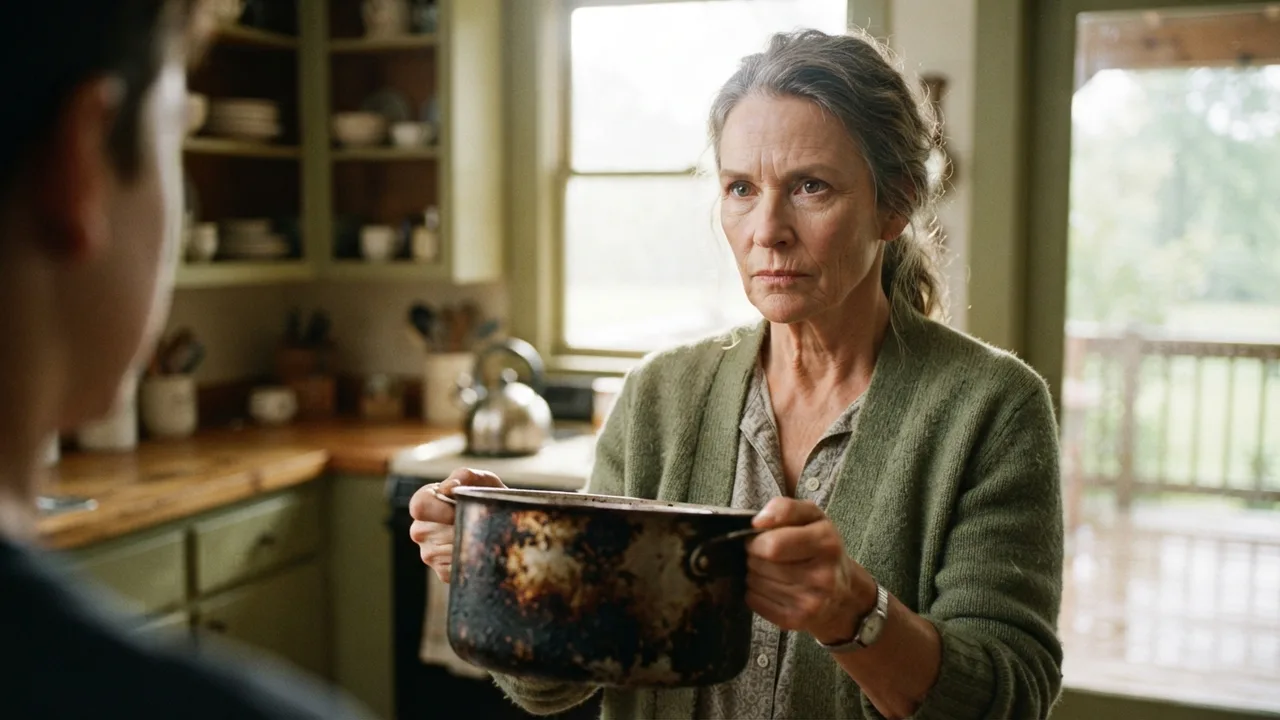
He lifted a pot from the back of my stove and set it on the table like a man laying down a winning hand. The bottom was black and the inside had a crust on it the color of tar.
"Tuesday," he said. "Dad put beans on, walked out to the shop, and forgot them. You were at the sale barn. The smoke alarm was the only thing that saved this house."
"It's a pot, honey."
"It's a pattern. The fall off the loading chute in August. The fender-bender at the Cenex pump. Now this." He tapped the brochures into a neat stack and slid the whole thing, envelope and all, into the leather folder he'd brought. "In my work we call it risk management. You wait for the catastrophe, you've waited too long."
I looked at that pot and the seed went in. I had been out in the pasture all week thinking about hay and weaning weights, and I wondered whether a man could go dim right under my nose while I was busy counting cattle.
I did not say so. I scrubbed the pot with steel wool until my knuckles stung, and I kept my eyes off my son.
On Wednesday I was at the north gate with a fence stretcher when my phone buzzed in my coat. It was Dwight Odom from the insurance office, who had written our policies since before Connor got his driver's license.
Advertisements
"Hazel, I hate to ask," Dwight said. "Connor called this morning. He wants Will taken off the policy on the red Dodge, the ranch truck. Said it was a safety matter."
The wind was coming down off the Absarokas with the first real cold in it, and I stood there with wire in my glove.
"He did, did he."
"I said I'd need to hear it from you. Margie was at the front desk, so I expect it's all over town by now. Is everything all right out there?"
Everything was not all right, but I was not going to say so to a man who sat three pews behind us at church. "We're fine, Dwight. Leave the policy as it is."
"You'll tell me if you need anything?"
"I will."
I hung up and drove the last staple into the post harder than it needed. For thirty-eight years nobody in Park County had looked at us and seen anything but a ranch that ran. Now Margie at the front desk would be telling the ladies at Albertsons that the Merricks had trouble.
That night I found Will in the barn, oiling the hinge on the tack room door. He had done that hinge a dozen times, and he was doing it again.
"Connor called Dwight," I said. "He's trying to take you off the truck."
"I heard."
"He wants you to sign over everything on Friday. Will, I want you to fight him. Tell him you're fine. Tell him about the beans and the fall and the Cenex post, and make him see it's nothing."
Will wiped the oil rag along his thumb. He looked tired down to the bone, like a man who had walked a long way carrying something he didn't mean to set down.
"He's just worried, Hazel," he said. "Let it be."
"Let it be?"
"Let it be."
He hung the rag on its nail and went out past me toward the house. I stood in the barn with the cat winding around my boots and understood that my husband had decided to lose.
I did not sleep. Will lay beside me breathing slowly, a man pretending, I thought, though I couldn't have said at what. A coyote worked the ridge behind the house, and the furnace came on for the first time that fall with a smell of burnt dust.
Somewhere past three I remembered an evening in August, when Connor had come out to the barn to take a phone call. I had been crossing the yard with the compost pail and caught a few words through the boards, lease and lender and Dad, and I had gone on to the compost heap. I had seen Will standing in the dark outside the barn door, still as a post, one hand on the cat. He had come in gray in the face and said it was the heat.
Then the Farmall had gone to a collector in Powell. Then the horse mower. I had thought he was clearing room.
Thursday morning I drove the twenty minutes into Cody and parked in front of a small yellow house with a cracked birdbath. Luis Calderon opened the door before I knocked. He had a dish towel over his shoulder and had clearly been watching for my truck.
"Ma'am," he said. "Coffee's on."
I sat at his table and told him all of it. The brochures, the pot, Dwight's call, Will saying let it be. The papers on Friday.
Luis turned his cup around in its saucer and said nothing for a long time. He had been our foreman when Connor was in diapers, and he knew how to keep quiet until a thing was ripe.
"I gave Will my word," he said at last.
"Luis. They're going to take his name away from him."
He looked at the window. "Will is sharp as ever, ma'am. Sharper than me, most days. Three days a week he's in Emmett Loomis's garage on Alger Avenue with an old Chevy half-ton. Fifty-one, rust to the windows when he bought it. He's rebuilt the engine himself. He argues with the parts man in Billings over a carburetor like it's a heifer at the sale barn, and he wins."
"Why?"
"He means to sell it. The Farmall too, and the mower. He's talked to a man about the back pasture." Luis raised his hands. "I don't know why. He wouldn't say, and I didn't push. That's the truth."
I put my coffee down. My hand wasn't quite steady, and I let Luis see it.
"Then he's not losing his mind."
"No, ma'am. He's hiding something. Those are different things."
I had been given a way out. I could have kept believing my husband was fading, and it would have been a sad, simple story with my son in it as the good one. Now I knew better, and there was no going back to not knowing.
"Will you come with me tomorrow?" I said. "To Jean Davison's office."
"What time?"
"Early. Don't tell Will."
He nodded once. "I'll wear my church shirt."
I did not go straight home. I drove to Alger Avenue and stood over that old Chevy for the better part of an hour, and I looked at everything on the bench.
On Friday morning I drove the red Dodge, the one Connor had tried to take out from under his father. Will sat beside me in his good jacket and kept his eyes on Heart Mountain until the road came down into town.
Jean Davison's conference room had an oak table, a pitcher of ice water, and a box of tissues set out where somebody would reach for it. Jean was sixty and kind, and she had drawn up our wills at this table. Connor sat across from his father with the leather folder squared in front of him.
"I appreciate you seeing us, Jean," Connor said. "I'll be brief, because I know this is hard for everybody."
He listed it all in order. The scorched pot, the fall, the Cenex post. Dad repeating a story at Sunday dinner. Dad forgetting the name of the vet's wife. He said "cognitive decline" twice and "long-term care strategy" once, and each time Jean nodded slowly, as if she were sorry to be agreeing.
Will looked at his hands the whole time, turning them over on the oak as if he'd never seen them.
"Will?" Jean said gently. "Do you want to say anything?"
"No."
Jean slid the papers across the table and laid a pen on top of them. Will's fingers moved toward it.
"Wait," I said.
I stood up. My chair scraped, and I walked past my son's folder to the door and opened it.
Luis stood in the hallway in his pressed white shirt with his hat in both hands.
"Luis is here so nobody can say later that I made this up," I said. "He'll stay by the door."
Jean's eyebrows went up. Connor swiveled in his chair.
"Mom, what is this?"
"You've told Jean everything that's wrong with your father. Now I'll tell her what's right."
I stayed on my feet. I would sooner have said it sitting down, but the oak was Jean's and my son was across it.
"Yesterday I stood in a garage on Alger Avenue. Will has a Fifty-one Chevy half-ton up on stands with an engine he rebuilt himself. There's a coffee can on the bench with every receipt in it, in his own printing, and I checked them against the parts list taped to the wall. Every one matches. A man whose mind is going doesn't talk a parts man in Billings down on a carburetor."
"So he has a hobby." Connor was up now. "Good for him. A hobby doesn't make the stove safe, and you brought the hired man to tell me about it."
"I brought him to stand there. I'm the one telling you."
I made myself keep still. You don't wrestle a steer that's already running.
"You're right that a hobby isn't the point, honey. The Farmall is. The Farmall and the horse mower. Since August your father has sold whatever he could, and there's a man looking at the back pasture. I thought he was clearing room. He was raising cash."
"For what?" Jean said.
I kept my eyes on Connor. "In August my son took a call in our barn. I was crossing the yard with the compost pail and I heard lease, and lender, and his father's name. On Tuesday there was an envelope from a bank in Denver under those brochures, and when I looked at it he put it in that folder."
Connor's hand dropped to the leather. "That's business. Every firm carries a line of credit. You heard half a phone call and built a house out of it."
"I washed a pot, Connor. That's all I built."
Jean said nothing, but she had set her pen down.
"A nursing home needs a checkbook," I said. "It doesn't need Dad's name on every matter that counts. What needs that is a sale. Whoever speaks for Will can sell the ranch, and nobody asks him why."
"That's a cruel thing to say to your own son." His voice shook. "I drove up here because I care what happens to him. You'd rather think I'm a thief than admit he's slipping."
"I'd rather think neither one. Open the folder."
He didn't move.
"The letter is in there. Take it out, and if I'm wrong I'll apologize to you in front of Jean, and I'll mean it."
The ice shifted in the pitcher. Connor's hand stayed where it was.
I turned to my husband. "Will. You were outside that barn door. I saw you, and you came in gray and said it was the heat."
"I was there," Will said.
"You heard what I heard, and more. You sold the Farmall so he'd never have to come to you for it. And you let me and him and the whole county think you were going soft, because a man going soft doesn't get asked where his money went."
"That's about the size of it, Hazel."
"The beans?"
"My mind was on my boy." He still didn't look at Connor. "That's all that was wrong with it. The beans, the chute, the post. I'm sorry you scrubbed that pot by yourself."
Connor sat down. He opened the folder and took out the envelope and laid it on the oak, and he looked at it instead of us.
"It's the second notice," he said. "The office lease, and the line I took out when the clients left. I thought if the ranch sold I'd have room to fix it, and you'd be somewhere nice."
"You were going to sell our home to pay it," I said.
"It wasn't like that."
"It was exactly like that. And you called Dwight Odom before you asked either of us."
He had no answer. I picked up the power of attorney, and I tore it down the middle. Jean's paper was good paper and it took two tries.
I laid the halves in front of him.
"Here is what happens," I said. "Nobody signs anything today. Your father keeps his name. The back pasture goes to the man who's been asking, and the check is made out to that bank in Denver, not to you. Will and I will carry it there ourselves. Once."
"Mom, that's the pasture with the spring."
"The only one that never quit in a dry August. I know what it's worth, Connor. I'm choosing it." My voice stayed where I wanted it, though my throat hurt. "After that the ranch stays ours, and you bring us the real books. Every page, at this table or ours."
"Dad?"
"Your mother's right," Will said. "Mostly."
"I'll need time to stop hearing that you called Dwight first," I said, more softly.
Connor nodded. A tear ran down the side of his nose, and he wiped it off with the back of his wrist as he had when he was small.
At the door Luis put his hat on, took it off again, and followed me into the hall.
"Thank you," I told him.
"Yes, ma'am," he said. "I'd do it again."
Connor drove back to Denver after supper. He hugged his father at the car for a long time. When he came to me I let him, and I held on, and it was not the same as it had been. We both knew it.
My phone buzzed on the porch rail. Can I come up Sunday with the books? I looked at it until the screen dimmed, and then I typed back one word, Yes.
Inside, the brochures were already in the wood stove. I took the dented pot down from its hook, filled it with water and a pound of pinto beans, and set it on the back burner.
Will pulled out a chair at the kitchen table and sat down where he could see the stove. I stood with the wooden spoon in my hand and stirred, and he stayed in the room.
Comments