The first loan default notice was for $4,815, and my husband told me it was a bank error.
I had opened it standing at the mailbox at the end of our lane, with the harvest reel still grinding in the bog behind me. The letter named a line of credit secured by our best bog, past due, and warned that the bank could act against the farm itself.
"Bank error," Philip said, taking the page out of my hand. He left a grease print on the corner. "I'll call them. It's handled."
"It says seventy-five thousand dollars."
"Annette, don't you worry about it. Fuel's up, the market's tight. Somebody in an office hit the wrong key."
He folded it into his shirt pocket and walked back toward the pump house. I stood there with the mailbox door open, and a gust off Narragansett Bay rattled the dry oak leaves across the gravel.
Advertisements
We were in the middle of the wet harvest, the bogs flooded and the berries floating up red as a spilled paint bucket. Drew ran the beater on the Upper Bog with his jaw set, because he had been told since boyhood that this was his. Philip and I had built it for him, one fall at a time.
For months my husband had been a man listening for something behind the house. He ate standing up and checked his phone in the barn with his back to me. When I asked what was wrong, he said "Cash flow" and went out to grease something that didn't need it.
I called the bank that afternoon, while he was on the tractor.
Carol Medeiros picked up. I had known her since our kids were in school together, and she had a daughter who bought her wedding flowers from my sister.
"Annette," she said. "I wondered when you'd call."
"Philip says the notice is a mistake."
"It isn't, honey." I heard her chair creak. "The line was opened against the Lower Bog six months ago. Seventy-five thousand. Philip signed it himself, and he's drawn on it steadily since."
"I didn't sign anything."
"The account is in his name with the farm as collateral. I'm sorry. I wish I could tell you something else."
I leaned against the kitchen counter. The linoleum under my boots was the same pattern my mother-in-law had picked out, and I counted its squares to keep my eyes busy.
Advertisements
"Carol, did he get the first notice?"
"That's the thing." She lowered her voice. "This is the second one we've mailed. The first went out weeks before the one you opened. I figured you knew."
"I didn't know."
"Do you want a copy of the second notice? I can print it while you wait."
"Yes," I said. "Please. I'll come by for it."
I did not sleep that night. Philip lay on his side of the bed breathing like a man who had nothing in the world to hide, and I watched the ceiling and felt the dread settle in me the way cold settles into a bog bed before the first hard frost, slow and all the way down.
A lie is like rot. It spreads underwater where you can't see it, and by the time you see the surface go brown, the roots are gone.
In the morning, while Philip was out at the pump house, I drove into town and Carol handed me the second notice in a plain envelope. Back at the farm I went to his truck. I had never gone through his truck in my life.
The glove box held a tire gauge, a flashlight, and the service manual for the old Case tractor. Tucked into the manual, folded in thirds, were the loan papers with his signature slanting across the bottom. I stood with the door open and the cab smelling of diesel and coffee. My face went hot, as if he had caught me.
He hadn't. I put it all back exactly as I found it.
That night, when his breathing went long and heavy, I took his laptop from the desk in the mudroom. The password was Drew's birthday, which told me something about him I did not want to know. I sat in the blue light with my cardigan pulled tight and opened our bank statements.
There were five transfers, one a month for five months, each a few thousand dollars. They added up to more than thirty thousand. Every one was sent to the same name: Milo Garvey.
I shut the laptop and sat in the dark kitchen with my hands in my lap. In thirty-five years I had never read his mail or checked his pockets, and now I felt small and sneaking, a woman crouched in her own house.
The next morning I typed the name into the search bar on the old desktop in the farm office, with Tiverton after it.
A local paper had run a short item about a DUI, two years back. Milo Garvey, thirty, of Portsmouth, had driven a pickup into a ditch on Bulgarmarsh Road. The article gave his father's name in the last line, as an address of record: Frank Garvey.
I knew that name the way you know the shape of a scar on your own knee.
Frank had been a seasonal hand on our place in the fall of 1996. I remembered the harvester stalled in the Lower Bog, Philip's face the color of the sky, the ambulance coming up our lane with no siren. Frank never closed his right hand again.
Philip had called it a terrible, unavoidable tragedy. He had said it so many times, in so many kitchens, that I had never once asked him a question about it.
I read the clipping a second time and looked out the window at the Lower Bog, where the berries lay thick on the water. I understood then that the money was only the part of the lie that had finally surfaced. The roots of it ran back to the year I thought I knew.
I did not confront him that day, or the next. The Harvest Supper was coming, and I wanted him in a room full of people who loved this farm, with his son standing close enough to hear.
The supper was always held in the big barn, the one Philip's father raised. We hung the string lights along the rafters and set up long plank tables with paper cloths. The workers brought their own dishes, and by six o'clock the place smelled of chowder, Portuguese sweet bread, and the coffee milk Drew insisted on keeping in a cooler for the old-timers.
A dozen seasonal hands came in with their hair wet from washing. The Pereiras from down the road brought clam cakes, and old Mr. Almeida sat nearest the heater with his hat on his knee.
Philip had invited Milo Garvey himself. He told me so that afternoon, rubbing the back of his neck. "Frank's boy. Needs a hot meal, that's all."
"That's kind of you," I said.
Milo came in late, in a faded Red Sox cap, and took a seat at the far end of the table near the door. He kept the cap on and his eyes on his plate. Drew nodded at him without knowing who he was.
I kept the second notice folded in the pocket of my good flannel. It rustled when I sat down, and Philip looked over at the sound.
Near the end of the meal, when the plates were scraped and the pie was going around, Philip stood and tapped his glass with a fork. He had shaved, and his hands were scrubbed pink. He talked for some minutes about the harvest and the weather, and then he began to ramble.
"We've got a good crop in," he said. "A good crop. But I'll tell you, folks, the numbers don't care how good it is. Fuel, equipment, the market. We're going to have to tighten our belts. There are lean years ahead, and I want everybody here to be ready for that."
He looked down the table at nobody. A few of the workers shifted in their seats. Drew stared at his father with his fork stopped halfway to his mouth.
Philip lifted his glass. "To the harvest."
"To the harvest," the barn muttered back, and he sat.
I stood up.
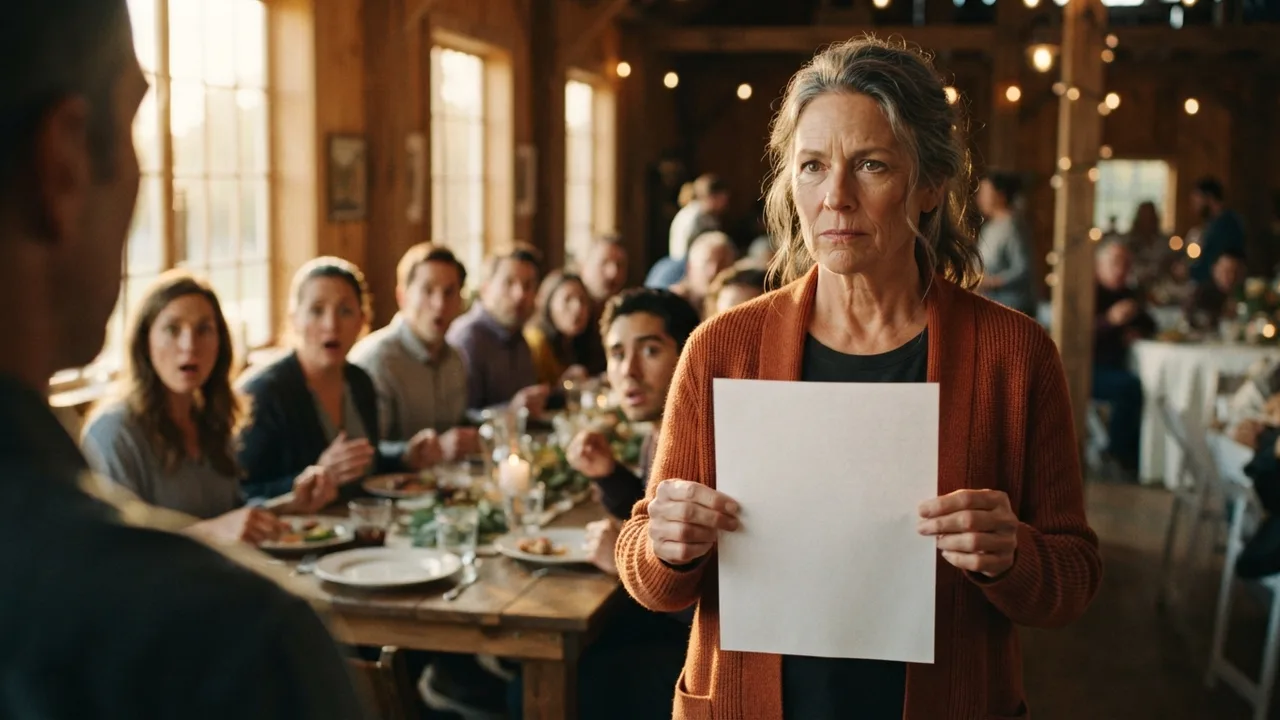
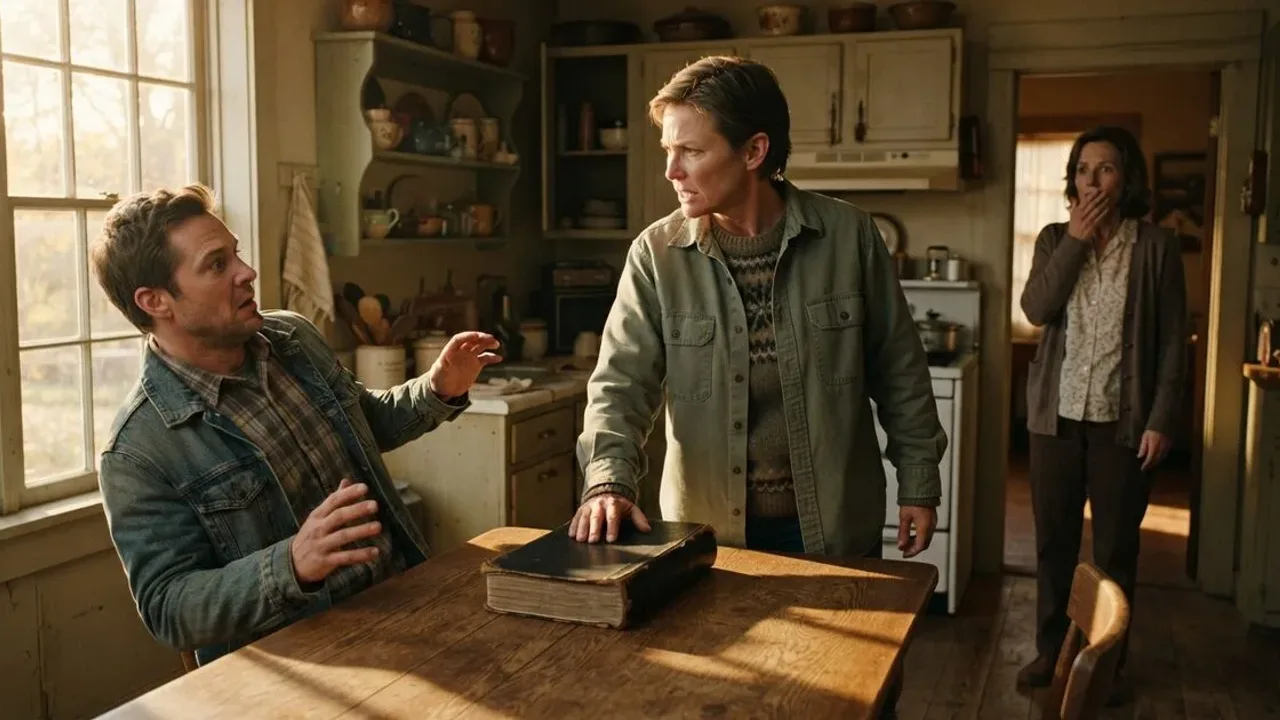
The bench scraped on the concrete floor, loud enough that heads turned. I walked down the length of the table, past Drew, past the Pereiras, to the end where my husband sat. I took the notice out of my pocket, unfolded it, and laid it beside his pie plate, where the white paper looked bright as a bandage under the string lights.
"Before we talk about lean years, Philip," I said, in the voice I use when I call the crew in from the far bog, "perhaps you can explain this."
He looked at the page. I watched his face go white, then slowly blotch with red from the collar upward.
"And while you're at it," I said, "maybe Milo Garvey can tell us all what he's been doing with the thirty thousand dollars you've sent him from our farm's credit line."
At the far end, Milo's spoon stopped in his bowl. He pulled the cap lower.
Philip stood fast enough that his chair rocked back on two legs and came down with a crack. "Annette, this is not the time or the place. This is a private matter."
He turned to the room, spreading his hands. "My wife is confused, folks. She's been under a lot of strain with the harvest."
Nobody laughed. Mr. Almeida set his hat on the table.
"I'm not confused," I said. "I called Carol Medeiros at the bank. I read the loan papers in your service manual. I saw five transfers with my own eyes."
"You went through my things?"
"I did, and I'm not proud of it." I held his stare. "It stopped being a private matter when you bet our son's inheritance on a thirty-year-old lie."
The scrape of a bench came from behind me. Drew was on his feet.
"Dad," he said. "What lie? What is she talking about?"
Philip's mouth opened and closed. He looked at the notice, then at Milo, who would not look back, then at his son.
"Tell him," I said quietly.
"It was an accident," Philip said, and the words came out cracked. "It was always supposed to be an accident."
"Dad."
"There was a gear on the harvester that needed work." His voice dropped, and the whole barn leaned in to hear it. "We were behind, the weather was turning, and I skipped the safety check. I patched it and told myself it would hold. It slipped, and Frank's arm was in the wrong place."
Drew said nothing. His hands hung open at his sides.
"I told everybody it was nobody's fault," Philip went on. "I told your mother. I've been paying for it in my head ever since. When Milo came to me this summer and said his dad couldn't work and he was struggling, I couldn't say no. I thought if I sent enough, it would square things."
"Enough," Milo muttered at last, to his bowl. "You offered."
"You asked me for it every month," Philip said. "You knew exactly what you were asking."
Milo shrugged, sullen, and stared at the paper cloth. "My dad can't hold a cup. Somebody owed us."
"Somebody did," I said. "Philip did. Not this farm, and not Drew."
Nobody spoke. The heater ticked in the corner. The workers looked from my husband to me and back, and the Pereira boys stared at their pie. A silence like that comes down over a bog the night a frost is called, when every grower within a mile stops and listens to the dark.
Mr. Almeida was the first to stand. He put his hat on, nodded to me once, and walked out. The others followed in ones and twos, murmuring thanks and not meeting anyone's eye. Milo went out with them, his head down, and I did not stop him.
When the barn had emptied, the three of us were left standing among the paper cloths and the cold coffee. Somebody had turned off the heater. I could see my breath.
Philip sat down heavily on the bench, and for a long time he held his hands between his knees.
"I'm sorry," he said. "Annette, Drew. I'm sorry."
"I know you are," I said.
"I should have told you in 1996."
"You should have." I kept my hands in my pockets so he would not see them shake. "Here is what happens now. The payments to Milo are over. Tomorrow morning I am going to the bank to see Carol, and we're setting up a repayment plan on that line."
"With what?" he asked. "There's no money."
"The stock your mother left you. You'll sell it. Every dollar of that loan gets paid out of what's yours, not out of this farm."
He nodded slowly.
"You don't touch the farm's accounts again," I said. "Not the checkbook, not the laptop, not the bank. I'll do the books. And you will sit down and tell Drew all of it, from the beginning, with nothing left out."
"Mom," Drew said, in a rough voice. "Let me—"
"Not tonight. Let him say it when he's ready to say it right."
"I'll tell him," Philip said. He did not look up. "Whatever you want. I'll do all of it."
He looked like a field after the water's been pulled, the vines still there but the life gone out of them. Drew stood a few feet off, his arms crossed tight, studying his father like a stranger who had walked into his house.
"You can sleep in the guest room," I said.
Philip flinched and said nothing.
I picked the notice up off the table, where it still lay by his plate, and walked out of the barn without looking back.
The night was clear and raw, the ground stiff under my boots. I followed the dike road down past the pump house to the last bog, the one we had flooded that week. The water lay black and flat, and a thin sliver of moon floated on it, trembling when the wind moved.
The harvest was in. The berries were safe, the farm was safe, and Drew would have his inheritance. I had done the work of a good grower and caught the rot before it reached the crown.
But I stood there with the cold coming up through my soles and did not know what I had saved. Some fields can be treated and brought back. Others have to be burned over and planted new, and the grower can't always say which until the next spring.
Behind me the barn lights were going out one by one.
I looked down at my right hand. The notice was still in it, creased from my grip, a white rectangle in the dark, the paper that started it all.
Comments