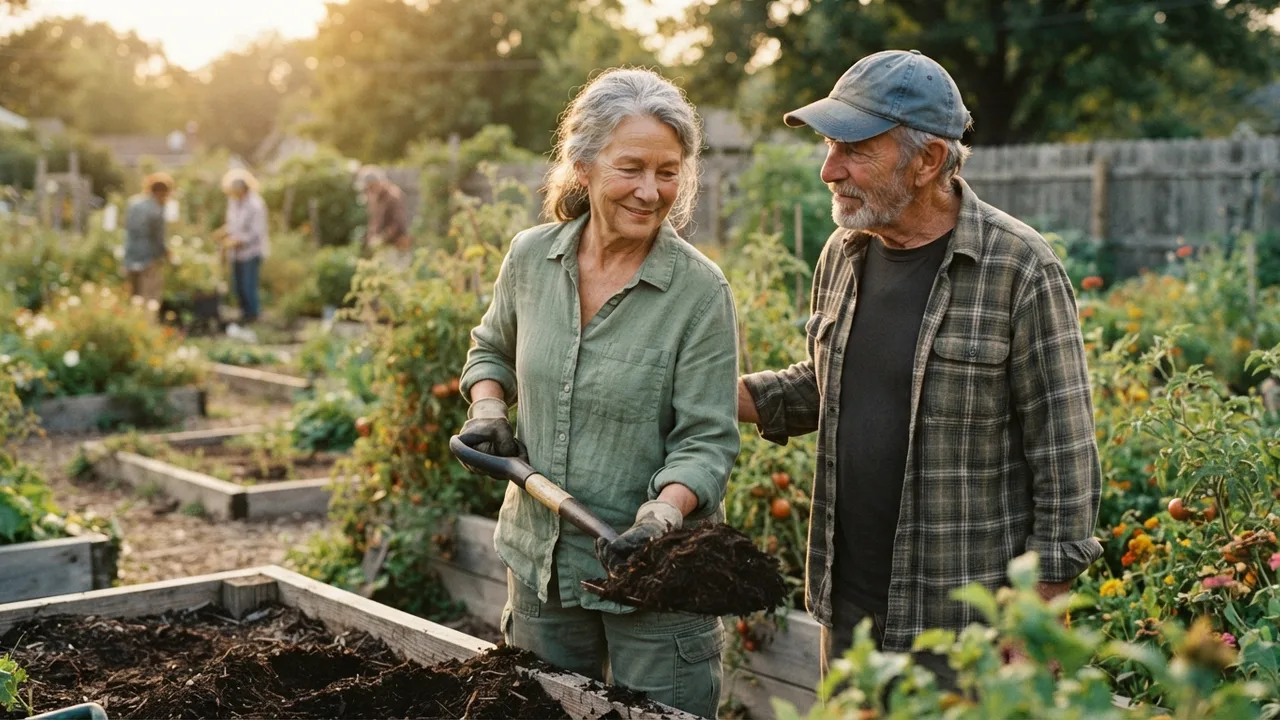
"The soil in Lot 14B is dead," Dustin Hedberg announced to the garden committee, tapping his tablet, "and I already have a very generous buyer lined up for the parcel."
I was forking cold compost across the yard from the picnic table, and the tines stopped halfway into the pile. Lot 14B was my husband's. Frank grew tomatoes there for thirty years, and people drove over from Modesto in August to stand at the fence and look at them.
I'm Rosalind Kirk, I'm sixty-eight, and I'm not on the committee. I never asked to be. I keep the compost bins along the canal fence and I know which spigot drips and which one sticks, and since Frank died the garden has been where I go so I don't have to sit in the house with his reading glasses still on the windowsill.
Advertisements
Dustin had moved to Oak Creek from somewhere with better coffee. He wore gray exercise clothes to the garden and trail shoes that had never met mud, and he called dirt "underperforming assets." The members had voted him chair over the winter because he talked about "community buy-in" and brought donuts.
"Dead how?" Walt Pruitt asked. Walt keeps the garden's checkbook. "That plot took a cover crop fine last fall."
"Walt, I've been hands-on in 14B since I took the revitalization on," Dustin said. "Weeding, amending, my own custom regimen. The numbers are what they are."
"What numbers?"
"I'll present everything at the all-members meeting Thursday, at the library. Come with an open mind."
The others drifted toward their trucks. I wiped the tines with a rag, walked to the table, and waited until he'd zipped his tablet into its case.
"Dustin, that soil was sweet last October. I tested it myself."
"Did you, Roz." He smiled at me the way he smiled at the children who came for the sunflower days. "That's lovely, that you keep track of things."
"I keep track because it matters. Something has changed in that plot since you took it on."
"What's changed is the data. We can't let sentimentality stand in the way of progress, Roz. It's time to look forward."
He patted my shoulder twice and walked off, and the heat climbed up my neck as if I'd been caught taking tomatoes that weren't mine. I felt like a foolish old woman holding a rag. I stood there until his truck was out of the lot.
Advertisements
Then I walked down to 14B and crouched at the edge of Frank's bed. The tomato cages were stacked against the fence, and the dirt between the rows had gone the pale gray of dried glue, with a crust that broke under my thumb.
I had seen ground that color once, along the ditch road, where irrigation runoff dried and left a white rim.
On Saturday I drove out to the Walmart on the highway and bought a gallon of distilled water and a box of new mason jars. It came to forty dollars with a pack of labels, forty dollars that had been set aside for the gas bill, and I stood in the checkout line doing sums in my head that came out the same each time.
At the kitchen table I took soil from four places in 14B and from my own plot, and I labeled each jar in pencil. A soil dispersion test is simple. You set a dry crumb of earth in still water and leave it alone, and you watch what it does.
Good soil holds its shape. The crumb from my plot sat on the bottom like a little loaf, and the water stayed clear around it.
The 14B crumbs slumped, then bled into the water until the jar went milky from the bottom up. I did it again with fresh samples and fresh water, then once more with a crumb from Walt's plot as a check. Every time, my jar stayed clear and Frank's stayed cloudy.
I had to put the jar down because my hands wouldn't hold it still. This was not a plot that had gone tired. It had been poisoned with salt, and someone had to have done the salting.
Sue-Ellen Morris came by Sunday afternoon with a loaf of zucchini bread in foil. She has been my friend since our husbands argued over a hose at the first plot-assignment meeting, and she stopped in my kitchen doorway and looked at the row of jars lined up along the windowsill.
"Roz, what on earth is all this?"
"Water from Walmart and dirt from 14B. Look at the one on the left."
She looked. She leaned in and tapped the glass with her fingernail. "Looks muddy."
"It's salt. Dustin said he's been feeding that plot his own mix, and the soil's gone to salt."
"Honey." Sue-Ellen set the bread on the counter. "I like Dustin's energy, I'll admit it. And he says he has data. What have you got?"
"Jars and twenty years."
"I believe that you believe it. But a jar of cloudy water won't carry a room. Bring me something with a stamp on it, or something in writing."
"Then I'll bring something in writing," I said.
That night I pulled down the attic ladder. The heat up there had been collecting all day in the rafters, and the air smelled of cardboard and mothballs and the pencil shavings Frank used to leave in his shirt pockets.
The logbooks were in a liquor-store box at the back, a row of marbled composition books with their spines taped. Twenty years of them. Every one had pages for compost additions, pH readings, rainfall, and harvest weights, plot by plot, in my square handwriting.
I sat on a trunk under the bare bulb and opened the oldest one.
Frank had written in the margins. I had forgotten that. "Rosie says go easy on the lime. She's right again." Then, three pages on: "Best Big Boys I ever grew. Don't tell Walt." The way he crossed his sevens hadn't changed since the day I met him, and I read those margins with my thumb pressed over my mouth until the bulb buzzed.
I read through the sleepless hours and the log for 14B told the same story year after year. Healthy pH, good yields, a plot that gave back whatever it was given. My last entry was from October: *14B, soil sweet, vetch turned in, ready for spring.*
After it came blank pages. Dustin had told me in the spring that the committee would handle 14B from there, and I had let him.
I put the oldest logbook in my canvas tote beside the jars. I never did sleep.
The all-members meeting was in the public meeting room of the Oak Creek Library, a ten-minute walk from the garden gate. The room had linoleum, folding chairs, an air conditioner that rattled, and a plate of lemon bars somebody's daughter had brought.
About twenty gardeners had come, the old-timers along the left wall by habit and the newer members on the right. I sat in the back row with my tote on my lap. Sue-Ellen sat three seats down in her floral apron, giving me a look that asked what I was up to.
Dustin's first slide said OAK CREEK 2.0: LEVERAGING OUR ASSETS. He walked the room in his clean shoes and talked about optimizing outcomes and a "boutique partner" who saw the value in our footprint.
Then he put up a slide with one number on it. "A hundred and fifty thousand dollars for Lot 14B and its frontage. That buys raised beds, a pavilion, a real tool shed. And frankly, the soil's dead anyway, so it's a win."
I stood up. My knees felt loose and the tote strap shook against my wrist.
"I'd like to say something about the soil."
"Rosalind." Dustin's smile arrived a moment late. "We have a Q-and-A at the end."
"This won't take long."
I walked to the front table, set out two mason jars, and held them up so the back rows could see. The air conditioner rattled in the quiet. My voice came out smaller than I wanted, and then it held.
"These are from the same spigot's water, distilled. In this one I put a crumb from my own plot. In this one, a crumb from 14B. Healthy soil holds together in water. Salty soil comes apart and stays cloudy. You can see which is which."
Someone near the front whispered. A chair creaked.
I took the oldest logbook out of the tote and opened it to a page I had marked with a seed packet.
"This is the log for Lot 14B from five years ago. August tenth. Frank pulled twelve pounds of Big Boys. Soil pH six point eight."
I looked up at the room, the old faces on the left and the newer ones on the right.
"This soil isn't dead. Something killed it."
Dustin laughed, a short sharp sound, and I felt it in my back teeth.
"Rosalind, that's a lovely story. But we're running a non-profit, not a memory circle. Your scrapbooks aren't evidence." He turned and spread his hands to the crowd. "This is exactly the backward-looking thinking that holds us back. Are we going to make financial decisions on old wives' tales and muddy water in a jar?"
A few people on the right shifted in their chairs. A young man in the second row nodded.
"And for all we know," Dustin said, warming up, "it's her compost that's the problem. She's the one spreading it."
"My compost goes on every plot in the garden," I said. "Yours too, Walt, and yours, Teresa. Only one jar clouded."
"Because 14B is a failing parcel."
"It's not an old wives' tale, Dustin. It's data." I made myself meet his eyes. "And here's the last data point. The soil was fine until you took over weeding that plot three months ago."
His mouth opened. Before he could use it, a chair scraped behind me.
"She's right," Sue-Ellen said. She was standing in her apron, her voice carrying to the back wall the way it must have carried across a lunchroom for thirty years. "I saw Frank's tomatoes. Everyone in this room over fifty saw them. That was the best soil in the whole garden, and I don't need a PowerPoint to tell me so."
"Sue-Ellen, with respect—"
"Don't you with-respect me, Dustin. I taught third grade."
A murmur ran through the old-timers on the left. Old Mr. Alvarado, who hadn't spoken at a meeting in years, said, "Frank's Big Boys, yes," and somebody else said, "Best I ever ate."
Walt Pruitt cleared his throat. "I move we table the vote on the parcel until we have a professional soil analysis. The garden fund can cover a lab."
"Second," said Teresa Lopez, from the right-hand rows. She had joined last fall and had never said a word against Dustin. "I'd like to see a lab report before I vote on anything."
The hands went up, left side first, then half the right. Dustin looked at them as though he were counting, and his face went the red of an overripe tomato.
"I cannot work in such an unprofessional and hostile environment," he said. He zipped his tablet into its case, and his trail shoes squeaked all the way across the linoleum to the door.
It closed behind him with a soft click. Nobody clapped. Sue-Ellen sat down hard and fanned herself with the agenda, and I stood at the front table with a jar in each hand and my knees shaking.
The following Saturday I woke before six, out of habit, and made coffee. I was halfway through it when I heard the gate latch at the garden, a sound I would know in my sleep, and then the squeak of wheelbarrow wheels.
I carried my cup out. Sue-Ellen stood at the gate with a wheelbarrow of finished compost from my own back bins, dark and crumbling. Walt and Teresa stood behind her with two more, and the sun was just clearing the almond orchard across the canal.
"The reclamation of 14B starts today," Sue-Ellen said. She pulled a long-handled shovel from the barrow and held it out to me. "And we're nominating you for committee chair."
"I like the mornings quiet, Sue-Ellen."
"Then you'll have to get up earlier. Take the shovel."
"Lab results will take a while," Walt said. "But I figured the ground doesn't need to wait on paper to start getting better."
I hesitated, and not for modesty. Since Thursday three different people had stopped me in the Raley's produce aisle to ask what was going on with Dustin. I had stood there holding a bag of onions and answering until my face ached. My phone had rung twice before nine every morning, and the garden I had kept as my own quiet refuge had become a place where people looked for me.
I wasn't sure I could have both.
I took the shovel. The handle was cool and smooth with other people's use.
"All right," I said. "But we turn the compost together on Saturdays, and nobody schedules a meeting before the dew's off."
"Madam Chair," Walt said, and tipped his cap.
I walked down the row to Lot 14B with them behind me, wheels squeaking. The pale crust still lay between Frank's tomato stakes, and for a moment I only saw his hands there, crossing sevens in the margins.
Then I saw the plot as it would be, a bed dug deep, vetch coming in, a row of seedlings I would choose myself. It was mine to build now, and I had the notebooks to do it right.
I pushed the blade into the nearest wheelbarrow and lifted the first shovelful of dark, rich, living compost, the smell of earth coming up around me, a plain answer to the word dead.

Comments