"I wouldn't trust her with the books, Dad, let alone a beehive," was the first thing I ever heard my new boyfriend's son say about me.
He said it through my screen door, before he had shaken my hand. By the week before the Briar Ridge Fall Harvest Festival he had said it to half the county. My name sat on the honey competition sheet, and my whole season sat in the honey house waiting for me to prove him wrong.
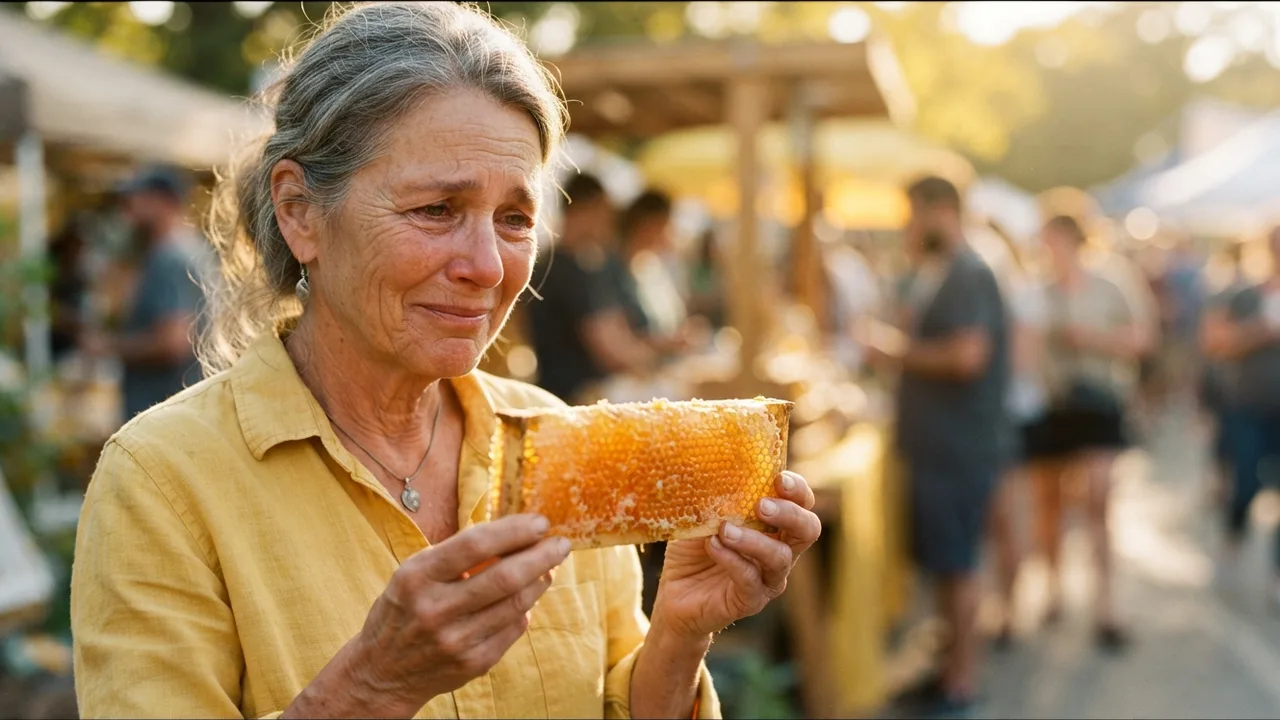
I'm Theodora Calhoun, Theo to anyone who has bought a jar from me, and I am sixty-four. I've kept bees on this farm outside Briar Ridge since before my husband died, and I've run Calhoun Honey alone for the two years since.
Roland Fowler walked into that quiet three months ago with a hand-turned cutting board he wanted to trade for a jar of buckwheat honey. He was sixty-eight, a retired furniture maker, tall, with a stoop like a man who'd spent his life ducking doorways. His hands were big enough to cradle a hive frame without a tremor.
Advertisements
His son Martin sold houses in Springfield, a ninety-minute drive north, and came down on Sundays in shirts too good for gravel.
The Sunday the trouble started, Martin wore blue pinstripe with mother-of-pearl buttons that threw little rainbows when he moved his wrist. He stood at my back fence with his hands on his hips like a man pricing the land.
"That post is wobbling, Theo," he said. "I'd hate for you to take a spill out here alone. Nobody would find you until supper."
"My husband set that post. It's held ever since."
"Things hold until they don't." He turned his smile on his father. "I say it out of concern, Dad. At a certain age, small things get missed."
Roland rubbed his jaw. "I could take a look at it, Theo."
"I'll see to it myself," I said, and watched Martin's smile widen.
The next morning the whole run of fence lay in the clover.
Hoofprints pocked the clay between the hive stands, two lids sat crooked, and the bees were boiling off their entrances in the heat. The gate latch I drop every evening hung open. I couldn't remember dropping it. I couldn't swear I hadn't either, and that was what I carried through the day.
Advertisements
I spent it in a veil and a soaked work shirt, setting posts and stretching wire. I made one trip to Orscheln for staples and paid $11.97 I hadn't planned on. By dusk my shoulders had gone to rope.
Roland came by with a foil pan of cornbread and stood at the new fence with a worried frown.
"Deer," I said. "They found the gate open."
"Martin was just telling me he was worried about that fence." He said it gently, the way he'd lay a board down. That was what made it land.
"He told you before it fell, Roland."
"He's got an eye for property, is all."
I let it lie there in the clover with the question I didn't ask. What was a man who sold houses in Springfield doing so interested in my hive stands?
A few days later the drive pin for my extractor was gone.
It had hung on a nail over the honey house bench every season of my working life. That morning the nail was bare. I went through coffee cans, boot toes, the floor drain, and the pockets of every coat I owned.
Roland was at my kitchen table when his phone buzzed. He put it on speaker, because Martin liked an audience.
"Pin's missing," Roland told him. "Theo's extractor is down."
"She's probably just misplaced it," Martin said, smooth as a showroom floor. "You know how things get when you're doing too much on your own, Dad."
"I hung it on that nail myself," I said. "It's hung there every year."
"I'm sure it felt that way." He sounded warm as lotion.
Roland looked at me then, and it was pity, soft and complete. I would rather he had shouted. He reached across and patted my wrist as you'd pat a good dog who had grown slow.
I ordered a new pin from a supply house in Iowa, $38 and overnight freight. It still took three days, and the goldenrod flow doesn't wait on a package truck.
Worse was the pat. I sat in my own kitchen and felt a man I was fond of begin to believe his son.
The afternoon before the festival I pulled frames for my entries.
I had two. The first was a jar of spring wildflower from the creek hives, gold as a church window. The second was a section of dark goldenrod comb from the hive nearest the fence, my best colony, the one that had never once let me down.
I lifted the frame and tilted it into the light.
The wax was wrong. A faint pink bloomed from the bottom of the cells, like a bruise coming up under the cappings. I have looked at wax every working day since my twenties, and I knew it the way I know my own handwriting.
Someone had fed that colony sugar syrup dyed red. Cheap, bulk stuff from a jug, and my bees had done what bees do with free food. They'd stored it fast and thin and called it honey.
I set the frame down very carefully, because my hands wanted to throw it.
Then I got on my knees and went through the grass under that hive stand. Caught on a splinter of the stand's leg hung a scrap of blue pinstripe, with a mother-of-pearl button still dangling by its threads. Both were tacky with the same red.
The button threw a small rainbow in the sun.
I knew that shirt. I'd watched it lean on my fence and tell me about concern.
I slid the scrap into a sandwich bag from the kitchen and sat on the back step until the shaking left my knees. Somebody had put a hand into my hive and then run, in the dark, from my bees.
Roland came at supper time. He ate half his chicken and dumplings and set his fork across the plate.
"Theo, I want to say something, and I want you to hear it kindly."
"Say it."
"Maybe sit this one out. The festival. Nobody would think less of you." He turned his big hands over on the table. "For your own sake. You've been run ragged since that fence."
"Who's been telling you I'm run ragged?"
"Nobody tells me. I see it." He hesitated. "Martin's carrying a lot this year, too. He means well."
The bag sat in my apron pocket. If I laid it out on the table tonight, Roland would see a woman holding a scrap of cloth, and a boy he had taught to ride a bicycle. I needed it in front of him where no one could say I'd arranged it.
"I'll think on it," I said.
That night I packed both entries, the clean jar and the pink comb, and wrote my name on both cards.
Saturday came up sunny and dry, the sumac along the county road gone red at the edges. The Community Building doors stood propped open, and ceiling fans pushed around the smell of fried peach pies from the church ladies' table.
The judges sat at a long table under a banner. Lucy Brewer was one of them, in her good overalls, dirt still under her nails because Lucy does not scrub for occasions. Beside her sat Ephraim Tull from the feed store and a young woman from the county extension office.
Roland stood next to me. Martin stood at his elbow with his right hand deep in his trouser pocket.
Lucy lifted my first jar to the window and let the light run through it. She tasted, and she closed her eyes.
"Clean as a creek," she said. "Wild blackberry, a little white clover. Ephraim, taste that."
"Tastes like August," Ephraim agreed, and the extension girl wrote something and underlined it.
Then Lucy took up the plastic spoon and dipped it into the second entry.
She put the spoon in her mouth and her face changed. She pulled it out and stared at it.
"Theo, what is this?" Her voice carried. "It tastes... chemical."
The room went still around the fans.
Martin stepped forward and laid a hand on his father's shoulder. "Dad, this is what I was afraid of." He said it loudly, for the back rows. "She's overextended, she's not keeping up. It's not her fault, but this is proof."
A murmur ran through the farmers and the pie ladies, and it was a sympathetic one. Somebody said, "Oh, poor Theo." I hated that most.
I watched him. He wore a fresh shirt, white, with ordinary buttons.
Then I walked to the table and picked up the comb.
"Lucy's right," I said. "It's tainted. This hive was fed cheap sugar syrup with artificial coloring in it."
I turned the comb to the window. Down in the cells, under the cappings, the pink stood out plain, the same pink in every cell like a stain in a cup.
"You see it in the wax," I said. "Goldenrod wax doesn't do that. No flower I know of does."
Martin laughed, low and kind, the laugh of a man humoring a relative.
"Artificially colored? For goodness' sake. It's a blossom blight, Theo, or some kind of fungus." He looked around the room for his audience. "Dad, this proves my point. She's getting paranoid, inventing conspiracies to explain one bad batch."
"A blight doesn't wear a button, Martin," I said.
I took the sandwich bag from my apron and set it on the judges' table.
Inside lay the blue pinstripe scrap and the mother-of-pearl button, both stained with the same sticky red. It gleamed under the fluorescent lights.
"I found this yesterday, caught on the leg of that hive stand," I said. "Torn off in a hurry. Maybe by someone who got stung and wasn't expecting it."
I looked at Roland. His eyes were fixed on the bag.
"You're a craftsman, Roland. You notice details. Have you ever seen a shirt with buttons like that?"
He didn't answer. He took the bag in his big careful hands and turned it, and I watched him go back through every Sunday.
"That's a button," Martin said quickly. "Springfield is full of men with blue shirts. Dad, come on. Anybody could have planted that."
"Planted it under my hive stand," I said. "Before I knew I'd need it."
Roland lifted his head and looked at his son's face. It had gone rigid as a plank. Then his eyes dropped to Martin's right hand, which had come out of the pocket without his noticing, and to the knuckle, red and puffed like a bit of dough.
"Martin," he said. "What happened to your hand?"
"Nothing. I caught it on a door."
"That's a sting." Roland set the bag down. "I kept bees with my grandfather. I know a sting."
Martin opened his mouth and nothing came out of it.
"You asked me for fifty thousand dollars," Roland said, low and shaking. "I told you no. This is what you did when I said no."
Nobody in that building breathed. Lucy's spoon sat in her fist.
"Go home," Roland said. "Get out of my sight."
Martin's face turned to stone and then to something worse. He shoved through the farmers, knocked a folding chair flat, and went out the propped doors into the sun. A car started in the gravel lot and kept going.
The fans went on pushing air. Ephraim cleared his throat, picked up the tainted comb with two careful hands as though it might still go off, and put it down on the floor behind his chair. Then he slid a blue ribbon across the table to my first jar.
Nobody clapped. Lucy reached over and squeezed my arm once, hard, and went back to her papers.
Roland turned to me. His face had caved in, apology and shame all in it, and he opened his mouth twice.
"Not here," I said gently. "Come on."
Later, when the crowd had thinned to a few folks stacking chairs, he found me at my stall. I had two dozen jars lined up on a checked cloth, and he stood a long while before he spoke.
"I don't know if he'll come to my door again."
"I'm sorry for that, Roland."
"Don't be." He rubbed his face. "But I'll feel it, Theo. You ought to know I'm going to feel it."
"I know."
I had pictured a long table at Thanksgiving with three of us around it, and a jar wrapped in brown paper to send home with a son. I folded that picture up and put it away where I keep my husband's reading glasses.
Roland ignored the blue ribbon on the cloth. He reached past the jars and laid one finger on the comb I'd cut for display, a clean slab of goldenrod that held the afternoon light in every cell.
"This is the truth," he said softly. "I should have trusted it. I should have trusted you."

Comments