The first thing Lawrence Bishop ever gave me that wasn't a compliment was a copper sauce pot older than my grandmother, and it must have cost him a month's rent. By the end of that autumn I would hand it back to him in front of his son, with a signed receipt, and not know whether I was handing back the man along with it.
He carried it into my kitchen on a Tuesday evening, wrapped in a bath towel, and set it on my stovetop as if it might wake up.
"Open it," he said.
Advertisements
I peeled back the terry cloth. The pot was hand-hammered, the tin lining worn silver, a maker's stamp rubbed nearly smooth beside the handle.
"Lawrence, this is somebody's great-grandmother's good pot."
"Estate sale in Galveston. It sat on a card table next to a box of doilies, and I thought, there is exactly one person in Texas who would know what to do with that."
"I know what to do with it. That's the trouble. I can't insure it and I can't give it back."
"Then don't insure it. Cook in it."
I'm Camille Landry, and I manage the cafeteria at an elementary school in Cy-Fair ISD, which means my life runs on a laminated schedule. Deliveries come Monday, the walk-in gets counted the last Friday of the month, and red beans go on the line whenever the calendar says they should.
Since my husband died I had kept the schedule tight and the circle small. Lawrence, a retired architect who had argued with me over the last decent bunch of collards at Kroger, was the first unplanned thing I'd done in years.
Advertisements
His generosity was wonderful. It also made me count.
A week after the pot, a truck backed into the visitor space outside my townhome and a young man wheeled a crate up my walk. Inside was a KitchenAid stand mixer from before I was born, cream enamel without a chip, the kind of machine church kitchens pass down in wills. The card said, *For the biscuits. L.*
I stood there a long while with my hand on the bowl. Then I mixed a batch of dough just to hear the motor, and it purred like it had been waiting for me.
That evening the phone rang with a number I didn't know.
"Ms. Landry? This is Geoffrey Bishop, Lawrence's son."
"Hello, Geoffrey. Your father talks about you often."
"I'm sure he does. I'll be brief."
I dried my hands on the dish towel and waited.
"My father is a generous man, sometimes to a fault. We're just trying to make sure he's looking after his own interests."
"We?"
"The family. We pay attention."
I pulled out a kitchen chair and sat down on it. "I'm not sure what you're asking me to do."
"I'm not asking anything. Enjoy your evening."
He hung up. The joy I'd carried around since noon drained out of the kitchen, and the mixer sat on my counter looking like evidence.
I ate supper standing up and couldn't have told you what it was.
Lawrence did not mention the call, because I didn't mention it either. Instead, the following Sunday, he arrived with a set of German knives, forged steel in a walnut block, the kind a chef buys once in a career.
I tried the paring knife on a tomato and it slid through like the tomato had volunteered. While Lawrence was in the bathroom I looked up the price on my phone, and my face went hot at my own kitchen table.
"They're too much," I told him when he came back.
"They're exactly enough. A cook ought to have decent knives."
"A cook ought to have a budget, too."
"I've never once seen you without one," he said, and kissed my forehead. I let him, and I was still doing sums in my head.
The next Saturday I was out front deadheading the mums the Texas heat hadn't killed yet when a black sedan parked behind my car. Geoffrey Bishop got out in a pressed blue shirt, the sleeves rolled to the elbow, an expensive watch catching the sun.
"Ms. Landry. We haven't met properly."
"I know who you are. Your father keeps your graduation picture on his mantel."
"May I come in? I'd rather not do this on the sidewalk."
Mrs. Alvarado next door had developed a sudden interest in her hose. I let him in mostly for her sake, and I regretted it the moment he stood in my kitchen looking at the knife block and the mixer the way an appraiser looks at a house.
"I'll be plain," he said. "I think you're taking advantage of a lonely man."
"Is that what you think."
"It's a pattern. I do risk assessment for a living. My father is liquidating assets that were never his to liquidate, and I've spoken to his doctor about a baseline cognitive assessment. Routine. For his protection."
"You told his doctor your father is losing his mind because he bought me a mixer."
I took the towel off my shoulder and folded it in half, then in half again.
"I told him my father's behavior has changed."
"His behavior changed because he's happy, Geoffrey."
"That's a lovely way to put it." He set a business card on my counter, squared it with his fingertip. "When you're ready to discuss terms."
"That's my front door," I said. "I'd like you on the other side of it."
He went. I watched his sedan reverse out of the lot, then took a dish rag to the spot where his card had been and scrubbed until the laminate squeaked. In thirty years of managing other people's children and other people's money, no one had ever called me a taker in my own house.
I kept the card. I didn't know yet why.
Lawrence's kitchen is bigger than my whole first floor, and the following Thursday he had a napkin sketch spread across the island, a floor plan of *my* kitchen drawn from memory. He had drawn a range in it the size of a small boat.
"Six burners, a griddle, an oven you could roast a hog in," he said. "Commercial. You'll want real heat when the catering starts."
"I've mentioned catering exactly once."
"You mentioned gumbo for the Methodist youth supper and pralines for the school auction and that you'd give a kidney for a proper stockpot. I listen, Camille. I'm an architect. I notice what people need before they do."
"Lawrence, I haven't said yes to a thing."
"I've already called a man about the gas line." He laughed, and then, offhand, reaching for his coffee: "Oh, and Geoffrey has called a family meeting. Him and his sister, in my own dining room, to discuss my 'erratic spending.' I believe there's a spreadsheet."
I set down my cup carefully.
I understood in that moment that denial would get me nowhere. If I told Geoffrey I wasn't after his father's money, he would file it under the first thing a woman after money would say.
"Lawrence, please hold off on the stove."
He put down his pencil. "Have I offended you?"
"No. I need you to trust me for a few weeks and not ask why."
"I trust you. That was never the question." But he looked at the napkin, and the light in his face had dimmed a notch, and I had done that.
At home I opened my laptop at the kitchen table and built the inventory the way I build everything at work. One sheet per item, a photograph against a white dish towel, a description, the date received, and an estimated value from comparable listings.
The pot, the mixer, the knives. Each sheet in its own clear protector, in a binder I bought at Office Depot for fourteen dollars and ninety-nine cents. At the back I typed one paragraph and signed it.
I boxed the knives and the mixer in their own crates. The pot I saved for last, and before I wrapped it I made one batch of pralines in it, because I was not going to hand back a pot I had never cooked in.
The sugar browned evenly all the way to the edge. The copper held the heat like it had been waiting.
I stirred until the pecans glistened, and I wept into the butter and didn't bother to hide it from the empty kitchen. I was building a door and I was going to have to hold it open myself for the man to walk through.
The invitation had come on cream cardstock, in Lawrence's careful architect's printing: *Come celebrate my sixtieth.* I didn't know whether I was going as his girlfriend or as the defendant.
He lived behind a gate that opened when I said my name to a speaker. Inside, his dining room wall held the late Eliza's collection: copper jelly molds in descending sizes, a hutch of cut glass, a rolling pin carved from a single piece of cherry. Everything was dusted and everything was hung level.
Ashley, Geoffrey's wife, greeted me at the door with a green bean casserole and a quick, apologetic smile.
"He's been in a mood all week," she whispered. "I'm sorry in advance."
"Don't be. It's his father's birthday. Let's get this on the table."
Lawrence had smoked a brisket, and I'd brought potato salad and a pecan pie in my own dish. Geoffrey sat across from me, his arms folded, and watched me the whole meal. He watched me slice, pass, take seconds, and hold my fork.
"Dad, did you ever open the quarterly statement I sent you?"
"Not tonight, son."
"It's an easy question."
"It's an easy question for another night." Lawrence raised his glass to me. "To the cook who made the potato salad, which is better than anything I deserve."
My tote bag sat beside my chair with the binder inside. My car keys were in my skirt pocket, because a woman who has made up her mind to leave a house should know where her keys are.
After the pie, Ashley gave Lawrence a soft gray sweater, and Geoffrey gave him a bottle of scotch with a card that said *Take care of yourself.* Then they all looked at me.
I stood, took the binder out of my bag, and walked it across the carpet.
"Camille," Lawrence said, turning it over. "I told you not to bring anything."
"Open it, please."
He opened it. He turned the first page, the pot on its white towel, then the mixer, then the knives. His thumb stopped at the back and stayed there.
"Camille, what is this?"
"An inventory. Everything you've given me, with what it's worth and a photograph of each piece. On the last page I've signed it back to you." My voice cracked on the final word and I cleared my throat and went on. "I can't keep such generosity while your family believes my intentions are impure. My good name is the one thing I will not put a price on."
Nobody moved. The brisket platter ticked as it cooled.
Then Geoffrey laughed, a short, hard sound.
"A ledger," he said, turning in his chair toward his father. "See? I told you. She kept a running tally the whole time. This isn't integrity, Dad. It's a negotiation tactic."
"Geoffrey," Ashley said quietly.
"No, look at it. She'll make you feel guilty, and you'll give her twice as much. It's the oldest play there is."
"If I wanted twice as much," I said, "I wouldn't have put my own signature at the bottom of it."
"You'd put whatever it took."
"Then call it whatever you like. It's still on paper, and the pot is still in the box by my front door."
Lawrence held up one hand. It was the first time I had ever seen him go still with anger.
"You've been worried about me spending your mother's money, Geoffrey," he said. "You're right. That's what I've been doing."
"Dad—"
"Sit, please."
He went down the hall to his study. We listened to a drawer open and close, and none of us said a word. He came back carrying a wooden box about the size of a bread loaf, with a brass hinge and a lid polished by years of handling.
From it he took a cream envelope, soft at the corners, with *Lawrence* written across the front in a firm, looping hand.
"Your mother wrote this before she died," he said. "It came with the Joyful Future Fund, the account you told me, I believe, was meant for her collection. I've kept it sealed until I knew whom to read it for."
He put on his glasses. His voice shook once, then settled.
"'My dearest Lawrence. The copper and the glass can go to a museum or a yard sale, I don't care which. The money is for you. Use all of it if you have to. Find somebody who will sit at your table and argue with you about salt, and then spoil her rotten. That is an instruction, not a suggestion, and you know how I get when I'm ignored.'"
He took off his glasses.
"She signed it the way she signed everything," he said. "*Your Eliza.*"
Ashley had one hand pressed against her mouth. Geoffrey was looking at the envelope as if it might still change.
"She told me it was a legacy fund," he said finally. "For the collection."
"She told you what you could bear to hear while she was dying. She wrote me what she meant."
Geoffrey said nothing. His jaw worked, and the expensive watch slid down his wrist as his hand went to his face. Ashley laid her palm on his back and kept it there.
"Dad." His voice came out small. "I'm sorry. I should have asked you. I should have trusted you before I called your doctor, before I called anybody."
"Monday morning you'll call that office and cancel."
"Yes, sir."
He turned to me. It was harder for him than the first apology, and he didn't hide that it was.
"Ms. Landry. What I said in your kitchen was unforgivable. I assumed a great deal and I didn't have the right. I'm sorry."
"I'll take that," I said. It was all I had in me at the moment, and he seemed to understand it.
Lawrence closed the binder and held it against his chest, then reached for my hand.
"I understand why you did it," he said. "I won't pretend it didn't sting, but I understand. And I won't accept any of it back."
"Lawrence—"
"They're from Eliza as much as they are from me. She'd haunt us both if I took that mixer out of your hands."
I looked at the copper molds on the wall, hung level and dusted, and at Geoffrey's bowed head.
"I'll take them back," I said, "on one condition. We pick out the new stove together."
"Together," Lawrence said, and the dimmed light came back into his face.
"I mean it. I'll pay for the gas line myself."
"Camille. That is the least reasonable thing you have said all night."
"It's the most reasonable. I'm the cook."
He laughed, a real laugh this time, and Ashley laughed too, wetly, and went to the kitchen for plates. Geoffrey stood and took the pie dish from my hands without a word and cut the first slice for his father.
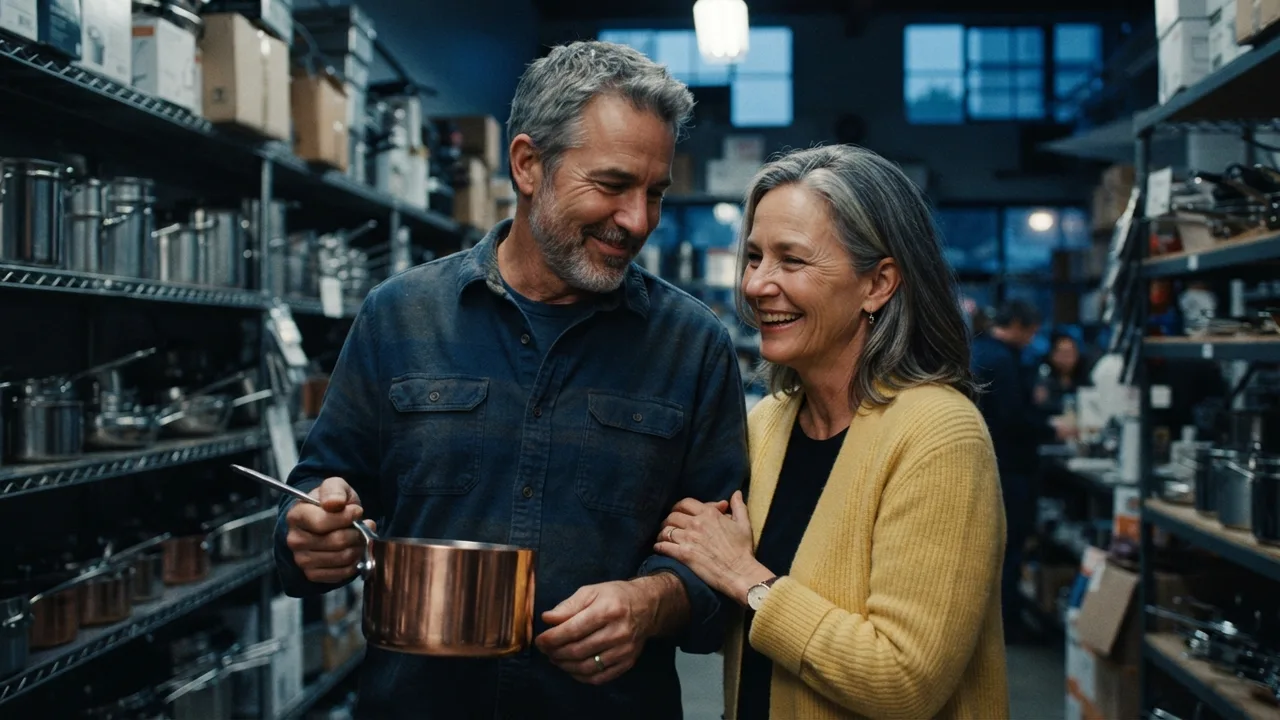
A month later, on a Saturday afternoon, we stood in a restaurant supply store off Highway 290, where the aisles smelled of cardboard and floor wax and a salesman in a green apron was patiently explaining burners. Lawrence had a floor plan in his jacket pocket and a pencil behind his ear.
He wandered off while I tested oven doors. When I found him, he was standing in the cookware aisle holding a copper sauce pot, plain and modern, with a clean handle and a lining still bright as a dime.
"It's a little different from the first one," I said.
"It has no past."
"That's what I like about it."
He turned the pot in the light and smiled at me.
"How about we start our collection with this one?"
Comments