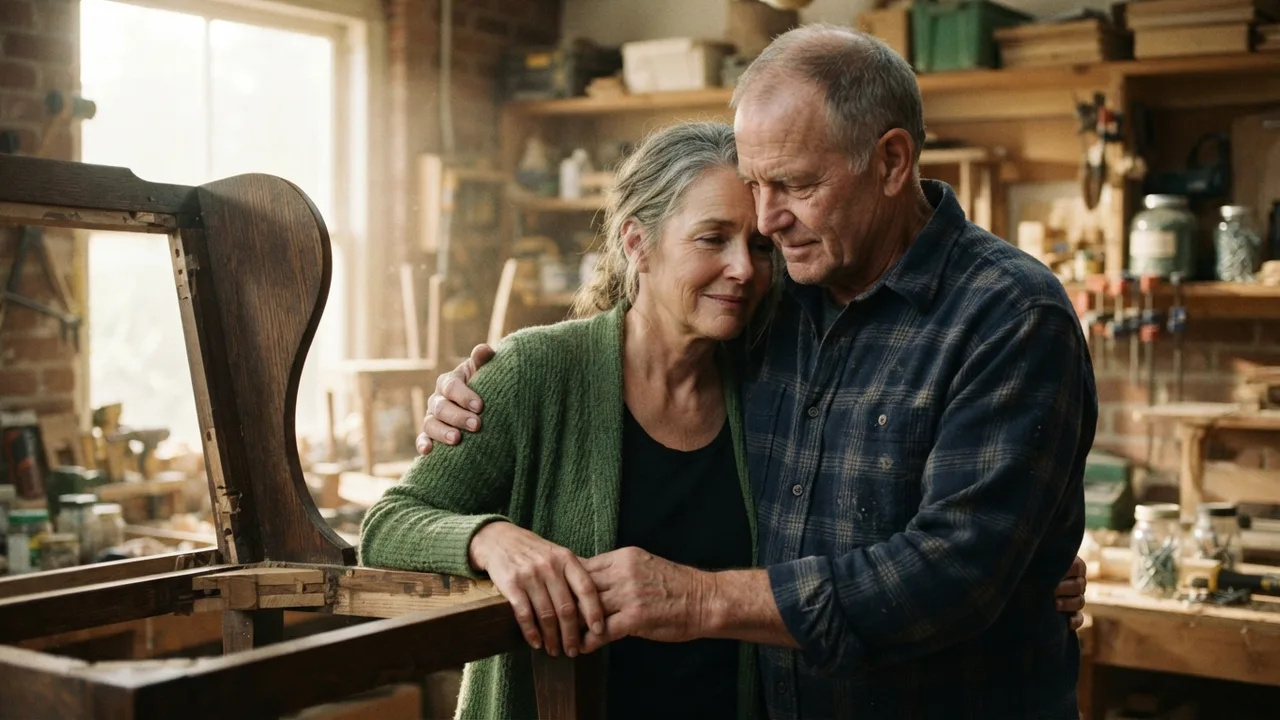
My son placed his great-grandfather's wingback chair in my workshop and told me the man I was seeing would steal the silver from my teeth.
"Mom, he'll have your savings by Christmas," Declan said. "And you'll thank him for the receipt."
He set the chair down on my drop cloth with a grunt. It was an ugly, magnificent thing, oak frame and horsehair stuffing, carried over from the 1890s on a wagon and never once reupholstered properly. The old green velvet had gone the color of pond water.
"Laura's always admired it," he said. "I thought you could do it up in something modern. A gift."
"It's a good chair," I said. "It deserves better than modern."
He was already looking at his phone. Declan wore loafers that cost more than he could afford, and he stood in them with his weight back on his heels and his chin lifted, like a man posing for a photograph of himself looking settled. The leather was creased across the toes from a lot of nervous walking.
Advertisements
"I'll do it," I said. "Take your time over the fabric."
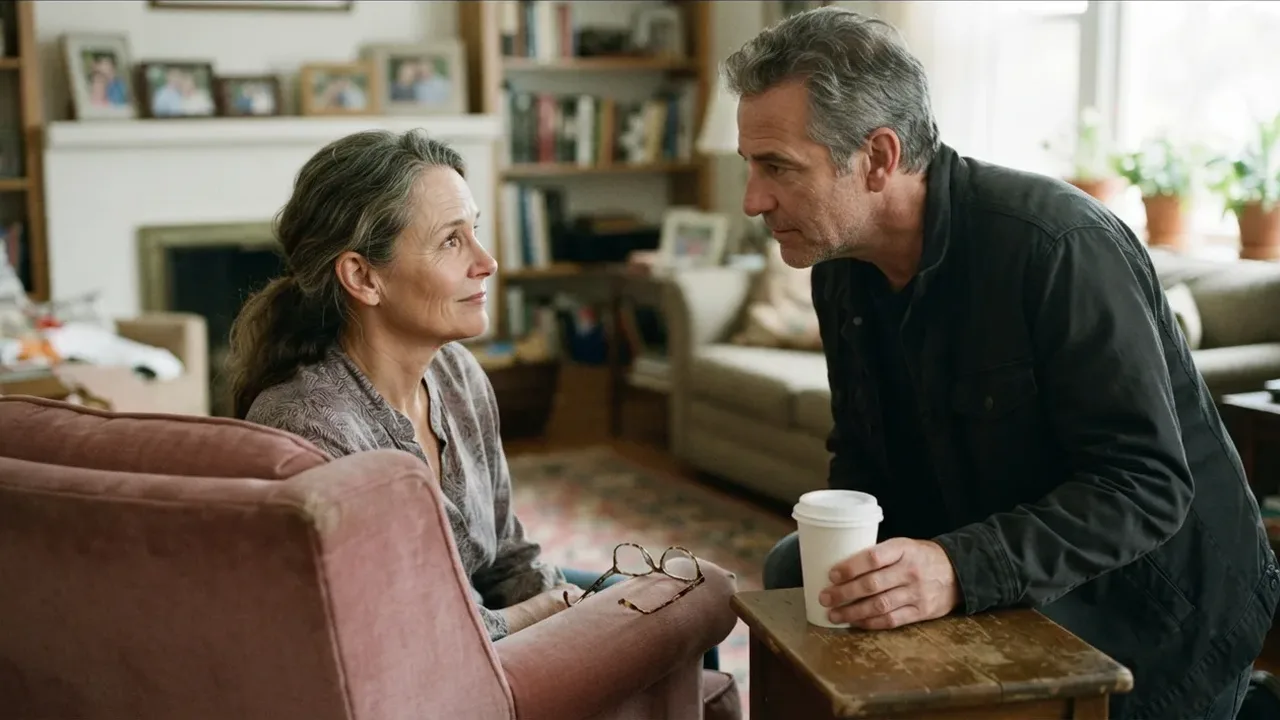
"Fine. Good." He reached into his jacket and laid a folded paper on my cutting table, smoothing it with his thumb. "I want you to read this. 'Sweetheart Scams: How Predators Target Widows.' I highlighted the parts that sound like Quentin."
"You've known Quentin a few weeks."
"That's how it works, Mom. Retired, polite, no family nearby. Brings you tomatoes."
"They were good tomatoes."
He laughed, but he didn't mean it. "I'm just concerned about your vulnerability. Since Dad died you've been alone out here, and a man like that sees a paid-off house and a woman who's lonely."
"I run a business, Declan. I'm not lonely, I'm busy."
"Think about it. That's all I ask." He kissed the top of my head, which he had not done since the funeral, and went out to his car.
I stood at the window and watched him sit behind the wheel for a full minute without starting it. Then he drove off toward his subdivision, fifteen minutes away.
That night I lay awake with the paper on the nightstand. I went over every doubt I owned, and there were more of them than my son could have guessed. By the time the light came gray through the curtains, I had put my own judgment on trial and found it wanting in several places, and I did not like who the witness was.
Advertisements
Quentin and I met on Friday at the Pisgah Perk, at the table in the front window. We had picked it ahead of time, because anyone driving down Main Street could see us there.
He arrived in his tweed jacket with the elbows worn pale, stooping a little under the door frame. He ordered two coffees and a slice of pecan pie to split. The whole bill came to eleven dollars and some change, and he counted it out in exact bills.
"You look tired, Ellen," he said.
"I didn't sleep." I turned my cup on its saucer. "Quentin, I have to ask you something, and I'd rather ask it badly than not at all."
"Ask it plainly. That's usually kinder."
"Your money. Where it comes from. Whether you've ever, well." I could not make the sentence finish itself.
He didn't flinch. He reached into the satchel by his feet and drew out a manila folder with colored tabs down the side, and slid it across to me.
"Pension statements. Two years of tax returns. The house deed, which has been mine since the year my wife and I bought it. Thirty-one years in forensic accounting, and I can give you the names of three firms who will say I was dull."
"I don't need all that."
"You asked. You're entitled." His voice stayed gentle, but a muscle moved in his jaw. "I'd rather you asked me than wondered."
He had told me to ask it plainly, and I had not known how plain it would sound. His eyes went to the window, to the street, and back to me, and I saw that the hurt in them was not anything we had rehearsed.
"I'm sorry," I said.
"Don't be. Eat your pie." He pushed the plate toward me. "Your son has a good eye for what frightens you. I'll give him that."
I told Declan about the coffee that evening, every word, and he sounded pleased. I told him I'd been foolish to doubt his concern. I went to bed ashamed, and not only of the act, because the shame had a real man's face in it.
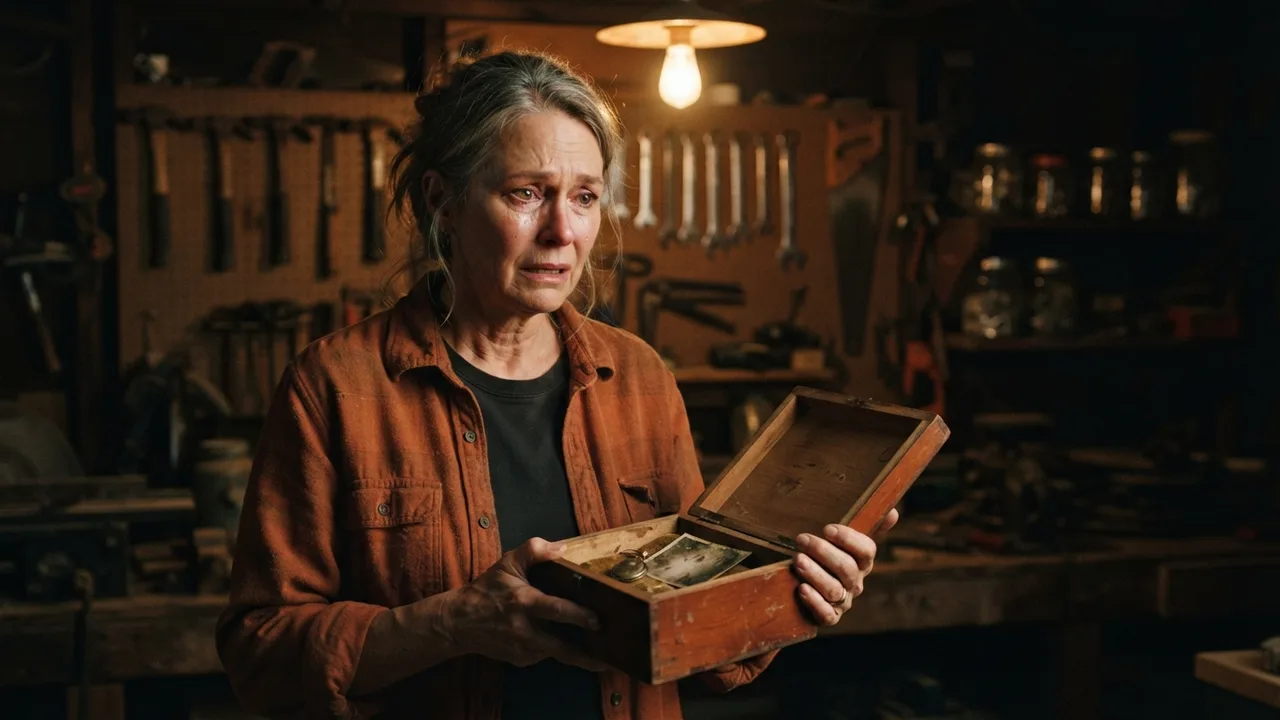
The chair waited for me through two days of other work. A dining set for a family in Hendersonville took most of one afternoon. On Sunday evening I finally rolled the old oak frame onto its back, and lifted my tack puller and my magnetic dishes down from the shelf.
I always start at the bottom, with the dust cover. The black cambric stretched across the underside of any good chair is the first thing a maker puts on and the last thing anybody looks at, and it tells you who has been there before you.
This one had been touched. The webbing under it was bunched where it should have lain flat, with one strap pulled loose and stretched out of its true line. Along the edge of the cambric, where I expected the dark, domed heads of hand-forged tacks, a row of bright steel crowns winked back at the work light.
I put my thumbnail under one and it came away clean. Shiny, modern, driven in by a pneumatic gun.
I knew what I was looking at, and I sat down on my stool because my knees told me to. The tacks, the real ones, were there too, forty or so of them hammered flat and then ignored, half hidden under the crooked line of new staples. Someone had opened this chair from underneath and closed it again in a hurry.
Frank had told our son, and only our son, that there was an emergency fund in the family. Gold coins, put away against a bad year. I had turned the house over twice after the funeral and found nothing, and I'd stopped looking when it felt like digging up his grave.
I pulled the staples one at a time and dropped them into a dish, clink after clink. A dozen. One I kept back in my apron pocket. Then I peeled back the cambric, and inside the cavity where the horsehair should have been packed hard against the frame, there was a hollow the size of a bread loaf. Wrapped around its edge was a scrap of patching canvas, gray and greasy, tacked to the torn burlap underneath.
I sent Quentin a single line. It said, "It's as we feared."
His answer came a minute later. "Then we're ready. Let him call his meeting."
On Monday I carried my one staple down to Pruitt's Hardware on Main Street and stood at his counter for a good while.
Declan called it Wednesday, by text. "Family conversation, Saturday at two, your front porch. Laura's coming. Please be open-minded. Love you."
I wrote back that I would be there, and that I'd be bringing a guest.
Saturday came up cool, the kind of October afternoon we get in the mountains when the maples on the ridge have gone red and the fog sits low over the French Broad until noon. I put out a pitcher of sweet tea and set four chairs in a half circle on the porch.
Declan arrived with a three-ring binder under his arm. He had parked nose to the porch and locked the Audi twice with the fob, looking back at the trunk. Laura followed him up the steps, tired around the eyes, in a cardigan buttoned wrong by one button. She hugged me too long and said nothing.
When Quentin came up the walk in his tweed jacket, my son's face did something quick and ugly that he smoothed away at once.
"Mom, I thought this was family."
"He's family enough to be sitting here," I said. "Sit down, Declan."
He opened the binder on his knees and cleared his throat the way he does before he sells people things. "I've done some research. Elder financial exploitation is the fastest-growing crime in this country. There are tabs here. Statistics. Case studies. I'm not accusing anyone, I'm just saying we need to protect your assets."
"Whose assets?" Quentin asked.
"Hers." Declan didn't look at him. "Mom, we need to be realistic. Men like that prey on women like you."
Laura's gaze dropped to her lap.
"What do you propose?" I asked.
"A power of attorney. Just a simple one, so I can monitor your accounts and flag anything unusual. Laura and I have talked about it. It would take a weight off you."
"Laura," I said. "Have you talked about it?"
"We, um." She looked at Declan. "Declan thinks it would be best."
Quentin sat with his hands folded on his knee and said nothing at all. He had the stillness of a man watching a column of figures add up. I stood and smoothed my apron, which I had not taken off, and looked down at my son sitting with his binder like a boy holding a report card.
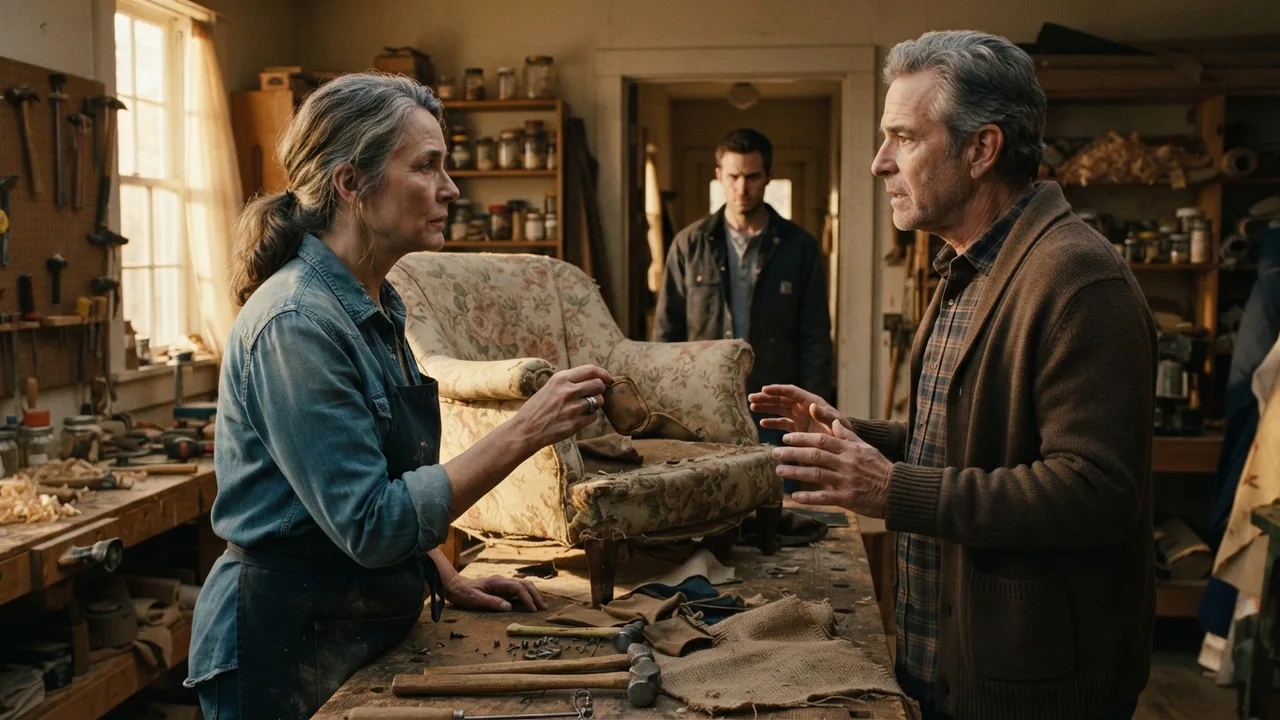
"Before I answer, I'd like to show you something in the workshop. All of you."
"Mom, we can look at the garage later."
"Now, please."
They followed me through the side door, Declan last, still holding the binder against his chest. The workshop was full of the late sun that comes through the high windows, and the old wingback stood in the middle of the floor, naked to its oak bones, the horsehair in a gray heap in a bin beside it.
On the bench beside the chair sat two small magnetic dishes on a clean white towel. One held a handful of dark, hand-forged tacks, pitted and domed. The other held eleven bright staples.
"This chair was built when your great-grandfather was a young man," I said. "Every tack in it was hammered by hand and never replaced. Look at the difference." I tipped the first dish, and the tacks rolled against the steel with a dull sound. Then the second, and the staples chimed. "These were holding the dust cover on when you brought it to me."
Declan said nothing for a moment.
"Whoever took the gold coins your father hid in this stuffing," I said, looking directly at him, "didn't know that your great-grandfather never owned a staple gun."
"What coins?" Laura said.
"Frank's emergency fund. He hid it years ago. I never found it, and Declan always knew roughly where."
Declan laughed. It was a bright, short laugh. "Staples? Mom, you're not making any sense. You're confusing a chair repair from decades ago with some theory. This is exactly what I was worried about." He turned to Laura. "You see it, don't you? He's got her seeing conspiracies in old furniture. We need to help her."
Laura didn't answer. She was staring at the bench.
I picked up the scrap of canvas from beside the dishes. It was gray, greasy at one corner, torn along an edge where somebody had cut in a hurry.
"When you pulled the stuffing out to get to the coins, you tore the inner burlap," I said. "You tried to patch it with this." I held it out toward him. "It's from the trunk liner of your Audi. I know the weave, because I mended a rip in that liner for you last spring. And I know that oil stain, because you spilled the can on it and asked me not to mention it to Laura."
His face froze. It did not fall, it simply stopped, as a clock stops, with the smile still hung on one side of his mouth.
"Mom."
Then it started again, all at once.
"It's a scrap of canvas," he said. "Every car in the county has a liner like that. You mended mine, so of course you'd know it." He swung the binder toward the doorway. "A man who audits people for a living puts an idea in her head, and now her own son's a thief. Laura, can't you see what this is?"
"Mr. Pruitt remembers you," I said.
I took the one staple I'd kept out of my apron pocket and set it on the towel beside the others. "I carried this down to his hardware store on Monday. Last Tuesday morning a man in loafers bought a staple gun and a box of these, and asked Mr. Pruitt to show him how to load it in the parking lot."
"Loafers." Declan's laugh cracked down the middle. "That's your proof? A shoe?"
"Mr. Pruitt looks at shoes, same as I do. He said the toes were creased, like the man had walked in circles before he came in."
Laura's head came up. "You told me you had a client that morning. You said it twice."
"I did have a client."
"Which one, Declan?"
He didn't answer her. When he turned back to me the bluster had gone out of his voice and the coaxing had come in, the tone he uses on the phone with people who owe him a signature. "Mom. Say I did borrow something. It's family money, and it was always going to be mine. Please don't do this in front of my wife."
"Where are the coins?"
"I don't have any coins."
"You locked that Audi twice when you parked," I said. "You never lock it at my house. Laura, who puts the groceries in that trunk?"
"Nobody." Her voice came out thin. "He won't let me. He says the liner's a mess."
"It is. There's a corner cut out of it, and under the liner is the spare-tire well, the one place your wife never cleans."
He had gripped his car keys since he came through the door, and his knuckles stood up pale. Laura held out her hand, palm up, and waited. Then the keys dropped into it with a jingle, and she went out, and we listened to her shoes on the gravel and the thump of a car door.
She came back with a gray gym sock knotted at the top and heavy at the toe. She gave it to me, not to him.
I untied it over the white towel. The coins slid out dull and yellow, none bigger than a quarter, and they landed with the soft heavy click Frank used to call the only honest sound in money.
"Some of them are gone," I said.
"I owed on the boat." Declan sat down on my sawhorse. "A dealer in Asheville gave me a slip. It's in my wallet."
Quentin came in from the doorway. He took the slip, read it, and drew a yellow legal pad from his satchel. He wrote for a minute, then turned the pad toward my son. "What the dealer paid you, repaid out of your commissions every month until it's covered. That's all it says."
"Mom, I can't—"
"You'll sign that you can," I said. "And you'll leave something with me that you'd miss."
He looked at the keys in Laura's hand. "Not the car. I need it for work."
"The boat. Take its key off the ring."
He worked it free with his thumbnail, and the nail bent back and he winced. He signed the pad against my cutting table. Laura signed under him as witness, her cardigan still buttoned wrong, and her handwriting did not shake.
The key landed in my hand warm from his fist. I put it in my apron pocket, where the staple had been.
"You'd do this to your own son," he said.
"I'd rather it had been anybody else's. You won't sit at my table for Thanksgiving, Declan. Not until the last payment clears." I said it plainly, so nobody would have to wonder.
He took his keys from Laura and went out past me, and he did not kiss the top of my head. Laura stopped at the door and took my hand in both of hers and held it. Then I heard the car doors, one and then the other.
I stood in the middle of the workshop with my arms aching, as if I had carried that chair in by myself.
Quentin gathered the dishes and tipped the staples back into their little cardboard box. He rolled the towel around the coins and set it on the shelf.
"That was hard to watch," he said.
"He was so sure about you." The smile that came to me was crooked, and it hurt my face. "All those lunches at the Perk, all that hand-holding at the farmers market. He must have driven past that window twice a day."
"That was the idea. Keep him watching the right hand." He set a cup on the bench. "He was so busy guarding you from me that he never guarded himself from you."
"I wish it had been less of a performance."
"Parts of it weren't." He said it lightly. "I'll put the kettle on."
I heard him run the water in the little utility sink, the pipes knocking the way they have since Frank put them in. I took the boat key from my apron and dropped it into the dish with the staples, and it clinked against the steel.
Then I laid my palm on the old oak frame and felt it, cool and sound under all the ruin, the one part nobody had touched.
Comments