My son, Thomas, told me he needed fifty thousand dollars to save his father's store, and the first thing I felt wasn't fear, but pride. Sixty-two thousand dollars of Ray's insurance money sat in my checking account, and I was ready to hand over nearly all of it before he finished asking.
He found me in the garden, pulling green tomatoes ahead of the first frost and laying them on newspaper in the wheelbarrow. His new black pickup sat in my driveway with the engine ticking. A players card from a casino over the Oklahoma line hung from the mirror on a bootlace. He kept checking his phone and turning it face down on the fence post, then checking it again.
"Mom, I need to tell you something, and I need you not to panic."
Advertisements
"I have never panicked over a tomato, Thomas. Say it."
He rubbed the back of his neck. His collar hung loose on him. I noticed it the way I'd notice leaf curl on a pepper plant, and I told myself it was a hard season for everybody.
"There's a silent partner. Rick. Dad took his money to cover the lumber loan, back when I was in high school, and they shook on it. Nothing in writing. Now Rick says he wants out, or he wants me out. He's got a buyer."
"Your father never once mentioned a Rick."
"Dad didn't mention a lot of things. That was how he was." Thomas laughed, and it came out thin. "Fifty thousand by the end of the month, and I buy Rick out. Clean title, all ours. It's just business, Mom. I wouldn't ask if there was any other way."
I looked at the store's name stitched on his jacket, STRATTON'S HARDWARE in red thread, the same jacket Ray wore every day for as long as I could remember.
"I'll go to the bank in the morning," I said.
He hugged me hard and smelled of cut keys and cold air. I stood in the dirt afterward, tomatoes in both hands, feeling like I'd done something Ray would have been proud of.
The girl at Arvest Bank turned her screen toward me the next day. The balance after the transfer read twelve thousand and some change, and she asked twice if I was sure. I told her I'd been sure since yesterday.
Advertisements
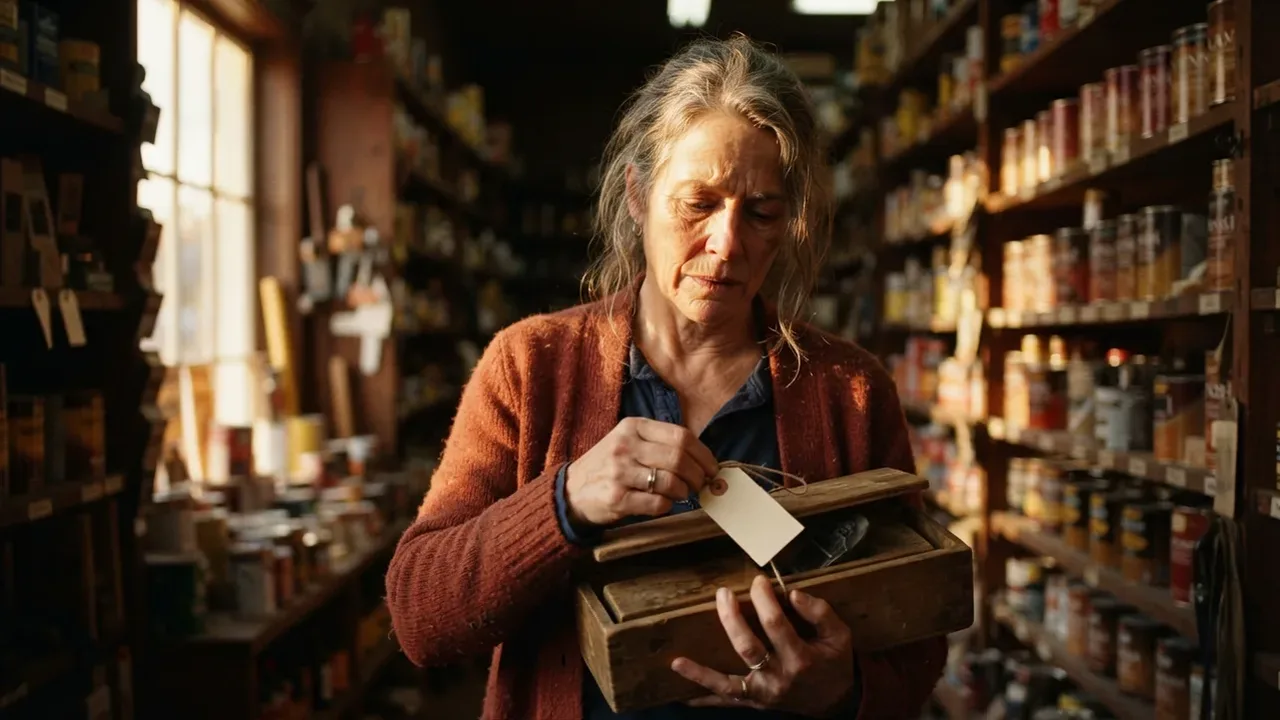
I walked home the long way, down Spring Street, past the fudge shop and the leaf-peepers in their fleece vests. I wasn't looking for anything. Then I stopped in front of Ozark Pawn & Gold, because something in the window had caught the light the way only one thing in this county ever did.
It was a block plane. Cast iron, brass lever cap, and a nick on the left cheek where Ray dropped it on the church steps in the year we were married. I'd know it blindfolded.
I went in. The man behind the counter had a gray ponytail and a name tag that said DELBERT.
"That plane in your window. May I see it?"
"Sure thing." He set it on a square of felt between us. His eyes went to the door and back.
I turned it over. Under the lever cap, scratched with a nail set, were two letters: R.S.
"Where did you come by this?"
"Folks bring things in, ma'am."
"Which folks?"
"I don't keep a guest book." He wiped a counter that was already clean. "Hundred eighty-five."
"My husband scratched those letters. Ray Stratton. He passed in the spring."
"Lots of Strattons around."
"Not with those initials under that cap."
Delbert picked up the plane and slid it back into the window as though it had gotten too warm in his hands. "I can't help you, Mrs. Stratton. I'm sorry for your loss."
He knew my name. I hadn't given it.
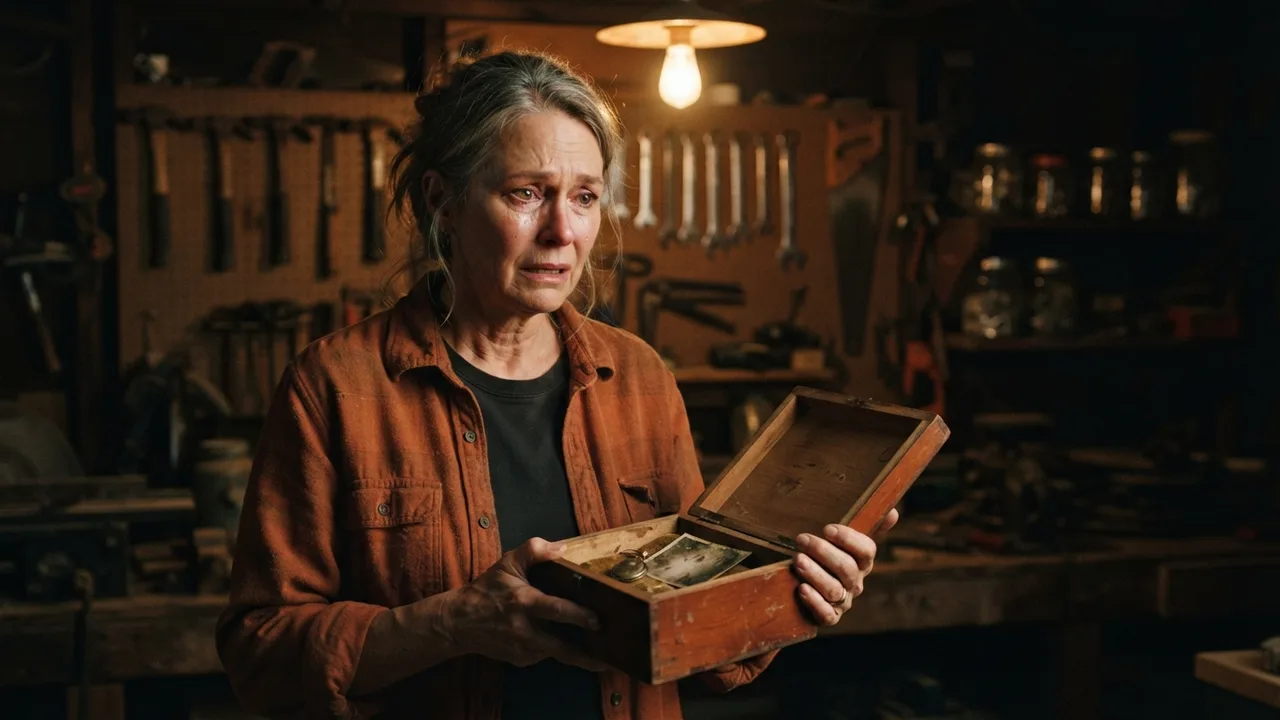
I went home and didn't make supper. At dusk I crossed the yard to Ray's workshop, switched on the single bulb over his bench, and stood in front of the pegboard.
Ray outlined every tool in black marker so each would have its own hook. The plane's outline sat there, empty, a clean shape with nothing in it. Two more were empty beside it. I hadn't looked at that wall closely since the funeral, because looking meant admitting he was gone.
I put my palm into the outline of the plane. The pegboard was cold.
On the shelf above the bench sat the box Ray carved for his ledger. It was cherry, hand-fitted, with a lid that closed with a sigh. I took it down and opened the ledger to the page for the block plane. His pencil drawing was there, his small square handwriting, and the history: bought at an estate sale in Berryville, restored the fall of the ice storm, restored again last October. Pressed between the pages was an oak leaf from the big tree by my clothesline, brown and crisp, brought in by Ray the last October he was well enough to walk the yard.
I remembered it. He'd come in with it held up like a trophy. "That's a good one, Lilly."
The back pages held every loan the store ever took, each one crossed through in pencil the day it was paid.
Behind the last page was the pocket he made for extra leaves, and something stiff was in it. An envelope, sealed. My name on the front in his hand, and under it: *When you know.*
I held it until my fingers ached. I knew a little by then, and a little wasn't enough to open it. Besides, I wanted to hear Thomas say it first, with his own mouth, to my face.
I slept on Ray's stool with my head on the bench. Near dawn the furnace in the house clicked on across the yard and I woke with the grain of the wood printed on my cheek.
At the kitchen table I opened my laptop. The pawn shop had a website, and on it, two more tools I knew. A miter saw with a burl handle Ray had turned himself, and a spokeshave with a repair in the brass, both listed the same week.
Then I searched the Arkansas Secretary of State for Stratton's Hardware. It took less time than brewing coffee. The owner of record was Thomas R. Stratton, sole proprietor, and there wasn't any Rick anywhere on the page.
I closed the laptop. My hands stayed on it a good while.
Thomas called Thursday, bright as a new nickel. "Mom, we're doing a little celebration. Back office at the store, Brenda's bringing pulled pork from Hickory House. We saved it. Dad's store is ours."
"I'll be there," I said, and put the cherry box in my tote bag.
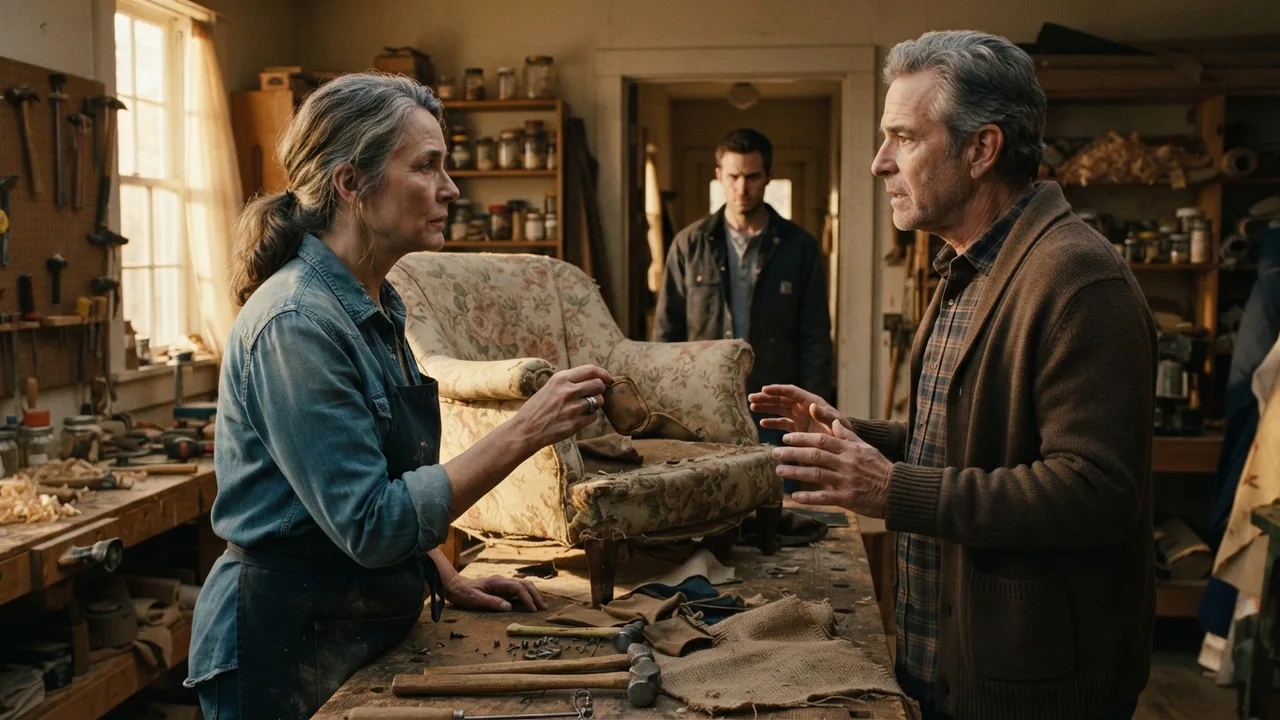
The back office of Stratton's Hardware smelled of motor oil and brisket. Brenda had set paper plates on the desk and a bottle of sparkling cider between two stacks of invoices. She wore a tangerine cardigan and a smile she kept adjusting.
"Lillian! Sit, sit. Tom's been practicing his speech all day."
"I have not," Thomas said, and he poured cider into plastic flutes with his thumb over the tremor in his wrist.
Ray's old desk calendar from the feed supplier still hung on the wall, flipped to the month he died. Nobody had ever turned it.
Thomas raised his glass. "To Dad. To his legacy, and every nail and board in this building. And to my mom, who believed in me when it counted."
"Hear, hear," Brenda said, shining at him, and then at me.
I did not lift my glass.
I set the cherry box on the desk instead, between the paper plates and the cider, and folded my hands.
"Thomas, I saw your father's block plane in the window of that pawn shop on Spring Street."
Brenda's smile held for a second and then began to come apart at the edges.
"His plane?" Thomas laughed. "Mom. Dad sold half his old tools years ago. He was always swapping at those flea markets. You're misremembering."
"Lillian, honey," Brenda said, quickly, "grief does that. Tom's told me how foggy things got."
"Did he."
I unlatched the lid. The ledger lay where Ray had left it, the corners of the pages soft from his thumb. I turned to the block plane and set it open on the invoices where both of them could see.
"Your father drew every tool he loved and pressed a leaf for the year he worked on it. This one is from the oak by my clothesline." I touched the page's edge. "Last October. That's the leaf. He had the plane in his hands last fall, and he died in the spring. It wasn't sold years ago."
Thomas went the color of drywall. Brenda looked from the leaf to him and back.
"So what?" he said. His voice cracked, and he pushed through it. "So he had it last fall. He was getting sick, Mom. He was selling things off. You know he wasn't himself at the end."
"Tom," Brenda whispered.
"No, she needs to hear this. She's standing here in Dad's store with a dried leaf, accusing me, when I've been holding everything together." He pointed at the ledger. "You want to drag Dad through this? You want to make him into some kind of liar because you can't remember how bad it got?"
I let the silence sit for a moment.
"You're right," I said quietly. "He wasn't himself at the end. But he kept this ledger the way he always did, right down to the back pages."
I turned to them. I found the lumber note and set my finger under it.
"Ozark Lumber. Paid in full out of Ray's own savings, the June you graduated, initialed R.S. Your father wrote down a three-dollar spokeshave and a church raffle ticket, Thomas. He would have written down Rick."
"It was a handshake," Thomas said. "That's what silent means, Mom. Nothing on paper."
"Then give me Rick's last name. I'll call him tonight and tell him he's been paid."
Thomas studied the invoices. "He's out of state. Everything goes through his lawyer."
"Which lawyer?"
"Tom." Brenda's cider sat untouched in her hand. "You told me there was a closing."
He swung toward me, red to the ears. "You came in here with a dead man's pencil marks to call me a liar in front of my wife?"
"I came with more than pencil marks."
I reached into the tote bag and set the block plane on the open ledger, beside the oak leaf. The nick on its left cheek caught the light from the desk lamp. Brenda took one step back from it.
"I went back to Spring Street this week. Delbert Moyer sold it to me for the hundred eighty-five dollars he was asking, which came out of what Ray left me, and this time he had something ready." I unfolded a carbon-copy sheet and smoothed it over the invoices. "Miter saw, spokeshave, block plane. Three pawn tickets, three signatures. Thomas R. Stratton, with your driver's license number. The first is dated the week after we buried your father."
Thomas didn't look at it.
"That's how he knew my name the first time I walked in. He'd read yours off that counter three times."
"Dad gave me those to sell." His voice had no air under it.
"Your father died in the spring, and that leaf says the plane was in his hands last October. The ticket says it went across Delbert's counter after he was in the ground. Don't tell me what Ray gave you. Tell me who Rick is."
He sat down hard on the swivel chair. The compressor on the soda cooler out in the store cut on, hummed, and cut off.
"There's no Rick," he said.
Brenda made a small sound.
"But the store was in trouble, Mom, I swear it was, and I had it figured. I only needed one good weekend to put every dime back, Dad's tools and your money and all of it, and nobody would ever have known."
"One good weekend," I said.
I had been watching the signs all month, the way I'd watch a bed for blight, and the only thing I'd needed was to be willing to look.
"At the casino across the Oklahoma line. The card hanging off your mirror was in my driveway the day you asked me for the money. And that phone, Thomas. You turned it face down on my fence post and turned it back over every time it buzzed. Nobody's lumber order buzzes that often."
Thomas put his face in both hands.
"The casino I can drive away from," he said into them. "The phone is in my pocket."
"The truck," Brenda said slowly. "You told me the truck was a bonus from the store."
He didn't answer. That was the answer.
"Give me the phone," I said.
He held it out as if it weighed more than it did. I looked at the banking screen, then turned it and read the number aloud for the room. Brenda sat down on Ray's stool and put her hand over her mouth.
I pulled the invoice pad toward me and took a ballpoint from the coffee can where Ray kept them.
"Whatever is in that account tonight, you write me a check for it. And Brenda, the store's checkbook is yours from here on."
"I'll take it," Brenda said. She opened the drawer herself.
"Your truck keys go in my hand, and the title with them. I sell it, and every dollar goes against what you owe." Thomas dug the keys from his jacket. They were warm when he set them in my palm.
"The rest is a payment on the first of every month out of your paycheck at this store, five hundred dollars, until the fifty thousand is whole. And Thursday you walk into a Gamblers Anonymous meeting in Harrison. I'll drive you."
"Mom, that'll take—"
"I know how long it'll take."
I wrote it out on the back of an invoice, four lines, and had him read it aloud. His voice cracked at his own name. He signed. Brenda signed under him as witness, her strokes small and slow, and I signed last. I folded the paper, laid it in the cherry box beside the ledger, and latched the lid.
"Are you going to forgive me?" Thomas asked.
"Ask me when the first payment clears."
He slid out of the chair onto the floor and put his forehead against the edge of his father's desk. I put my hand on the back of his head, the way I had when he was small. Then I took it away.
"Lillian," Brenda said, "I don't know if I can stay."
"Nobody's asking you to decide tonight, honey."
The keys pulled at my coat pocket all the way out to the car. Ray's insurance money was never coming back whole, whatever the paper said, and I had just taken the one thing my son was proud of out of his hand. Thomas didn't look up when I left.
I drove home with the heater running, because the Ozark night had dropped into the thirties. In the workshop I switched on the bulb over the bench and hung the plane on its hook. It fit the black outline the way it always had, with the nick turned toward the wall. The two outlines beside it stayed empty.
Then I took the envelope out of the cherry box and opened it. One page.
*Lilly. I never found a way to say it out loud, so I'm writing it where you'll only look when you already know. I'm sorry for the hooks. I'm sorry for the savings. The house is yours and it's clear. Forgive me when you can, and not before. Ray*
I read it standing at his bench. Then I told the pegboard, out loud, that I wasn't there yet, and I put the page back in the box with the paper Thomas signed.
Frost was due by morning, and the last of the tomato vines were still out in the dark. I switched off the bulb, took Ray's flashlight from its hook, and went to pull what was left.
Comments