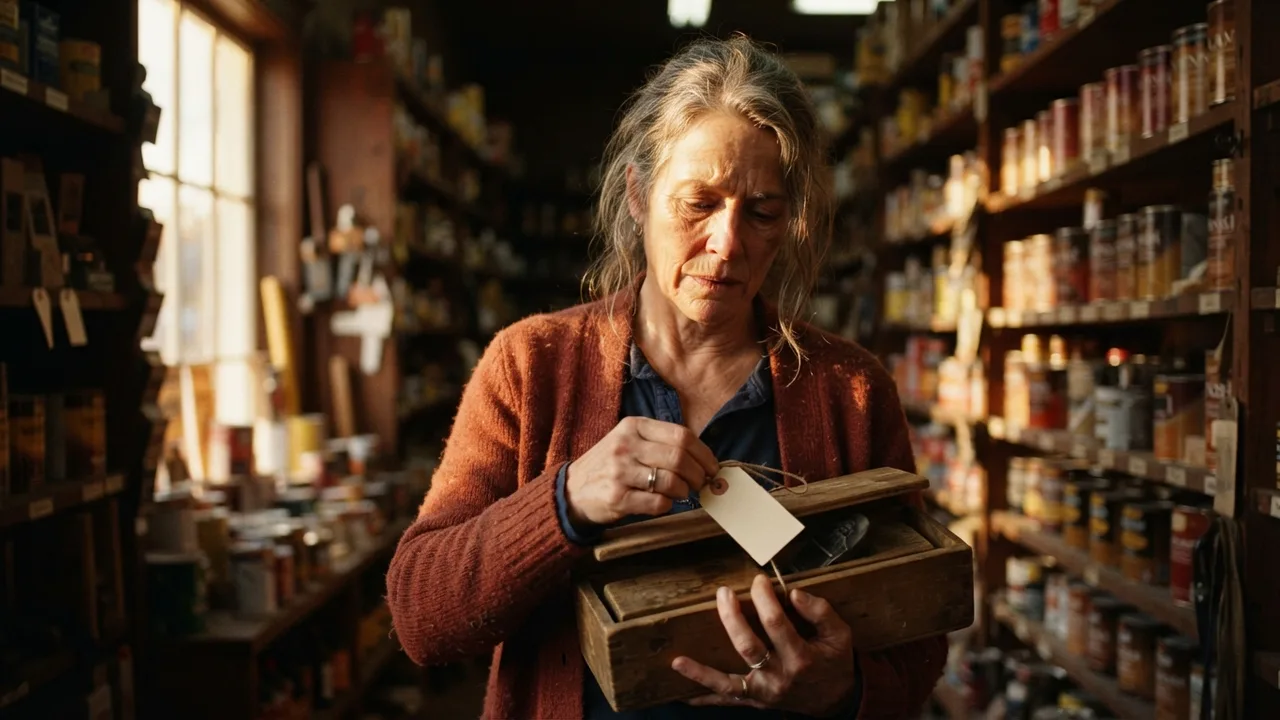
The first time Todd Roche told me I was bad for his father, he said it with a polite smile, right here in Aisle 3, between the wood stains and the varnish.
"Dad gets carried away," he said, tapping the lid of the box in my hands, a Japanese hand plane that cost $250. "You see a man with a debit card, Rhonda. I see my father's retirement."
Gilbert had gone out to the truck for his reading glasses. Todd had waited for exactly that.
"I'm sure you mean well," he went on. "But people in Atherton talk, and I'd hate to hear that the woman at the Grange was helping herself to a widower's savings."
I set the box on the shelf between the Minwax and the spar varnish. My hands had started to shake, and I didn't mean to let him watch.
Advertisements
"Gilbert is a grown man," I said.
"He's sixty and he can't tell you where he parked. I'd call that a man who needs looking after."
He kept the smile until his father came back through the door. Then he put it away.
I manage the Atherton Grange Supply. I've lived in this town thirty years, and for the last five, since Ray died, I've lived quietly: work, the woodstove, a Sunday call to my daughter in Oregon, a frozen lasagna from Hannaford on the nights I couldn't face cooking for one.
Three months ago Gilbert walked in for sandpaper and stayed until closing, talking about grain. He was tall, with a gentle stoop and white hair, and he smelled of sawdust and varnish. He was a widower too. Once he brought me a curl of shaved walnut, thin as ribbon, and I kept it in my desk drawer.
For the first time in years my life felt like it was starting up again. Todd, who drove down from Burlington most weekends, had been wary since the Saturday he caught us laughing by the register.
Gilbert bought the plane anyway. It was his money and his decision, and he carried the box out against his chest like a boy with a new sled.
The next morning Todd was at my counter with the receipt.
"Dad and I talked it over," he said. "He agrees it was an extravagance."
Advertisements
"He didn't mention that to me."
"He wouldn't. He's embarrassed." Todd tapped his phone against the counter. "Refund to the card, please."
I gave it to him. A few keystrokes, a slip of paper, a polite thank-you from a man who didn't look at my face.
On Thursday I asked Gilbert about the plane. He studied a rack of chisels as though they might answer for him.
"Todd handles that sort of thing," he said.
I'd run this store for years without once feeling like a clerk in it. I felt like one all weekend.
In late October Gilbert carried a board of curly maple to my register, the grain rippling under the lights like water. It was for a blanket chest, a commission from a couple in Stowe. His card came back declined.
He stood very still. Red climbed his neck.
"There's a mix-up," he said. "Todd moves money around for me. I'll come back tomorrow."
"A dealer from Middlebury was asking about this board this morning."
I rang it at my employee price, which brought it under the cash in his wallet. He counted out bills with a hand that wouldn't hold steady.
"Rhonda, I can't let you."
"It's a discount. Everyone on staff gets one."
"Nobody on staff gets it for a friend," he said quietly. "Please don't tell Todd. He worries."
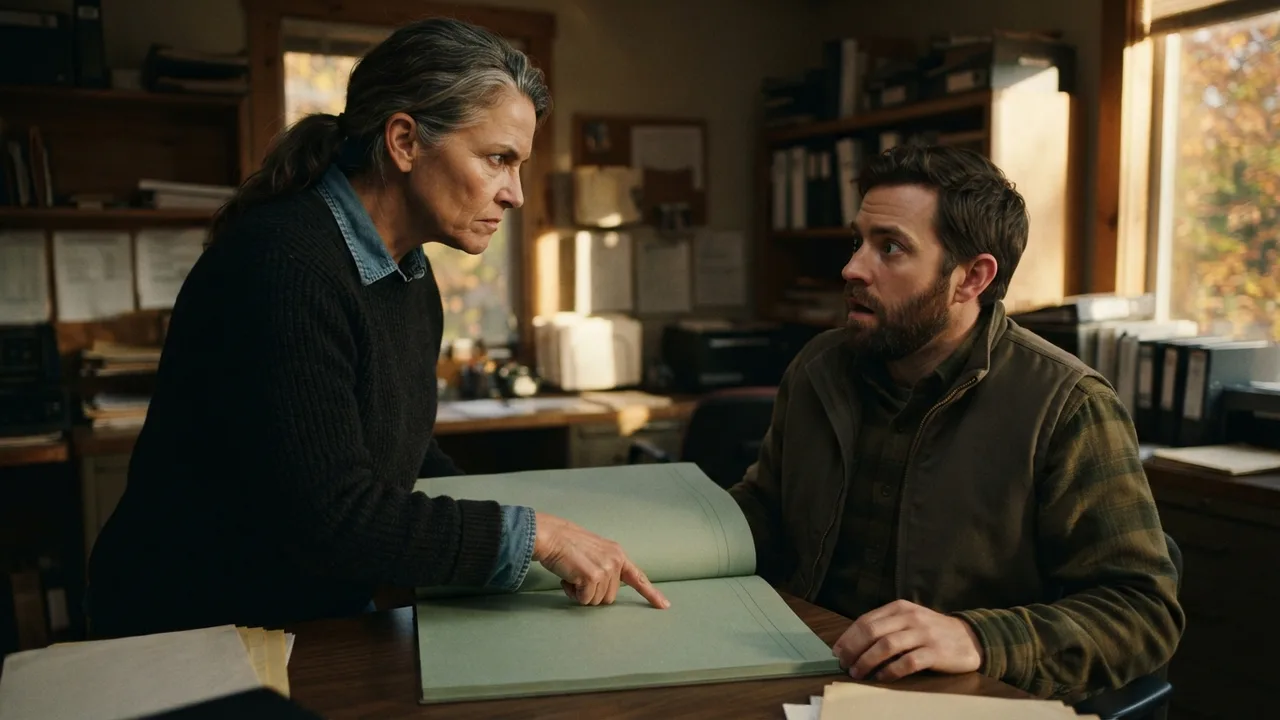
Todd knew by Monday. He found me in the stockroom, breaking down a pallet of birdseed, and he didn't bother with the smile.
"I saw the receipt on his workbench," he said. "Employee pricing. You're trying to make my father dependent on you."
"I was helping him finish a commission."
"He's a proud man. He doesn't need your charity."
"Todd, I—"
"Next time, you call me."
I had been called plenty of things in thirty years behind a counter. Nobody had ever made me feel small in my own stockroom. Now I had a secret with Gilbert, and Todd had a reason to dislike me out loud.
I count things for a living. That's the whole of my talent, and it's why I noticed the returns bin.
Brass cabinet pulls came back and became zinc ones. A stack of cherry came back and became pine. A can of oil-based finish came back for a quart of basic polyurethane. Every item had gone out on Gilbert's card on a Wednesday, and every item came back on a Thursday or Friday, in Todd's hands, usually when Dale was on the register and I was at the bank with the deposit.
Exchanges go back across the counter, and a difference comes back as store credit. Todd pushed for cash. Dale, a good kid, never pushed back on a man in a good jacket.
I stayed late on Tuesday and Wednesday with the register logs, a legal pad, and a thermos of Dunkin' coffee gone cold. Forty dollars on one line. Sixty on the next. By Wednesday night the column on my pad ran past $3,000, and that was only what had crossed my own counter.
I didn't sleep either night. It felt like reading a stranger's mail, and the stranger was the man I was falling for.
I tried once. Gilbert came in for wood glue on Friday, and I asked him, as lightly as I could manage, whether Todd ever talked about the store.
"He says you're good to me," Gilbert said, smiling. "He's all I have left of Marian, you know. I'd be lost without him."
I put the pad back in my drawer, under the walnut curl.
The Town Hall Supper is the Saturday that kicks off the fall festival, and Atherton does it the same way every year. Folding tables, crockpots of baked beans, chicken pie, Cabot cheddar mac and cheese, three kinds of apple crisp, and a microphone that squeals if you stand too near it.
Gilbert had made a rocking horse for the charity auction. It stood on a side table at the front of the hall, dappled gray and dark, with long cherry-red runners that caught the light.
He'd asked me to sit with him. By the time I came in from the parking lot, Todd had the chair beside him and the one next to that, and he'd draped his coat over mine. I sat with Walt Ames, who buys wood pellets from me every November, and I kept a manila folder on my lap.
After the pie, Marlene Tuttle, our town clerk, tapped the microphone.
"Thank you all for coming," she said. "And a special word for Gilbert Roche, who has given us that beautiful horse. Gilbert, stand up."
Gilbert stood halfway and sat again, pink to the ears. Todd rose and put an arm around his shoulders.
"I want to say how glad I am to be able to look out for my dad," Todd said. "To help him keep doing what he loves. We're making sure he's financially secure for the future." He squeezed his father's shoulder. "Somebody has to."
A few people clapped. Walt glanced at me.
I stood up. My knees were steady, which surprised me. I walked the length of the hall with the folder in front of me, past the crockpots, past the coffee urn, and stopped at their table.
"It's a beautiful horse, Gilbert," I said.
Then I looked at Todd.
"You do look out for him. I see it all the time at the store."
I opened the folder and laid one printout on the tablecloth, between the butter dish and Gilbert's plate. It was a summary of returns for the last six months, in columns, with the dates down the side.
"I only have a question about the materials. You returned the cherry runners for pine, and the brass hardware for zinc. You took the $185 difference in cash." I kept my voice low, so the people near the back had to lean in. "Was that for his financial security, too?"
Todd's face went red from the collar up.
"This is an outrageous violation of privacy," he said, loud enough that Marlene lowered the microphone. "She's obsessed with my father's money. Dad, can't you see what she's doing? She can't control you, so she's trying to drive a wedge between us."
He reached for the printout. I got my hand on it first and held it against the cloth.
"Let go of that."
"It's store property, Todd."
He turned to the room, palms out. "My father is a grieving man. He gets confused. I help him manage his affairs, and she's standing here with a folder, making me look like a thief."
Nobody answered. Someone's fork touched a plate and stopped.
Gilbert hadn't spoken. He was pale, and he wasn't looking at the paper or at me. He reached out to the rocking horse on the side table and ran his hand along the runner, slowly, the way he'd test a board in my store before he bought it.
His thumbnail pressed into the wood and left a small bright dent.
Cherry doesn't dent like that. Gilbert had picked every board of that cherry himself, standing in my lumber rack, turning each one to the light. Pine, stained dark to pass.
"Dad, don't," Todd said. His voice had dropped. "Not in front of everyone. Let's go home and sort it out like family."
"The tools from my workshop," Gilbert said. "Last spring. Was that for my security too, son?"
"You told me to sell them. You said they were collecting dust."
"I said I'd think about it. Then they were gone, and you told me I'd agreed." His hand stayed on the horse. "I believed you. I thought something was wrong with my head."
Todd looked at the room, at Walt, at Marlene, at the faces turned toward him over the pie plates. Nobody gave him anything. He picked his coat up off my chair, folded it over his arm, and walked out through the double doors. A minute later we heard his car start in the lot.
Marlene set the microphone down. "Why don't we get the coffee going again," she said, and a chair scraped, and people moved because they needed something to do.
Gilbert still hadn't looked at me. When the line formed at the urn he spoke to the tablecloth.
"Sunday afternoon. Will you come to the house?"
"If you want me there."
"I can't hear the numbers alone. Bring your pad."
Gilbert's kitchen has an oilcloth with yellow pears on it and a percolator older than Todd. Through the doorway I could see the pegboard over his workbench, with the outline of every tool still painted in white and nothing hanging inside the lines.
Todd came at two, in the good jacket, and he didn't take it off.
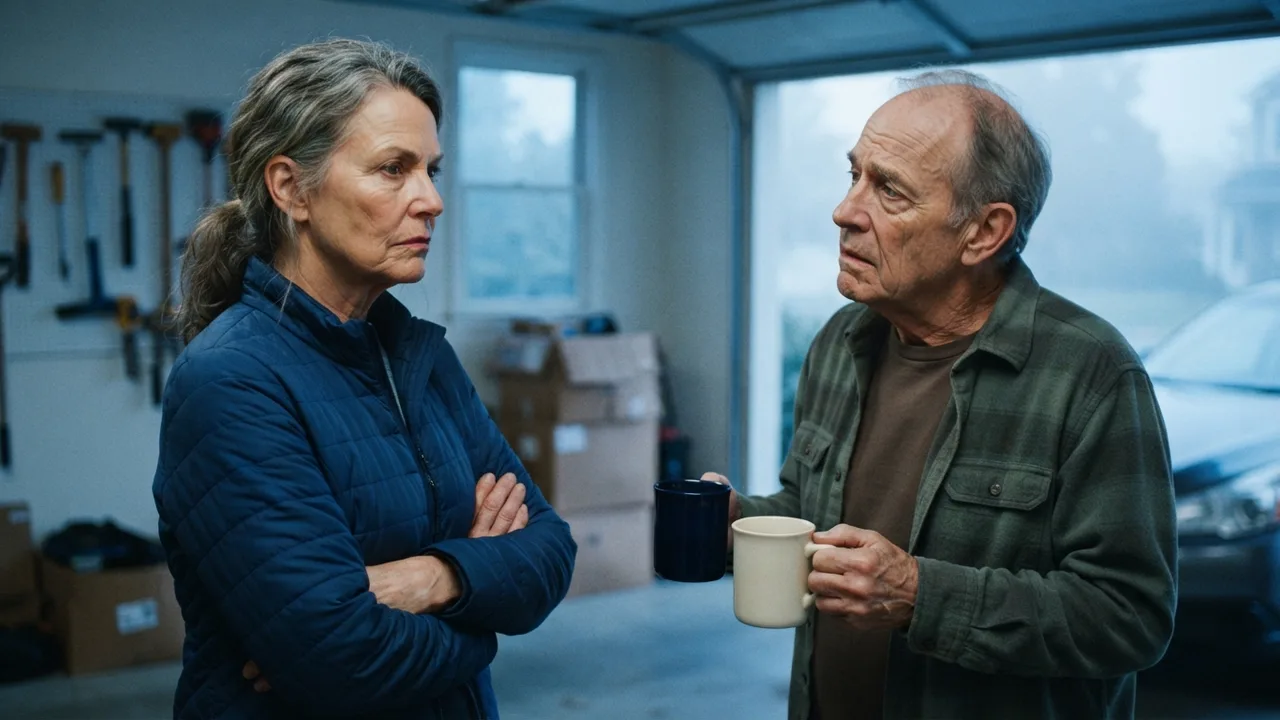
"Dad, she doesn't need to be here."
"She counts," Gilbert said. "I can't anymore. Sit down."
Todd sat. I put the legal pad on the pears and left it closed.
"Start with the tools," Gilbert said.
"A man in Barre bought them. Four thousand, for all of it." Todd rubbed his jaw. "The deck business folded in the spring. I owed the lumberyard, and I owed a man who'd lent me money. I figured I'd put it back before anybody noticed."
"And my card?"
"I had the number. I'd buy materials on it, take them back for cash, and move the money where it had to go. Small amounts. Nobody looks at forty dollars."
"I look at forty dollars," I said.
"I know you do." He glanced at me for the first time. "That's why I wanted you away from him."
Gilbert's hands lay on the table, very still. "How much, Todd?"
"I don't have a number."
I opened the pad and turned it around. He ran his finger down the dates, and I watched him do it.
"You missed some," he said. "Rutland. The hardware place there, twice, and the stove shop in Barre."
That landed on me harder than the whole supper had. I'd found a column, and he was telling me it was a smaller part of the story than I'd thought.
"Write them in," Gilbert said.
Todd took my pen and did, line by line, and nobody spoke while he wrote. When he finished he pushed the pad back and sat up straighter, and I knew the next part before he opened his mouth.
"Dad, you'd have done the same for me. It all comes to me anyway. I only borrowed ahead."
"Did you ask?"
"You'd have said no."
"That's what asking is for," Gilbert said.
"If this goes around Atherton, I'm finished in Vermont. I can't get work. Is that what you want for your son?"
"You should have thought of Atherton when you stained pine."
Todd's jaw worked. He looked at the pegboard, then at the floor, and said, very low, "I'm sorry, Dad."
Gilbert didn't answer that. He stood and went to a drawer and came back with a pen and a fresh sheet from my pad.
"I'm selling the back parcel by the brook. That clears the lumberyard and the man. You'll write down what you owe me beyond that and sign it. Your card on my account, the password, all of it, comes to me today. And you don't go into Rhonda's store for anything."
"Dad—"
"I won't take it past this table. Your mother wouldn't forgive me. I'm not sure I'd forgive me." He set the pen in front of his son. "Sign."
Todd signed. He laid his phone beside the paper and unlocked it with his thumb, and Gilbert slid it across to me, and I read off the account names one at a time while Gilbert wrote them down in a hand that shook. Then Todd stood, and his chair scraped on the linoleum, and the door closed behind him with no sound at all. Out in the drive his engine turned over twice before it caught.
Gilbert sat down heavily. I stayed where I was.
After a while he took my hand. His grip, once so sure, had no strength in it.
"I'm grateful, Rhonda. And ashamed. You saw it and I didn't, and I had to hear it from a folder in front of everybody I know."
"I didn't want to do it like that."
"I know you didn't." He looked at our hands. "I need time. I don't know who I am right now."
"Then take it."
"I'd like to come back to the store. When I can."
"The store will be here."
He walked me to my car in his shirtsleeves and stood in the cold until I'd backed out of the drive.
Monday morning I came in before Dale and wrote a check from my own account for the cash that had gone out of my till on returns I'd let pass. It was my counter, and the owner wasn't going to hear it from anyone but me. The check went into the deposit bag with the weekend receipts.
Then I walked to Aisle 3. The Japanese hand plane was still on its shelf between the Minwax and the spar varnish, a skin of dust across the lid, because nobody in Atherton had wanted to spend $250. I wiped the box with my sleeve, wrote HOLD, G. ROCHE on a tag, and tied it to the lid with a bit of twine.

Comments