"My husband sold his 1968 Mustang for fifteen thousand dollars," he'd said, and I'd mourned the loss right alongside him.
Now I sat on the den floor with a banker's box and a retirement statement, and the balance did not match what forty-five years of saving said it should be. The lender for the condo wanted proof of our funds by the end of the month. The proof I had would barely cover a down payment.
"Phil," I called. "Come look at this."
He came in from the garage, wiping his hands on a dish towel. His reading glasses were pushed up into his hair, where he would look for them later.
"What's the matter, Mo?"
"The account. This is supposed to be our whole cushion. It's nearly empty."
Advertisements
"Bad investments," he said. "The market's been all over the place. Don't you worry about it."
He tugged the dish towel through his fingers and did not look at the statement.
"Which investments?"
"Funds, mostly. A fella at the bank put me into a few things."
"What fella? What things?"
"Mo." He kissed the top of my head. "We'll have enough for the condo. Don't you worry about it."
He went back to the garage. I noticed that he had not named the man at the bank, and that in thirty-five years of typing other people's depositions I had never once let a witness leave the room without a name.
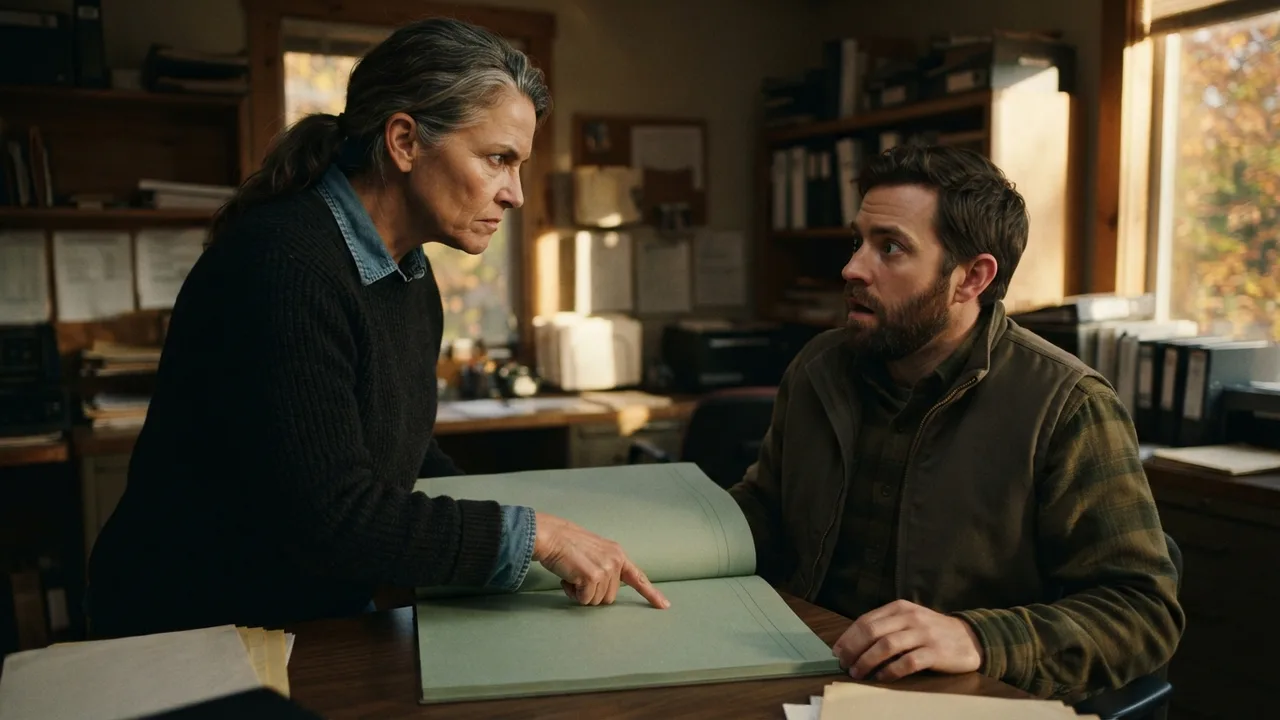
I pulled the green hanging folders out of the file cabinet that night. I had labeled them myself, in block capitals, back when Liam still had a lunch box.
The statements went back further than I needed. Every few months there was a cash withdrawal, always a round number, always from the branch on Main Street, always on a Thursday. Phil had told me those were "moves in the portfolio."
I took a legal pad and wrote the dates down the left margin. Then I looked up the market for each of those weeks, on the library's computer first and my own after midnight.
The market had been climbing in most of them. In the months it fell, Phil had withdrawn nothing at all.
I did not sleep that weekend. I lay listening to the dehumidifier in the hall and to Phil's breathing, which was easy, and on Sunday at three in the morning I got up and alphabetized the spice rack. Cardamom, cayenne, cinnamon. It did not help.
Advertisements
By Monday I had the legal pad added up twice, and both times it came to $120,000, counting the one line I kept circling. The Mustang.
Phil had loved that car since before he loved a mortgage. He'd sat in the driveway on the day it left, one hand on the hood, and I had brought him a cup of Folgers and stood beside him in the drizzle. He'd said fifteen thousand was a shame but we needed it. I had believed every word.
I found the plate number on an old insurance card in the folder marked AUTO. A classic-car registry listed the fastback, dark green, with a restoration thread posted by a user called MitchC. For fifty dollars a month I could see the title history, and I paid it without letting myself think.
The title had changed hands in Cascade Springs and gone to a Mitch Callahan on a quiet street in Eugene.
I printed the page and sat with it in the kitchen while the coffee in my cup went cold. It felt like going through the pockets of a coat I had pressed myself, and I did it anyway.
On Wednesday I told Phil I was driving to Eugene to see Joan Hadley from the old law office.
"Take the Buick," he said, not looking up from the box of cords he was coiling. "Fill it up at the Fred Meyer, they've got the better price."
"I will."
"Tell Joan hello. Don't wear yourself out."
He said it kindly, and that was the part I carried down the interstate for two hours with the wipers going.
Mitch Callahan's house had a detached garage with the door rolled halfway up. A man in a worn denim jacket stood inside under a work light, wiping a wrench with a rag that was darker than the wrench.
"Mr. Callahan? I saw your thread online. I'm told you've got a '68 Mustang."
He studied me for a moment, then lifted the door the rest of the way.
She sat in the middle of the floor, dark green, polished until the light slid off the roof in one long piece. I knew the dent Phil had put in the glove box door in 1989. It was still there, and Mitch had left it.
"My husband owned one like this," I said. My mouth had gone dry.
"Did he." Mitch ran a thumb along the fender. "Everybody's husband did. Mine's the best one I ever had my hands on."
"He sold his for fifteen thousand. I've wondered since whether that was fair."
Mitch's hand stopped moving.
"Fifteen," he said. "I paid fifty-five."
I held onto the edge of the workbench. It was gritty with metal filings, and I kept my grip anyway.
"Ma'am, who's your husband?"
"Philip Phelan. I'm his wife. I told you I was a fan of the car, and I'm sorry. That wasn't honest."
"No," Mitch said. "People who love a car don't ask about the price first." He wiped his hands on the rag, went to a metal cabinet and came back with a folder. "I deal straight. I'd want to know."
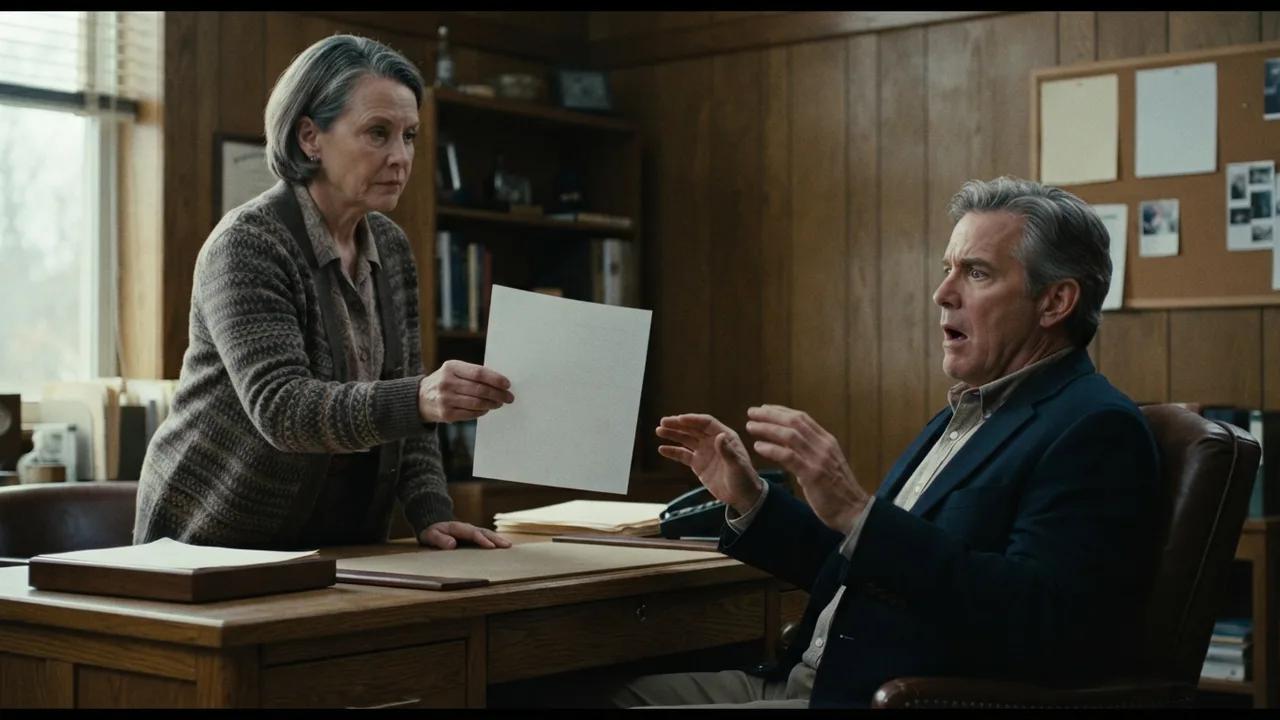
The bill of sale had Phil's signature on the seller line and $55,000 in the box beside it. Clipped behind it was the bank's carbon copy of the cashier's check request, and the payee line read Russell Phelan.
"Man came with your husband," Mitch said. "Younger, nice coat. Said he handled Phil's affairs and the check should go to him. I didn't think twice."
"May I photograph these?"
"Take whatever you need." He looked at the Mustang and then at me. "I'm sorry. She's a good car. I didn't know she came with that."
I photographed both pages twice, at the workbench, with a hand that shook until the second try. At the Chevron on the way out of Eugene the pump read five-twelve a gallon, and I paid it without a word.
Phil's retirement party was that Saturday.
Chloe had been planning it for weeks. The Cascade Springs Volunteer Fire Hall smelled of floor wax and coffee, and a banner across the apparatus bay read THIRTY YEARS, THANK YOU PHIL. There were folding tables, a Safeway sheet cake, marionberry pies from the Grange ladies, and about fifty people in good jackets, many of them in station uniforms.
I stood by the coffee urn in my navy dress with my phone in my pocket. Liam kept looking at me with a worried crease between his eyebrows, and I kept telling him I was fine.
The fire chief spoke first. Then Dale Whitmer, who had ridden the engine beside Phil, told the one about the chimney fire and the cat, and the room laughed in the right places.
"One more surprise," Chloe said into the microphone, grinning. "Somebody came a long way."
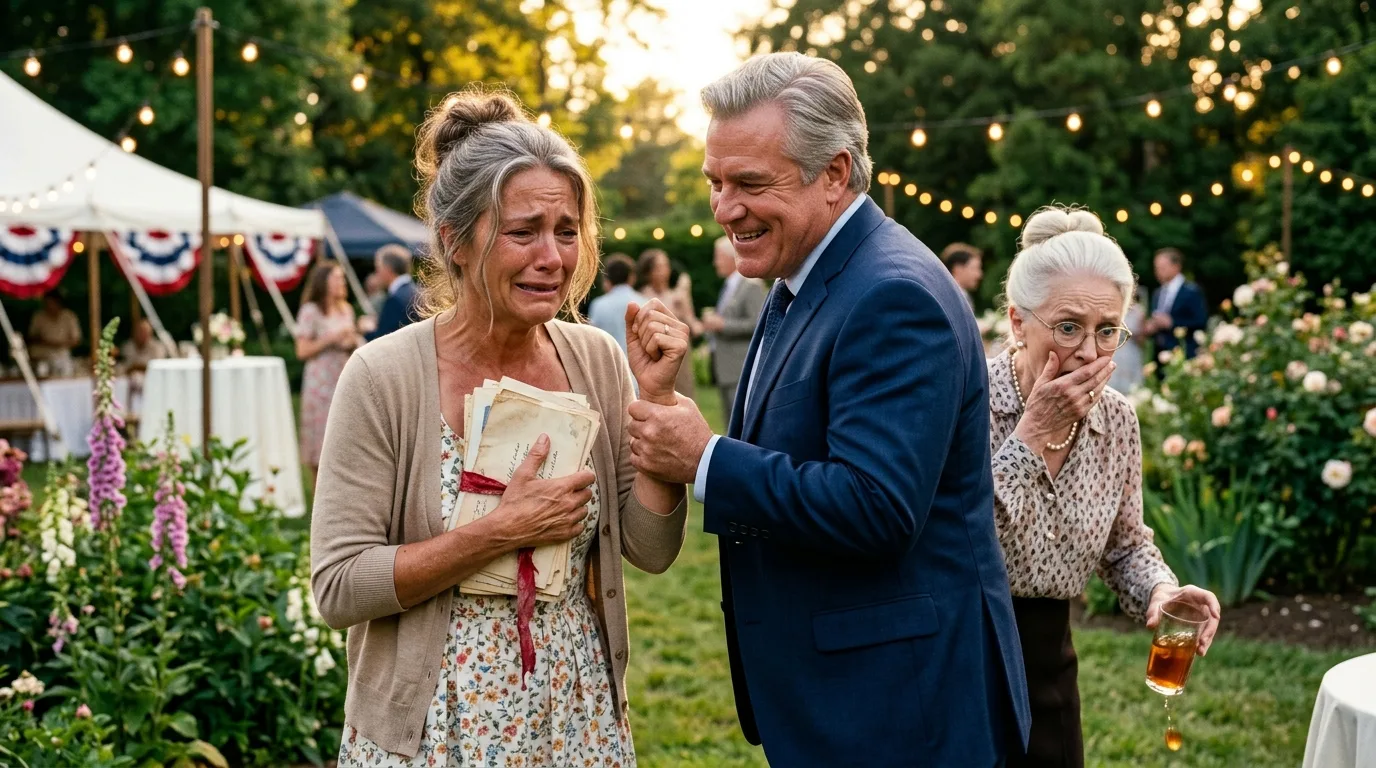
Russell walked in from the side door in a blazer that looked expensive from across the room. Up close the cuffs were frayed. He spread his arms, and Phil, who had not been told, went white and then pink and then reached out and hugged him.
"My big brother," Russell said, taking the microphone. "The most loyal man I've ever known. Phil gave me a place to stand when I had nowhere to stand. He never once counted what he gave. That's what family is, folks. That's generosity."
People nodded. Somebody dabbed at her eyes with a paper napkin. Russell kept talking for a good while, and when he finished, the applause went around the bay and thinned out.
I walked to the front before it quite died.
Russell held out the microphone to me with a smile, because he took me for a woman who would say something about casseroles. I thanked him and turned to the room.
"Thank you all for coming," I said. "Phil has given this town thirty years, and I'm proud of every one."
Phil beamed at me from his folding chair, relieved.
"It's wonderful to celebrate family loyalty," I said. "So wonderful, it seems to be worth fifty-five thousand dollars. That was the real price for the Mustang, wasn't it, Phil?"
I held up my phone, and the bill of sale was clear enough for the back row to read the number.
The hall made no sound except the urn ticking.
Russell was across the floor before anyone else moved. He put his arm around Phil's shoulders as if Phil needed protecting from me.
"What are you talking about, Maura?" he said. "Phil was helping his brother. It was a loan! You never did understand family. You've always been too busy counting pennies."
"Mo." Phil's voice had thinned out. "It's a private matter. We can talk at home."
"We could have talked at home any day for ten years," I said.
I kept my eyes on him, not on Russell.
"'Counting pennies' that add up to one hundred and twenty thousand dollars of our retirement, Phil. That's not a loan, Russell. That's a theft. And you are not part of our future."
Chloe had one hand over her mouth. Liam had gone still beside the pie table. Dale Whitmer looked at his shoes.
"Phil," I said. "Whose side of the room are you standing on?"
He looked at his children. He looked at the banner. Then he stepped sideways, out from under his brother's arm, and the arm hung in the air for a second before Russell took it back.
"Russ," Phil said, barely above the hum of the urn. "Sit down."
I set the microphone in its stand and told the room there was cake. No one touched it. The chief began folding the banner himself, and one by one the good jackets went out the door into the rain.
The house had boxes in every room, and the kitchen table was the last piece of furniture left in the kitchen. Russell sat at it with his blazer over the chair, saying we were being dramatic and that Phil would regret this.
I stood by the sink with my hands wrapped in a dish towel.
"Your bag is by the door, Russell. Phil is going to drive you to the Rodeway on Highway 99."
"Phil." Russell turned in his chair. "After everything. You're going to let her do this?"
"I'm not letting her do anything," Phil said. "I'm doing it."
He took an envelope from the drawer under the phone and counted bills onto the table, slowly, with his thumb. "That's the motel and a ticket back to Boise on the morning bus. It's the last of it, Russ. The money has stopped."
"You owe me," Russell said. "You know what you owe me."
"I know what I paid." Phil's hands were not steady. "It's done."
Russell looked at the cash and at his brother, then at me. For the first time he seemed to see someone who was not a wife. He picked up the envelope, shrugged into the blazer and left without another word. Phil's keys scraped off the hook, and a minute later the truck pulled out of the drive.
He came back alone. I had not moved from the sink.
He sat down at the table where the cash had been and put his hands on it. They looked older than they had that morning.
"It started a decade ago," he said. "Russ called from Boise, said he'd lost a job, needed rent. I sent it. Then there was always something. A truck, a lawyer, a woman who left him."
"And the Mustang?"
"He asked for the car. He said I owed him." Phil rubbed his thumb across the grain of the table. "Dad favored me. Russ never let me forget it. I got out of that house and he didn't, and he made that cost me every year."
"You could have told me."
"I know. The business had slowed, Mo, and I'd lost the Kessler bid, and I felt like half a man. Every time I wired him money I felt like the big brother again. Then I had to lie to keep it going." He raised his eyes. "I'm not asking you to forgive me. I'm telling you what happened."
"I know what it was," I said. "I counted it."
He nodded. He did not say don't worry, and I noticed that.
"The money's gone," I said. "All of it. We'll get a smaller condo, if they'll still have us, and you'll take the part-time work at the lumber yard."
"Yes."
"Go to bed, Phil."
He went. I sat on at the table with the legal pad and wrote the figure again at the bottom of the page, though I did not need to.
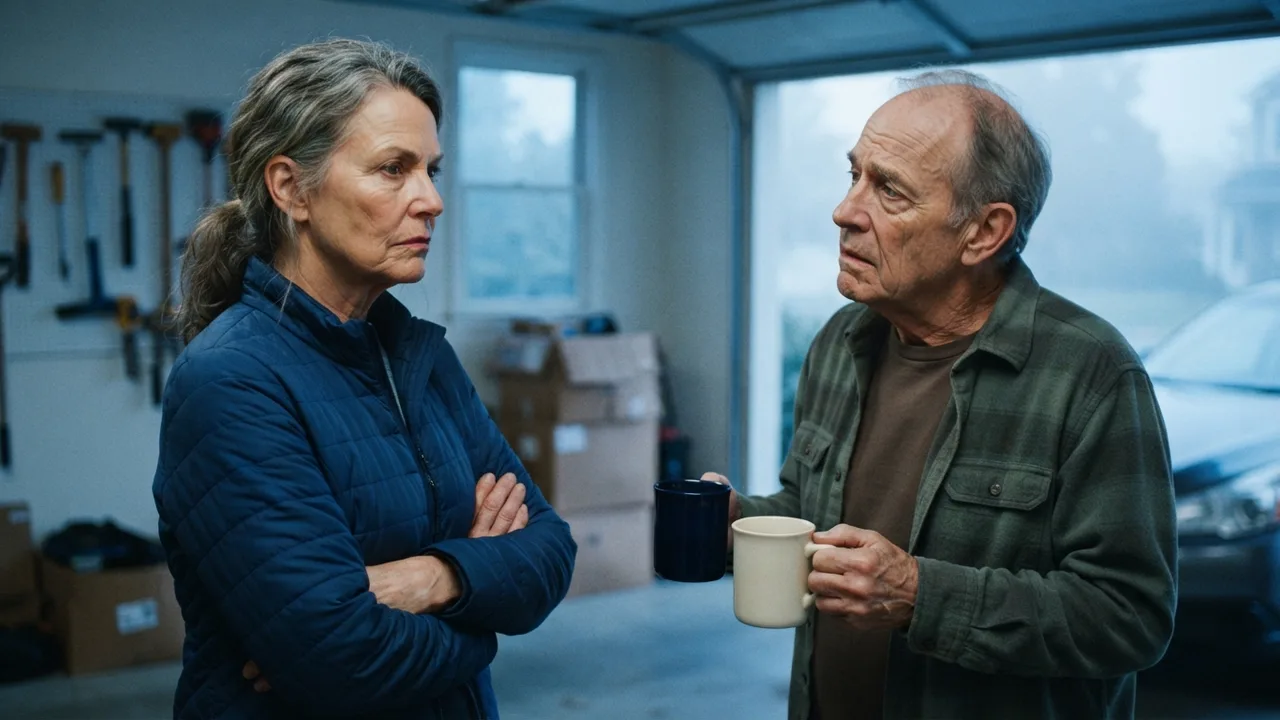
In the morning the rain had stopped. I went out through the kitchen door into the garage, the two-car one he had built with his own hands.
Half the shelves were emptied into boxes. The roll-up door was down and the light came in thin around its edges. Where the Mustang had stood for all those years there was a stain in the concrete, dark and wide, deepest at the center where the engine had sat.
I had mopped it, scrubbed it with a brush and bleach, and once used a pad of cat litter that Liam swore would work. Nothing took it out. I stood at the edge of it with my arms crossed and looked.
A board creaked in the doorway behind me.
Phil stood on the threshold in his old cardigan with a mug in each hand. Steam came off both of them. He did not say my name or offer an apology or ask for one. He waited.
The stain had soaked in too deep for any cleaner Fred Meyer sold, and it went on holding the shape of the car.
Comments