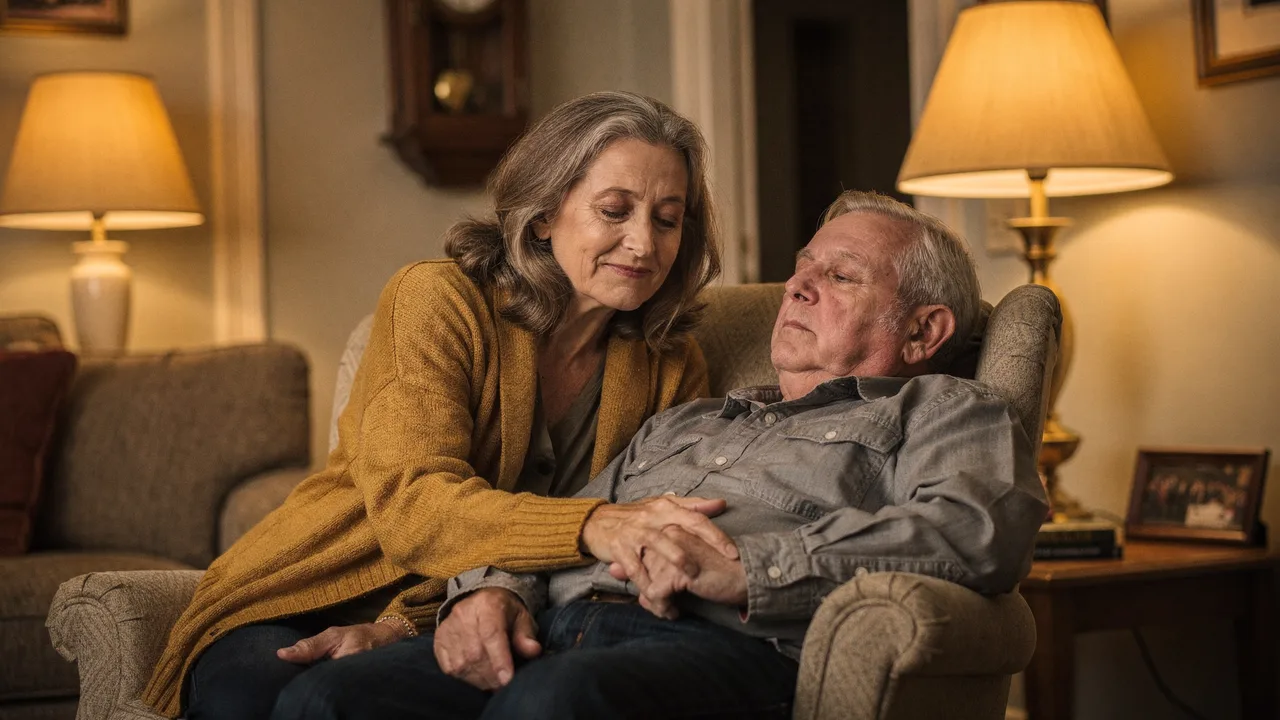
The day my stepson tried to erase me from my own home, he started with the wifi password. By supper he had changed every login to my husband's bank accounts too, and Vince's savings, along with a collection of antique clocks worth over $60,000, sat behind a screen I could no longer open.
He did it at my kitchen table on a Tuesday in late September, with his leather tablet propped against the sugar bowl. He had driven over from his newer suburb in a pressed shirt that had never met a dish towel.
"I've streamlined things, Cece," Tony said. "Everything's consolidated into one account now. With Dad's confusion, we can't risk a bill slipping through."
"Your father pays the bills at this table on the first of every month. He likes to."
Advertisements
"Liked to." He smiled, the polished smile from his business cards. "Now he signs where I tell him."
He turned the tablet toward me. One page, gray cells, my household reduced to a few rows of numbers with my own paycheck from the agency folded in like a rounding error.
"How do I see the electric bill?" I asked.
"You don't need to. I'll pay it. I'll leave cash for groceries every Friday, eighty dollars, and you keep the receipts." He tapped the screen closed. "It's just easier this way."
That morning my own tablet had stopped finding the internet. The label on the router had been scratched out, and a new network name sat in its place, with a password that arrived on a sticky note in Tony's neat architect's print.
I put the note in my cardigan pocket. Then I washed two coffee cups that were already clean, because my hands needed something to do besides shake.
Fifteen years I had been this man's wife. I had washed his father's back, counted out his pills, and kept the checkbook in the drawer with the rubber bands. Now I was being handed an allowance like a girl.
"I'll walk Dad through it when he's having a good day," Tony said at the door. "You focus on him, Cece. That's what you're best at."
---
The cuckoo clock began to bother me that same week.
It was the Black Forest clock that hung beside the front window, the one Vince bought at an estate sale outside Latrobe when he still had all his words. He used to stand under it on the hour with his coffee, watching the little door open as if the bird might say something new.
Advertisements
On Thursday the little door opened, and the call came a half-second late. It was thin, with a tin edge to it, like a spoon struck on a pot lid.
I stood at the hall archway with a dish towel in my hands. Vince was in his recliner, and his head was tilted toward the sound, his mouth working at something he could not name.
I wrote it in my care notebook, the one where I log his sleep and appetite. Beside the date I put: *Cuckoo, late by a half-second. Tone changed.* Then I listened to the grandfather's strike, the hall regulator, and the mantel clock, and wrote those down too.
On Friday Tony brought the eighty dollars in an envelope. I waited until he had set down his keys.
"The cuckoo sounds different," I said. "The chime is a half-second behind, and the tone is tinny. Something has been done to it."
He laughed, kindly, the way you laugh at a child who has found a monster in the closet.
"Dad's hearing isn't what it used to be, Cece." He tucked the envelope into my hand and closed my fingers around it. "Maybe yours isn't either."
I said nothing. I put the envelope in the bread drawer and went to check on Vince, and I stood outside the bedroom door until my face was my own again.
I had never once doubted my ears. Now, alone in a house full of clocks, I did.
---
So I stopped using my ears and started using a camera.
On a Thursday, while the senior center van carried Vince to his lunch, I photographed the French mantel clock on the sideboard in the morning light. I took the dial, the back plate, the maker's name, and the little crack that Vince's clock should have had at the numeral six.
It did not have it.
Marco Rossi's shop sat on Main Street, five minutes from my driveway, between the vacuum repair and the pizza place. He wore his loupe on a cord around his neck like a pendant, and his fingers were stained black to the second knuckle.
He took my phone and spread the picture wider with his thumb. I watched him frown for the first time since I had known him.
"Cece. Where is this?"
"On Vince's sideboard. Where it always is."
"The dial on the clock I sold him was enamel, and it had a hairline at the six. I mended that hairline myself with a brush the size of an eyelash." He handed the phone back. "This dial is printed. Bring me the clock itself."
"If Tony finds it gone—"
"Then bring it when he isn't there."
I carried it out the next morning in a Giant Eagle bag, wrapped in a bath towel, with Tony at a job site in a development across the county. Marco carried it to his bench like something sleeping.
He opened the back. He wound it and let it strike, and the sound that came out was a chirp, a recorded sound with no brass in it.
"Well made," Marco said quietly. "Somebody took pains. It's a modern replica, built to fool a person across a room." He set down his loupe. "The one I sold Vince was eight thousand dollars. This is worth about three hundred."
"I need it in writing."
"For you, I'd do it for nothing."
"A paper that costs nothing is worth nothing, Marco. Charge me."
He charged me two hundred dollars. I paid it from the envelope in my dresser, the little savings I had kept at the Conroy credit union under my own name, and Tony did not know it existed.
That night I lay awake listening to the house. Every settling board was Tony's key in the door, and every tick from the living room was a lie I had not learned to hear.
I was back at the sideboard before noon Saturday, setting the replica on its exact spot and turning it until the shadow lined up with the old ring in the dust.
Then Marco and I went through my photographs of the rest of the house and Vince's old purchase ledger, written in a machinist's square hand. Six clocks had been sold or swapped, and I wrote each one on a legal pad.
"His birthday is coming," I told him. "Tony has invited everyone."
"I've been invited."
"Come," I said. "And bring your loupe."
---
Vince turned eighty on a Saturday, and our small living room held more people than it had since the funeral of his first wife.
Walt and Gene, his old friends from the machine shop, sat on the sofa with paper plates of pierogies and kielbasa on their knees. Tony's wife, Dana, stood by the window in a good wool coat. Marco stood near the door with a cup of coffee and said nothing to anyone.
Vince wore the blue cardigan I had pressed. He kept looking at the cuckoo clock and then at his hands.
Tony clinked a fork against a glass.
"Everybody, if I could have a minute." He put one hand on his father's shoulder. "My dad built things his whole life. Engines, gears, a family. Now it's my turn to take care of him, to preserve his legacy, so every piece of what he built is protected for the next generation."
Walt murmured "Hear, hear." Dana's smile did not quite reach her eyes.
"I got him something special."
Tony pulled a sheet off a large box by the wall and lifted out a modern wall clock, black rim and white face, wide as a dinner plate. He hung it on a nail he had already driven above the sofa, and it hung there silent and exact.
The room applauded, and Vince looked at it as if it were a window onto somebody else's house.
I stepped into the middle of the carpet.
"Thank you, Tony. That was kind."
He nodded, gracious, already turning back to the room.
"It's wonderful to have new things," I said, and I let my gaze travel to the sideboard. "But Vince always loved his old collection best. Marco, you sold him this piece years ago. What do you think of it?"
Every face turned. Marco set down his coffee.
He crossed the carpet and lifted the French clock in both hands, and he turned it over and studied the back. The room was so quiet that I heard the hall regulator's pendulum.
"This isn't the clock I sold Vince," he said gently. "This is a reproduction."
"Marco, come on," Tony said, with a laugh that cracked in the middle. "You haven't seen this thing in years. Memory plays tricks at our age."
"I mended a hairline at the six with my own brush," Marco said. "There's no hairline."
Tony spread his hands to the sofa. "Walt, Gene, you know how much there was to look after. I had the originals moved to a storage unit, climate controlled, for safekeeping. These are stand-ins."
It was a good answer. It was the one I would have given.
"Which unit?" I asked. "Marco can drive over this afternoon and look."
"It's under the firm's name. I'd have to dig out the paperwork."
"Then we'll wait while you dig."
I took Vince's ledger out of the sideboard drawer and opened it to the page with the French clock, his square hand pressing hard into the paper. I held up my phone beside it, Marco's letterhead on the screen.
"Eight thousand dollars, in Vince's writing. Three hundred, in Marco's. The cuckoo is a copy and so is the regulator by the door, and you told me on a Friday that I was the one who couldn't hear."
His face went red from the collar up.
"This is an ambush!" He swung toward the room. "She's been poisoning his mind, trying to get her hands on his money. She's got him confused. Dad." He dropped to a crouch in front of the recliner. "Dad, tell them she doesn't know what she's talking about."
Dana had taken a step back. Gene's plate tilted on his knee and nobody caught it.
Vince looked from the clock in Marco's hands to the face of his son. His eyes cleared like a windshield when the wipers finally catch, and I saw the machinist behind them.
"Dad doesn't even know what day it is," Tony said, quickly now, to the room.
"Saturday," Vince said. "My birthday." He lifted one hand toward the sideboard. "The chime, Anthony. You got the chime wrong."
Nobody moved.
When Tony was a boy, Vince had held the child's finger against the brass rod of that mantel clock so he could feel it hum. Tony knew that sound as well as his own name, and he had paid a man to make a cheap copy of it anyway.
He stayed on his knees in front of the recliner with his mouth open and no sentence in it.
"Tony," Dana said. "What did you do?"
Walt set down his plate, stood, and put on his hat. One at a time the guests found their coats. Gene took the paper plate off his knee and carried it to the kitchen trash himself, so I would not have to.
When the room had emptied I stood in front of my stepson.
"Next Saturday," I said. "Ten o'clock, my kitchen table. Bring the tablet."
---
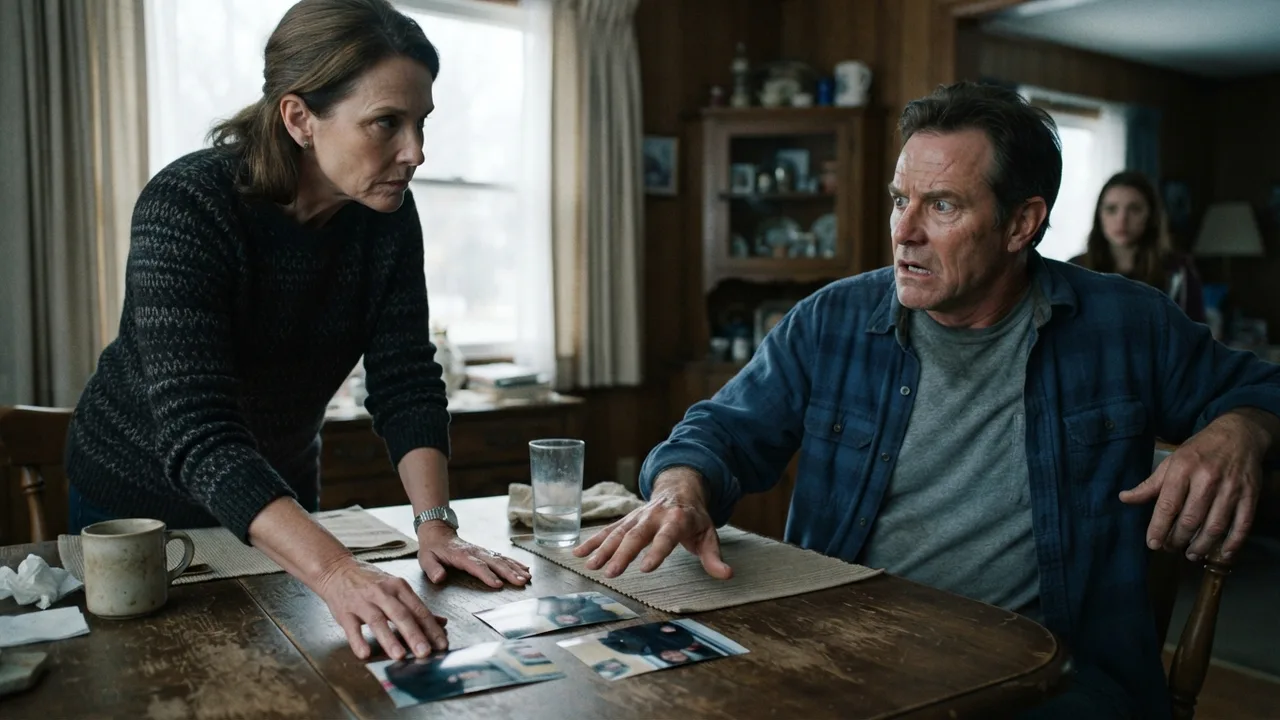
He came at ten with Dana, who sat at the end of the table with her coat still buttoned and her purse in her lap. Tony set the leather tablet against the sugar bowl, in the same spot as before.
In the next room the radio carried a Penn State game, low. Vince had not asked who was at the table.
"Open it," I said.
"Cece, can we start with the clocks? I can explain the clocks."
"We'll get to the clocks. Open the accounts."
He typed. I made him turn the screen so that I faced it, and for the first time in weeks I saw the rows of gray cells that held my life. I read them aloud, slowly, the way I read Vince's chart to the visiting nurse.
"A transfer from the savings to your firm's operating account. Another one, the week after. Another." I looked at Dana. "Do you want me to go on?"
"Go on," she said.
"It's a bridge loan," Tony said. "Payroll was tight. Dad would have wanted the firm kept afloat."
"Your father put his name on every check for thirty years and knew what each one was for. He did not know about these."
"If I put that money back this month, I can't make payroll."
"Then you have a hard month." I turned the legal pad around. "What came out of the savings goes back today, from your firm to his, and I will sit here while you press the button. The clocks are another matter. You sold them, and I'm not asking for them back. You will sign a note for their value and pay five hundred dollars a month until it's paid."
"And if I don't?"
"The Hendersons on Laurel Ridge. The builder in Ligonier. Every client on your website gets a copy of Marco's appraisal and this list." I kept my hands folded. "I have the addresses."
Dana did not look at him. She looked at the sugar bowl.
"Do it, Tony," she said. "I'll find the rest from somewhere."
He did it. His thumb hovered over the screen, and then it came down, and the confirmation came up in a little green box. I spoke the amount aloud for Dana's sake, since Tony would not.
"Now the logins," I said.
"Cece." He rubbed his forehead. "Let me keep view access. For Dad's sake, so I can help. You're going to be alone with all of it."
"I have been alone with all of it since you stopped coming on Sundays."
He had no answer for that. He opened the settings and turned his shoulder, and I typed a new password myself, long and strange, with symbols I had to hunt for on the keyboard. When he handed over the tablet, the cursor was blinking in a field with my name above it.
I put the note in front of him.
He signed in that neat architect's print. Dana signed under him as a witness, without being told to, and I understood she had decided something about her marriage that I would not be told.
Tony stood and fumbled for his keys. At the living room doorway he stopped, where his father sat with his back to him.
"Dad," he said.
Vince reached over and turned the radio up. The announcer said something about third and long.
Tony stood there a moment longer. Then he went out through the kitchen, and Dana followed with her purse held in front of her in both hands, and I listened to the car back out of the driveway.
When it was gone I sat down at the table and my hands began to shake, so I held them under the edge of it until they stopped.
---
I won, and I knew exactly what it cost.
Vince has not been the same since the birthday. He eats when I set the plate in front of him and takes his walk to the mailbox without looking at the maples. He asks no questions about his son. I think he understands everything now, and I think that is worse.
Some afternoons I find him standing on the faded rug, looking at the walls. Where the cuckoo clock hung, the wallpaper is a pale rectangle. He lays his palm against the boards where the grandfather clock's footprint is, and I do not know what he is hearing.
The large black clock from Tony's party went back in its box. Neither of us could bear the silence of it.
On Thursday I changed the wifi again, though no one had asked me to. I wrote the new password on the inside cover of my care notebook where no one else would look.
Now I sit by the lamp in the evening with my tablet open on my lap to the account with my name on it. The numbers are small, and every one of them is where it belongs.
The house is so quiet I can hear the refrigerator in the kitchen. Vince is asleep in his chair, his mouth a little open, his hands loose on the armrests.
Then I hear the one clock Tony never noticed, the plain schoolhouse regulator over the kitchen doorway that Vince repaired himself and never bothered to insure. It goes on ticking, quiet and steady and true.


Comments