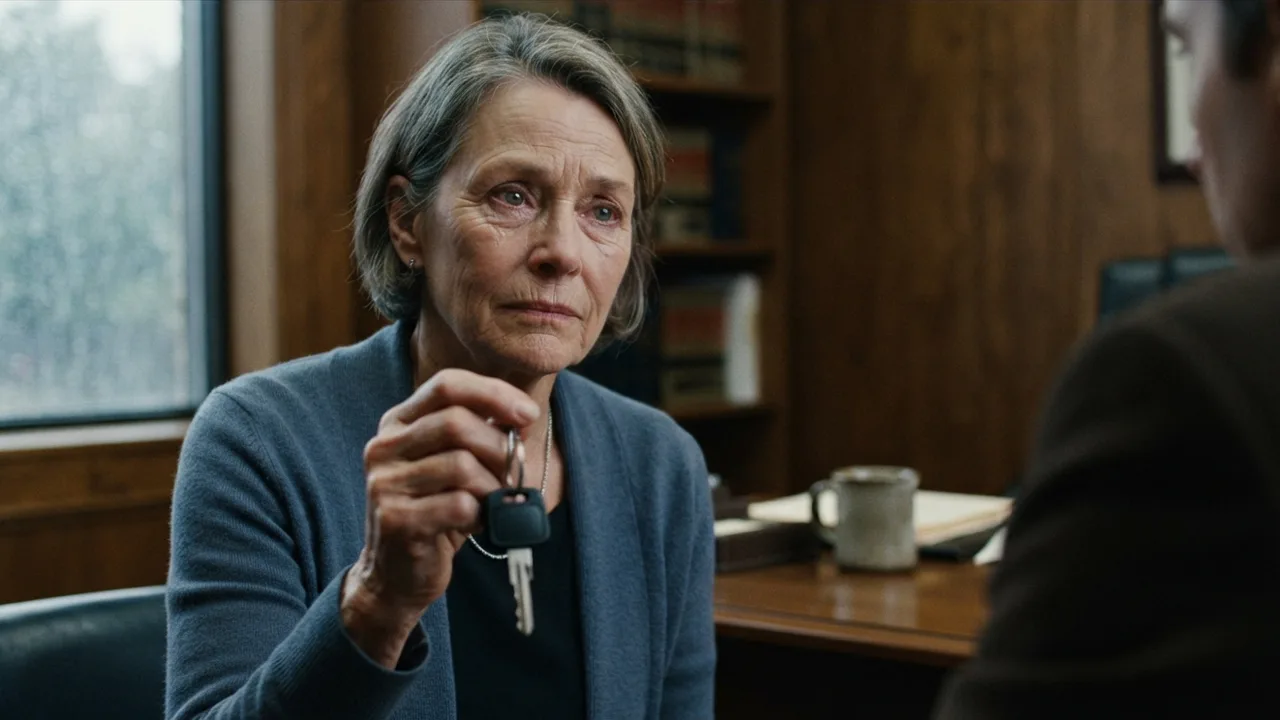
"We're signing the papers with Sylvie on Friday to sell the south pasture to Luke," my husband said, not looking up from his toast.
I set the coffeepot on the trivet. Forty acres of the best ground we owned, and he'd said it the way he might mention that the propane man was coming.
"For how much?" I said.
"Fifty thousand. Luke's got it lined up."
I pulled out my chair and sat down. Outside the kitchen window the corn stood tasseled and still, with a haze already hanging over it, the kind that means a sticky afternoon by noon.
"Carl, that field is worth three times that. At least."
"It's not about the money." He reached across the table and patted the back of my hand, twice, the way you pat a horse you're about to ask something of. "It's about family. Luke wants a piece of home, and I want him to have it."
Advertisements
"Then give him a fair price and let him have it."
"Annette." He chewed, swallowed, and set down the crust. "Dr. Okafor said my heart's tired. My back's gone. I can't keep running this place the way I did, and I won't leave you stuck with all of it. I'm trying to make things easier on you."
"I've run this place beside you since before Luke was born."
"I know you have. And I'm telling you it's for your own good." He smiled at me then, tender and tired. "Don't go getting greedy on me now. Not over our own boy."
Greedy. I looked at my hand where he'd patted it. The knuckles were thick and the nails were cut short, and there was a pale stripe on the thumb where a hay hook had caught me in June.
"All right," I said. It was not agreement. I didn't know yet what it was.
I carried my cup to the sink and rinsed it twice. Forty-five years married, and for the first time I'd been made to feel like a girl who'd wandered into the wrong meeting. He had always handled the bank and the paper, and I had handled the ground. I'd never minded the split until he used it to close a door on me.
His heart scare had been in July, a tightness on the combine seat and a night in the hospital in Peoria. The stress test came back with a note to take it easy, nothing more. I knew what a failing man looked like because I'd nursed my father through it. Carl, last Sunday, had carried a bale of straw to the hen yard without stopping once.
Advertisements
That afternoon I drove the pickup to the end of the lane, where the cell signal holds, and parked in the shade of the walnut. I called Dot Haverkamp, who had sold half the farms in the county and had sat across from me at every church supper since our kids were in Sunday school.
"Annette Stern. Is it going to rain, or are you calling to tell me it won't?"
"Neither one. Dot, I need a ballpark on the south pasture. Quietly."
"Well." I heard her chair creak. "That's the one with the tile you put in, along the creek side?"
"That's the one."
"Easy ground to sell. Hold on, I've got the sheet from the Meyer sale." Paper rustled. "A hundred fifty thousand, and I'd say more if the buyer's farming it. Why, honey? You and Carl thinking of selling?"
My mouth went dry. I watched a grasshopper climb the windshield.
"It's for our records," I said. "Carl wants the numbers updated."
"Oh, sure. Insurance. Tell him I'll send a comp if he wants."
"I'll tell him."
I hung up and sat there with my thumb pressed against the phone case. I had never lied to Dot Haverkamp in my life, and the lie had come out smooth as a boiled egg.
That night I lay on my back while the window fan pushed warm air across the quilt. Carl slept easily beside me. The tree frogs went on and on. At some point I got up and stood in the dark kitchen with a glass of water I didn't drink, and when I went back to bed his breathing hadn't changed.
Thursday morning he left for the co-op in town, for feed and for the coffee he took with the men at the counter. I watched his truck go down the lane and then I walked to the main barn.
I told myself I was looking for the hitch pin for the little tractor. If Carl was too frail for the big one, I'd see what the small one could pull, and I'd see it for myself. That was the story I carried across the gravel.
The barn was cool and smelled of dust and diesel. I went past the baler and the empty hay wagon to the back wall, where the old seed bags had been stacked since spring, and I saw that the stack was wrong. It leaned too far out from the wall. Somebody had pushed it to make a hole.
I dragged two bags aside, and a wooden crate stood behind them.
It was long and heavy, strapped with steel bands, and the lumber was so new it was still pale. A shipping slip was stapled to the end, and I knew the weight of the thing before I read the slip. Three steel shanks, a toolbar, a subsoiler for the big tractor. The slip carried Tuesday's date and the price in black ink: eight thousand dollars.
I read it standing with my feet apart, the way you stand on ground you're afraid to trust.
A subsoiler breaks up hardpan. It tears through the packed layer under the topsoil where water pools and roots quit. The south pasture had that layer. I had watched Carl's father drive a disc over it in a dry year and watched the blades skip off like they'd hit a parking lot. Nobody buys eight thousand dollars of iron to open ground he's about to hand off.
I took out my phone and photographed the crate, close and then wide, with the slip in the frame and the date showing plain. My hands shook, so I took it twice.
Then I pushed the seed bags back where they'd been, and I stood a minute looking at that dark wall. The last of what I'd been telling myself went out of me like air from a tire. I had spent two days finding excuses for him, and the crate had not left me a single one.
At supper I passed him the green beans. He told me about the price of diesel at Casey's. I said I'd heard it was coming down, and I ate meatloaf I couldn't taste.
Friday the sky was a hard clean blue. We drove in together in my truck, Carl in the passenger seat with a folder on his knees and his good shirt buttoned to the collar. For twenty minutes neither of us said anything beyond the corn.
Sylvie Pham's office sat above the hardware store on Main Street, and her conference room had a table so polished I could see the ceiling lights in it. Luke was already there, wearing a pressed shirt and the careful face he'd worn at his own wedding. He hugged me. He smelled of cut grass and cologne.
"Mom. You look tired."
"I'm fine, honey."
"Dad said you've been quiet this week."
"I've been thinking."
Sylvie came in with a stack of documents and a cup of pens. She was forty-five and precise as a ruler, and she'd drawn up our wills five years back without ever raising her voice.
"Good morning, everyone. We have the purchase agreement, the deed, and the closing statement." She fanned the pages across the table. "Carl, Annette, you're the sellers. Luke, you're the buyer. If there are no questions, I'll show you where to initial."
She set a pen in front of me. A clip of yellow flags marked the lines.
I laid my hand over the top page.
"Before we do this, Carl, I have a question."
My husband looked at my hand. Then he looked at me, and I saw the small flinch he got when a bill came in higher than he'd planned.
"Annette. We went over this."
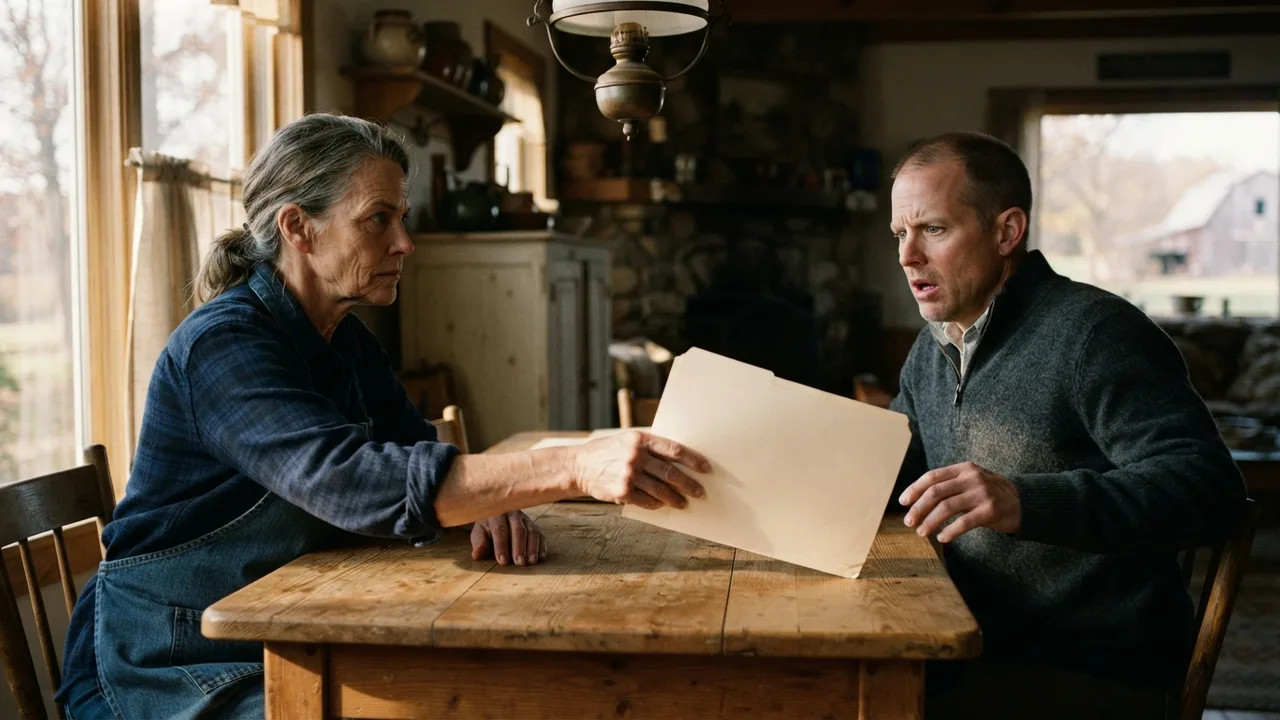
"We did. I have one more." I took out my phone, brought up the photograph, and set it on the table where all of them could see. "This was delivered on Tuesday. It cost eight thousand dollars. Could you explain why you'd buy a new deep ripper for a field you say you're too sick to work?"
Nobody moved. Sylvie leaned in to read the screen, the shipping slip, the date. Luke bent beside her.
"That's a subsoiler," Luke said slowly. "Dad, is that yours?"
Carl's color had gone patchy, red at the neck and gray at the temples. "It's a gift," he said. "For Luke. To help him get started on the land."
"Dad." Luke straightened. He wasn't angry yet, only baffled. "I do landscaping. I don't own a tractor that could pull that. I don't own a tractor at all."
The room was so quiet I could hear the hardware store's back door slam below us.
"You went in my barn," Carl said. He said it to me, low and hard, and I knew the voice. I'd heard it on the day a hired man left a gate open. "After everything I do to protect this family, you go behind my back, sneaking around in the barn like I'm some kind of crook? You don't trust me?"
I did not rise to it. I could feel the old reflex, the one that says smooth it over, say you're sorry, pass the beans. But I had stood in that barn with my feet planted, and I stayed planted now.
"This isn't about trust, Carl. It's about partnership." I turned my head so I was speaking to Luke and Sylvie too. "A partner doesn't sell off your life's work without telling you the real reason. You told me you couldn't work that field, and you bought the tool to work it. Both of those can't be so. We are not signing these papers."
Sylvie set down her pen. "Annette, to be clear, you're withdrawing your consent to the sale."
"I am."
"Mom." Luke's face had gone raw. "I thought this was settled. Dad said you were fine with it."
"I know what he said." I reached over and took my son's wrist, briefly, the way I'd held it crossing streets when he was small. "Luke, I love you. But the farm is not for sale."
Carl stood up. For a second I thought he'd say something that couldn't be taken back. Instead his shoulders came down, slowly, the way a barn settles after a hard wind, and he sat again and put both hands on the table where he could see them.
"I needed the money," he said. His voice had no edge left in it. "For something from a long time ago."
"What something?" Luke asked.
"I'm not going to say it here." Carl looked at the polished wood. "It was mine to fix. I thought I could fix it without anybody having to know."
I waited for him to look at me. He didn't.
Forty-five years, and I couldn't tell what was under that sentence. I knew only that he'd have sold Luke's inheritance and my ground and let me call it kindness, rather than tell me.
"Sylvie," I said, "please shred these documents."
She gathered them without a word, the deed, the agreement, the closing statement with its little yellow flags, and fed them one at a time into the machine under her credenza. It chewed each page with a grinding sound I will hear for a long time. When the last one was gone she emptied her cup of pens back into the drawer.
"I'll note in the file that the matter was withdrawn at the sellers' request," she said. Her voice stayed professional, but she held the door a moment longer than she had to when we stood.
In the hallway Luke caught my sleeve. "Mom, I'd have paid more. If I'd known."
"I know you would."
"Dad's going to need to explain."
"Yes, he is." I took my keys out of my jacket. "Take your father home, Luke. Take him in your car. I'm driving myself."
Carl said my name once, quietly, from the top of the stairs. I kept walking down.
The drive was twenty minutes of two-lane road with the windows open. Combines had started on the early beans out past the county line, and dust stood up behind them in slow brown columns. I drove with both hands on the wheel and thought about nothing I could hold on to.
I parked by the house and did not go in. The kitchen window was dark, and the toast plate from breakfast was still on the drainboard where I'd left it before we drove in.
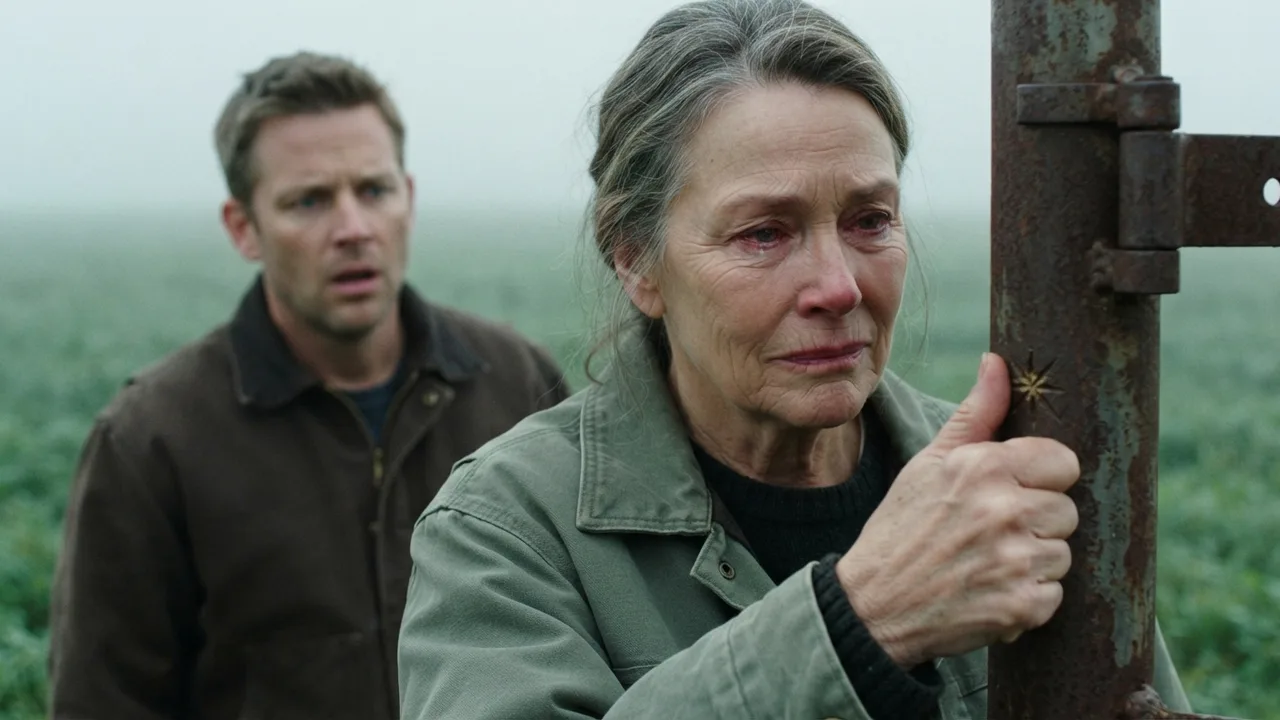
I walked out past the barn and the machine shed, along the lane, until I reached the fence line at the south pasture. The top wire was warm from the day. I rested my forearms on the post the way I had ten thousand evenings, and I looked at the ground.
It was all there. The tile line along the creek, the low place that stayed wet after rain, the hardpan under it all that Carl's father had cursed and Carl had bought iron to break. Mine. Safe and solid under my boots, and I had kept it.
I had never once stood at this fence and felt alone.
His truck sat in the yard, empty. I didn't know what I would say when Luke's headlights came up the lane, or whether I would unlock the kitchen door or leave it for him to find. I didn't know what supper would be, or whether there'd be a second plate.
The sun dropped lower over the creek timber, and the light came in sideways across the field. It caught the tops of the tall grasses in the south pasture and set them burning gold, the field I had just fought to keep.
Comments