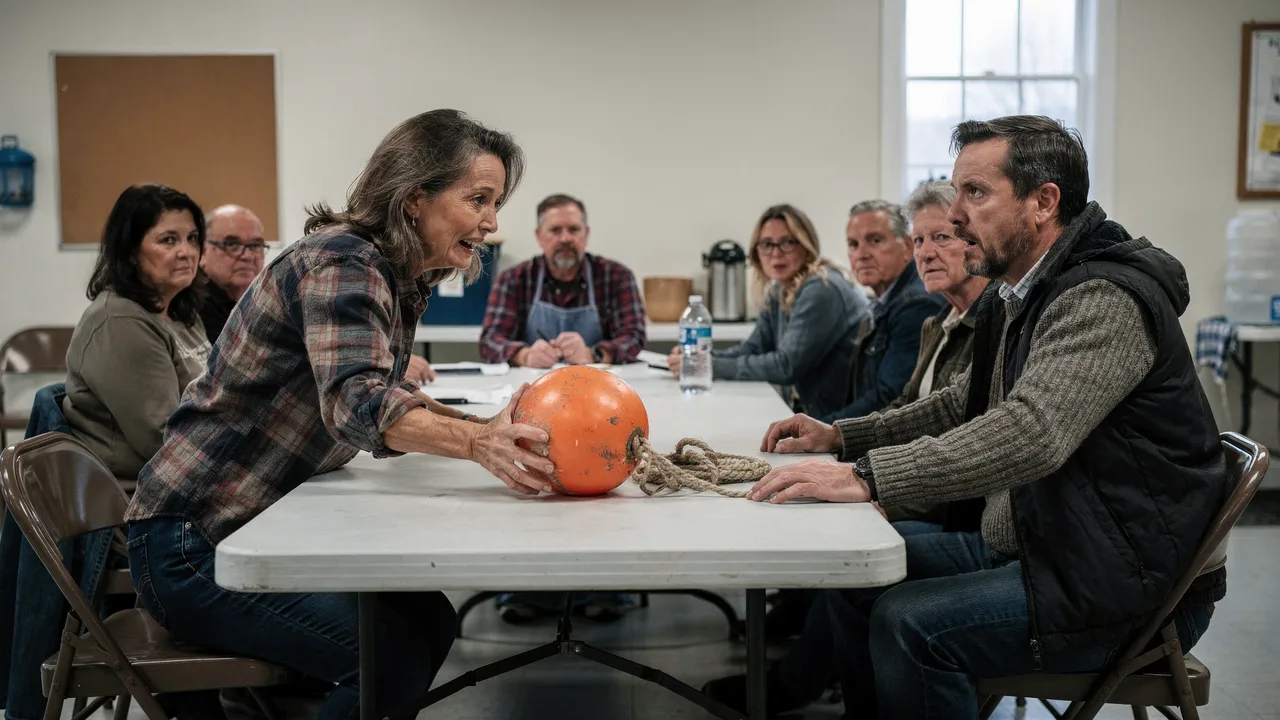
Wyatt Sanford told everyone at the co-op my traps were light because I was getting old, but I'd seen the new engine on his boat leaving a wake near my buoys at dawn. My commercial license was worth over $100,000, and I was sure he wanted it. He wanted my mooring too, and a man doesn't take a little at a time from a woman's traps unless he means to take the rest.
I'm Cassie Rowe, 58. I've hauled out of Port Alistair since I was sixteen.
The Constant was my father's boat. He bought her the year I was born, and I learned every board of her before I learned to drive. After my husband died, she was what got me up in the morning.
Advertisements
The season had started well. Then, for a month, my traps came up thin while the dock filled with talk of other men's hauls.
One Thursday I brought in a catch thirty percent lighter than it should have been. I knew that number the way I knew my own pulse. I'd hauled the same string in the same water at the same tide, and it should have come up heavy.
I was lifting the last tote onto the dock when the Sea-Claw eased in behind me. Wyatt's hull was white and spotless, with not a smear of bait on her. He stepped off in boots that still looked new.
"Rough morning, sweetheart?" he said.
"Ayuh. Light."
"Light." He said it loudly enough for the men gutting bait at the next piling. "Cassie, I say this with love. Hauling a string that size alone, at your age? You ought to get yourself a younger sternman. Somebody to keep up."
Advertisements
Hank Doucette stopped what he was doing. So did Walt Pruitt, and the Lund boys.
"I keep up fine," I said.
"I'm sure you do, honey. Gotta keep up with the times, though. This ain't your daddy's fishery anymore."
He smiled the smile that never got to his eyes and walked up the dock with his hands swinging easy. Nobody laughed, but nobody said a word to me either. Walt went back to his bait bag and kept his eyes on it.
I stood there with a tote of short lobsters and felt the doubt go in like a splinter. I'd never once had to wonder what the men on that dock thought of me.
That night I sat at my kitchen table with the harbor lights out the window and my coffee gone cold. I couldn't prove a thing. I could only count.
Friday I drove to the Tractor Supply and bought a pack of heat-resistant zip ties for $11.99. They were chartreuse, a color no one on that waterfront used for anything. I worked by deck light and snugged a tie around the claw of a dozen legal lobsters from my best traps. Then I put them back in and set the traps.
I slept badly. Water doesn't care if you're tired, but a person does.
Saturday morning those traps came up nearly empty. Not one chartreuse tie anywhere, not in a trap or on the deck or floating in my wake. Whoever had taken them had cut the ties off first and thought about it.
I did the sum standing at the rail. Over $400 in lost lobsters, plus the ties, and that came out of my own pocket. Wyatt had learned something from me, and I hadn't learned anything from him yet.
On Monday I went to the co-op office. Reuben Foley was at his desk with his glasses on their cord and the ledger open. Wyatt stood by the coffee urn with two of his friends, near enough to hear.
I didn't look at him. I wanted him to hear it and wonder.
"Reuben," I said, "somebody's been messing with traps out my way."
Reuben took his glasses off and rubbed the bridge of his nose. "Messing how?"
"Hauling what isn't theirs."
"That's a serious thing to say, Cassie."
"I know what it is."
Behind me the urn clicked and Wyatt's voice rose, warm and worried. "I hate to say it, fellas, but I'm concerned about her. Poor Cassie's been forgetting things. I bet she's pulling her pots a day early and doesn't know it."
I turned. He looked at me with such gentle pity I wanted to put him through the window.
"Wyatt," Reuben said slowly. "That's not what she said."
"I know, Reuben. I just worry. She's been out there alone a long time."
Reuben put his glasses back on. "Cassie, I've got nothing to look at," he said quietly. "It's your word against his. You see that, don't you?"
"I see it."
"The rules are the rules. I need something I can put in the book."
I went out onto the dock. Walt Pruitt tipped his cap to me, and it was a soft, kind tip, the way you'd greet a widow at a funeral. I'd known Walt since I was in braids. I would rather he'd spat.
By Wednesday the story had gone all the way down the harbor. Forgetful Cassie. Poor Cassie. Nobody said it to my face, which was worse.
The co-op met Thursday evening. Wednesday night I went to work.
I had ordered the clear grease and a little UV flashlight from a supply house in Portland, and they had come in the mail the week before. I hadn't known whether I'd ever have the nerve to use them. Wednesday I had the nerve.
I hauled twenty of my best traps in the last light. On the Constant's deck, under the work lamp, I picked up every legal-sized lobster, turned it over in my gloved hand, and touched a dab of grease to the underside of its shell. Then I checked it with the light. A small blue-white smudge glowed on the dark deck, and when I switched off the flashlight it was gone.
I marked every legal lobster in those traps. Then I put them back in the water instead of in my totes.
That was money I could have sold, thrown back for the sake of one gamble. My knees ached and my hands cramped, and the cold came up off the bay and into my back. When I finally rowed in and let myself into the house, it was close to morning.
I lay down in my boots. I did not sleep.
Before first light I gave up on the bed and rowed back out to the Constant. I didn't start her engine. I sat in the cabin with the door cracked and watched my orange buoys come up out of the gray.
The Sea-Claw came at the hour he always came. She slowed over my string, and a man in new boots gaffed my buoy line and hauled my trap onto his rail like it had his name on it.
He pulled six before the sun cleared the point. Every time, his gloved hand went in and came out full. Then he opened her up and ran for the co-op float.
I gave him time to unload. Then I started the Constant, ran in, and walked into the co-op office with salt still stiff on my sleeves.
"Reuben, I'm filing on disputed landings," I said. "Under the rule, every crate in this week stays on the floor until the meeting hears it."
He looked up over his glasses. "You can ask for that once, Cassie. You'd best have your reasons."
"I'll have them tonight."
"Wyatt's crate is already on the hand truck by the scale."
"Then it stays there."
He studied me a long moment. Then he wrote a line in the ledger and went down himself to lock the freight door.
That evening the hall above the fish market was crowded and stuffy. Two ceiling fans pushed the warm air around, and the smell of bait came up through the floorboards. About fifteen men sat on folding chairs with paper cups of coffee, and a plate of whoopie pies went around from Dot Lund's kitchen.
Noah Parsons sat near the back with his cap in his hands and grease on his thumbs. He nodded to me once.
Wyatt sat in the second row with his boots stretched out. He'd made a show of it that afternoon, telling anyone who'd listen that he had nothing to hide and Reuben could hold his crate till Christmas. Now he drank from a Dunkin' cup and smiled at the room.
Behind him, by the scale, the hand truck stood where Reuben had left it, the crate on top and the coolers beneath.
"Landings for the week," Reuben read. "Hank, good. Walt, steady. Wyatt Sanford, highest in the harbor again."
Wyatt lifted a hand like a man accepting a handshake. A couple of men clapped him on the shoulder. I kept my eyes on my coffee until Reuben said, "Anything for new business?"
I stood up. The chair legs scraped. Every head came around, and I saw Walt look at the floor.
"For the past month," I said, "somebody's been robbing my lines."
Wyatt laughed out loud. "Here we go."
"Let her speak, Wyatt," Reuben said.
I walked down the middle between the chairs, past Dot's whoopie pies and Hank's folded arms, and stopped at the hand truck. The crate looked back at me, shell on shell, claws banded.
"Reuben, I need the lights off."
He looked at me over his glasses for a long breath. "Noah, get the switch."
The overhead tubes clunked off and the hall went the dull gold of the last window light. I took the flashlight from my jacket and turned the first lobster belly-up. The beam crossed its underside, and a blue-white smear lit up like a thumbprint on glass.
I set it down and picked up another. Then another. The same pale mark glowed on each one, and the room made no sound but the fans.
"What is this?" Wyatt was on his feet and his chair had gone over. "You planted that! She's been sneaking around my boat. She marked them at the dock!"
"The crate has been locked in this building since nine this morning," I said. "Reuben locked the door himself."
"Then somebody got to it before nine. Any boat could've pulled those. Any boat in this harbor."
"Wednesday night I marked every legal lobster in twenty of my traps and put them back. This morning before light I sat in the Constant's cabin with the engine off and watched the Sea-Claw haul six of them." I kept the beam on the shell. "I know your hull the way I know my own hands, Wyatt."
He stood there with his jaw working. When he spoke again the warmth was back, thin and quick.
"All right. Say my sternman bought a few off somebody at the dock. I wouldn't know, Cassie, I don't count what comes over the rail. I'll make it right. I'll pay you for what's in that crate and we call it square, no hard feelings."
"No."
"Then you're a woman who sat quiet while the whole harbor called you forgetful, just to stand up here and make a stunt of it."
"I sat quiet because I wanted it to hold," I said. "Show the room your gloves."
His hand went to his back pocket before he could stop it. I swung the light across the room, and the work gloves poking out of his jeans glowed blue-white to the wrist, the fingers stiff with it. A smear of the same pale light ran down his sleeve.
"That's off the crate," he said. "You made me handle it."
"You haven't touched that crate since Reuben called the meeting to order." I peeled my own bare hands open under the beam, palms up, knuckles scraped, nothing on them. "I wore rubber gloves on the Constant, and they're in my trash bucket. Yours are in your pocket."
Somebody at the back let out a low breath. Hank said, "Sit down, Wyatt," and Wyatt did, in the chair Noah had set upright without a word.
Noah found the switch. The lights came on harsh and white, and under them the crate was only lobsters again, dull and wet.
Reuben cleared his throat and picked up his pen. "Cassie, the bylaws on theft say—"
"I know what they say, Reuben. I'd like to say what I want, if the room will hear it."
He lowered the pen and nodded.
"Every marked lobster in that crate goes on my ticket at the co-op price," I said. "You set the figure for a month of my string, Reuben, and it gets paid in your book by Monday, to the dollar. Wyatt doesn't tie up at the co-op float or put a crate on that scale until the next meeting votes on his membership. I'll stand up and say my piece then, and so will anyone else who's been short."
Wyatt looked at the floor. "And if I don't?"
"Then Hank holds the light again, and the room hears it again."
"That's fair," Reuben said slowly, and wrote it down.
"One more." I turned to Wyatt. "You said it on my dock where the men could hear. You'll say this where they can hear too. My traps were mine, and you pulled them."
His throat moved. The fans turned.
"Her traps were hers," he said at last, through his teeth. "I pulled them." He didn't look up. "And she isn't forgetful."
"Thank you."
He took the Dunkin' cup off the floor, crushed it in his fist, and went out by the freight door. It banged in its frame. A minute later I heard his truck start in the lot.
I put the flashlight away. The men filed out slowly and quietly. Hank gave me a short nod, the kind you give across a grave, and one of the Lund boys said, "Sorry, Cassie," to the floor. Walt couldn't meet my eye at all.
I had won. I stood in a room that smelled of bait and cold coffee, and I had never felt less like it.
Every one of those men had watched me get the look of pity on that dock and had said nothing. Now I had put a thief in front of them, and they'd have to carry that too. The easy talk across the pilings was gone. Tomorrow nobody would hand me a coffee without thinking about it first.
And I'd thrown back a night's good catch to get here. That was sold to nobody, and no ticket in Reuben's book would bring it back.
I took the empty cups off the folding table and stacked them, because my hands wanted something to do.
The dock was dark when I got down to it. The tide was slack, and the harbor lay flat and black under the few lights on the pier. I went along the Constant's rail and drew her canvas over the stern. My fingers fumbled the first snap and I had to do it again.
Boots sounded on the planks behind me. I knew the walk before I looked.
"That was something, Cassie," Noah said. He stopped a few feet off with his cap in both hands. "You going out tomorrow?"
I looked at the bow my father had painted himself and the cleats I'd replaced one by one. Then I looked past her at the dark water.
"Five o'clock," I said. "Bring your own coffee."
"Ayuh."
He went off up the planks. A stack of my buoys stood against the pilings by the bait shed, their orange chalked and faded. I put my hand on the top one, and it was cool and rough and ordinary, with nothing on it that glowed.

Comments