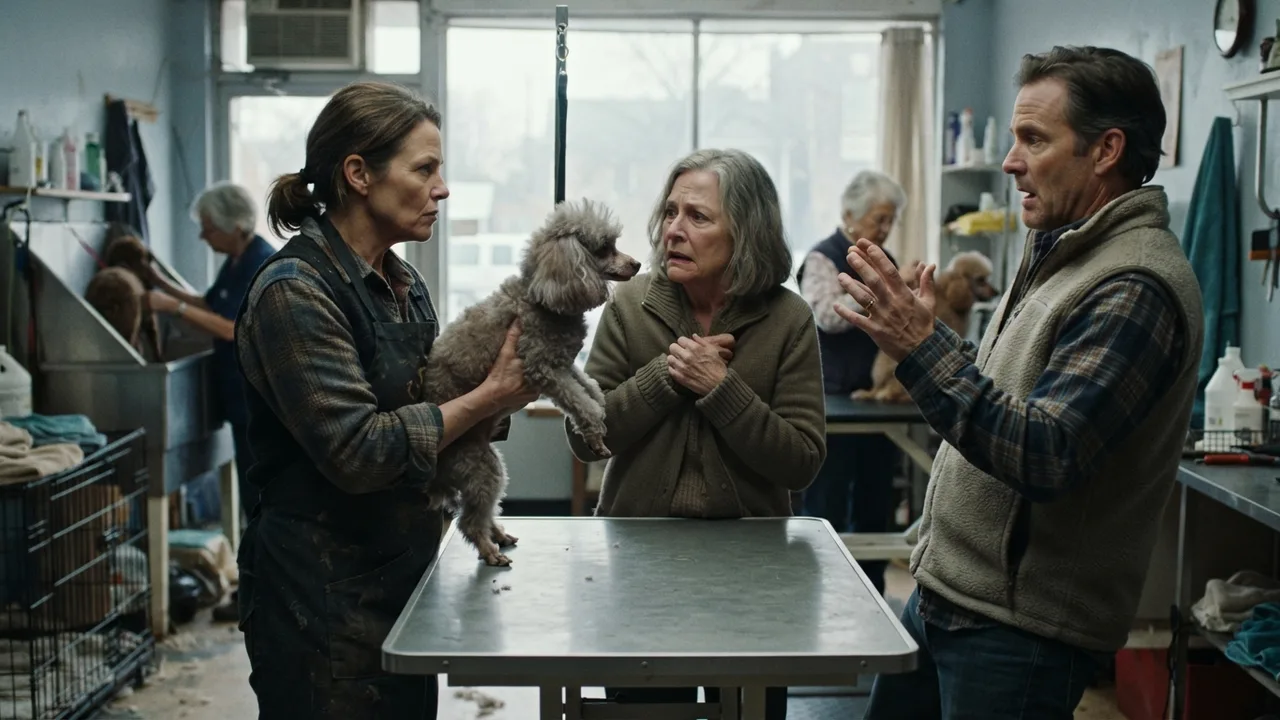
Cameron Holt took $800 in bookings out of The Scruffy Mutt in his first week next door, but the proof that he was a fraud turned up in the coat of a prize-winning miniature poodle named Colette.
I did not go looking for it. I wanted a full appointment book and a quiet Tuesday, the same as I had wanted for twenty years in this shop on the town square in Three Peaks, Wyoming.
Pristine Paws went into the empty storefront beside mine at the start of summer. It had a glass front, chrome fixtures, and a neon paw in the window that hummed all night. Across the top hung a banner in letters taller than my own sign: 50% OFF YOUR FIRST GROOM.
Advertisements
He came to my door the morning he opened, in a crisp polo with a paw stitched on the chest.
"Cameron Holt," he said, hand out. "You must be Astrid. We're not just grooming over there. We're curating a canine wellness experience."
"I groom dogs," I said. "Welcome to the square."
He laughed as if I'd made a joke. His hand was soft, with no calluses and no clipper nicks on the knuckles, and I noticed it at once, as I would a dog that had never been walked on gravel.
Martha Sweeney stopped on the sidewalk that Thursday with Colette on a rhinestone lead. She did not come in.
"Astrid, darling, I have a confession, and it's a catastrophe of the highest order."
"You're taking Colette next door," I said.
"Half off the first groom, and they have a bubble bath with a, a *ritual*. Colette adores a novelty."
Advertisements
"You've been bringing her to me for fifteen years, Martha."
"I know. Don't make me say it twice." She touched her turquoise necklace and kept her eyes on the neon paw.
Colette looked at me over Martha's wrist. She stood square and sound, her feet neat, her coat in good order from my last visit. I wanted to say that, and I said nothing.
Three more regulars followed Martha by Friday. The appointment book had gaps you could have backed a horse trailer through, and the pencil total of the cancellations came to $800. I went upstairs to my apartment and ate a Smith's rotisserie chicken thigh over the sink, standing up, because sitting felt like agreeing with something.
The next Wednesday I stood in line at Elkhorn Coffee for a huckleberry scone and heard my own name.
Cameron sat at the corner table with Dorothy Albright, who ran the kennel club and had sent me half my newer clients. His back was to me. Hers wasn't.
"I'd never badmouth anyone," Cameron said. "But the equipment over there is decades old. Hygiene is the whole ballgame now. We're holistically certified."
"Astrid's shop always seemed so clean," Dorothy said.
"Clean-looking. That's a different standard."
I stood there with my napkin going damp in my fist. Dorothy glanced up and saw me, and her eyes slid away like I was a stranger asking directions. I left the scone on the counter.
That night I did not sleep. At midnight I went downstairs and bleached the tub drains, pulled every blade from its case for another soak, washed each comb by hand, and wiped the grooming table until the vinyl squeaked, and by dawn the shop was cleaner than a place had any need to be.
Nathaniel Pike came in that morning with Winston, his scruffy Airedale, who was due a trim. Nathaniel wore tweed in July, the same as always. He took one look at the bleach bucket and sat on the waiting bench.
"You've been up all night."
"The drains were due."
Winston leaned against my shin. I ran my thumb along his flank and found his coat harsh and healthy, his skin clear.
"Is there a certification called holistic?" Nathaniel asked.
"Not one I've ever been asked for."
Nathaniel brushed a curl of Airedale fur off his sleeve.
"Has anyone asked to see his?"
"It's framed on his wall. Master Groomer. It looks like a diploma."
"Does it look like something you'd recognize?"
"I don't know. I've never gone over to look." I set Winston on the table. "Nathaniel, I don't go to war with my neighbors."
He turned his tweed cap over on his knee and waited.
"What do you do?"
"I work."
"Then it might be worth looking at his work," he said, "before you decide anything else."
I thought about that through the whole of Thursday, between the three dogs who still came to me. I didn't have to look for long.
Martha came to my back door on Friday evening, the night before the Founder's Day Dog Show, carrying Colette in a quilted tote. The show was the biggest day of the town's summer. Martha's face was the color of paste.
"Astrid, it's a catastrophe," she said. "It's truly a catastrophe."
I lifted Colette out. Before I looked at her coat I looked at how she stood, and she stood wrong. Her hind legs were tucked under her and her belly was pulled up tight, and when I set her on the table she shifted her weight as if the vinyl were hot.
Then I looked at the coat. The hind pants had been taken down with a number ten blade run freehand, no comb, so the pattern was scooped at the thigh and stepped in clipper tracks. The topknot had been cut on a slant with thinning shears to hide one side that had gone too short.
"Who did this?" I asked, though I knew.
"Cameron said it was a modern interpretation. He said Continental was dated." Martha's voice cracked. "I thought it looked rather avant-garde."
"It looks like a mistake, Martha."
I turned Colette gently onto her side. A pale dust lay on her belly, fine as cornstarch, and I brushed at it with a damp cloth. Under it the skin was red and raised and hot to the touch, in broad streaks where a blade had passed more than once.
Colette pulled away and looked at me. I held very still until she settled.
"That's not finishing powder," I said. "Somebody covered this."
"He said it was for volume."
"A hot blade, pressed flat to the skin, no guard, run over the same ground to save time. Then powder on top so nobody would see." I washed my hands before I spoke again. "I'll fix what can be fixed on her topline. I won't touch the belly. She needs to rest, Martha, and she shouldn't be shown."
"Cameron's sponsoring the Best in Show ribbon. Everyone will be there." She pressed the tote against her coat. "What would I say?"
"The truth."
"Oh, Astrid. I can't."
She worked beside me for an hour, holding the lead, saying little. Colette stood patiently under my comb and shears, and when the topline was as good as hair could be made, Martha carried her out into the evening. I stood in the doorway until her Navigator's taillights turned off the square.
I had wanted to stay out of it. I had spent two weeks telling myself a dog's belly was none of my business, that the town would sort out who it liked, and that a woman who grooms for a living does not go picking fights. Then I had seen that dog's face. There was no more peace in my head that night than there had been the night of the bleach.
The Founder's Day tent stood on the green behind the courthouse, white canvas snapping in the afternoon wind, folding chairs in rows, the smell of kettle corn drifting in from the vendor lane. Clouds were stacking over the mountains. By the time I got there, about twenty dog owners and shopkeepers had crowded near the ring, and the three judges sat at their long table with the Best in Show ribbon laid out in front of them.
Mayor Gil Hutchins stood beside the table holding a cardboard folder. Cameron stood next to him in a fresh polo, shaking hands. Somebody told him the spa looked wonderful. Somebody else asked about a gift certificate.
"We just love being part of the community," Cameron said.
Nathaniel stood near the entrance with Winston at his knee. He saw my canvas kit roll under my arm, and he lifted his eyebrows and nothing else.
Martha stood ringside with Colette in her arms. The topknot I'd rescued had gone lopsided again, and the hindquarters still showed what I couldn't undo. Hair doesn't grow back because you've asked it to. Martha looked like a woman waiting outside a principal's office.
I walked past Cameron without turning my head. I crossed the sawdust, set down my kit beside Martha's chair, and knelt.
"Martha, may I correct the damage?"
I said it clearly, in the voice I use when a dog is nervous and the room is loud. It carried, and I felt the nearest chairs go still.
"Please," Martha whispered.
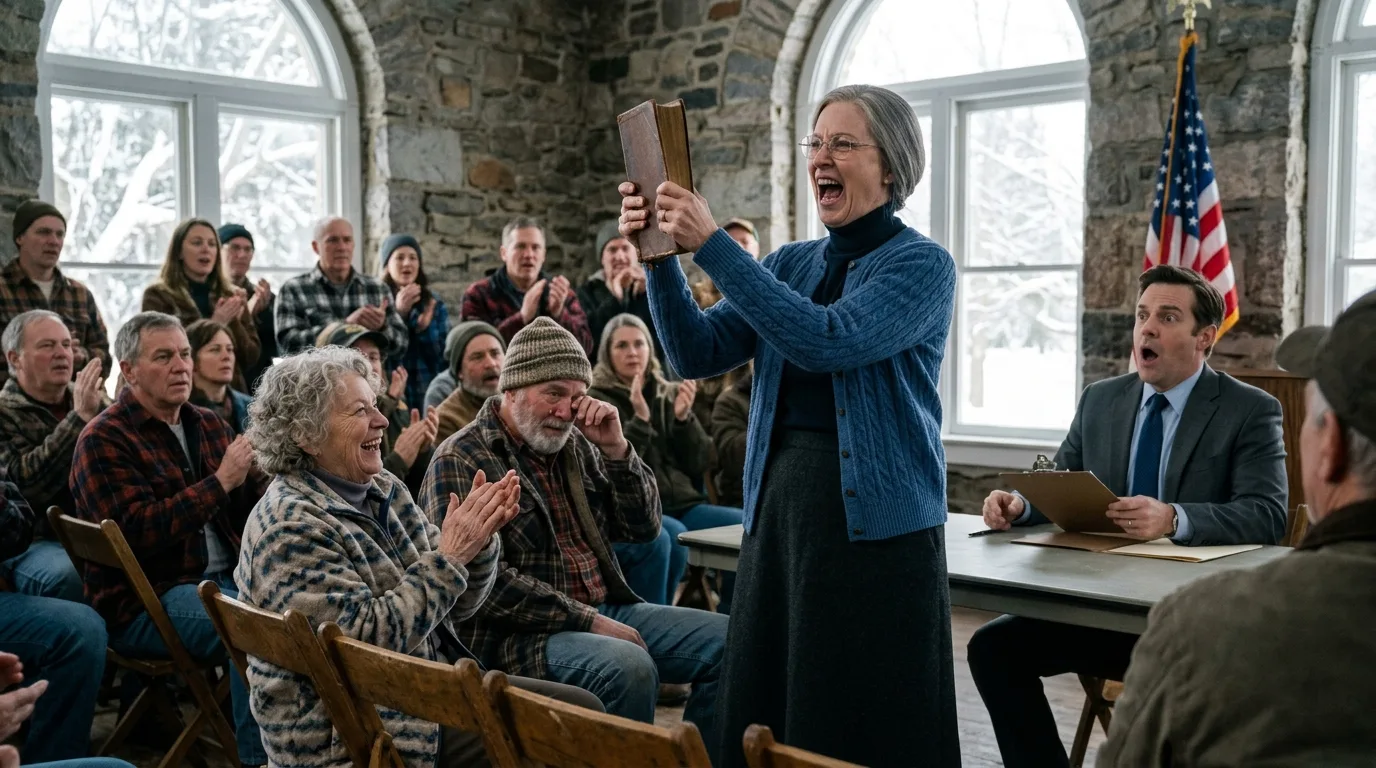
I set Colette on the grooming mat and opened my roll. "The hind pants were taken down with a number ten run freehand. No comb on the blade. That's why you see the tracks, these stepped lines, and this scoop at the thigh where the blade dug in. A Continental wants scissor work through the pants, blended into the saddle. This is a shortcut."
I turned her head with my palm. "The topknot's been thinned on a slant to hide a short side. A show clip never goes on a slant."
Someone behind me murmured. A chair creaked.
"Now the belly," I said. "Martha, may I?"
She nodded. I rolled Colette gently on her side and wiped away the powder, and the red streaks stood out on her skin in the white light of the tent.
Martha put both hands over her mouth.
"That's clipper burn," I said, to the room and to nobody. "A blade run hot and pressed flat, over the same patch, in a hurry. Then powder to cover it." I looked up, finally, at the man by the judges' table. "This is not the work of a Master Groomer. This is the work of an amateur in a hurry."
Cameron's face went from tan to red in the time it took me to breathe in.
"Hold on," he said. "That's a pre-existing sensitivity. We use a, a proprietary finishing protocol, and—"
"What blade did you run on her hindquarters, Mr. Holt?"
"It's a premium, it's a custom—"
"What number?"
He opened his mouth and nothing came out. He looked at the mayor. He looked at Dorothy Albright, standing six chairs down with her Labradoodle's lead wrapped twice around her wrist. She was looking at Colette's belly.
The lead judge, a silver-haired woman named Evelyn Marsh, pushed back her chair and walked over. She knelt on the sawdust beside me and touched the skin with the backs of her knuckles, then smoothed the hind coat against its grain, and her mouth went into a hard line.
"Mrs. Sweeney," she said, "I would withdraw her today. And I would see that this dog gets looked after properly."
"I will," Martha said. "Oh, I will."
Judge Marsh stood and brushed off her slacks. She looked once at Cameron, a long and ordinary look, as if reading a price tag, and went back to her table.
Nobody shouted. A man in a feed-store cap turned away to study the ceiling. Dorothy Albright unwound the lead from her wrist, led her dog the long way around the ring, and did not pass him. Two women who had taken Pristine Paws brochures put them back on the folding table, square with the edge.
The mayor opened the cardboard folder, took one look at the certificate inside, and closed it. He tucked it under his arm and walked toward the coffee urn.
Cameron stood alone in a space that had been full of people. He tried a smile. It didn't hold, and he walked out through the side flap of the tent with the wind snapping the canvas behind him.
I finished what I could. With Martha's nod I blended the saddle line with my shears, three clean passes, and squared the topknot so Colette looked like herself. Then I lifted her into Martha's lap, and Martha held her tight against her chest, as if she had nearly dropped her.
Nathaniel brought coffee to my kitchen counter a week later and set a manila folder next to the cup. Winston lay down across the doorway of the shop.
"I thought you'd want to hear it from me," he said. "The landlord of the building next door is a client. Mr. Holt is breaking his commercial lease. He'll be out by the end of the month."
"Leaving town?"
"Back to his parents' summer place, and from there I'd guess anywhere that hasn't heard." He opened the folder and turned a page toward me. "He's selling his equipment. Tables, tubs, the dryers, the lot, at ten cents on the dollar. The landlord asked me whether you might be interested."
I looked at my own grooming table. The vinyl was patched in two places with gray tape, and the stainless on the tub had gone dull from twenty years of shampoo. My clippers had been rebuilt twice.
"No," I said.
"Not even the dryer? It's a good one, I'm told."
"My dryer works, Nathaniel."
He nodded and closed the folder. He didn't ask what I was thinking, which was one of the reasons he was my friend.
"Are you all right?"
"The business is."
"That isn't what I asked."
"I know it isn't," I said, and drank my coffee.
Martha called that Thursday afternoon. I knew her voice before she said her name, because she had never once in fifteen years spoken that quietly.
"Astrid. It's Martha."
"Is Colette's belly healing?"
"Every bit of it. You were right about the rest, too." She stopped and began again. "I'm retiring her from showing. I can't go back into a tent with that dog and have people look at us. It's not her fault. It's mine, for going next door because of a banner."
"Martha, she's a beautiful dog. She'd do well anywhere."
"She'd do well because of you, and I walked past your door." Her breath shook. "I'm ashamed, darling, and I don't know how to walk into your shop."
"You could bring her Tuesday."
"I'd like to. I'll try." She said it to the receiver and not to me, and I understood the Tuesday slot would stay empty. "Thank you for what you did. I mean that. I'm sorry for all of it."
She hung up gently. I set the phone on the counter.
Next door, the neon paw had gone dark. The banner was down, and a man in coveralls was carrying chrome fixtures out through the glass front. Nobody had said a word to me at the pump or the post office about the tent, but Dorothy had called to rebook her Labradoodle, and the appointment book was filling in pencil again.
I had kept my shop. I had lost a poodle I'd groomed for fifteen years, the one that stood best under my hands, and with her the pleasure of seeing my own work walk into a ring and be known for what it was. No ribbon would ever have my name on it, and Martha's Tuesday would stay empty.
I went to the wall behind the table, where my old German-made shears hung on their hook, the finish worn bright along the handles by my own grip. I lifted them down. They sat in my palm with the same weight they'd always had, and I opened and closed them once, the blades meeting clean.
The tools that tell the truth.
Comments