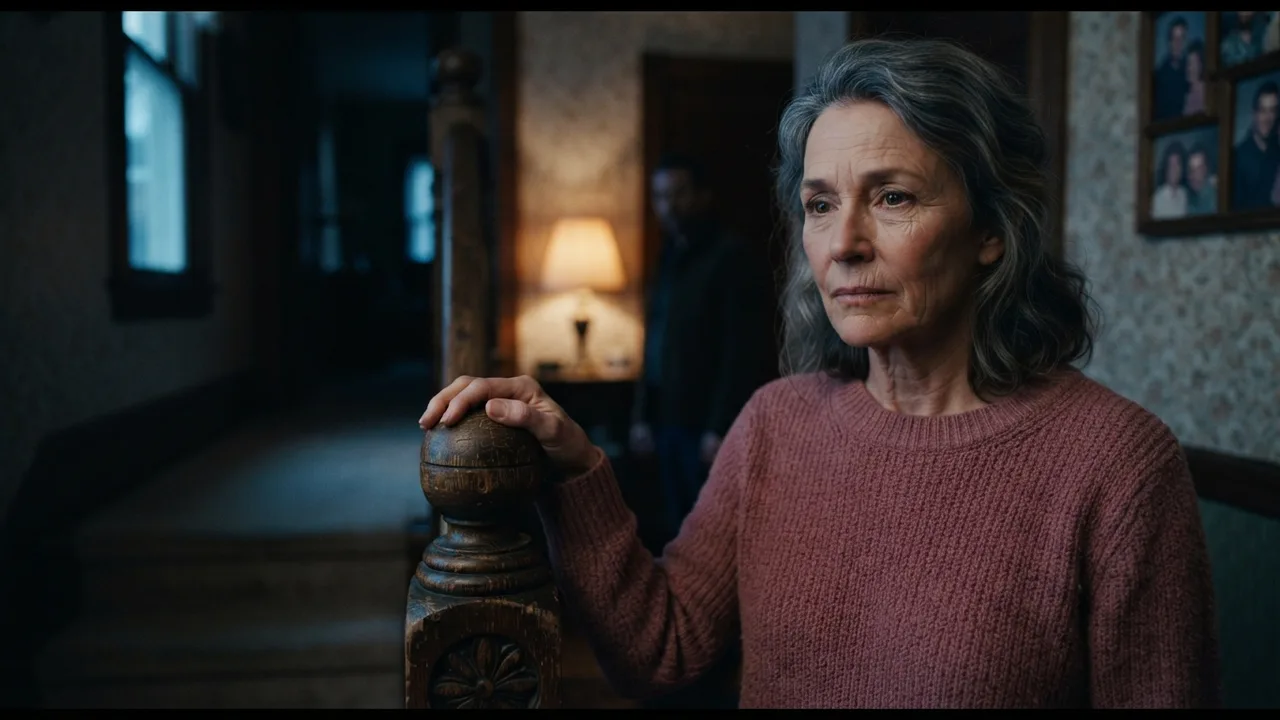
"It's just a house, Mom," my son told me, sliding the developer's offer across my kitchen table. "It's time to let go."
Two hundred seventy-five thousand dollars, all cash, for the house I had lived in for thirty years. A line at the bottom, in bold, said the offer expired in seventy-two hours. Under that was a blank where my name went.
Jesse had laid a pen on top of the page, square to the edge. His phone lay face down beside it and kept buzzing against the oak.
"I want to read it," I said.
"Of course you do. Read it. I'm only concerned about you, Mom, rattling around in this place alone. Your emotional well-being matters to me."
I read it. The buyer was Ridgeline Land Partners, out of Charlotte. The sale was as-is, with no inspection and no walkthrough by the buyer, and the closing was quick. Nothing in it said anyone would live there.
Advertisements
Roger and I had built this house with our own hands, one weekend at a time, pouring the footings before we could afford the lumber. Eighteen months ago he went down the basement stairs and died at the bottom of them. Since then Jesse had driven up from Charlotte every other Sunday to tell me I couldn't manage.
"Seventy-two hours is not a lot of time," I said.
"That's the point. Offers like this don't sit. Friday evening, Mom. I'll bring Uncle Clyde so it's family at the table."
He kissed the top of my head. His blazer smelled of a car that had been cleaned that morning.
---
The Saturday before, Jesse had come with a woman named Dana Pruitt from his office. He called it an informal walkthrough. I found out when I opened the door to a stranger holding a tablet.
They walked my living room as if it were a lot for sale. Dana ran her thumb along the mantel Roger had planed himself.
"Cosmetic, mostly," she said. "Pull the carpet, paint everything white. Kitchen's dated."
"Cabinets are solid, though," Jesse said. "We'd stage around that."
"I'm standing right here," I said.
"Mom, we're brainstorming." He didn't look up from his phone. "Dana, we can skip the basement. It's unfinished, nobody wants to see it."
Advertisements
"Then I'll put the stairs in the listing as a bonus feature, instead of a liability," Dana said, and he laughed too loudly.
I stood there with a dish towel in my hands. In my own house I'd gone silent as a coat rack.
---
I didn't sleep Tuesday night, or Wednesday either. I lay listening to the house settle, the front hall floor ticking as it cooled, and did sums on the ceiling.
Roger's retirement account had come in thinner than he always told me it would be. Jesse had sat with me for that paperwork and explained how the market had dipped. I'd believed him, because he was my son.
He called Wednesday night, and his voice was soft.
"Mom, I hate that we're fighting. Dad would want you safe. He'd want you in a condo near me, with a doctor down the road and no stairs."
"I like my stairs."
"Do you? Do you really?" He let that sit. "I can't lose you too. If something happened and I'd begged you to sell and you said no, I couldn't live with it."
I had the offer in front of me and the pen in my hand. I heard myself say, "All right, Jesse," and my throat closed on the next word.
"That's all I'm asking. Thank you. Thank you, Mom."
I hung up and sat there with a pen cap between my teeth. I hadn't signed anything, but the sentence was out of my mouth.
By morning I had decided on one thing. If I was going to give up this house, I would know what I was giving up, down to the last cracked footing. I would clean the basement from the washer to the stairs and find out whether it was as sound as I believed. Then I would be able to tell Jesse, and myself, that I'd checked.
---
Thursday was cold and bright, the maples on Howard Street gone orange. I filled a bucket with Murphy's Oil Soap and hauled the shop vac down the steps.
The stairs themselves were fine. Roger had built them from oak, tight-fitted, and not one tread had loosened. I went down slowly with a hand on the rail, as I had not been able to do for a long time without my chest tightening.
At the bottom I stopped.
Roger had carved the newel posts as a pair, one at the head of the stairs and one at the foot, from a white oak that came down in an ice storm. It took him most of a winter. Each post had an acorn at the crown and a leaf wrapped around the shaft, and the grain ran so true you could lay your cheek to it and feel the tree.
The post at the foot of the stairs was pine. It was lathe-turned, squat and orange with stain, and a stub of price tag still clung to its base. It said $14.97.
I stood there with the bucket in my hand.
Jesse had told me the paramedics broke the post, carrying Roger out. He said he'd fixed the wall right up, to spare me the sight. I had come home from Ingles that afternoon to an ambulance in the drive and my son already standing on the porch. He said he'd driven up to surprise his father. He had never once mentioned the post's replacement to me again.
I set down the bucket and put my hand on the wall behind where the old post had stood.
The paint was a different white from the rest. Under my palm the surface was lumpy, a crusted patch the width of a dinner plate, with a single brush hair dried into it. I dragged my thumbnail across and a crumb of it came away, chalky and soft.
Roger once tore out a bedroom ceiling because he could feel a seam in the dark. He taped every joint, coated it three times, and sanded until the wall felt like a river stone. He would have sooner gone without supper than leave a patch like this.
And the patch sat at the height of a man's head, if the man were falling.
My phone buzzed in my pocket. It was Jesse: *Just confirming Friday! Love you.*
I looked at the stairs for a long time. I had spent eighteen months picturing my husband's last minute as a missed step, a bad luck of the foot. Now I looked up the stairs from the bottom and couldn't see him slipping anymore. I saw only the wall.
I carried the bucket back up and poured it down the drain, and I did not clean another thing.
---
Friday evening Clyde came first, in his flannel and work boots, with a sack of apples from his tree. He set the boots by the door, as he always did. Jesse arrived after, in a fresh blazer, carrying a leather folder.
We sat at the dining room table. I had set out coffee. Nobody touched it.
Jesse laid out the agreement and clicked the pen, and his voice cracked in a way that sounded practiced.
"Mom, I miss Dad every day. Every single day. This house is where he died, and you're living in it like it's a shrine. I can't watch you do that to yourself."
"Marlene," Clyde said gently, "the boy has your best interests at heart. I know it's hard. But he's trying."
"I know he is," I said.
Jesse held the pen out across the table. The cap ticked in his fingers. I looked at it and did not take it.
"Clyde," I said, "if you were patching a hole in drywall, a deep one, you'd use joint compound and tape, wouldn't you? And you'd sand it smooth before you painted?"
He frowned. "Well, yes. Sure. Spackle won't hold on anything deep. Why?"
I turned to my son.
"You used spackle, Jesse. You didn't sand it. You didn't even prime it. And that newel post. Your father spent a month carving the original. You put in a piece of junk with the price tag still on."
He hadn't moved the pen.
"The paramedics didn't break that post, did they?"
Jesse's chair scraped back. "This is exactly what I mean!" His face had gone red up to the hairline. "You're obsessed with nonsense! A piece of wood! Who cares? I'm trying to give you a future, and you're stuck in the past, making up stories!"
He turned to his uncle. "Uncle Clyde, see? She's getting confused. She's not thinking straight. This is why she needs me to handle things."
Clyde said nothing. He was looking at me.
"I'm thinking clearer than I have in eighteen months," I said. My voice came out quiet, and it did not shake. "Ridgeline tears things down and puts up strip malls, doesn't it? They aren't going to live in this house. They're going to bulldoze it."
"Mom."
"You told Dana to skip the basement. You wanted no inspection. You wouldn't let Clyde look at the foundation when he offered, twice." I held his eyes. "You don't care about the money. You need the evidence gone. You pushed him, didn't you? That's the hole in the wall. That's your father's head hitting the studs."
Clyde's mouth had come open. Across from me my son's face went the color of the paper in front of him, a gray that started at the lips.
"Where's the old post, Jesse?" Clyde asked, and his voice was very low.
"I threw it out. Dumpster."
"Paramedics carry a stretcher. They don't snap white oak."
Clyde stood and went to the basement door. Jesse said, "Uncle Clyde, don't," and it was that word, said so fast, that told me everything the wall had not.
---
Clyde was down there a while. I heard his boots on the oak treads and then nothing. When he came back up he held his thumb out under the lamp, white to the first knuckle.
"Joint of the stud's cracked behind it," he said. "Spackle's sitting in the crack. Wasn't primed, wasn't sanded. Roger would've skinned a man for that."
Jesse sat down hard. For a time he looked at nothing, and then he said, to the table, "He was going to tell you about the money."
"What money?" I said.
"The account. I took it. I was going to put it back." His hands came up over his face. "He was on the top step and he wouldn't listen. I only wanted him to stop talking."
Nobody said anything. In the kitchen the refrigerator hummed and cut off.
---
Later that night the signed papers, which no one had signed, lay on the table in two torn halves. I had ripped them myself, lengthwise, while Clyde watched. The pen sat beside them, uncapped.
Jesse stood in the hall in his good blazer with his shoes still on, the way he'd stood at six, waiting to learn what his punishment was.
"Keys," Clyde said. "To this house. On the table."
Jesse dug in his pocket. The ring rattled so hard against the wood that I put my hand over it to quiet it. He had kept the brass one I gave him at eighteen, the one with the worn-down teeth.
"We're not calling the sheriff," Clyde said. "Tonight. Tomorrow you and I are driving to a lawyer. You're signing over your share of any inheritance, everything, to your mother. In exchange, she won't press charges."
Jesse nodded. His mouth moved and nothing came.
"Go on," I said.
He went. The screen door sighed shut behind him. I went to the window and watched his taillights go down the gravel and turn toward Highway 321, a two-hour drive to a city that no longer had a reason to want him.
"I'll stay in the guest room a few days," Clyde said.
"Sheets are in the hall closet."
"I know where they are."
He went up. I gathered the torn offer and put the halves in the stove, though the fire wasn't lit, and left the door open.
In the front hall the school pictures ran up the wall, kindergarten to a cap and gown. I turned the light off as I passed them. I didn't look.
At the basement door I stopped, and I went down no farther. I rested my palm on the post Roger had carved to match the other, the oak worn smooth by thirty years of our hands, the acorn fitting my grip the way it always had. It was the one that still stood.

Comments