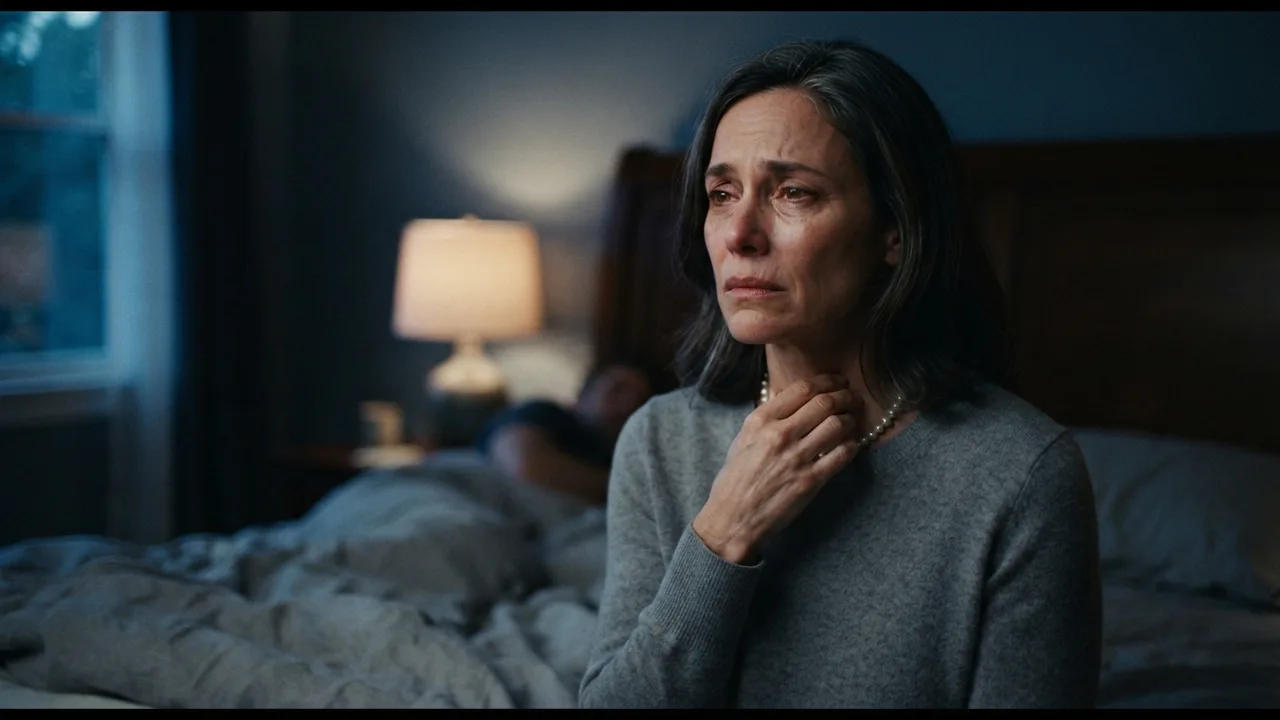
The receipt I found in my husband's coat pocket was for one long-stemmed lilac, the kind I am violently allergic to. It was dated the previous Sunday, from a florist in McKinney, and it landed in my hand the same week I discovered forty-five thousand dollars missing from our retirement savings.
I was carrying Derek's good sport coat to the dry cleaner at the Kroger on Parker Road. Our twenty-fifth anniversary dinner was Saturday, and he wanted the coat pressed. I checked the pockets out of habit, because I manage SecureSpace Storage and I check everything out of habit.
People hide things in storage units. Wedding dresses, tax boxes, a recliner a husband wasn't supposed to buy. I have learned that a secret usually comes with a receipt.
Advertisements
The money had been easier to find than the receipt. I log our balances in a green ledger at the kitchen table on the first Thursday of every month, in pencil. For years I copied the figure from the paper statement Derek brought in with the mail. This spring the bank stopped mailing them, I logged in myself, and the number was short.
Twelve withdrawals, all identical. All to the same recipient, an account number with no name I could read.
I put the coat back on its hanger and drove home with the lilac receipt folded in my purse.
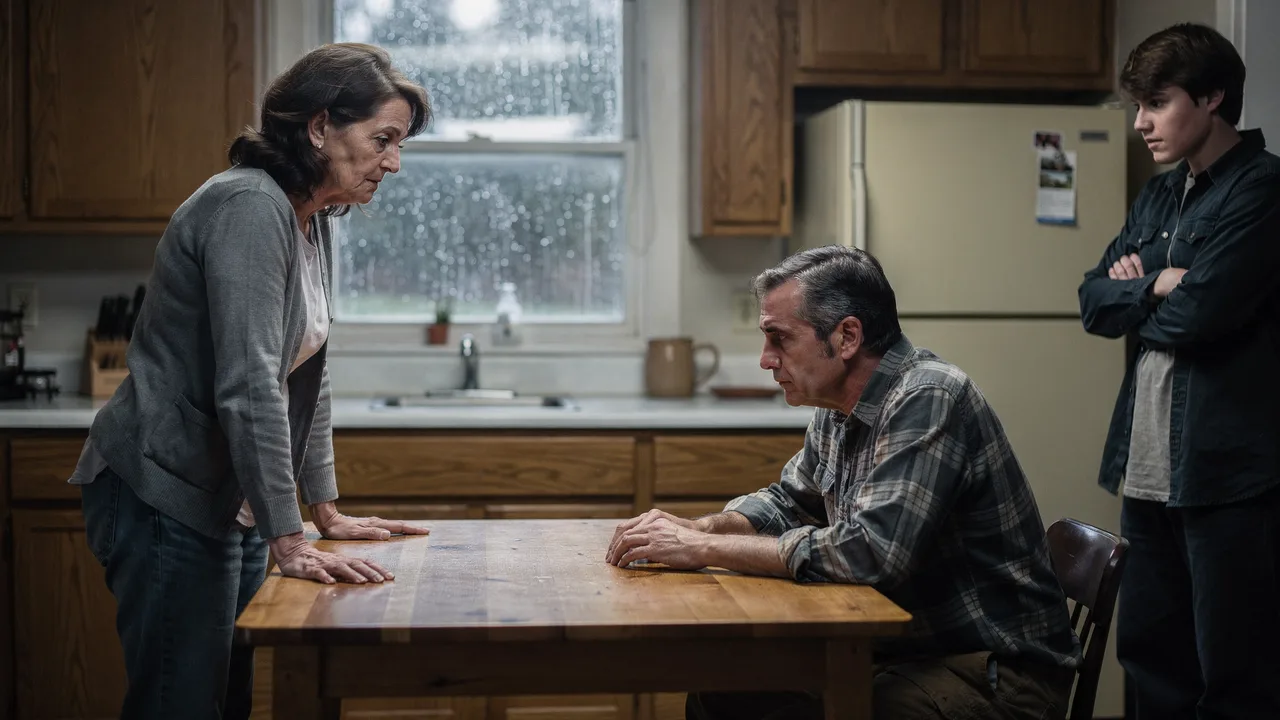
Derek got home at six, smelling of drywall dust and the Texas heat. He set his lunch cooler on the counter and kissed my cheek. I waited until he had a glass of tea in his hand.
"Derek, there's a receipt for a lilac in your coat and forty-five thousand dollars gone from savings. Explain the timeline."
He set the glass down slowly. "You went through my pockets?"
"I was taking your coat to the cleaners. Answer the question."
"It's a private investment, Jan." He rubbed the back of his neck. "It's for us. For later. I was going to tell you."
"What kind of investment?"
"The kind where I ask you to trust me."
I laid the receipt on the counter between us. "Twenty-five years, and you have never once brought me a lilac. You buy roses because of my allergy. So this flower was not for me."
Advertisements
His jaw worked. "I'm not discussing this tonight."
"Who is it for?"
"Trust me," he said again, and took his tea out to the patio.
We ate pot roast in the same room without passing a single sentence across the table. That night we lay back to back, and I counted what I knew like inventory. A missing sum, a flower, a man who had never lied to me about anything that I could prove. The columns did not reconcile.
For the first time in our marriage I felt like a visitor in the house I'd scrubbed and budgeted for. I slept in two-hour pieces.
I called Adam the next afternoon, because he is the person I trust most after his father. He met me at the Whataburger near his school after his last class, still wearing his lanyard. He ordered me a coffee I didn't touch.
I told him everything. The ledger, the twelve withdrawals, the lilac. He listened the way he listens to a student explaining a late paper, with his head tilted and his pen-clicking hand still.
"Mom." He took my hand. "Dad's not a secretive guy. He's a guy who cries at the Cowboys' pregame video."
"Forty-five thousand dollars, Adam."
"Maybe it's a mid-life thing. Maybe he's buying a boat he's embarrassed about." He gave me the kind smile he gets from my side of the family. "Or it's an anniversary surprise that got out of hand. Dad would do that, a big gesture and a bad plan."
"A surprise that comes with a flower I can't be in a room with?"
"You're stressed. The anniversary, work." He squeezed my fingers. "I just don't want you to get paranoid and say something you can't take back."
Paranoid. I had never been called that in my life. I nodded and paid for his fries and drove back to the facility with my face hot.
I had wanted an ally, and what I got was a gentle, loving verdict. I sat in my office with the gate camera feeds running on the monitor and understood that I was doing this alone.
That evening, after Derek went to bed, I opened my laptop at the kitchen table. I found an online financial investigator with good reviews and a clear fee schedule. I paid five hundred dollars from my own checking account, the one Derek has never touched, and uploaded the twelve transaction records.
The report came back Friday evening in a plain PDF. I read it standing up.
The money had gone to The Meadows Memory Care, a facility in Collin County. Each of the twelve payments carried a memo line, and every line said the same thing: *For Elizabeth Sorrell.*
I read the name aloud in the empty kitchen. It meant nothing, and that was the worst of it. I had spent two days braced for another woman, with a face and a hotel and a reason, and instead I had a stranger's name and the words *memory care*.
I looked up the facility's website and printed the page. Then I searched the Collin County clerk's records for *Sorrell*, and at eleven o'clock I found what I'd been too frightened to expect. I paid the fee for a certified copy and sat with my hands pressed between my knees until the page finished printing.
A marriage license. Derek Allen Walsh and Elizabeth Marie Sorrell, thirty-one years old, signed by both of them.
Derek had told me, early in our courtship, that his first wife died in a car accident. He had spent a month in the hospital afterward. He never spoke of her again, except every May, when he went quiet for a week and I learned to let him be.
The timeline did not reconcile. Not even close.
Saturday I cooked a brisket, because Derek likes it and because my hands needed a job. I set the dining room table with the good plates from our wedding, the ones with the gold rim. Adam and Sarah drove in from Richardson, forty-five minutes in Saturday traffic, and arrived with a bakery box and a bottle of sparkling cider.
Derek met me at the door of the bedroom as I fastened an earring. He held out a velvet box.
"Happy anniversary, Jan."
Pearls. A single strand, creamy and even. I let him close the clasp at my neck, and I felt his thumbs shake against my skin.
"They're beautiful," I said. "Thank you."
I wore them to the table, and the folder sat under my chair the entire meal.
Over dessert Derek stood and lifted his glass of cider. Sarah smiled at him. Adam had his phone out, ready to film.
"Twenty-five years," Derek said. His voice was warm and rough. "I married a woman who balances a checkbook to the penny and still lets me eat pie for breakfast. We built this house on honesty and love, and I'm the luckiest man in Plano."
Adam clapped. Sarah wiped her eye. I looked at my husband's face, at how much of it he meant, and I felt the floor of the room tilt.
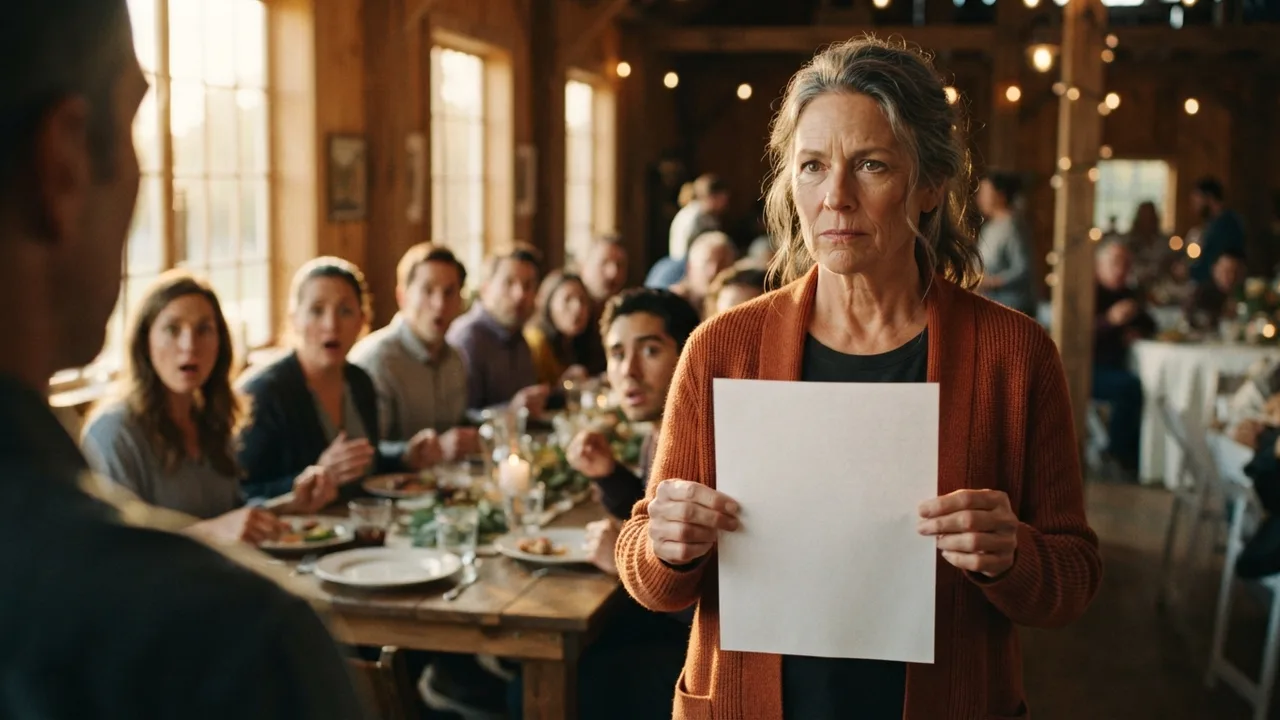
Then I took the thin folder from under my chair and set it on the tablecloth. I pushed it across the gold-rimmed plates until it stopped against his glass.
"Open it, Derek."
He sat down slowly. He opened the cover and the first page was the bank statement, the twelve withdrawals highlighted in yellow. He turned to the printout from The Meadows Memory Care, and I watched the color leave him from the forehead down. The last page was the certificate.
"Derek," I said quietly, "I was told your first wife died. Can you tell me why we've spent forty-five thousand dollars on her memory care this year?"
Nobody at the table moved. Sarah set her fork down without a sound.
"You hired someone," Derek said. "You went behind my back and spied on me." He pushed the folder an inch away. "On our anniversary. In front of our son."
"I paid five hundred dollars of my own money to find out where yours went."
"This is a misunderstanding." He turned his chair toward Adam. "Son, your mother is trying to start a war over a misunderstanding. Elizabeth Sorrell is a relative of a business acquaintance. I've been helping the family out. That's all it is."
Adam was looking at the certificate now. "Dad, why would you have to hide that?"
"Because your mother gets ideas." Derek's laugh came out brittle. "Look at her. Hiring investigators, printing things out. Jan, honey, you're not yourself."
I did not raise my voice. I have managed too many angry tenants to think volume wins anything.
"The certificate has your date of birth on it, Derek," I said. "Your signature, and her name, Elizabeth Sorrell. That's the same name on every payment. You told me she died in the car accident that put you in the hospital for a month. You told Adam the same thing."
I turned the certificate so Adam could read the line with his father's name. His finger followed it to the end and stopped. Then he looked up at Derek's pale face, and I watched my son's whole childhood rearrange itself behind his eyes.
"Dad."
Derek put both hands over his mouth, then lowered them. When he spoke, his voice had broken in the middle.
"She didn't die." He swallowed. "She just left. She was never the same after the crash."
The quiet that followed was the longest I have ever heard in my own house. The refrigerator hummed through the wall, and a sprinkler ticked on somewhere in the yard.
Adam stood up. "Sarah, I think we should go."
"Adam," I said.
"I can't, Mom. I can't be in here right now." He kissed my cheek, hard and fast, and did not look at his father. Sarah squeezed my arm on her way out and said, "I'm so sorry, Janice." Then the front door closed on both of them.
Derek and I sat in the living room with one lamp on. The brisket was still on the table. I had not cleared a single plate, and the fact of it bothered me more than anything he'd said.
"Tell me from the beginning," I said. "Don't leave out one thing."
He sat on the edge of the armchair with his elbows on his knees. "We were married one year. The crash was on Highway 75, a wet night. I got a broken collarbone and a month in the hospital. Elizabeth hit her head on the window frame." He stopped, started again. "She woke up, but she wasn't the woman I married. The doctors used the words *severe injury*. And then, over time, the dementia came in early, and it never stopped."
"Her family?"
"Her mother passed the year after. There was no one else. I signed the papers, Jan. I had no one to hand her to."
The lamp buzzed faintly. I waited until he lifted his eyes before I spoke.
"And then you met me."
"And then I met you." He looked at the carpet. "I was young and I was drowning, and you were the first person in a long time who laughed at my jokes. I couldn't make you share that. I thought, if I say she's alive, she'll be the first thing in every room we ever stand in. So I said she died."
I smoothed the afghan over the arm of the sofa, one pass, then another.
"And you've been paying all this time."
"The house we're sitting in has paid for it. Not directly. I took extra work, a lot of Sundays." He raised his head. "I go on Sundays. I take her a lilac. They were her favorite. She doesn't know my name anymore, Jan. But when I put one in her hand, she knows what it is."
I thought of the receipt on my kitchen counter, and of every May he had gone silent. I had pitied him for a grief that belonged to nobody who was dead.
"I'm not sorry I cared for her," he said. "I'd do that again. I'm sorry I lied to you. I lied to Adam. I put a headstone in my own story and you built your whole life on it."
"Yes," I said. "I did."
"I'll go tonight if you want me to. I'll sign the house over to you. The savings, whatever's left. Anything." His hands were open on his knees, the big builder's hands, and they would not stay still.
I sat with my own hands folded, and I felt nothing I could enter in a column. Not hatred, which would have been easier, and not forgiveness. Twenty-five years of anniversaries and a thirty-year-old lie, and both of them were true.
"I want to say I know what to do," I said. "I don't."
"Jan—"
"I need time, Derek. I don't know how much." I stood up. "Don't leave tonight, and don't ask me for anything either."
"All right," he said. "Whatever you need."
I carried the plates to the kitchen and scraped them one by one, because the work was something I knew how to finish. When the dishwasher was running, I turned off the lamp over Derek's bowed head and walked down the hall.
In the bedroom, the pearl necklace lay in its open velvet box on the dresser, where I had set it down after the front door closed. The strand caught the light from the hallway, creamy and even.
I picked up the box and closed the lid. I opened the top drawer, set it under a stack of winter scarves, and pushed the drawer shut.
Comments