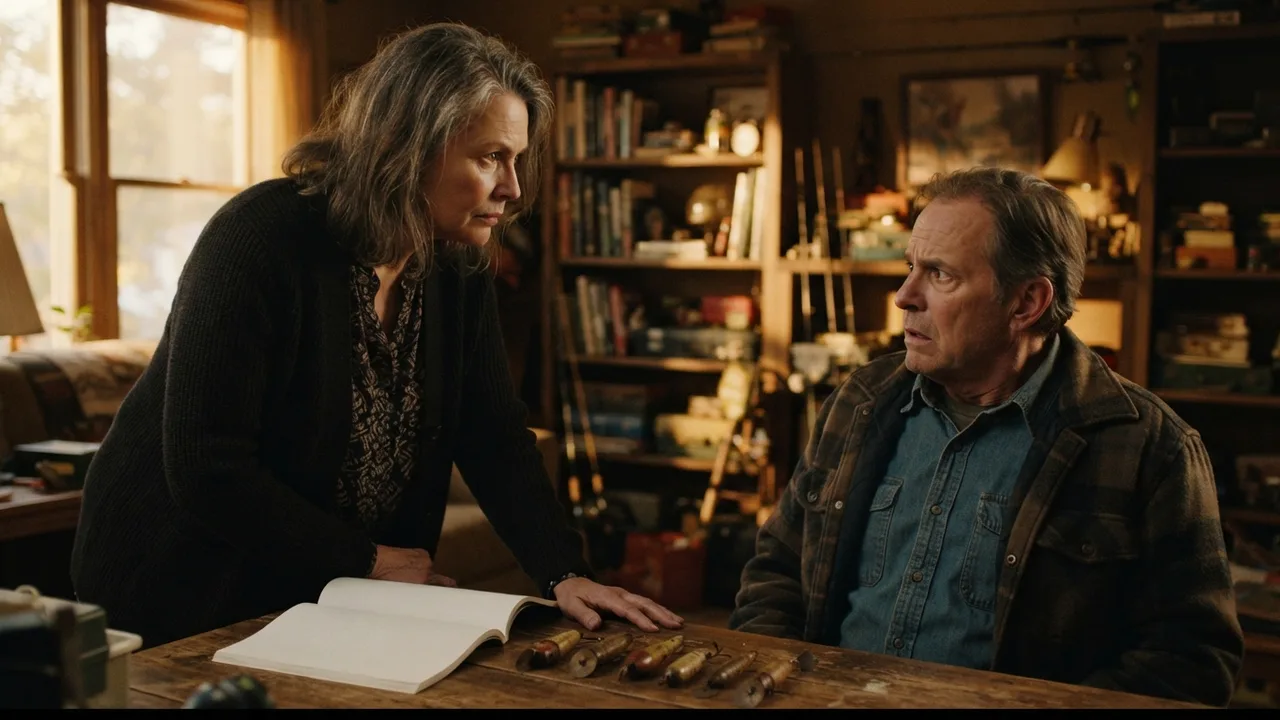
My husband said he sold his father's collection of antique fishing lures for two thousand dollars to help pay for my mother's funeral. I nodded and kept stirring my coffee. Mitchell had paid every bill in this house for forty-five years, and I had never once doubted that the roof over my head and the savings under it were ours.
"Twenty of them, Judy," he said. "Dad's whole collection. A fellow from Springfield came and took the lot."
"Two thousand dollars?"
Advertisements
"The funeral home wanted its money. So did the church hall, and the florist." He squeezed my shoulder on his way to the sink. "Don't you worry about it, hon."
I did not worry about it. For three years the walls of this house in Harrison, Arkansas, had been my whole world, and in the middle of them sat my mother, whose mind went out like a tide a little more each month. I had learned to cut her toast in squares. I had learned which song stopped her crying at dusk. Now she was gone, her afghan was still folded over the arm of the blue chair, and I couldn't make myself move it.
Mitchell had been kind through all of it. He took over the checkbook and the mail. He told me money was tight and we had to protect our retirement, and that my only job was to rest.
I rested for two weeks. Then I picked up a dust rag.
Advertisements
His office was on the second floor, at the end of the hall, and he kept it the way he kept his shirts, squared and buttoned. I started with the bookshelf, and when I lifted the dusty brass lamp I found a manila folder wedged behind it. Inside was an insurance rider dated 2021, one page, with his father's name typed at the top.
It listed a single item. A Heddon "Black Sucker," a wooden lure I remembered from the glass case in his father's den, a fat little black fish with glass eyes. Valued at fifteen hundred dollars.
By itself.
I sat down on his desk chair, which I almost never did. It struck me as odd, and I told myself there was a reason. The paper was old, and maybe the man from Springfield had talked Mitchell down. A man grieving his father's lures and his mother-in-law in the same month might take a bad price.
I put the folder back exactly as I found it, with the lamp on top, and felt like a thief in my own house.
That night Mitchell hummed over his pork chops and asked if I wanted to drive out to the lake Sunday. I said yes. I watched him cut his meat and thought, forty-five years, Judith, and you are checking his paperwork.
The guilt sat on me like a wet coat. It was a week before it came off.
---
He told me about the boat on a Thursday, in the same easy voice.
"Sold the Lund," he said, hanging his keys on the hook by the door. "Ten thousand. Fellow from Branson paid cash."
"The boat? Mitchell, we took that boat out nearly every Sunday since before Ethan left home."
"Engine needed work, sweetheart. Real work. We can't swing it right now, and I'd rather have the cash in hand." He kissed the top of my head. "Don't you worry about it."
My mother had loved that boat. She used to sit in the bow in a hat the size of a pie tin and tell me the lake was her favorite person. In her last year she forgot my name but not that.
After supper I sat in the dark den with the phone and thought about what I was about to do. Then I looked up the marina on Bull Shoals Lake and dialed.
"Lakeview Marina, this is Dale."
"Dale, hello, it's Judith Keller. I think I left my sunglasses on our boat last Sunday, the green ones with the tortoise rims. I wondered if anybody turned them in."
"Mrs. Keller! Let me look." Paper rustled. "Nothing in the box. But I'll tell you what, that boat sure cleaned up nice. Mitch had her detailed and the whole motor serviced last week. Six hundred dollars' worth, and it showed. Runs like a sewing machine."
"I'm glad to hear it," I said. "Thank you, Dale."
"You folks selling her?"
"Oh, no," I said. "I don't think so."
I hung up and stayed in that chair until the streetlight came on. A man did not spend six hundred dollars on an engine he claimed we couldn't afford to fix. He spent it to get a better price from a buyer, and he spent it quietly, and he told his wife the opposite.
I didn't sleep that night. I lay beside him listening to him breathe, and I took every conversation of the past year out and turned it over. The folder he carried to the bank on Tuesdays. The way he'd stopped opening the mail in front of me. How he said "protect our retirement" as if he had practiced it in the truck.
Before dawn I understood that he was not confused, and not mistaken. He was lying to me, and he was good at it.
---
The next Wednesday I told Mitchell I was meeting a friend for lunch.
"Which friend?" he asked, not looking up from the sports page.
"Carol from church. Don't wait supper."
"Have fun, hon."
I had never lied to him in my life, and it came out of me as smoothly as a recipe. That frightened me more than anything yet.
I drove to Berryville with a shoebox of photographs on the passenger seat, pictures of the six antique duck decoys on the mantel and my grandmother's silver set, the one with the monogram nobody in our family could pronounce. Lorraine Haskins kept a shop off the square. I knew her from the church charity drive, where she had priced donated china without ever making anybody feel it was worthless.
She spread the photographs on her counter and studied each one with a little magnifier.
"Judith, who told you these were junk?"
"My husband said they were old things, maybe worth a few garage-sale tables."
"Then your husband hasn't looked at them." She tapped a decoy. "That's a hand-carved pintail, and the paint is original. The silver is sterling, and the maker's mark is a good one. I'd tell you to triple whatever figure he gave you, and I'd still be careful about the low end."
I wrote her a check for two hundred fifty dollars. It came out of my own account at the credit union, the mad money I had put aside a few dollars at a time for forty years. I had once used it for a birthday gift Mitchell didn't know was coming and a cake pan I didn't want to explain.
"You all right?" Lorraine asked.
"I will be," I said.
When I got home he was in the garage, and the kitchen phone's little red light was blinking. I pressed the button, thinking it was the church.
"Mr. Keller, this is Renee Calloway with Gulf Coast Realty in Sarasota, returning your call. We've got your deposit on the two-bedroom condo, and I'll send the paperwork Friday. Looking forward to getting you down here."
I wrote the number on the back of the Kroger receipt in my purse. Then I erased the message, and I stood with my hand on the counter until I heard the garage door rattle.
I was no longer a wife who had run into some odd numbers. I was investigating my husband.
---
The Collier House has a private room in back with a stone fireplace and a long table, and Mitchell had booked it for our forty-fifth anniversary. I'd assumed it was a gift. I put on my navy dress and the pearl earrings he gave me at our thirtieth, and I put a little recorder from Walmart in my purse. It cost nineteen dollars.
That morning I had called the number on the receipt.
"Renee Calloway."
"Hello, Renee. This is Mrs. Keller, calling about the condo."
"Oh, Mrs. Keller! Mitch said you'd be joining him in Florida. He was so excited. The unit faces the water, and I'll hold the deposit as long as you need."
I thanked her. I clicked the recorder off and sat in the hallway with my purse in my lap for a long time.
At the restaurant there were ten of our oldest friends, Wendell and Doris Pruitt among them, and our son, Ethan, with his wife, Carla. Ethan had driven the ninety minutes from Fayetteville in his school blazer and hugged me longer than usual. "You're thinner, Mom," he said. I said I was fine.
We ate the chicken-fried steak the Collier House is known for, and the peach cobbler was already on its way when Mitchell tapped his glass and stood.
"I want to say a few words about my wife."
He did it beautifully. He always could. He called me his rock, and said I had held this family together through the hardest stretch we'd ever known. He spoke about my mother, and the long nights, and the funeral. His voice caught in exactly the right place.
"And we've had to make some tough financial choices," he said, "to get through it. Judy trusted me with that. I don't know many women who would. To my wife."
The glasses lifted. Doris dabbed her eyes. I stayed in my chair.
"Mitchell," I said, into the quiet, "that was a lovely speech. But you and I need to talk about what a tough choice is."
He smiled at the room. "Judy, hon."
I looked at Ethan first, then back at my husband. "Is it a tough choice to sell your father's lures for a tenth of their value? Or was the tough choice not telling me you had the boat engine serviced the week before you sold it?"
Nobody moved. A fork touched a plate somewhere.
I took the little recorder from my purse, set it on the tablecloth, and pressed the button. Renee Calloway's cheerful voice filled the room. *Mitch said you'd be joining him in Florida. The unit faces the water.*
I stopped it.
"The toughest choice must have been calling that realtor in Sarasota yesterday to put a deposit on a condo. I called her back this morning. She was so happy to hear from Mrs. Keller."
His face went white. Then it went red.
He laughed, a harsh, loud bark that made Doris flinch. "Judith, what on earth are you talking about? That could be anybody. Honey, your grief is making you confused."
He turned to the table and spread his hands. "My apologies, everyone. It's been a terrible strain on her."
Then he leaned down, and his voice dropped to something sharp I had heard only a handful of times in forty-five years. "You're embarrassing yourself. You're embarrassing me. Sit down, now."
I was already sitting. He took my hand as though to steady me, and his fingers closed hard.
I pulled my hand free.
"I'm not confused, Mitchell. I am grieving, but I am not confused." I turned to my son. "Ethan, ask your father about the SunTrust account he opened online six months ago. The mailman has known me for twenty years, and he put a statement for it in our box before he could grab it back."
None of it was true except the bank's name, which I had read on a torn envelope in his office wastebasket. The mailman, the six months, the statement in our box, I had built out of a guess and a hope, the way you'd put together a quilt from scraps.
Ethan looked at his father. Mitchell's face had come apart. His mouth opened and shut, and he looked, for one moment, like a man in a photograph of himself taken without warning.
Wendell Pruitt set his napkin down very quietly.
Nobody had to say what they had just watched.
---
By ten o'clock that night the house was cold. Mitchell had left the thermostat low again, the way he always did, and I didn't turn it up.
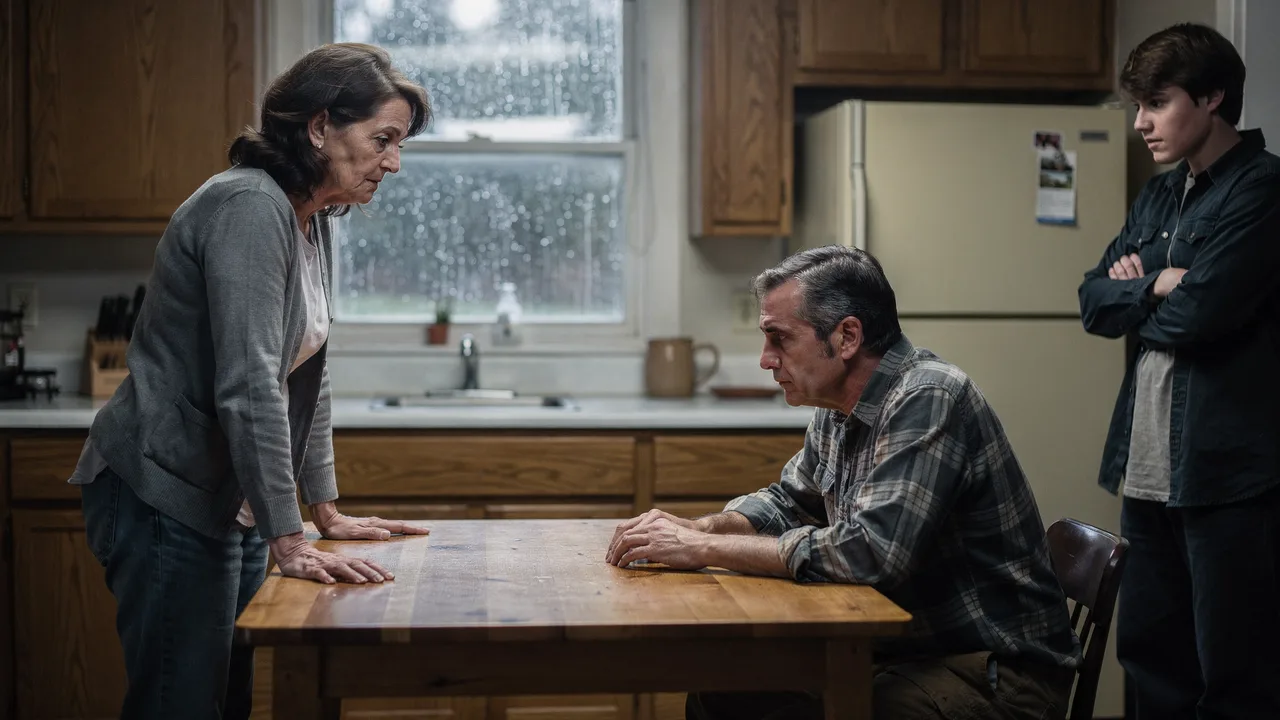
Ethan sat at the kitchen table between his parents with his blazer still on. Carla had taken the car home to Fayetteville. Mitchell sat with his hands wrapped around a glass of water he didn't drink. The salesman had gone out of him, and what remained was a tired old man in a good shirt.
"The mailman never put anything in our box," I said. "I made that part up. I saw the bank's name on an envelope in your wastebasket. Your face did the rest."
"Mom," Ethan said quietly.
"I need to hear him say it, honey."
Mitchell rubbed his eyes. "I was tired, Judy. That's all it was. I was so tired, and you were so far away in that room with your mother, and I thought, I'm sixty-seven, I'll never get these years back. I didn't want a fight. I didn't want anybody to look at me the way you're looking at me now."
"Where's the money?"
"In the SunTrust account. The boat, the lures, some of the silver I already sold in Fort Smith. Most of it's there." He didn't raise his head. "I was going to leave you the house."
"The house that needs a roof," I said.
"Dad," Ethan said, and I saw my son's face and wished I could have spared him that.
"Here is what's going to happen," I said. "We will see a mediator. You will sign the deed to this house over to me, free and clear. I get half of everything, the retirement accounts and every penny you put into that Florida fund, and I'll see the statements myself. And you will be out of this house by Friday."
"Judy, forty-five years—"
"I know how many years it was, Mitchell. I was here for all of them."
He nodded slowly. He did not argue, and that was the worst of it. Some part of me had wanted him to fight, so I'd have something to push against.
Ethan walked his father to the guest room. I stood alone in the kitchen and rinsed a glass that was already clean. My mother's afghan was still on the blue chair in the next room, and I understood that I had won my house and lost the man I thought I'd been living in it with.
I was sixty-five years old, and the only person awake in the house was me.
---
A week later the moving truck pulled out of the driveway with Mitchell's recliner in the back, and I sat down in the rocking chair on the porch. The dogwoods along the fence had dropped their petals, and the evening smelled of cut grass from the Hendersons' yard.
My phone buzzed with Ethan's name on the screen, and I answered it with the porch light still off.
"Hi, Mom. You eat today?"
"I had a biscuit at Sonic," I said. "Don't scold me."
"I'm not scolding." I heard him breathe. "Mom, I keep thinking. Have you thought about the house? It's a lot for one person. Carla and I looked at some places near us in Fayetteville, nice ones, with a little yard. We could be close."
I looked out at the garden. The tomato cages stood in rows where my mother and I had set them, her knees on a folded feed sack, her hands in the dirt, calling every seedling by the wrong name and being right about all of them. The hostas she planted in her first summer here had come up fat and green.
"I don't know yet, honey," I said. "I'm just sitting here, enjoying the peace."
"Okay," he said. "Okay. I love you."
"I love you too."
I hung up without answering him. I watched the sun go down behind my own roof, the one that needed work, and the light turned the porch boards the color of honey.
On the little table beside my rocking chair sat a single antique lure, a Heddon Black Sucker with its glass eyes catching the last of the light. I had found it that morning at the back of the hall desk drawer, wrapped in one of his handkerchiefs. It was the one thing he'd missed.

Comments