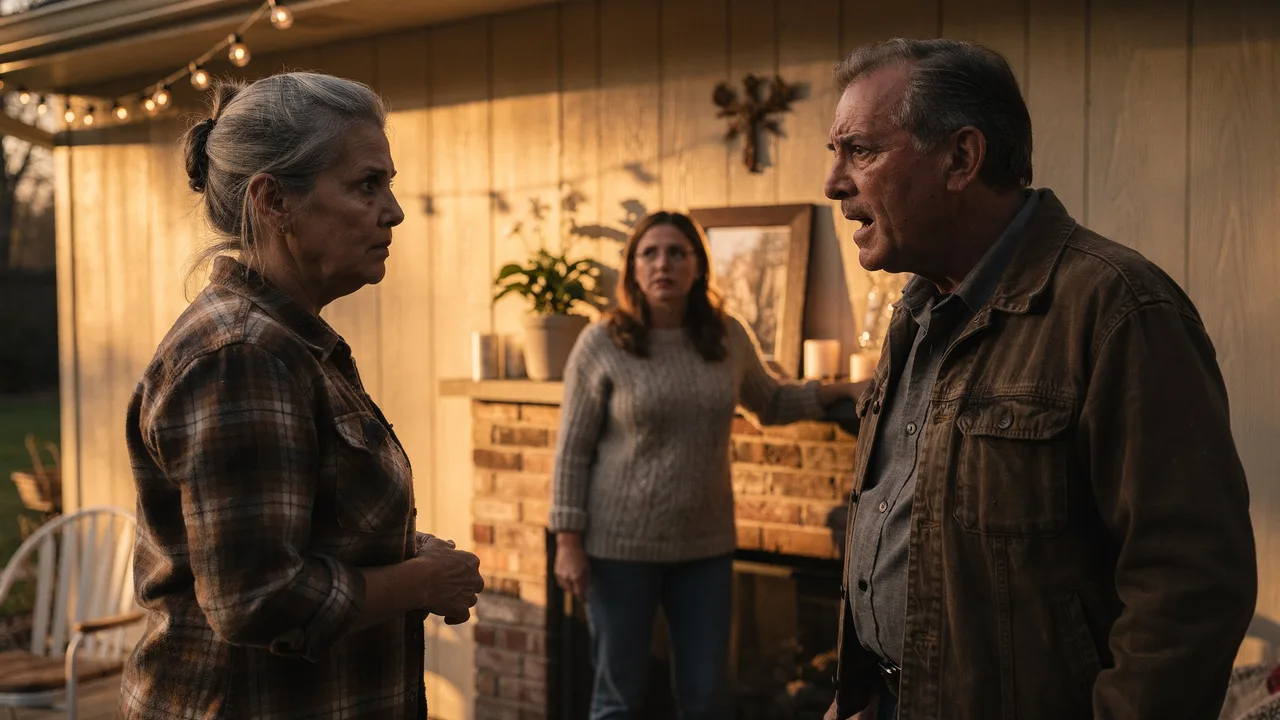
The first time my husband of forty-five years lied to my face, he held a pen in one hand and a quitclaim deed in the other. He had laid the deed beside the butter dish with a yellow flag stuck where my name went, and he wanted it signed before the coffee cooled. Eighty acres, the house, the machine shed, all of it in both our names.
"Sign right there, honey," Jack said. "Lawyer says it puts the farm in a trust for Sean and Bridget. Saves them a mess down the road."
I looked at the paper. Then I looked at him. He had his seed-company cap on at the breakfast table, which he never did, and he was smiling the way he smiled at the co-op when he wanted a better price on fertilizer.
Advertisements
"Why a quitclaim?" I asked. "Doesn't that just take a name off?"
"It moves the name over to the trust. It's the easiest way."
"Which lawyer?"
"The one in town. Maureen, it's just what he said to do."
I'm Maureen Gallagher, sixty-seven years old. Jack and I have lived on this ground our whole lives. He farmed it and I ran the house, the checkbook, the insurance, and the Christmas cards, and for most of those years I thought of us as one hired hand with two heads.
Jack had been retired five years. The Hanson boy rented our corn and bean ground, and we were supposed to be sitting on the porch, drinking coffee and watching somebody else's tractor.
"I'd like to read it first," I said.
His smile stayed where it was, but it stopped reaching his eyes. "Read it? Forty-five years, and you need to read it."
Advertisements
"I read everything, Jack. I read the back of the cereal box."
He set the pen down hard enough to make the butter dish ring. He went out to the machine shed without finishing his eggs. I slid the deed into the Betty Crocker recipe box on top of the refrigerator and stood there with my hand on the lid.
He never brought it up again that day. In forty-five years, a thing Jack didn't push on was a thing he wanted very badly.
On Thursday the mail came, and I walked down the gravel to the box the way I had every day since I was a bride. Jack beat me to the porch. He took the stack out of my hands, said he'd sort it, and slid one envelope out and into his back pocket before I could see more than a corner of a return address.
"Seed catalog," he said.
"Seed catalogs come in the big envelopes."
"This one's a small one." He went inside whistling.
That evening I carried his clean laundry into the den and found his laptop open on the desk. The screen showed a letterhead, blue and green, with a sun drawn over a row of panels. *Apex Solar Development.* I had time to read the name and a line beneath it that began *Re: Gallagher parcel* before he came in behind me and closed the lid with one motion.
"Just the co-op's newsletter," he said.
"Mm-hm," I said, and set his shirts on the chair.
I didn't sleep that night. I lay on my side of the bed, listening to him breathe, and I got up twice to check the porch light, which I knew was on. Around three I stood in my own kitchen in my stocking feet and understood that I was keeping something from my husband for the first time.
It was a strange thing to do in a house I had painted myself. Every board in that floor knew where I was.
On Tuesday morning I told Jack I was driving to Des Moines to see Bridget. I said she needed help picking out centerpieces for the anniversary party, which was a lie that sounded better than most of my truths.
"Take the good umbrella," he said. "It's supposed to rain by noon."
I turned south at the end of our road, and then I turned the other way. The Tama County Courthouse was a twenty-minute drive, and I spent all of it with both hands on the wheel.
I had been in that building for my marriage license, my children's birth records, and my father's estate. I had never once gone to the second floor on my own business.
The woman at the recorder's counter wore reading glasses on a beaded chain and had a Hy-Vee cup of coffee at her elbow, so she was my age or close to it. Her nameplate said Linda.
"Can I help you, hon?"
"I need to look up land records," I said. "I don't know how. I've never had to."
My face went warm. Sixty-seven years old and I had to say that out loud to a stranger. Linda only slid her glasses up her nose and came around the counter.
"Nobody does until they do," she said. "Come on, it's easier than the grocery store."
She sat me down at a computer terminal that smelled of floor wax and radiator dust. She showed me how to type our section number, then the name Apex, then how to sort the results by date. Her nails clicked on the keys.
"Here's a run of them," she said. "Those showed up this spring."
There were leases, one after another. I clicked the first and found Ron Brandt, whose wife had brought a ham to every funeral in our parish since before my mother died. I clicked the next and found Dale Voss. The payment was spelled out in plain type in both: eight thousand five hundred dollars an acre.
I stared at it. Ron Brandt had told me last week at Casey's that his knees were shot and he didn't know how he'd keep the place. He hadn't said a word about this.
"Linda," I said. "Could you look under Gallagher?"
She typed. She stopped typing. She looked at me over the top of her glasses, and I knew before the page came up that she was deciding how to be kind.
It was called a memorandum of option. It named Jack Gallagher as owner and nobody else, and Apex Solar Development as the party that would pay six hundred and eighty thousand dollars for the right to our eighty acres. The last paragraph said the option was good *upon delivery of sole and unencumbered title.*
My name was not on it anywhere.
"What's that last part mean?" I asked.
"It means they want one name on the deed," Linda said quietly. "I'm sorry, hon."
She printed every page. She charged me fifty cents a copy and wouldn't take the tip I tried to leave in the cup. In the parking lot I sat in the Buick with the papers in my lap and watched the rain start, right on schedule, and did not cry.
I made a list instead. He had lied about the lawyer. He had lied about the mail, and the laptop, and the trust. He had wanted me to sign the farm away so he could sell it out from under me, and he'd sat across from me eating eggs.
The part I could not make a list of was the forty-five years. I drove home with the wipers going and rehearsed saying "Bridget's fine."
"How's our girl?" Jack asked when I came in. He was standing at the counter in his stocking feet, and there was nothing in his face but a man waiting for supper.
"Fine," I said. "She sends love."
Now I was a liar too. I hung the good umbrella on its hook.
I could have put the pages on the table that night. I knew how that would go, though. Jack had talked me out of every worry I ever carried into that kitchen, from a hailstorm to a mortgage, and he would have talked me out of this one by morning. He'd have said the paper was a draft, or a mistake, or something the lawyer was handling. I would have wanted to believe him, and that was the trouble.
So on Wednesday I told him I'd sign after the party. I said I wanted nothing hanging over our anniversary.
"That's my girl," he said, and kissed the top of my head.
I put the courthouse pages in my good purse, under the tissues, and zipped it shut.
The party was Saturday at St. Jude's. The kids had planned it, and Bridget had hung a banner in the parish hall that said *45 Years of Gallagher Love* in glittery letters. The long folding tables were covered in white paper, and the coffee urns hissed in the kitchen. A sheet cake from the Hy-Vee bakery, thirty-eight ninety-nine, sat under plastic wrap with two gold rings piped on top.
About thirty people came. Ron and Peggy Brandt took the table by the window. Dale Voss sat near the punch bowl with his hat on his knee. Sean came in a clean shirt with his wife and the kids, and Bridget had driven up from Des Moines the night before, bringing a hot dish nobody had asked for.
Jack was in his element. He worked the room with a hand on every shoulder, laughing at every joke before the end of it. I wore my blue blouse and my mother's earrings and kept my purse on my lap.
After the ham and the scalloped potatoes, Sean tapped a fork on a glass. "Dad wants to say a few words," he said.
Jack stood. He picked up his coffee cup, then put it down and picked up a water glass because the cake was coming and he wanted a toast. He looked around the hall, and he looked at me, and I'll say this for him: he looked sincere.
"Forty-five years," he said. "Maureen, you've put up with me through droughts and low prices and a hog barn that never paid. You raised two fine kids and kept a roof over every one of us. I want to thank you for building a life with me on this blessed land. It's our legacy."
They clapped. Peggy Brandt dabbed her eyes with a napkin. Bridget was crying openly and smiling at once, the way she always had.
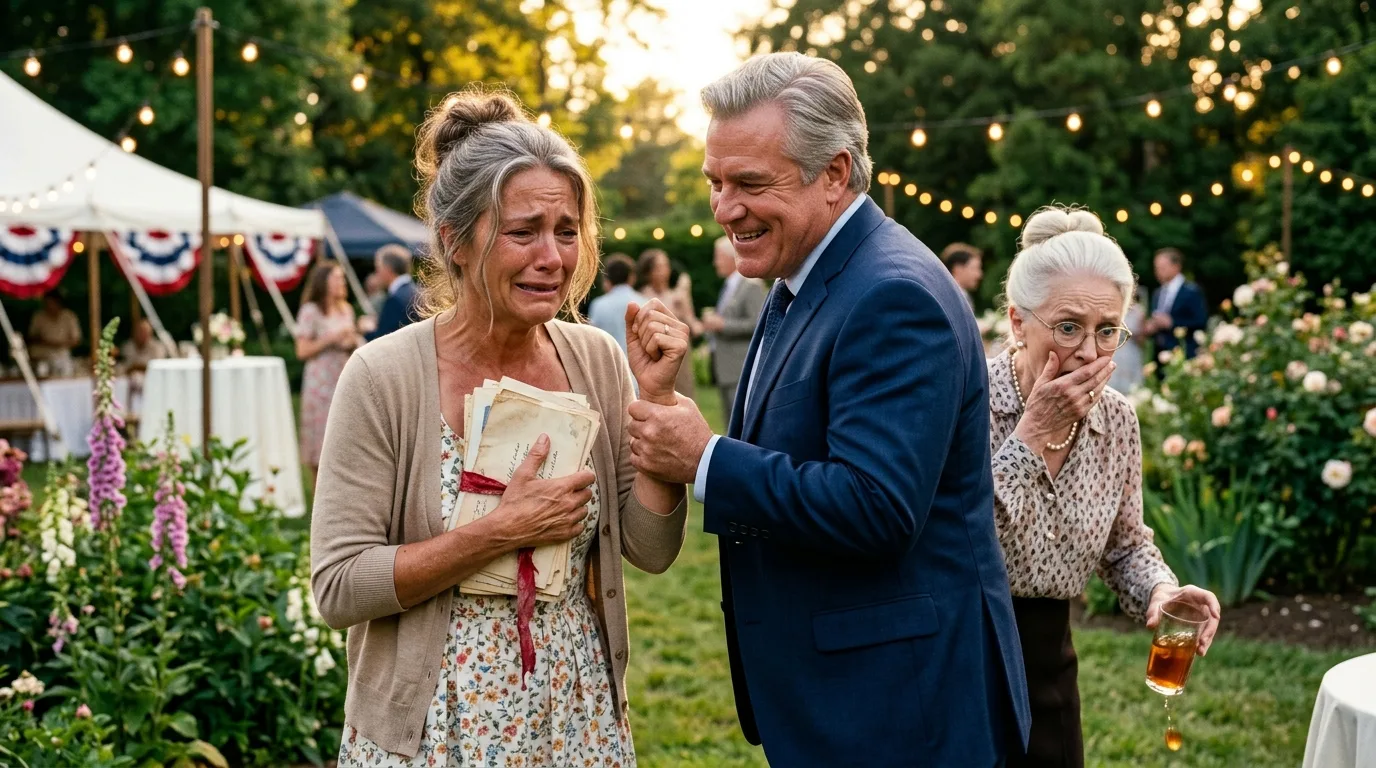
I stayed in my chair until the clapping stopped. Then I stood, holding my water glass, and the scrape of the folding chair carried through the whole hall.
"That was a beautiful speech, Jack," I said. I spoke at the pace I use for reading the announcements at Mass. "Now I think you should tell them about the other legacy. The one from Apex Solar."
Nobody moved. A spoon rang on a plate somewhere and then went still.
I turned to the window table. "Ron, Dale. Did they offer you eight thousand five hundred dollars an acre too?" I looked back at my husband. "Jack, you should have held out for more."
Ron Brandt's face went slack. Dale put his hat on the table.
"And please," I said, "tell the children why you needed my name off the deed before you could accept it."
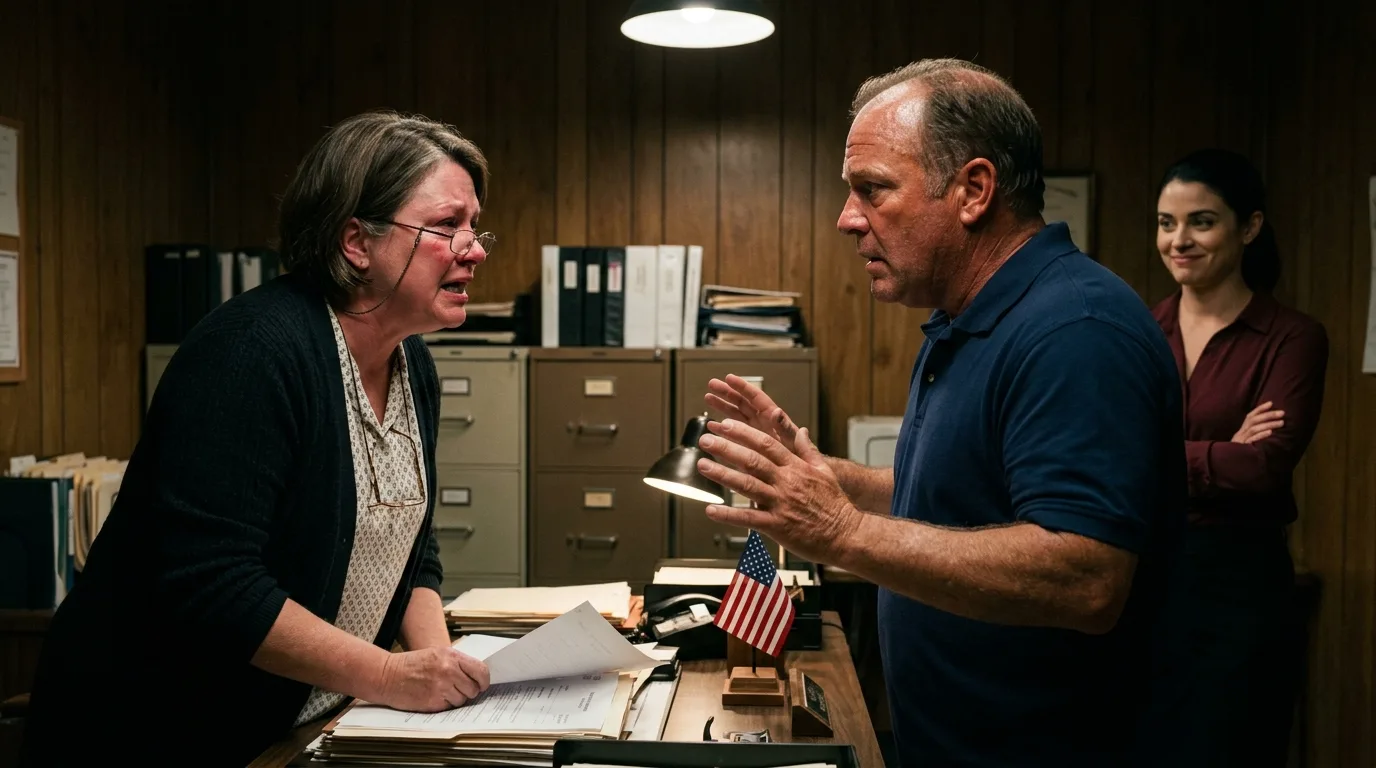
Jack laughed. It came out loud and shaky and too long. "What on earth is she talking about?" He spread his hands at the room. "Mom, you've been working too hard on this party. You're confused."
He turned to Sean, then to Bridget, with the look he used to give them when they were small and he wanted them on his side. "Your mother's getting things mixed up."
"Dad," Bridget said. "What deed?"
"I'm not confused." I said it to Sean, because Sean was the one who trusted his father with money. "Your father is leasing our land for six hundred and eighty thousand dollars, and he tried to get me to sign away my half to make it work. I was at the courthouse on Tuesday. The records are public."
"She told me she was in Des Moines on Tuesday," Jack said, quick and loud. "She lied to me. She's been sneaking around behind my back."
"I did lie," I said. "I told you I was seeing Bridget. I learned how from you."
I opened my purse, took out the folded pages, and walked them across the hall to my son. My knees felt like wet sand. Sean read the first page, and the second, and I watched his jaw work.
"Ron," he said without looking up. "Did Dad ever mention this to you?"
"Apex came to us in March," Ron said slowly. "Dale too. Everybody figured Jack got the same letter. Nobody figured he'd keep it from Maureen."
"Dad, your name's on this alone," Sean said. "It says sole title."
"It's an option. Nothing is final." Jack's face had gone the color of the paper tablecloth. "I was going to tell her after. I was doing it for the kids. For all of us."
"Then why not put it in front of Mom?" Bridget said. Her voice cracked in the middle.
He opened his mouth. Nothing came out of it.
Somebody coughed. Peggy Brandt got up and began collecting paper plates, because that is what you do in a church hall when there is nothing else to do. The murmuring started at the back and moved forward. Thirty people had known Jack Gallagher all their lives, and I watched each of them adjust what they thought they knew.
Nobody cut the cake. Sean's wife quietly took the children out to the van.
By ten o'clock the hall was empty and the cake sat on our kitchen counter with one corner gone, where Bridget had pressed a fork into it and then pushed the plate away. The sheet pan had left a ring of frosting on the Formica.
Sean and Bridget sat at the table across from me. Sean had his jacket still on. Bridget had both hands wrapped around a mug of decaf she wasn't drinking.
Jack was in his armchair in the living room, with the television off. I could see one stocking foot from where I sat. His good boots stood by the back door with the scuff on the left toe from the day he'd kicked the gate, and I knew that scuff better than I knew my own handwriting.
"Is it true, Dad?" Bridget called to him, and her voice broke on the last word.
He didn't answer. The clock above the stove ticked, and the refrigerator started up.
"Dad," Sean said.
Jack looked at the dark television and stayed quiet.
I spoke low, so the children would lean in. "We'll talk to a lawyer on Monday. Not about the solar lease. About everything else."
"Mom," Sean said. "I'll go with you."
"I know you will." I reached over and straightened his collar, which didn't need it. "Thank you for reading it, honey."
Bridget slid a folded slip of paper across the table. She had written a name and a phone number in her round teacher's printing. "She did my friend Annie's divorce," she said. "She's good. You don't have to call her."
"I know."
I put the slip in my blouse pocket. Then I looked through the doorway at my husband, the back of his gray head over the chair.
"Jack," I said. "The deed is staying right here."
He lifted one hand off the armrest and let it fall. That was all the answer I got.
Sean left at midnight. Bridget took her old room upstairs, and I heard her crying through the floor, and I stood at the bottom of the stairs and didn't go up. I didn't have anything to tell her that was true.
In the morning I was up before the birds. I made the coffee strong, carried it out to the front porch in the blue mug with the chipped handle, and set the Betty Crocker box on the little wicker table beside my chair.
I took out the deed. I laid it flat, unsigned, with the yellow flag still sticking out where my name belonged. Next to it I put the notepad, with the lawyer's name copied out in my own handwriting under Bridget's.
Behind me the house was quiet. Jack was in the guest room, or at the kitchen table, or standing at a window. I hadn't looked.
The fields ran out in front of me, black and wet, with the first green of the corn showing in rows. They were my fields as much as his. They had been mine the day I carried my first baby across that yard, and they were mine this morning, whatever he'd signed or tried to.
The phone was on the table by the notepad. I hadn't picked it up, and I could hear the first meadowlark working through its song along the fence. The sun came up over the Hansons' ground and lit the whole yard without asking anyone's leave, and nobody in the world needed anything from me yet.
The pen he had tried to hand me lay on top of the unsigned deed.
Comments