My husband swore the $850 monthly payment was an investment in a friend's fishing boat, but the LLC it went to was registered to a woman I'd never met, in a town he had no reason to be in. By the time I knew that, I had already counted. Thirty thousand six hundred dollars of our retirement had left our account in three years of first-of-the-month transfers.
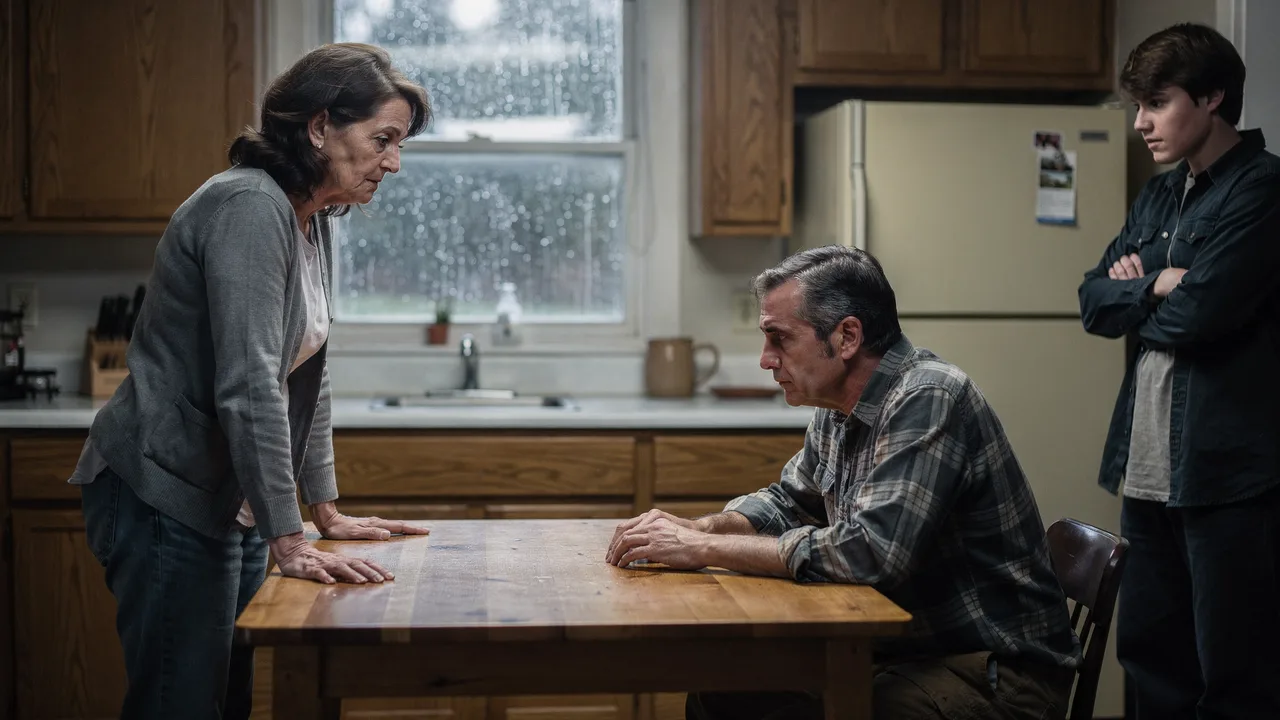
I found it on a Tuesday evening at the kitchen table. I was reconciling statements for the mortgage refinance, with my reading glasses on their chain and a highlighter uncapped.
The line item read ESPOSITO EDUC TR LLC, 850.00. It appeared every month on the same date, with no exceptions and no variation. I highlighted thirty-six of them in yellow.
Advertisements
I am an HR assistant at the Portside Fish Co-op. I spend my days noticing when a timecard does not match a schedule. I know what a pattern looks like.
The statements only went back three years because that was when the credit union folded Richard's old account into our joint one. The balance in our savings was lower than the spreadsheet I'd kept since Matthew was in grade school said it should be. I had a terrible feeling the pattern was older than the paper.
Rain ticked on the window over the sink. Richard's boots sat by the back door where he'd left them, and his lunch cooler sat beside them.
I waited until he came in from the garage.
"Richard, what is the Esposito Educational Trust?"
He stopped with his flannel half off one shoulder. "The what?"
"Eight hundred and fifty dollars, the same day every month. Thirty-six of them." I turned the page toward him. "I highlighted them."
Advertisements
He looked at the page for a while. "That's Gary's boat. I told you. I put money into Gary's boat."
"You said it was a one-time thing, and you never said Gary had a trust."
"It's how he set it up. For the taxes." He picked up the cooler and put it down again. "You went through my accounts."
"They're our accounts."
"You went looking, Sarah. Thirty years, and you go looking."
"I was filling out a refinance application." I kept my voice low. "I wasn't looking for anything. It was just there."
He didn't answer. He took his laptop off the counter and carried it down the hall, and I listened to the keys. He typed for a long time for a man who only used it to check the weather and the mill schedule.
We fought until the dishwasher finished its cycle and the kitchen went dark around us. I said "trust" and he said "snooping." Around eleven I said I would sleep in Matthew's old room, and he did not tell me not to.
The twin bed still had the Trail Blazers comforter. I lay on top of it in my slacks and listened to my own house, which had been safe the day before.
In the morning I noticed the laptop's login screen had changed. It was a small thing.
On Thursday I called Denise at the co-op at seven-fifteen.
"I have a migraine," I said. "I'll need the personal day."
"Oh, honey, of course. Take Friday too if you need it."
"Thank you. I'll be in Monday."
I have never in my life lied to Denise. I put the phone face down on the counter and noticed that my hands were cold.
The Oregon Secretary of State keeps a business registry that anyone can search for free. I have used it a hundred times to verify vendors. I typed the name and the entity came up on the first try: Esposito Educational Trust LLC, active. The registered agent was Loretta Esposito, with an address on Alder Street in Pelton, forty miles down the coast.
I read the name aloud in the empty kitchen. It meant nothing to me.
The cheap printer in the hall gave me two sheets of the registration page. Then I sat there feeling like a spy in my own marriage, a woman in a cardigan running surveillance on a man who still packed his own lunch.
I was sick in the downstairs bathroom, once, and then I washed my face and found my car keys.
That Saturday I told Richard I was driving to the Costco in Warrenton. He said fine and did not look up from the paper.
I filled the tank at the Shell on Marine Drive at $4.29 a gallon and drove south with the wipers going. The road ran along gray water and wet pasture. Somewhere past the elk crossing signs I stopped rehearsing what I'd say to a woman who might have my husband's other life in her kitchen.
Alder Street was four blocks of small houses with trimmed hedges. The one at the address was white with green shutters and fuchsia baskets hanging off the porch rail. A wooden ramp ran along the front steps, sanded smooth and recently stained.
I parked across the street and left the engine off. I took a photograph through the windshield, because I make records.
The front door opened and a young man came out with a lunch cooler. He was in his late twenties, with dark hair and a narrow build, and he wore a utility company jacket. He locked the door behind him, checked the knob, and checked it again.
He was not Richard's son. I looked for Richard in him, in the jaw or the walk or the set of the shoulders, and there was none. I was relieved, and the relief lasted about as long as it took him to back his pickup out of the drive.
An affair I could have understood. I would have known what to do with an affair. This was a ramp and a locked door and a young man who checked the knob twice, and I had no category for any of it.
I drove home on what was left of the tank, past the same pastures. I made a pot roast. Richard ate two helpings and said it was good.
Our anniversary fell on the following Saturday.
Matthew drove in from Portland with trays of food from a caterer in Astoria. It was his gift to us, and he had paid for all of it. He set the table himself with my good plates and two white candles, in a button-down shirt that looked wrong in our dining room.
"Dungeness crab cakes, the roasted potatoes, and marionberry pie," he said. "Don't touch the pie, it's for after."
"It looks wonderful, honey," I said.
Richard sat at the head of the table and ate with his eyes on his plate. I sat at his right with the folded printout in my cardigan pocket. It was warm from my body, and I was aware of it the whole meal.
Matthew stood and raised his glass of sparkling cider.
"I want to say something," he said. "Mom, Dad. Thirty years. I've been to enough weddings to know how rare that is. You've never lied to each other, never given up. Thirty years of perfect partnership. I hope I find half of what you two have."
He drank. Richard lifted his glass an inch, and the candle flame moved in the cider.
I stood up.
My hands were shaking, so I used them. I took the printout from my pocket and set it on the tablecloth beside Richard's plate. Under it I laid a second sheet, a photocopy I had made on my lunch hour that week at the Pelton branch library's machine, ten cents a page.
"Richard, before we celebrate, you need to tell me who Loretta Esposito is. And why you've sent her family what amounts to our entire retirement fund."
Matthew set his glass down hard. "Mom. What are you doing?"
"Asking a question."
"On your anniversary? In front of me?" He looked at his father. "Dad, tell her."
Richard did not look at the paper. "It's Gary's boat, Sarah. We've been over this."
"There's no boat." I turned the second sheet so it faced him. "The Pelton paper keeps its old issues on microfilm. I searched the name Esposito and found this."
He read the headline without picking it up. *Tidewater Mill Worker Hurt on Number Two Line*, with the spring of 1997 under it.
"Hector Esposito," I said. "His wife is Loretta. The paper says he was injured on second shift."
"Plenty of men worked second shift," Richard said.
"You did. I pulled your pay stubs from the tax box in the hall closet. That whole spring, second shift, Tidewater, number two line."
"You went digging through my papers again." His voice climbed. "Matthew, look at this. Your mother drives to a stranger's house, goes to a library, and turns up an accident that happened before you could walk, to spite me at my own table."
"Mom, this is a lot," Matthew said. He did not sit.
"Let me deal with it," Richard said, softer, reaching for my sleeve. "Monday. We'll go through it Monday, just us. Not tonight."
I moved my arm out of his reach.
"Monday, you'll have a better story," I said. "Last Thursday you told me the money went to Gary. Tonight you'd like it to be Monday. I need the true one tonight, with Matthew here, because he's about to be asked to carry it too."
Richard's hand dropped to the tablecloth.
"There's one more line," I said. I picked up the photocopy and read it the way I read policy to new hires. "'Foreman David Pruitt told the paper the line had passed its safety inspection and that no fault had been found.'"
Nobody moved. The refrigerator hummed in the kitchen.
"Grandpa?" Matthew said.
"My father signed off on that line," I said. "And my husband has been paying that family every month since. I want to know why those two facts are on the same page."
Richard put his napkin down very carefully.
"I had a check to do before shift change," he said. He said it to the candles. "Matthew was three weeks old and I hadn't slept. I signed the sheet and I didn't do the check. Hector went in to clear a jam, and the carriage came down."
"Dad," Matthew said.
"He never walked again. Loretta had a baby." Richard's mouth worked. "I went to your grandfather that night. He was my foreman. He said the line would be ruled no fault, that I'd keep my job, and that I'd handle my obligation quietly, like a man, and not drag the family name through it. He told me to start with cash. He told me never to tell you, Sarah. He said you'd never look at me the same."
I heard my father say it, across the kitchen table of my childhood, over a dozen small things. *A man handles his obligations quietly, Sarah.*
I had admired that sentence all my life.
Matthew picked up his keys from the sideboard and held them without moving. "I'm driving back tonight. I can't sit here."
"Matthew," I said.
"I'm not angry at you, Mom." His voice cracked on the last word. "I don't know what I am."
The screen door shut behind him. A minute later I heard his car back out of the driveway, slowly, in the low gear his father had taught him.
We left the dishes. We left the pie.
Richard sat with both hands on the table. I stayed standing, because if I sat I did not think I would stand again.
"The money's gone," I said.
"Yes."
"I can't get it back from a man in a wheelchair. I wouldn't ask."
"I know. I wouldn't let you."
He took out his wallet, the one I'd bought him at Fred Meyer, soft at the corners. From behind his license he slid a photograph with white creases. A man in a mill jacket grinned and held a thermos like a trophy.
"Hector," he said. "I look at it when I go in the bank. The trust ends when Daniel finishes school at the end of this year. I meant to stop and let you never know."
"Monday morning we go to the credit union together," I said. "Every statement goes on the counter. And you drive me to Alder Street and I meet Loretta myself."
"All right."
"Not because I forgive you. I don't know yet what I do."
"I'm not asking you to."
I took the highlighter from the sideboard drawer where I kept it with the pens. I uncapped it, drew one yellow line under Loretta's name on the printout, and capped it again.
Then I cut two slices of the marionberry pie, because Matthew had paid for it, and set one in front of my husband.

Comments