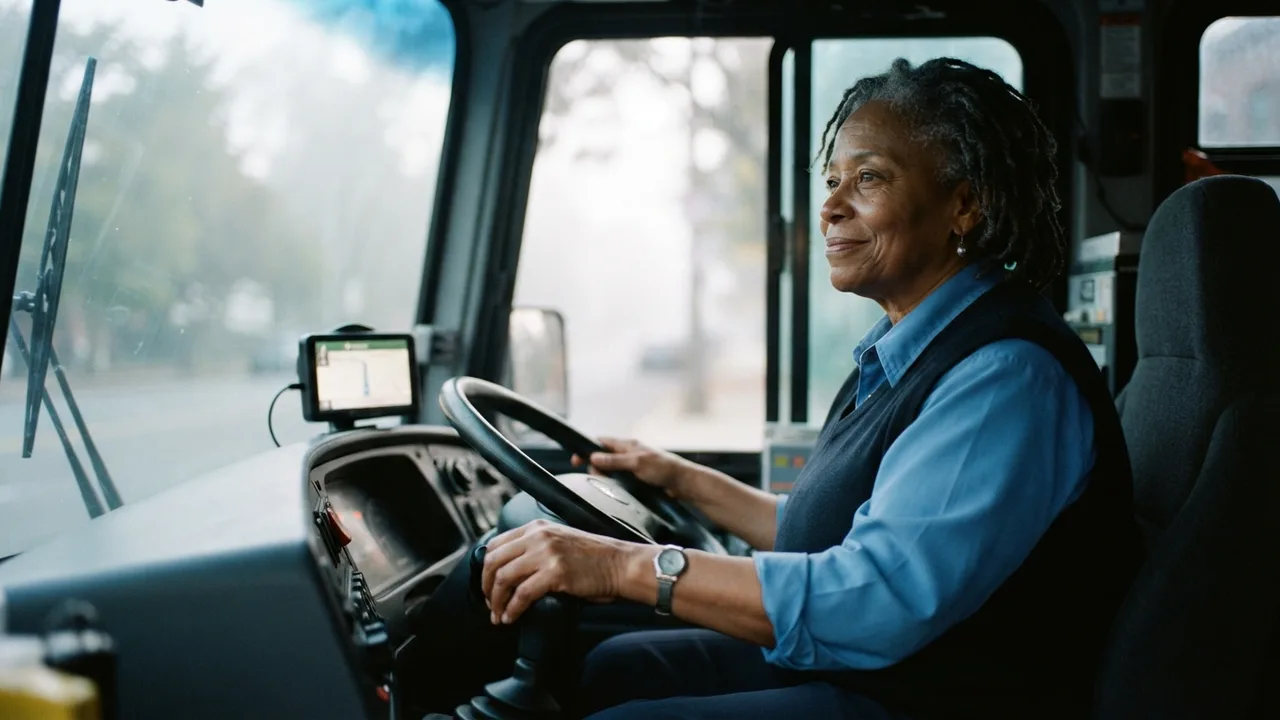
"The GPS will back me up," Barry Temple told our manager, and I knew right then he'd built his lie on the one thing that could also tear it down.
Ron Kline nodded and made a mark on his legal pad. The complaint sat squared in front of him with my name typed in the second line. Under it was the charge that could cost me my job, twenty-eight clean years, and a full pension I was three years from collecting.
I kept my hands in my lap. In the folder beside my knee were four stapled printouts, and I did not touch it.
Fatima sat at the far end of the table in her gray cardigan, a paper cup of tea at her elbow. She looked at the ceiling tiles like a woman counting them. She was there as the union's neutral eye, and she had told me that meant her face did nothing at all.
Advertisements
The fluorescent light over the table buzzed. It had buzzed since the depot was built.
Let me back up to how we got to that room.
It started at the depot coffee machine, back when the maples along Route 332 were still dropping leaves on the depot lot. I drove the senior route, the one that loops from the lake out past the library, the Wegmans plaza and the apartments on Elm, and back. I had driven it so long my hands made the turns before I thought about them.
Barry drove the afternoon express, which he called a stepping stone. He was thirty-four, fit, and always had his phone out, and he wore the company jacket like he was auditioning for a better one.
"Morning, Dee," he said that Tuesday, stirring creamer into a coffee from the machine that charged a dollar fifty. "Heard you held the Lakeshore stop a little long yesterday."
"Mrs. Abramowitz has a walker," I said. "It takes what it takes."
"Totally. I'm just being proactive. Optimizing the whole line, you know? Nobody wants you to get dinged for missing your marks." He smiled. "I'm only concerned."
Somebody at the next table cleared his throat. Nobody looked at me. I took my thermos to the far corner and drank my own coffee.
He did it again the next week, and the week after. Slow on the uptake, he called me, with that smile on. Maybe time to let some new blood take the heavy routes. The old-timers had earned a rest, he said. He always said it loud enough to carry.
Advertisements
I noticed what changed. Gus, who had saved me the chair by the heater for years, started eating lunch in his truck. Two of the younger drivers stopped saying good morning. On the route I caught myself checking my mirrors for Barry's bus, and I braked early for lights I had hit green for decades.
I have never liked the tech on those buses. The GPS box bolted to the dash chirped at me. The camera over the windshield watched me, and the recorded voice announced stops I could have called in my sleep. I treated all of it like a pushy relative. I nodded and ignored it.
Then, on a Thursday, Ron's door opened and he said, "Deirdre. A minute."
His office smelled like burnt microwave popcorn. He sat down behind the desk and did not look up at first.
"Barry Temple has filed a formal complaint," he said. "He alleges you made an unsafe lane change where Main meets Chapel. He says it forced him to brake hard enough that a passenger's groceries went all over the floor."
"When?"
"The report is in my file. The company has to treat it seriously."
"Ron, I didn't cut anybody off. I haven't cut anybody off since before he could drive."
"I'm not saying you did." He turned his pen over. "I'm saying there's a process. You're on paid administrative leave pending a hearing. I need your badge and your route sheet."
I put them on the desk. My badge had a photo on it from when my hair was still brown.
"Paid," I said.
"Paid." He finally looked at me. He was a tired man in a polo shirt that had shrunk in the wash, and I believe he wished it were somebody else sitting there. "Go home, Deirdre."
The bungalow is a fifteen-minute drive from the depot. That day it took longer, because I drove past the turnoff and had to circle back.
I did not sleep. At that hour a house is mostly sounds. The refrigerator hummed, and the furnace ticked on when the lake wind came up. My husband's coat still hung by the back door where he left it ten years ago. I lay there running the route in my head, every stop and every light, and I came up with nothing wrong. That scared me more than a mistake would have, because it meant the story didn't need one.
At six I made toast I didn't eat. At seven I called Fatima's cell.
She told me to meet her at the Tim Hortons on Routes 5 and 20 on her break. She came in wearing her vest over a wool sweater, ordered a medium tea, and sat down across from me without taking her coat off.
"You look terrible," she said.
"Thank you."
"I'm not supposed to say anything about an open complaint." She took the lid off the tea and blew on it. "So I'm going to tell you what I tell everybody. Ask for the incident report. The actual document, not Ron's summary. People get lazy about what's written down."
"What am I looking for?"
"Whatever's in it that doesn't fit." She tapped the table once. "I've been dispatching those buses a long time, Dee. Barry files a lot of paper. Paper's his whole personality."
I laughed, and it came out rusty.
I filled out the request form that afternoon, standing at the depot counter on my day off, in my own coat. The clerk slid the report across without a word. It was two typed pages with the words "proactive" and "safety-forward" in them, and it was not bad work. The incident, it said, occurred at exactly 2:17 PM at the intersection of Main and Chapel.
I stood there holding the page.
At 2:17 that Tuesday I was at the library stop, the better part of a mile from that intersection. I sit there every trip and hold for the schedule. Mrs. Abramowitz had been coming down the library steps with her walker, and I had lowered the ramp. I knew it the way I know my own address.
But knowing it was only my word. Barry had a report with a time on it and a better smile than mine. I'd seen what happens to the older person in these stories, and so had everybody in that depot.
I went back to the counter. "I need another form."
"For what?"
"The full GPS and camera logs. Both buses, mine and Barry Temple's, for the entire day."
The clerk blinked. "Nobody asks for those."
"Then it shouldn't take long to find the form."
It took three days. I called twice, and a man in the county office told me the data might be "inconclusive" if the units hadn't synced, and I had to ask what that meant. I had to learn what a data log was. I sat at my kitchen table with a pot of coffee and a printout of timestamps and coordinates and a Google map on my daughter's old laptop, matching latitude to street names with a ruler and a pencil.
The machines I'd called a nuisance for twenty years had been writing down my day, second by second, without ever once being asked to.
Fatima stopped me in the hallway the morning the logs came. She said nothing, but she looked at the folder in my arms and gave one short nod.
The hearing was on a Wednesday, in the conference room with no windows. The table was long and pale and scratched. Ron sat at the head with his pad. Barry took the chair across from mine and set his phone face down, then picked it up, then set it down again.
Ron read the complaint out loud. It sounded worse in his voice.
"Mr. Temple," he said. "Anything to add?"
"Just that I take passenger safety seriously." Barry leaned forward, hands clasped. "I don't enjoy this, Ron. Dee's a legend around here. But I was right behind her at Main and Chapel, she came across the lane without a signal, and I stood on the brake. A lady's whole bag of groceries went across the floor. Cans, eggs, everything. If I'd been a second slower, somebody could've gone down the aisle."
"I see."
"I did what anybody would. I'm proud of how I handled it, honestly." He glanced at me and let his face go sorry. "And the GPS will back me up."
"Ms. Crowley," Ron said. "Your response?"
I didn't argue. I had practiced arguing in the shower and in the car, and every version sounded like an old woman defending herself. I opened the folder and laid the printouts down one at a time, turned so Ron could read them.
"These are the GPS logs for my bus and for Barry's, for that Tuesday," I said. "Same day, same system, side by side."
Ron pulled them toward him. "Walk me through it."
"Here's my log, the entry for 2:17 PM." I put my finger on the line. "It puts me at the library stop on South Main. That's the better part of a mile from the corner Barry named. I was holding for the schedule with the ramp down."
"And his?"
"Here." I moved my finger across to the other sheet. "Barry's bus at 2:17 is sitting at the light on Main and Chapel. His own report says that's where it happened and when. So at the minute he says I cut him off, I was a mile away and he was sitting at the intersection."
The room got very still. The light buzzed.
Fatima's pen stopped moving.
Barry's smile stayed on, but it had gone stiff at the edges. "Well, hold on. Hold on." He laughed, one note. "Come on, Ron, you know how glitchy that system is. The clocks drift. Maybe the time is just wrong on hers."
"Barry," Ron said.
"It happened at that intersection! It did! She was driving erratically the whole route. Ask anybody. Ask the guys on the lunch shift!"
I had heard those voices over the vending machines. I knew exactly how far they carried and how few of them would say a word out loud.
I looked at Ron, not at Barry.
"The GPS clock is synced to the Naval Observatory, Ron," I said. "It doesn't drift. But Barry has a point. We shouldn't trust one source."
I took out the last printout and slid it down the table. It stopped against Ron's pad.
"That's the timestamp log from the camera on Barry's own bus. It records every hard-braking event with the time, the speed, and what's on the road ahead. The hard stop that spilled the groceries is at 2:24 PM. By then Barry was two blocks past Main and Chapel, on a straight stretch, with nobody in front of him. I was already on Elm Street."
Barry's mouth opened and shut.
"You couldn't have seen that," he said.
"I asked for it," I said. "Nobody told me I couldn't."
Ron picked up the page. He read it. I watched his eyes go down the lines and back up again, and I watched the furrow in his forehead get deeper. Then he looked over the top of the paper at Barry, who had gone the color of the table.
Nobody spoke. Down the hall somebody dropped a clipboard.
"Ron," Barry said. His voice had gone high and thin. "Think about this. I have two kids. I made a mistake on the time, that's all. The point is the safety concern. You can't throw away a whole career over a typo."
"A typo," Ron said.
"A clerical thing! Dee and I can talk about it. Dee. Come on. We work together."
I held his eye. I had been afraid of that man for weeks, and I found I wasn't anymore.
"You braked on purpose on a clear road," I said. "You spilled a woman's groceries to have something to write down. I'm sorry about your kids, Barry. I really am. That doesn't change what's on the page."
He turned to Fatima. She looked back at him with her tea in her hand and nothing at all on her face.
Ron set the printout down. "Barry. Your employment is terminated, effective immediately. Leave your ID and your keys on the table."
"You can't—"
"Now, please."
Barry stood. He took his badge off the lanyard and set it down, and the keys beside it with a small clink. He picked up his phone and put it in his jacket and walked out. The door swung shut behind him. Nobody had said another word.
Ron rubbed his eyes with the heels of both hands. When he lowered them he looked about ten years older than he had a half hour before.
"Deirdre," he said. "My apologies. I should have asked for the raw data myself, and I didn't. The complaint is dismissed. Your record is clear, the way it's always been. Your route starts at six tomorrow morning, if you want it."
I put my copies back into the folder, one at a time, and squared the edges.
"I'll be there," I said.
Fatima walked me out to the parking lot. The sky over the lake had gone the flat gray it turns in late November, and the wind had a little ice in it.
"You didn't tell me you could do all that," she said.
"I didn't know I could."
"You were good in there." She pulled her sweater tighter. "I couldn't say that in there."
"I know."
"Dee." She waited until I looked at her. "Gus asked me about you this morning. He wants to know if he can sit with you at lunch again."
"Tell him the chair's open," I said, and my voice cracked on the last word, and she let it.
But I knew what I'd lost, and it was not a small thing. I had spent twenty-eight years believing that if you did the work right, the work spoke for you. It had taken me a folder and a ruler and a week of sleeplessness to learn that sometimes you have to make it speak. I would drive the next three years past men who'd looked at their shoes while Barry talked. I would nod to them and they would nod back, and we would all remember.
The next morning the depot lot was black and the frost on the windshields had not yet burned off. I let myself in the side door at a quarter to six. Diesel and stale coffee hit me in the doorway, and it was the best thing I had smelled in weeks.
I walked the bus once around, the way I always do, and checked the tires and the mirrors. Then I climbed up into the seat and set my thermos in the holder.
Mrs. Abramowitz was the first one on, at the Lakeshore stop, her walker clicking up the ramp. She looked at me for a moment and nodded. Gus's cousin got on at Gibson Street and nodded too. By the library, the bus was warm and half full, and I had the rhythm back, the lights and the turns and the soft hiss of the doors.
It was just another morning, and it was mine.
As I pulled out from the first stop, I glanced down at the GPS unit on the dash, its screen glowing with the map of my route. I reached out and tapped it, not to shut it off, but to check the time. It was exact, and it was on my side.
Comments