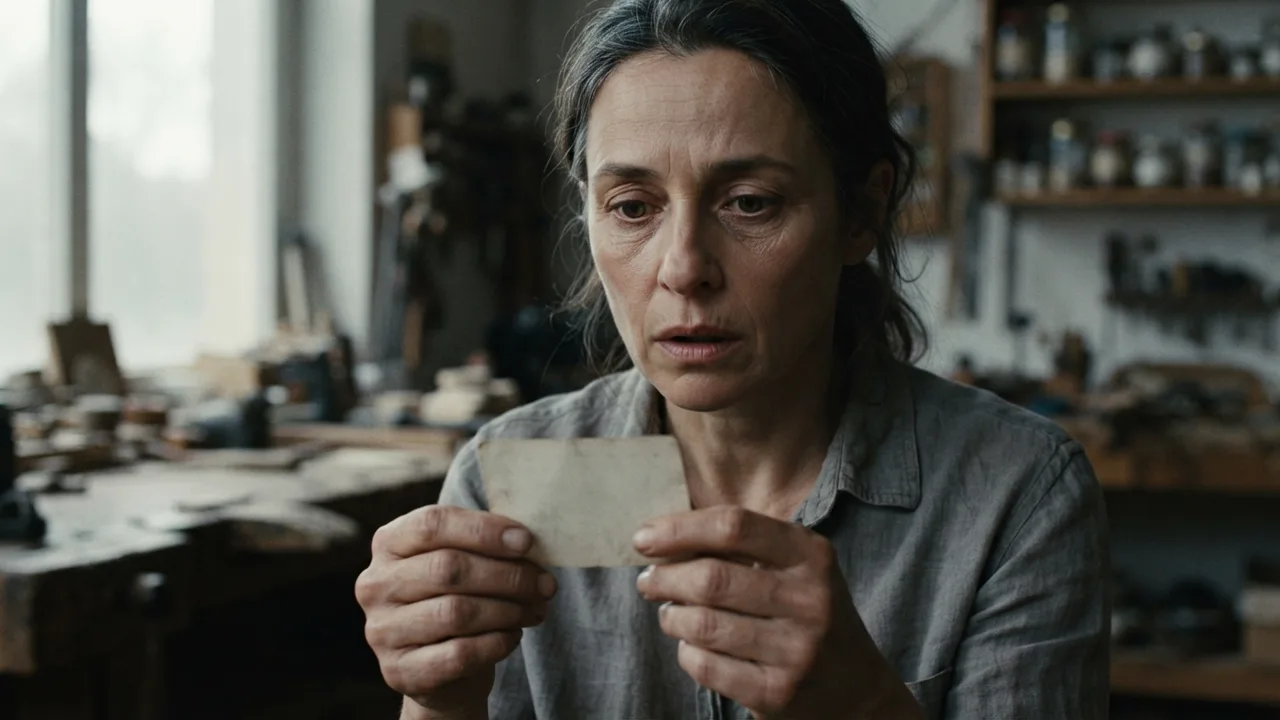
My brother Wayne set the old frame on my counter and said, "Let's give Dad's proudest day the treatment it deserves."
By Thursday I was holding a pawn ticket for our mother's wedding ring, dated the very afternoon Dad was honored in Astoria.
But that came after Wayne left. First he stood at my worktable in a pressed oxford shirt, the only person I knew who dressed up to clear out a dead man's closets, and ran one finger along the dusty edge of the glass.
"Museum glass," he said. "Acid-free everything. Whatever it costs."
"Whatever it costs is a real number, Wayne. Let me see what I've got first."
I turned the frame over. The veneer was oak-look, cheap even for 1996, the staples had rusted through, and the backing board was as brown and brittle as a grocery sack. The certificate read *Citizen of the Year*, with Dad's name, Robert J. Calloway, in gold script flaking at the loops.
Advertisements
"You remember that day," Wayne said. He told it as he told it every Thanksgiving, already smiling. "Straight from a client in Portland, stuck behind a log truck on Highway 30, and I slid into the Elks hall just as the mayor said Dad's name."
"Tie in your pocket," I said. "Libby still tells it."
"Dad stood up there like he was born at a podium. Best day that man ever had."
"Mom cried."
"Mom had one of her headaches," Wayne said. "She left before the cake." He tapped the glass once. "End of next week, Norah. Libby wants to see it finished."
He left with the bell of his Lexus key fob chirping on the sidewalk, and I carried the frame to the bench under the good light.
I work slowly, and I work in order. Glazing points first, then the tape, then the brittle backing, lifted a corner at a time. The certificate came free with a faint brown shadow along its lower edge where the cardboard had been eating it for thirty years.
Behind it was a clipping from the *Daily Astorian*. Dad shook the mayor's hand, and Mom stood at his elbow with her left hand clamped on her purse strap, the knuckles pale in the newsprint. I had always read that as nerves on his behalf.
Advertisements
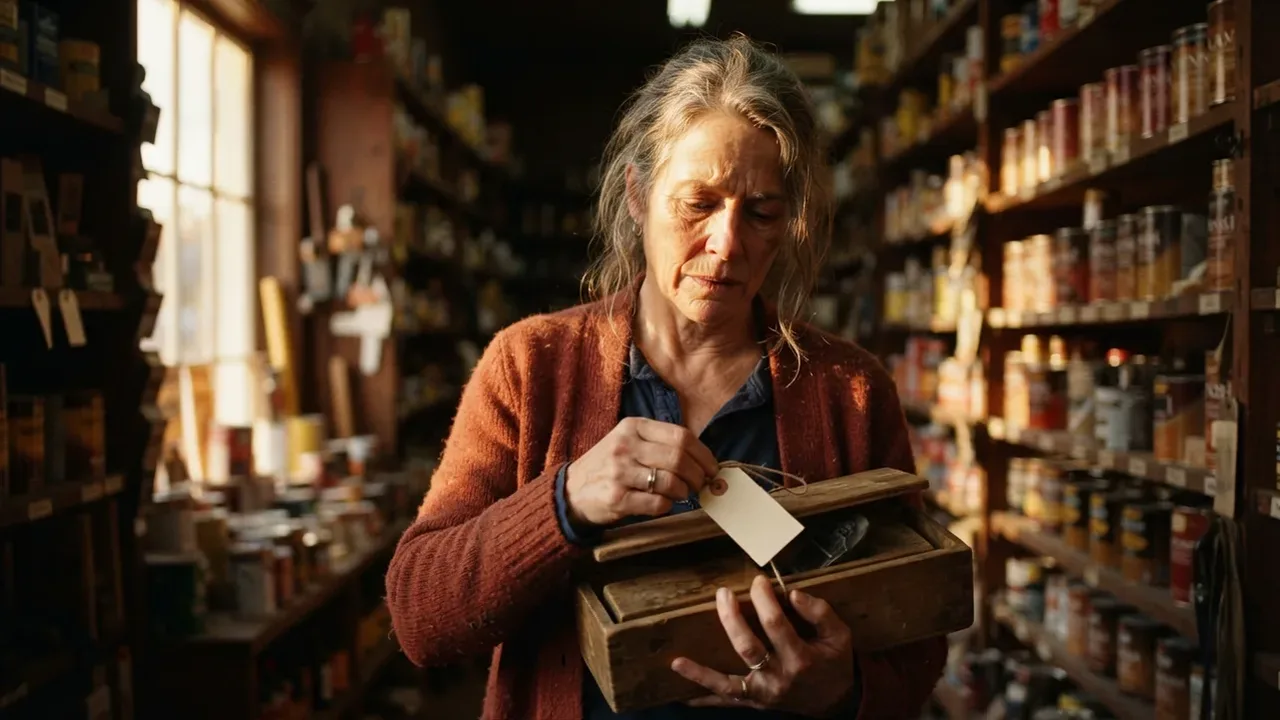
Folded once, flat against the clipping, was a slip of pink paper.
*Burnside Loan & Jewelry, Portland, Oregon.* August 15, 1996. *One 14k gold ladies' wedding band.* A ticket number, a loan amount, and a clerk's initials pressed hard enough to dent the paper.
I set down my bone folder. I went to the back sink and washed my hands, and then I washed them again.
The ceremony was at two o'clock in Astoria. Portland was a two-hour drive, and Dad had been at that podium in front of two hundred people. Mom's ring had been in a pawn shop the whole time.
I called Wayne that night, standing in my kitchen with the ticket on the counter under a juice glass.
"Wayne, it's Norah. I found something behind the certificate."
"What kind of something?"
"A pawn ticket. Burnside Loan and Jewelry in Portland. August 15, 1996. For a woman's wedding ring."
I heard a chair roll back on his end, and then a door close.
"That's nothing," he said. "Dad kept every receipt he ever got. It got swept in when he framed the thing."
"It's dated the day of the ceremony."
"So it's trash. Throw it out."
I held the ticket down with one finger while the furnace kicked on and the vent stirred the edge of it.
"It's Mom's ring, Wayne. Dad was on a stage in Astoria at two o'clock. This shop is two hours away."
"Don't go looking for trouble," he said. The smooth voice he used on clients had gone thin. "He's been gone a year. You want to spend that year picking at him?"
"I'm asking one question."
"You're asking it about a man who can't answer. That's not a question, Norah. That's tarnish." He breathed out hard. "Finish the frame. Burn the ticket. And do not bring this up with Libby."
He hung up before I could say that I had not mentioned Libby.
I did not burn it. I sat at the kitchen table until the rain on the window turned from a patter to a steady drum, and I thought about how Wayne had known, before I finished my sentence, exactly which day I meant.
Two mornings later I called Portland from the shop.
"Burnside Loan and Jewelry, this is Ignacio."
"I'm trying to learn about a ticket from August of 1996."
"Ma'am, paper that old is long gone. But the state wanted our daily logs kept, so back then we put them on microfilm. I can scan you a single day. Fifty dollars."
"Fifty dollars is fine. August 15."
"Give me till Monday. I'll email it."
I paid by card while the kettle boiled, and the fifty dollars was nothing. What I paid for was crossing a line I had never imagined crossing, looking into my own family the way I would look at a crooked miter, hunting for the gap.
The email came Monday at noon. I printed it on the shop machine and stood over the tray while the page slid out warm.
The scan was gray and speckled, a ledger page photographed decades ago. My ticket number sat in the fourth row. *10:40 a.m. Wedding band, yellow gold, woman's.* A loan amount. A box for the customer's signature.
The signature had a looping, showy *W*, the same *W* that had signed every birthday card I had received since I was a girl.
I laid the page in a clean folder and put the folder in the flat file with the ticket. For the rest of the afternoon I cut mat board and could not get one corner to come out true.
Friday morning the shop was bright and cold, the way Astoria is in late April, with the river the color of pewter at the end of the street. Wayne and Libby came in together at ten, Libby in a yellow cardigan, carrying a Fred Meyer bag with lemon bars in it.
"Oh, Norah," she said, before I had the cloth off. "Oh, it's beautiful."
It was. I had used a narrow walnut molding, a linen-wrapped mat the color of oatmeal, and glass that threw back almost no glare. Dad's certificate looked like what Wayne always said it was.
Wayne bent close and admired it for a long time. He ran his thumb along the corner of the frame and nodded.
"This is the standard," he said. "This is how you honor a man. Thirty years from now somebody walks into the house and sees this, and they know what Robert Calloway meant to this town. Integrity. A man who never put a foot wrong."
"He had a good laugh, too," Libby said, wiping her eyes.
"He had a good everything." Wayne straightened his cuff. "Norah, send me the invoice."
I let him finish. Then I took the pink ticket out of my apron pocket and laid it on the counter between the lemon bars and the cash register.
"I have a question about that day, Wayne."
Libby looked from the ticket to me. "What is that?"
"It's nothing," Wayne said. He didn't look at it. "A scrap. I told her so."
"It's a pawn ticket from Portland for Mom's wedding ring," I said. "Dated August 15, 1996. The ceremony started at two in the afternoon, here, and Dad was the man on the stage. Portland is two hours away, Libby. So I've been wondering how Dad could be in two places at once."
Libby's hand went to her collar. "Mom's ring? Mom wore her ring."
"She wore a plain one in later years," I said. "She told us it had been resized."
"It was resized," Wayne said.
"Wayne."
His face changed. The easy authority drained out of it, and what was left was a man with his jaw set against a wind. He picked up a lemon bar and put it down again.
"Fine!" he said. "You want the truth? Dad wasn't a saint. He had debts. He made a mistake, one mistake, and I helped him fix it. Are you happy now, dragging his name through the mud in front of Libby?"
"Wayne, stop," Libby whispered.
"No, she wants it." He turned on me. "I kept that quiet for thirty years so none of you would have to know. That's what a family does. And you spend a year with a dead man's things and a magnifying glass, and for what? Some morbid need to knock down the one thing we had left."
I took the folder from the flat file. I did not hurry. I slid the printout out and pushed it across the counter until it rested against his wrist.
"I don't think Dad signed for it, Wayne."
I tapped the signature line.
"The signature is *W. Calloway*. That's your W. The log says ten-forty in the morning. You went to Portland. Why were you pawning Mom's ring on Dad's big day?"
Nobody spoke. A truck went by outside and the glass in the front window hummed with it.
Wayne looked at the page. His hand came up to touch it and stopped an inch short, and I saw the fingers shake, which I had never seen in sixty years of knowing that hand.
"It wasn't Dad's debt," he said.
"No."
"It was Mom's." He sat down on the stool I keep for customers and put his elbows on his knees. "She'd quit. Years. And that summer she started again, small, a card room off Sandy Boulevard, then bigger, and by the morning of the ceremony a man had phoned the house at seven o'clock. He wanted it settled that day or he'd come to the hall."
"Oh, Wayne," Libby said.
"Dad took me out to the driveway. He had the ring in his fist. He said, 'Son, I have to be in that building at noon, and I have to look like nothing's wrong. Go. Don't speed. Be in your seat by two.'" His mouth worked. "So I went. I paid the man, I drove back behind that log truck, and I walked into the hall with her ring gone and Mom standing at his elbow holding her purse with one hand."
I thought of the clipping, the pale knuckles. She had not been nervous for him. She had been hiding her finger.
"Dad kept the ticket," I said. "He tucked it behind the certificate."
"I didn't know that." Wayne laughed, a short ugly sound. "If I'd known, I would have burned that frame in the yard myself. He must have wanted to remember what the day cost. When you called, I thought, there it is, thirty years, and it's going to come out now."
"You let me think it was Dad."
"I let everybody think whatever was easiest on Mom. After she died, easiest on Dad too. Somebody had to hold the story up." He wiped his face with the back of his hand. "I'm sorry I yelled at you, Norah. You didn't do anything wrong. You looked at what was in front of you. You always do."
Libby was crying openly now, her shoulders shaking under the yellow cardigan. She did not cry for the lie. She went around the counter and put both arms around her brother's neck, and she said into his collar, "All by yourself. You carried that all by yourself."
He let her. He put one hand on her back, stiffly, as if he had forgotten how.
I stood very still and looked at the certificate in its beautiful walnut frame. The man in that gold script had stood on a stage and accepted applause while his wife stood with her hand clamped to her purse, and his son drove two hours home with her ring gone. He had also been the man who taught me to cut a square corner, and I could not make those two men into one.
"I don't think we hang it," I said.
Wayne looked up. His eyes were red. "No."
"No," Libby said.
I lifted the award off the easel and carried it into the back room. I laid it face down on the shelf where I keep finished work waiting for pickup, and I stood a moment with my hand on the cool glass. Then I opened the flat file, found what I wanted, and came back out.
It was a four-by-six color print, faded toward orange as prints from that decade do. Cannon Beach, with Haystack Rock behind us. Dad squinting, Wayne in a ridiculous striped shirt, Libby missing a tooth, me with my hair in a braid. Mom was laughing at something outside the frame, her left hand on Dad's shoulder, and the ring caught the sun.
"Let's frame this one instead," I said. "The real story."
Wayne took the photograph from me by its edges. He studied it for a while, and his thumb moved once across Mom's hand.
"She looks happy," he said.
"She was," Libby said. "Sometimes she was."
"Put a good mat on it, Norah," said Wayne.
"I always do."
They left together at noon, Libby carrying the lemon bars she had forgotten to open, Wayne holding the door for her and then standing a moment on the sidewalk with his hands in his pockets. I watched them go up the street toward the river.
The shop was quiet. I unplugged the printer. I put the ticket and the printout into an envelope and wrote *Eleanor* on the front, because I did not yet know what else to call it.
Then I looked down. On the floor by the trash can, where I had dropped it that first night, lay the old frame, empty and dusty, with its rusted staples still standing in the wood. I left it there.
Comments