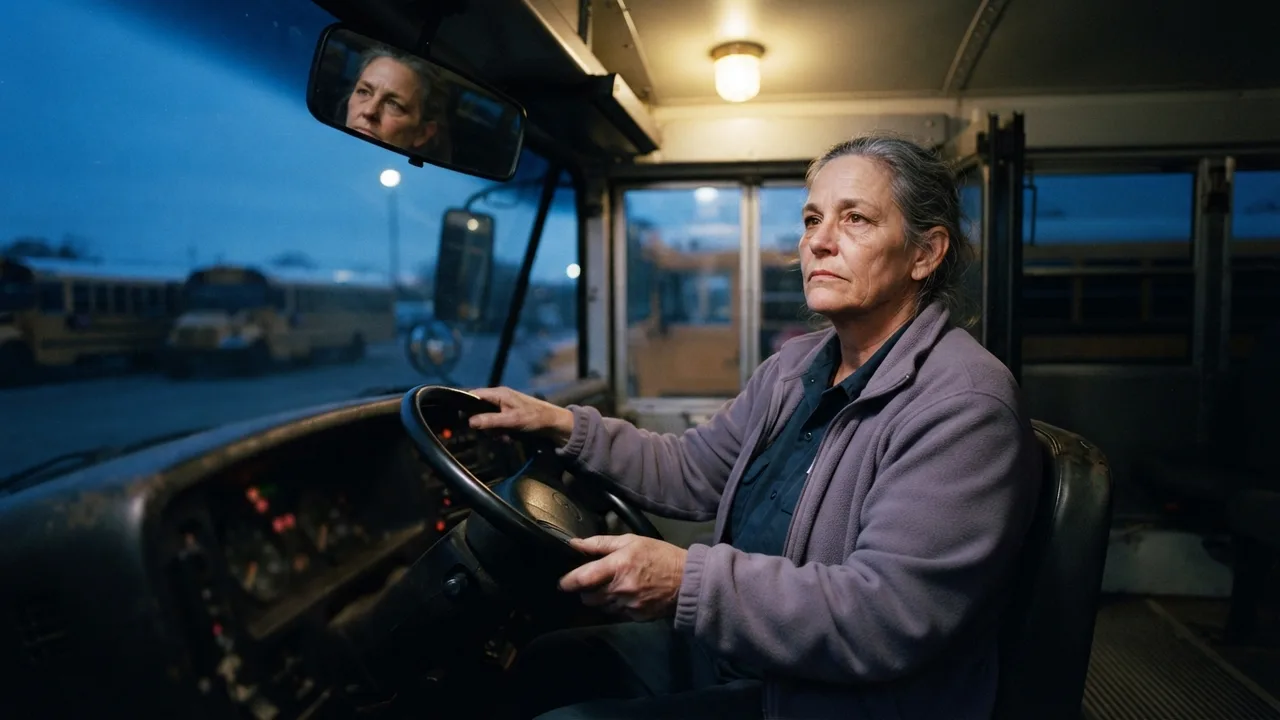
The first time the new director suggested I retire, he called it "a well-earned rest," but I heard "you're too old for this job." I had driven the same route in Verde Crossing for 25 years without a mark on my record. My commercial license was the one thing standing between me and a pension I couldn't draw yet.
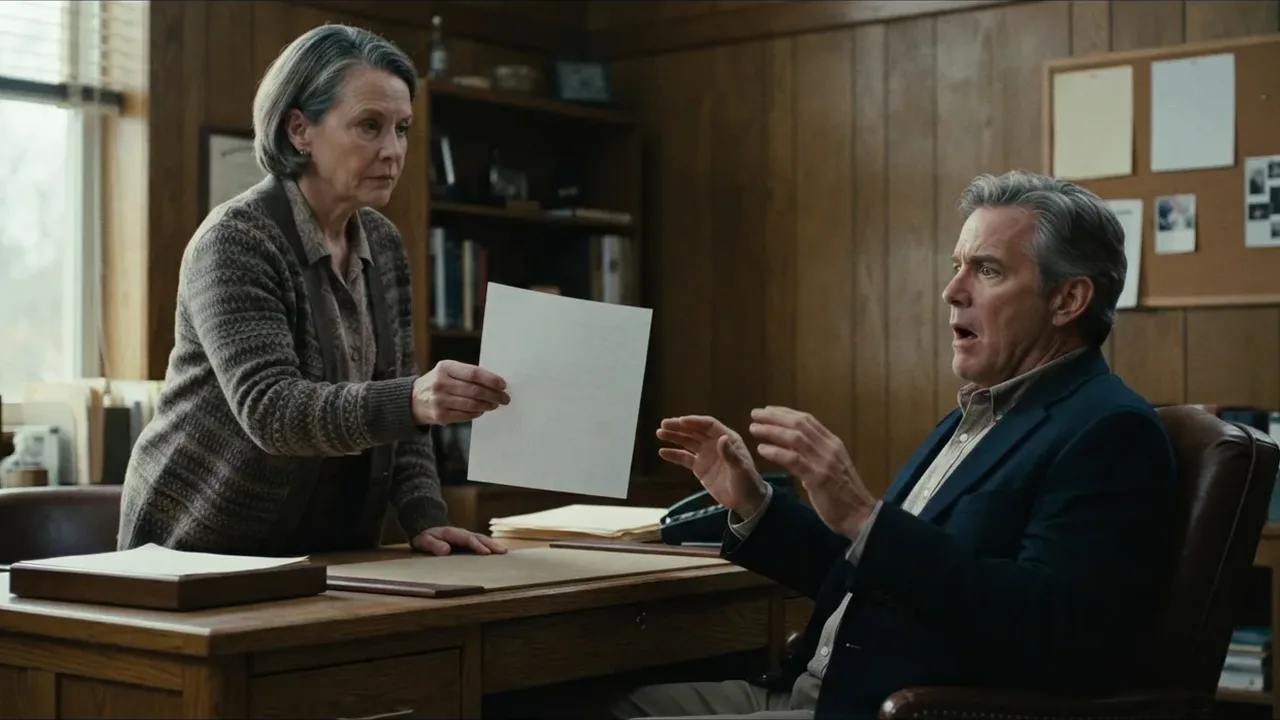
Elliot Grant slid a printout across his desk. It was late September, and the window behind him showed the depot lot going pink with dust from a monsoon that had blown through overnight.
"A parent called Tuesday," he said. "Your morning run came in ten minutes late. I'd like to get ahead of it."
"I wasn't late."
"The caller was specific." He tapped the page. His fitness tracker lit up when he did it. "I'm not here to second-guess you, Pauline. I'm being proactive. Have you thought about how tired you might be getting?"
Advertisements
"I sleep fine."
"I'm only saying, a well-earned rest isn't a bad word."
I folded the printout in half and carried it out to Bus 7. I had never been late without calling it in. Dispatch had every call I'd ever made, and they would tell him so if he asked.
That night I lay in bed and drove the route with my eyes shut. Yucca and Sage, where Tobias waits with his trombone case. The cattle guard on Agave. The long curve past the canyon overlook where the red rocks catch the first sun. I got to the end of it and started over, and the clock on my nightstand said it was nearly morning.
On Verde Canyon Road at 7:42, Melissa Corbett's bus passes mine going the other way. It has done that every school day since she started four years ago. She waves, her ponytail swings, and I wave back.
She was waiting by my bus the next morning with two cups from the Circle K.
"Hazelnut, extra cream, just how you like it," she said. "I heard about Elliot's little chat. Oh, Pauline, that's just awful. Don't you worry, we all know you're the best driver here."
"Who told you about a chat?"
"Hector, I think? You know how the dispatch window is." She squeezed my arm. "Honestly, if you ever need me to cover a run, I'm right there."
Advertisements
I thanked her and drank the coffee. It was good coffee.
The second complaint came the following Monday.
Elliot didn't ask me to sit this time. He stood behind his desk with a binder open and a form on top of it.
"A caller reports that your bus skipped the stop at Yucca and Sage," he said. "A child was left standing at the corner."
"Tobias was on that bus. I counted him on and I counted him off."
"The caller says otherwise. And the call is logged." He turned the form toward me. "I have to put you on a Performance Improvement Plan. It's standard, it's not punitive, and it's a chance to demonstrate your—"
"Standard for who?"
"For anyone with a documented concern."
I signed where he pointed. My signature looked like somebody else's. In 25 years the only paper I'd ever signed in that office was a birthday card.
The break room went quiet when I walked in for my thermos. Dwayne, who has driven the Cactus Flat run since before I started, studied his sandwich. Two of the newer drivers found something on their phones. Melissa was the only one who looked straight at me.
"Honey, ignore them," she said, loud enough for the room. "People love a story."
I filled my thermos at the tap. My hands were steady, and I noticed that the way I notice the oil pressure gauge.
The voicemail came on a Thursday.
Elliot played it on speaker. The voice was tinny and pitched wrong, like a recording of a recording.
"I'm calling about the school bus that blew through the stop sign at Aspen Court and Juniper Crest Drive. I watched it from my front window. It didn't even slow down. Somebody could have been killed."
The message ended with a click.
"Juniper Crest," I said.
"The new subdivision off Canyon Road." Elliot closed the binder. "Pauline, I have to take this to the school board. If they act, the first thing they do is review your license. I've put together an early retirement package. It's generous. If you sign before the board meets, it's your decision and not theirs."
"Who have you told about this?"
"Nobody. The board hasn't seen it."
"Then somebody in the depot has a good imagination."
"I don't know what you mean." He looked honestly confused, and that bothered me more than anger would have. "I'll set up a meeting. A final chance to go over the paperwork. I'll ask a colleague to sit in, somebody supportive."
In the hallway Melissa caught my sleeve and said, "Don't let them pin that stop sign on you, Pauline." Hector's dispatch window was shut, and the shift-swap sheet taped to the glass had Ray's name penciled over Hector's for that Thursday.
I went home and sat at my kitchen table with my route sheet and a pencil. Aspen Court and Juniper Crest Drive were not on my route. They were not near my route. My bus had no reason to be within sight of that stop sign at any hour.
So why would a caller say they'd watched me from a front window?
I drove out Saturday morning in my own car. The entrance sign had been put up the year the lots were graded, a wooden arch with a painted juniper on it. The streets were new, black and smooth, with curbs no one had ever parked against. Every house was a shell of stucco in two shades of tan.
I parked at the Aspen Court stop sign and got out. Nothing had been dropped on those lawns, not a hose or a bike or a flag. The front windows had no curtains. In the one nearest the corner I could see straight through the house to the desert on the other side. A tumbleweed had lodged against a lockbox on the front door.
I stood there a long while. Then I walked the block, and not one house had a car in the drive.
Hector at dispatch was eating a Fry's rotisserie chicken out of its plastic dome when I leaned into his window on Monday.
"Hector, I need the log on those three complaint calls. Time and tower."
He wiped his fingers. "Elliot's got those."
"Elliot has the notes. You have the system log."
He looked at me, then at the hallway, then he pulled a chair up to his screen. "I'm not supposed to print this for you."
"Then print it for the district. Somebody's going to ask."
The printer hummed. He handed me three pages, and he didn't say anything else. On the way out I read the column headed Tower, and I read it again in the car with the engine off.
The County Assessor's office had a counter and a woman with reading glasses on a beaded chain. I asked for the plat map for Juniper Crest. She came back with a long sheet that had to be folded in thirds to fit my bag, stamped last month, and every lot on it was marked unoccupied.
At the Water & Power counter, a young man—I never got his name—typed the subdivision into his computer, frowned, and typed it again. He printed the page. Zero active residential accounts. I asked him to say it out loud so I'd know I hadn't misread it.
"Zero," he said. "Nobody's hooked up out there yet."
Then I went home and ironed my blue polo, because I wanted to look like myself.
The meeting was Friday afternoon. Elliot had set out three chairs and a folder. Melissa was already in the one beside the window, and she stood and hugged me before I had my bag off my shoulder.
"I told Elliot I'd be here for you," she said. "I'm just so sorry it's come to this."
"Thank you for coming, Melissa," Elliot said. "She'll also be talking through logistics, Pauline. Covering Bus 7 temporarily while the transition happens."
"Just temporarily," Melissa said. "Until we get you settled."
Elliot opened the folder. "So. The retirement package. It includes a bridge payment until you reach full pension age, and the district would—"
I took the plat map out of my bag and put it on his desk. It was thick and creased from the folding.
"Pauline, I'd like to finish—"
"You will." I unfolded it, one panel and then the next, until it covered his keyboard and half his blotter. "After the third complaint, I went to the County Assessor. This is the plat map for Juniper Crest. It's dated last month. Every lot on it is marked unoccupied."
"I don't see how—"
"Here's the second page." I set the Water & Power printout beside the map. "Zero active residential accounts in the whole subdivision. No power, no water. I drove out there on Saturday. You can see straight through the front window of the house on the corner of Aspen Court."
Elliot looked at the map. He looked at the printout. He didn't say anything.
"The voicemail said somebody watched my bus blow that stop sign from a front window," I said. "There's no one in those houses to watch from. And my route doesn't go anywhere near it."
Melissa's hand was at her throat.
"Pauline, that's horrifying," she said. "Who would do such a thing to you?" She turned to Elliot. "Somebody's been lying. This is a disgrace. It's got to be some parent with a grudge, don't you think? There was that man on the Agave route who yelled at Dwayne last spring."
"Could be," I said.
I took the third sheet out of my bag and laid it on top of the plat map, over the corner of Aspen Court.
"This is the dispatch log. The complaints were anonymous, but dispatch records the cell tower every call connects through. All three came from the tower on Highway 89A, the one that serves your apartment complex, Melissa."
She laughed. It came out high. "Half the town is on that tower."
"Maybe. And the second complaint, the missed stop, was logged at 7:42 in the morning. That's the exact time your bus passes mine, going the other way. You wave at me every day."
"I'm on hands-free all the time. Everybody is."
"Then here's what a hands-free phone doesn't cover." I kept my eyes on her. "Elliot played me that voicemail on a Thursday, with the door shut. When I came out into the hall, you caught my sleeve and said, 'Don't let them pin that stop sign on you.' Elliot, who had you told about the stop sign?"
"Nobody," Elliot said. "I said so to your face. It isn't in the binder. It isn't anywhere."
"Hector told me." Melissa said it quickly. "You know how the dispatch window is."
"Hector's window has a swap sheet taped to the glass," I said. "That Thursday, Ray's name is penciled over his. I read it standing right next to you."
Elliot reached for the desk phone and pressed the button for dispatch.
"Hector, it's Elliot. Were you in on Thursday of last week?"
"No, sir. Ray had the window. I was at my sister's." The speaker crackled. "Why, what happened Thursday?"
"Did you talk to Melissa about a stop sign?"
"A stop sign? No, sir. I didn't know about any stop sign."
Elliot let go of the button. Nobody in the room moved.
"So Ray, then." Melissa's voice had climbed. "Somebody. People talk, Elliot, I can't be expected to remember who said what in a hallway." She turned on me. "Pauline, you're twisting this. You've been under so much strain. Maybe that's all anyone was saying. Maybe you really are tired, and you're making a lot of paper out of nothing."
"I'm not tired of anything but this."
"I only wanted you taken care of." She was talking to Elliot now. "If she signed the package, she'd get her bridge money, I'd cover Bus 7 for a while, and nobody gets hurt. It was a kindness."
"You put Tobias in a complaint," I said. "A boy who plays the trombone, left on a corner. You used a child's name so I'd look careless."
"I never said his name."
"It's on the form, Melissa. Elliot read it to me."
She opened her mouth, and nothing useful came out of it. She said she'd never, and that this was so unfair, and then that she'd only been trying to help, and each sentence ran into the next without arriving anywhere. Her ponytail had come loose on one side. She pushed at it, and her face had gone the color of the stucco in Juniper Crest.
Elliot stood. He was looking at the map and then at her, and I watched him put the two together.
"Melissa, I'm suspending you, effective now," he said. "The district will conduct a full investigation. Please leave your badge and your keys on the desk."
"Elliot, you can't just—"
"Please."
She put them down. The keys slid across the blotter and stopped against the edge of the plat map. She picked up her bag and stopped at the door.
"Four years I've waved at you," she said.
"I know," I said.
The door closed behind her with a soft, ordinary click.
Elliot sat down. For a moment he rubbed his forehead with the heel of his hand. Then he reached across the desk, picked up the Performance Improvement Plan, and tore it in half, and again, and dropped the pieces in the wastebasket.
"I was wrong, Pauline," he said. "I took a stack of phone calls over twenty-five years of clean driving. I should have pulled your file and talked to the drivers, and I should have checked the address. I'm sorry."
"You'll want to take the retirement papers off your desk," I said. "I'm not signing them."
"Of course." He slid the folder into a drawer. "Of course not."
I folded the map back into thirds along its creases. "I accept your apology, Elliot."
That was all I said. He seemed to be waiting for more, and I let him wait.
Outside, the lot had dried to the color of a brick. Dwayne was by the fuel pump with his thermos, and he took a step toward me with his hand half out, like a man in a receiving line at a funeral.
"Pauline, I never believed it," he said. "Not for a minute."
"Thanks, Dwayne."
"If there's anything you need—"
"I need to get home."
Two of the newer drivers watched me cross to my car with their faces arranged in sympathy. I knew every one of them by name, and I knew their kids' names, and not one of them had said a word to me in the break room when I'd needed it. They would be kind now. That was going to be worse.
I didn't sleep much that night. I wasn't scared anymore. I was tired in my bones, like after a field trip day with no air conditioning, and I lay there thinking about the coffee. Hazelnut, extra cream. I had told her how I liked it once, years ago, in passing, and she had kept it ever since.
I thought about 7:42 on Verde Canyon Road, and whoever would be driving the other bus, and whether I would lift my hand.
Monday morning I got to the depot before the lot lights switched off. Bus 7 was where I had left it, nose out, with a little red dust on the windshield from Friday's wind.
I climbed up and set my thermos in its holder. I checked the stop arm, the lights, and the emergency door handle, in the order I had checked them since the first year, and I ran the wipers once across the dust.
Then I reached up and adjusted the big mirror over my head, the one I use to watch the children. It had drifted a little. I tilted it down until the empty seats filled the glass, row after row, and my own face came into the corner of it.
My eyes were steady. I looked at them for a good while before I started the engine.
Comments