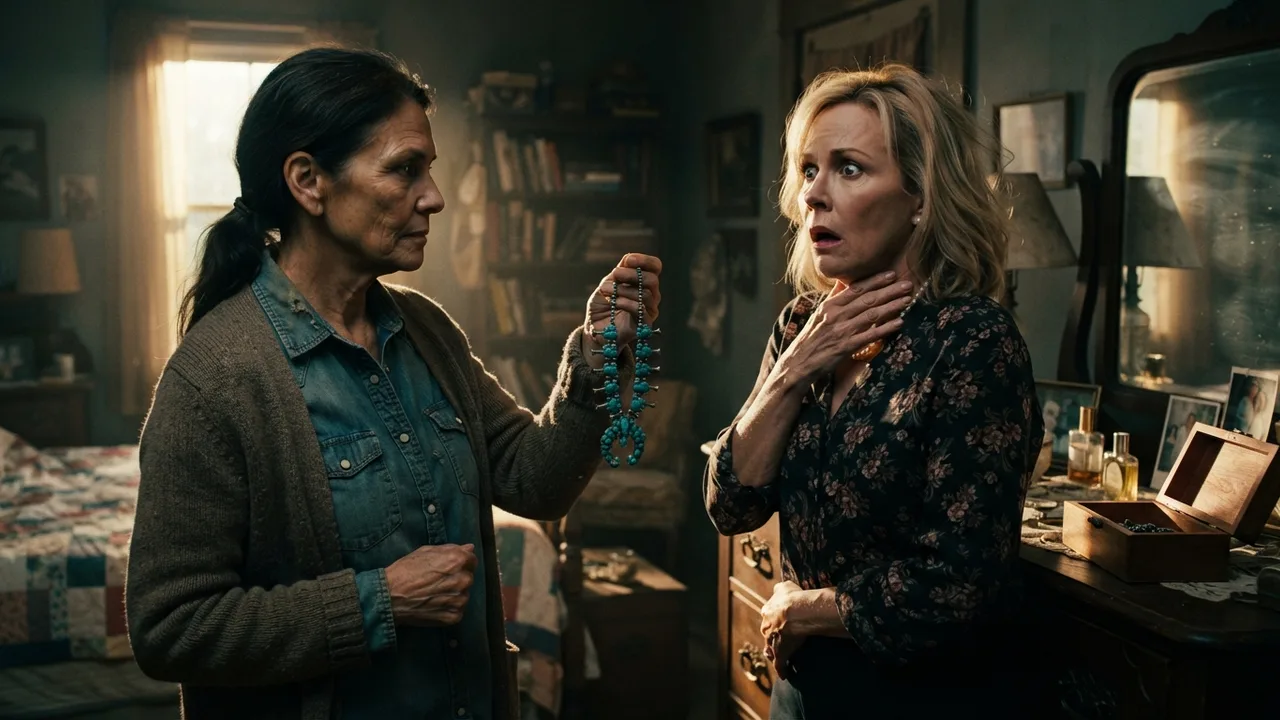
The first thing Genevieve Ashford said when I answered the phone was not hello, but "The necklace is gone, and you were the only one here."
I was standing at my kitchen counter with the Desert Bloom Cleaning ledger open, forty years of clients written in my own hand. I set my coffee down before I spoke.
"Genevieve, which necklace?"
Advertisements
"Don't insult me, Vera. The squash blossom. It was in the box on my dresser Monday. This morning the box is locked and there is nothing in it."
"Locked and empty," I said. "Then I don't see how anyone could have taken it."
"Somebody did. You have a key to this house, and you were in my bedroom yesterday with a dust rag." Her voice had the cultivated edge I knew from committee meetings. I had never once heard it aimed at me.
"I have been in that bedroom every Tuesday since before your grandson could drive."
"Which is why I am being generous. I have not called the sheriff, and I would like to keep it that way. You are finished here. Put the key in my mailbox and do not set foot on this property again."
She hung up before I could answer. I stood holding the phone until it began to beep at me.
Advertisements
My name is Vera Castillo. I am sixty-eight years old, and for thirty of those years I cleaned the Ashford estate every Tuesday, a sprawling adobe on the edge of Verbena Vista with eleven doors that opened onto the desert. I knew which floor tile rang hollow and which window stuck in humid weather.
I had considered Genevieve a friend. She poured my iced tea into the good glasses and asked after my husband until the year he died. We were never friends, of course. I was her cleaner. But it was a comfortable illusion, and both of us had lived in it a long time.
I drove out that afternoon and put the key in the mailbox. The brass was warm from the sun. I did not look at the house.
The next morning I went to Fry's for limes and a bag of tortillas, because the routine of a day is something you hold onto when the rest has been taken. I was in the produce aisle, weighing an avocado, when I heard my name.
"...Castillo. Thirty years in that house."
"Well, the Ashfords don't let go of someone for nothing, Donna."
They were two women I had cleaned for, years back, before they moved to the new development by the golf course. They saw me then. Donna found something fascinating in a bin of onions. I paid $4.29 for my limes and walked out with my back straight, because I have never learned another way to walk.
My phone rang in the parking lot. Linda Whitcomb, who had hired me every Thursday for six years.
"Vera, I hate to do this," she said. "I'm going to pause the service for a while. You understand. I just think I need to be careful."
"Careful of what, Linda?"
"Of everything. I've got my mother's rings in the house." She sounded sorry. She sounded relieved to be saying it from a distance. "I'm sure it will all blow over."
"I'm sure it will," I said, and sat behind the wheel with the air conditioner running, watching a boy collect shopping carts into a long, rattling line.
Maria Reyes called that evening. She had been my client for twenty years, a retired middle school teacher who still made me read the labels on cleaning products out loud, just to hear me say "ammonia" correctly.
"I heard," she said. "Don't explain it to me. I don't need it explained."
"Thank you, Maria."
"The Historical Society brunch is Sunday, out at the Ashford place, as it is every spring. I bought you a ticket. You'll sit with me."
"I've been told not to set foot there."
"You've been told by a woman who hasn't earned the right to say it," Maria said. "Wear the navy dress."
I did not promise. I hung up and washed the same cup twice.
The call from Phoenix came at nine. I knew the voice before he gave his name. Russell Ashford, Genevieve's son, who had visited the house three times a year in a pressed shirt and left before supper.
"Mrs. Castillo. I want to resolve this quietly. My mother is upset, and at her age that matters."
"I'm sure it does."
I closed the ledger and squared it against the edge of the counter.
"I have a statement for you to sign. It says you made a lapse in judgment, that you regret it, and that you won't speak of my family again. There's $5,000 attached. That's a great deal of goodwill for a misunderstanding."
"A lapse in judgment about what, Mr. Ashford?"
"You know what."
I pressed my thumb against the counter's edge until the nail went white.
"I know I never touched that necklace," I said. "I won't sign something that says I did."
He was quiet a moment. When he spoke again the polish had gone out of him. "Then I'll file a formal police report. It will have your name on it, and it will sit in a county file for good. Think about your business, Mrs. Castillo. Think about what a report does to a woman in your line of work."
"I have thought about nothing else since yesterday."
In the hall, the swamp cooler shuddered on.
"Then sign the paper."
"Good night, Mr. Ashford."
I did not sleep. I lay in my narrow bed listening to the swamp cooler tick, and sometime after midnight I did the only thing I know how to do when my mind will not settle. I started cleaning.
I began at the front door, the way I always did, with the wrought-iron handle and the saltillo tile that needed oiling. I walked the long hall in my head. I dusted the portraits and straightened the runner. Then I went into Genevieve's bedroom, where I had been two days before.
The dresser stood against the white wall. On top of it sat the jewelry box, dark walnut with a brass lock, which Harold Ashford had built for her in the year they married.
I remembered the lid. In January I had told Genevieve it was warping from the dry heat, riding a finger's width crooked along its back edge. She had waved a hand and said Harold would have fixed it. No one had.
I remembered something else, and it came so clearly that I sat up in bed. On Tuesday I had wiped a smudge from the wall above the dresser, a small greasy gray mark at about shoulder height, the kind a dirty tool leaves. Beside it was a faint scuff, as though a palm had pressed there for balance.
I had thought, mice, or a careless grandson. I had wiped it and moved on.
Then I walked into the sitting room, to the fireplace nobody had lit since March. The brass tool stand held its shovel, its brush, its long iron poker. On Tuesday the poker had been hanging on the wrong side, handle out, the tip blackened as if freshly used. I had set it right and thought nothing of it.
A long iron rod. A lid that did not seat. A necklace on a chain, resting in a box that never needed to be opened.
I put my feet on the cool floor and sat there in the dark. Something had cracked inside me, a window, and through it I could see exactly what had been done and exactly who had done it. I could also see the rest. Genevieve had called me before she called anyone else. She had not asked to see the box or looked for a mark on the wall, and she had not wondered how anything came out of a locked lid.
She had not wanted to know.
I had no proof that would satisfy a sheriff. I had a clean woman's memory of a dirty wall. But I had something else. The Historical Society brunch would put thirty of the town's most listened-to people on that patio, and I knew the house better than anyone who would stand in it.
On Sunday I wore the navy dress and my husband's silver earrings, and I drove out with the windows down to keep from arriving wilted. The covered flagstone patio was set with white cloths and pitchers of prickly pear lemonade. There were deviled eggs on a platter, a tray of green chile quiche, and a line of ladies in linen who stopped talking when I came around the corner of the house.
Maria rose from a table near the back. I shook my head, and she sat.
Genevieve stood by the fountain in cream silk, thin as a held breath, a small cluster of women around her. Spencer was beside her with a mimosa in his hand, handsome in the way of a man who has not had to earn it. His eyes went to me and then away, to the lemonade.
I crossed the flagstones. I kept my voice low, because I had not come to make a scene, only to say a true thing in a room where it could be heard.
"Genevieve. I know how the necklace was taken."
"You are not welcome here," she said, very quietly.
"The lid of that box is warped. It has been since January, and I told you so. There's a gap along the rear edge, where it won't meet the wood. Someone slid the long poker from your sitting room through it and hooked the chain."
The women around her had gone still.
"There was a greasy gray mark on the wall behind your dresser, from the tip of that poker. Beside it was a scuff, where a hand braced against the plaster for leverage. I cleaned both off on Tuesday. I didn't understand what they were until now."
"This is outrageous," Spencer said, loud enough for the back tables. He stepped forward, his drink sloshing. "Grandmother, she's making this up."
"I'm describing a wall, Spencer."
"Then let's look at it," I went on, to Genevieve and not to him. "The box is on your dresser and the poker is in your sitting room. Send for them."
"I will do nothing of the kind."
"Maria," I said. "Second door on the left. The walnut box, and the long poker from the fireplace."
Maria laid her napkin beside her plate. "I'm fetching a box, Genevieve," she said, and went into the house. Nobody stopped her.
"This is a stunt," Spencer said. He had found his footing, and I watched him find it. "She had a key to this house. She knows every inch of it, and now she's been let go and wants to hurt us."
"I do know every inch of it," I said. "That's why I can show you."
Maria came back carrying the box in both hands, the poker under one arm like a rolled umbrella. I moved a pitcher of lemonade off the nearest table, and she set the box down.
"Genevieve, the key is on the chain at your neck. Open it."
Her fingers went to her collar. For a moment I thought she would refuse, and I could feel thirty people waiting to see whether she would. Then she drew out the little key, came to the table, and turned it. The lid lifted and sat crooked, a finger's width of daylight showing along the rear edge.
"It's empty," she said. "As I told you."
"Look at the inside edge, right at the gap."
A pale new groove ran across the dark walnut there. I fed the tip of the poker through the gap, and it slid in as if someone had measured it. The little hook at the end came to rest in the groove, and a smear of gray grit stayed behind on the wood.
Somebody behind me let out a breath.
"That's how it was done," I said.
Genevieve did not look at the box. "Vera, this is a family matter. Come inside, and we will discuss it privately."
"You called me a thief on the telephone, with no one listening. I'll be answered with people in the room."
"Anyone could have done that," Spencer said, his voice climbing. "Anyone who's ever stood in that bedroom."
"Anyone could have. But a person who goes fishing for a necklace wants money, and a squash blossom that size doesn't sit in a sock drawer. It goes to a dealer, and a dealer writes a receipt with a name on it." I turned to Genevieve. "You can telephone and ask whose name."
"That man cheated me, it was worth twice what he—" Spencer stopped.
Nobody moved. The lemonade left a wet ring on the white cloth.
"Spencer," Genevieve said. Only that. He looked at her, and she looked at the door. "Inside."
He went. The screen door clapped behind him.
Genevieve stood with the little key in her fingers. She did not say she was sorry, and I had not expected it. "You might have come to me privately," she said.
"I'd have liked to be asked privately, Wednesday morning."
I laid the poker on the cloth, hook up, and walked out through the side gate. My knees held until I reached the car. Maria caught me there, took my arm, and let me stand with the keys cutting into my palm until the shaking worked its way out.
On Tuesday morning, when I would have been driving out to the Ashford place, a firm knock came at my front door. Russell Ashford stood on my step in a gray suit that was wrong for April.
"May I come in?"
I let him into my kitchen and did not offer tea. He sat at the table where my husband used to do the crossword and took an envelope from his jacket.
"I'm not here to apologize," he said. "What happened was a family matter that got out of hand."
"It got out of hand on a Wednesday morning, when your mother telephoned me."
"Spencer has gone to a wellness center in California. My mother is not well herself." He slid the envelope across the oilcloth. "That's a cashier's check for $25,000. For your trouble and your discretion."
I set my fingertips on the corner of it and pushed it back until it stopped against his wrist.
"I don't want your money, Mr. Ashford."
"Everyone wants something."
"Then I'll tell you what. The squash blossom was always meant for the Historical Society. Your mother told me so herself, over a pitcher of iced tea. I want it in the glass case at the museum by the end of the month, with a card that says it was recovered by a concerned citizen. No name."
"Spencer sold it," he said slowly. "I'll have to buy it back."
"Then buy it back."
He folded the envelope once and put it away. At the door he turned. "She's eighty-five, Mrs. Castillo."
"I know exactly how old she is. I sent her a card every year."
He nodded and left. I watched his car back down my gravel drive and turn toward the highway.
Linda Whitcomb came on Thursday, in person, and stood on my porch holding a Safeway apple pie still in its plastic dome.
"I should have asked you to your face," she said. "I called from my kitchen like a coward."
"You called because you were careful. You said so."
She winced, and I let her. The pie shook a little in her hands.
"Will you come back, Vera? Thursdays?"
"I'll come. Eight o'clock, same as always. But if you ever have a question about me, you ask it in my kitchen."
"I will. I promise."
I took the pie. She stood a moment longer, as though there should be more to it, and then she went down the steps. Donna's name did not come up. Neither did the Ashfords'.
That evening I sat at the counter with a cup of coffee and the ledger open. I wrote *Whitcomb, Thursdays* back into its line, in my own hand.
Then I turned to the page for the adobe on the edge of town and ruled one line through *Ashford, Tuesdays*, using the edge of the counter to keep it straight. The row beneath it stayed empty, and I let it.

Comments