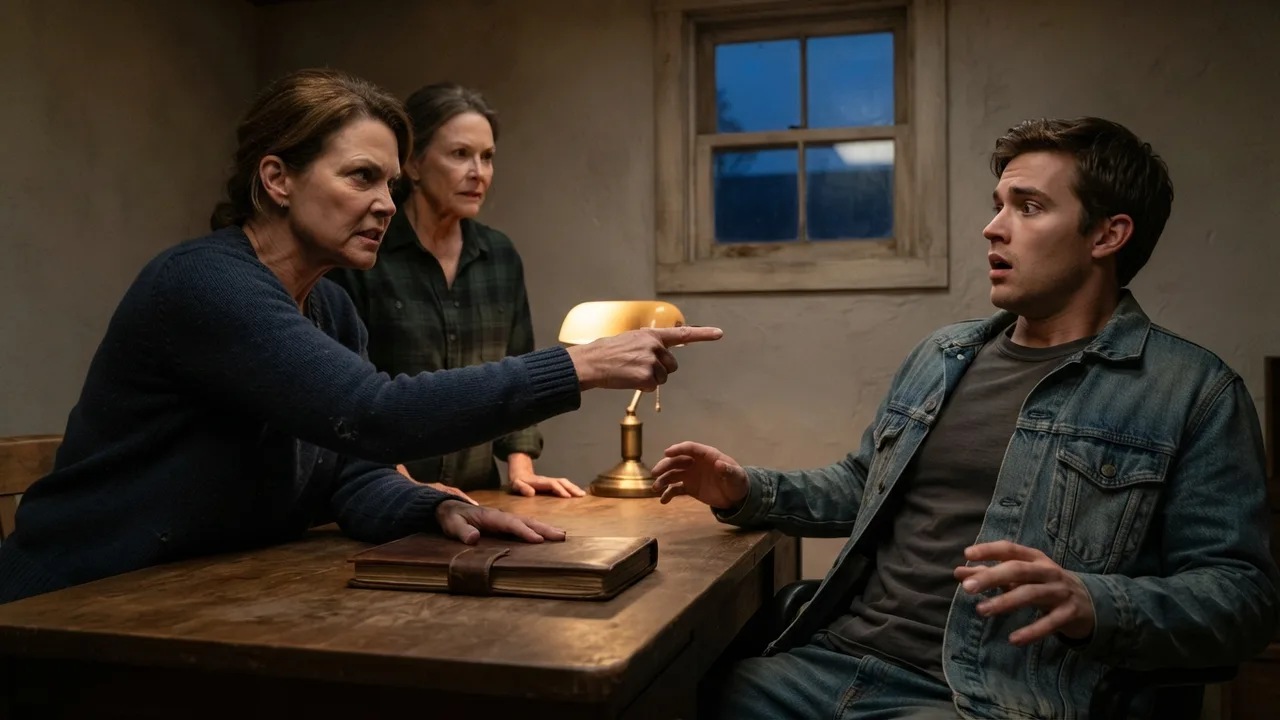
The first time the cash deposit came up short, the new owner asked me to count it again, as if twenty years of balancing a register could be undone by a bad morning. Fifty dollars was missing from a bag I had sealed myself the night before. Tristan Locke stood over my shoulder in the back office of The Reading Nook, and I felt my job tilt under my feet.
"Humor me, Claire," he said. "One more pass."
I ran the register tape through my adding machine again. I checked it against the tally sheet in my own handwriting, the same blue ballpoint I had used since before he finished high school. The numbers agreed with each other and with me.
Advertisements
"The tape and the sheet match," I said. "The bag went to the bank with exactly what's written here."
"Then the bank is wrong, or we are." He smiled with his lips pressed together, as though I had tracked mud across his floor. "I'm sure it's nothing. Let's not make this a thing."
He said the last part loud enough for Esther to hear from the front counter, and for old Mr. Abernathy, who was holding a Louis L'Amour paperback against his chest like a hymnal. Tristan had a way of being kind in front of witnesses.
"Everybody has an off day," he told me, warm as a cough drop. "Don't beat yourself up."
I thanked him. Then I went to the shelves and straightened the Vermont history section, which didn't need it, because my hands are rarely still when I'm frightened.
That afternoon, I went back to the office for the stapler and saw a manila folder on his desk with my name on the tab. Under it, in his neat slanting print, he had written *procedural review.* I did not touch it. I stood there until I heard the front door chime.
Advertisements
That night I lay awake above the hardware store, listening to the furnace tick. I got up at some hour I refused to look at and sat at my kitchen table with every deposit slip from the last quarter. I added each one twice. Every figure held, and the only thing that changed was how I felt about my own handwriting.
---
A week later the shortage was $250.
Tristan didn't ask me to count it again. He asked me to come to the office and close the door, and he had the folder open on the blotter this time, with a legal pad beside it.
"Claire, I want to say first that this is hard for me," he said.
"I'm sure it is."
"I have grave concerns." He turned the pad so I could see the date he'd written at the top. "Two shortages in two weeks. As the owner, I'm obligated to document a pattern."
"Tristan, that bag was sealed with a numbered strip. The number on my sheet matches the number the teller wrote down. Nobody broke it between here and the bank."
"Which tells me the error happened before sealing."
"It tells you nothing of the kind."
He tapped his pen against the legal pad, twice. His watch was thin and silver and probably cost more than my car. "I'm issuing a verbal warning today. It's informal. But if it happens again, the next conversation won't be."
"And if the bank has made a mistake?"
"Then the bank will correct it." He stood and held the door for me, the way you do for a guest you've already decided to see out. "I know this isn't what you want to hear."
I walked to the front of the store and found Esther rearranging the staff picks. She had on her green scarf and the brooch shaped like an open book, and she watched my face for one second.
"Verbal warning," I said.
"For what?"
"For money I didn't lose."
Esther set down the copy of *Gilead* she was holding, which in fifteen years I had never seen her do while upset. "Claire Redmond, in this store, you have never lost a dime."
I stood at the register and made myself think it through like an inventory. The bag left my hands at closing, locked in the office safe, and Esther and I left together. Tristan had insisted, in his first week, on taking over the bank run himself so he could, in his words, own the workflow. He opened the safe each morning before anyone else arrived, and he alone carried the bag across the square to Northwood Savings.
He was the last person to touch it every time.
I did not want it to be true. I would have preferred incompetence, a misread slip, a bank clerk with a bad week. But a man who makes notes in a folder before there is anything to note has already decided the ending.
---
We talked at the Birch Street Café, in the corner booth by the radiator, where the cider donuts cost two dollars and fifty cents and the coffee refills never stop. Esther listened to all of it with her chin on her hand.
"So he's skimming it," she said.
"I can't prove that."
"Then prove it."
"How? If I accuse him with nothing in my hands, I'm the clerk who stole and then blamed the owner."
Esther tore a donut in half. "What do you need?"
"A deposit where the amount is so fixed, so witnessed, and so memorable that nobody could call my arithmetic careless." I turned my cup on its saucer. "A big cash sale. Right before closing. Counted in front of you."
"And who buys a big cash sale in Northwood in October?"
I knew the answer before she did. Eleanor Gable had stood in front of our locked glass case twice that month, looking at the two Frost first editions the way some people look at a grandchild's school photo. She had taught English at Northwood High for forty years and she paid for things in checks, in a hand so exact you could have framed it.
I called her that evening from the apartment.
"Cash?" Eleanor said. "Claire, I haven't carried that much cash since the Carter administration."
"I know. I'm asking you a favor and I can't explain why yet."
"Is it about the young man?"
I looked at the dark window over the hardware store's sign. "I'd rather not say, Eleanor. I'm asking you to trust me."
"Forty years I've trusted you with my reading," she said. "I can manage a Thursday."
I hung up and felt ashamed. Eleanor would be a witness without knowing she was one, and I had spent my life believing you tell people the truth about what you're asking of them. I had never set a trap for anyone, not even a mouse in the stockroom.
But I thought of the folder with my name on it, and I let the shame sit there while I made tea.
---
On Thursday, an hour before closing, Eleanor came in wearing her good camel coat and bought both Frost volumes. She counted twenty-dollar bills onto the counter one at a time, saying the total aloud as she went, and when she reached four hundred she squared the stack with her fingertips.
"There," she said. "Now they're going to a home where someone reads them."
"They will be very happy, Mrs. Gable," I said, and wrapped them in tissue.
After she left, I pulled the till drawer into the office. Esther stood beside me while I counted it, bill by bill and coin by coin, and read the total aloud. Then I wrote it on the tally sheet, and we both signed and dated it. Esther took a photograph of the sheet with her phone, held at arm's length like a woman reading a menu.
"I feel like I'm in a spy novel," she whispered.
"Please don't say that," I said. "I already feel like a thief."
"You're the opposite of a thief, honey."
I put the cash in the bag, pressed down the strip, and wrote its number at the bottom of the sheet. Esther watched me lock it in the safe. My hands shook a little on the dial, and I didn't hide it from her.
The next morning I was in the stockroom, pricing a box of estate-sale mysteries, when Tristan walked past with the bag under his arm. He did not look at me. He looked at his phone. At noon I found the stamped bank receipt in the office tray where he left them for filing, and I read it standing up.
It was $250 short of the sheet in my left hand. Beneath the teller's stamp was a signature I knew well, because it was grandly slanted, and it was his.
---
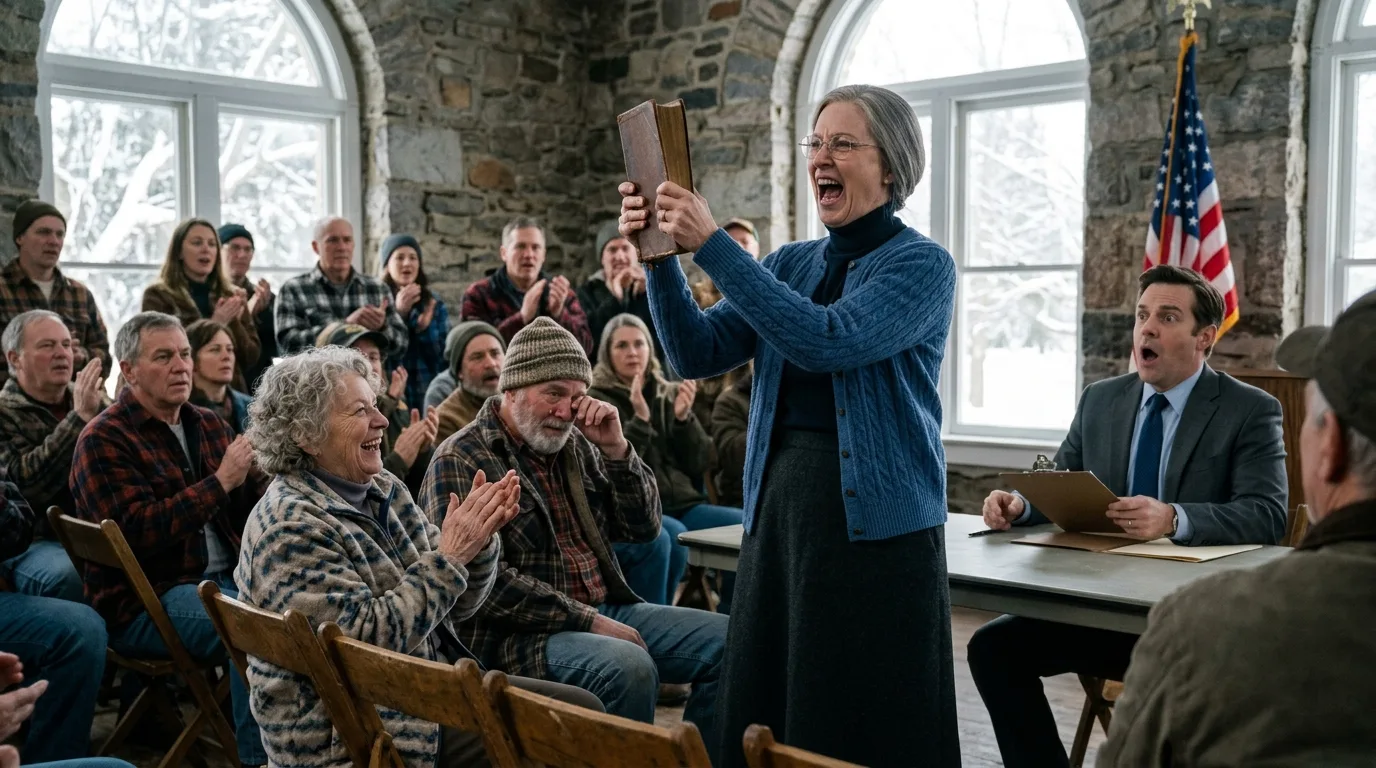
That evening Tristan held his Meet the New Owner event. He'd had folding chairs delivered from a rental place in Rutland, and the long table by the window held Cabot cheddar on slate boards, sliced apples, and cheap pinot noir poured into plastic stemware. About twenty people had come. Mr. Abernathy sat in the front row with his boots crossed. Hal from the hardware store had changed out of his work apron into a plaid shirt that still showed the folds from the package.
Esther stood by the poetry shelf, her brooch fixed at her collar like a badge. Eleanor Gable took the aisle seat and kept her coat on.
Tristan spoke for a long time, with a clicker in his hand and a slide behind him that said *The Nook 2.0.* He talked about the store as an experience, as a platform, as a space that would leverage the town's heritage to drive foot traffic. The words *curated* and *community* each came up often, and he said them like items on a checklist.
"And at the foundation of everything," he said, "is transparency and accountability. Every dollar. Every decision. That's the promise I'm making to Northwood."
Somebody coughed. A woman near the back asked whether the children's corner would stay, and Tristan said it would be "reimagined as a family engagement zone." Mr. Abernathy asked whether he'd still be able to find a plain paperback, and Tristan laughed and said they'd be "optimizing the mix."
Then he looked around and said, "Other questions?"
I raised my hand.
He saw me and smiled with his teeth. "Claire. Of course."
I stood. I had on my gray cardigan and my reading glasses were on top of my head where they always are. My voice came out in the tone I use when a customer asks about a first printing, which is the only tone I have ever trusted.
"Tristan, I'm so glad you mentioned accountability. It reminds me of the deposit from yesterday."
"Sure," he said. "Though maybe that's better for the office."
"It will only take a moment." I turned. "Mrs. Gable, it was so lovely to see you find those Frost first editions. I know you paid cash."
Eleanor folded her hands on her purse. "Four hundred dollars, Claire. In twenties."
"After her purchase, our closing till was exactly right. Esther counted with me and we both signed the sheet." I held up the paper, and Esther lifted her phone beside her head to show the picture. "But the bank slip you signed off on, Tristan, was for $250 less than what was in the bag I sealed. I'm sure it's just a clerical error. I was wondering what the new procedure is for correcting a manager's signed deposit slip?"
No one moved.
I heard the radiator knock in the wall. I heard Hal set his plastic cup on the windowsill, very slowly, so it wouldn't make noise.
Tristan's face lost its color from the top down. He still held the clicker, and I watched his thumb find the button and press it, so that the slide behind him flipped to a picture of a latte.
"That would be," he said. "The bank, I'd have to. There are a lot of moving."
"The teller wrote the strip number," I said gently. "It matches my sheet."
"I'd need to verify with."
He stopped. He couldn't say the bank had made the mistake, because anyone in the room could walk over to Northwood Savings on Monday morning and ask. He couldn't say I had made it, because the sheet in my hand had two names on it and a photograph. And he couldn't say what had happened to the money, because the only person who knew was standing under a slide of a latte.
Eleanor Gable stood up. She looked at Tristan for a long moment, then at me, and I saw the whole afternoon arrive on her face, the cash and the favor and the reason I couldn't explain.
"Young man," she said, "I counted those twenties onto that counter myself."
Tristan set the clicker down on the cheese table. He picked up his phone and his jacket and said, to nobody, "I think we'll continue this another time," and walked out into the October dark. The door shut behind him without the chime, because he'd caught it with his hand.
Nobody clapped. Mr. Abernathy cleared his throat and said, "Well." Then people stood up and put their plastic cups in the trash and came to me one at a time. Hal squeezed my elbow. A woman I'd known since she was a girl pushed a paper plate of cheddar at me and said, "Eat something, Claire," and I took it because I couldn't think what else to do with my hands.
---
He did not come to the store on Saturday.
Esther opened with her key and sold two copies of the new Louise Penny before nine. I stayed home, because I'd been told by my own legs that I would not be useful. At ten the phone rang, and an unfamiliar Boston number was on the screen.
"Ms. Redmond? This is Warren Pruitt of Pruitt and Vale. I represent Mr. Locke's father."
"I see."
"My client is aware of an unfortunate misunderstanding at the store yesterday evening." He sounded like a man reading from a card he had written in the car. "The family would like to resolve it with discretion."
"What does resolve mean?"
"A severance arrangement. Generous. In exchange for a confidentiality agreement covering all matters relating to the business and the ownership." He cleared his throat. "I'll send the terms by email. The family would appreciate an answer promptly."
"Is Mr. Locke going to call me?"
"That isn't contemplated."
"Is there an apology in the email?"
"The email contains the offer, Ms. Redmond." He thanked me for my time, and that was all.
I sat at my kitchen table with the laptop open and read the terms. The number was big enough to be comfortable. It would cover my rent above the hardware store and a better car and a few winters with the heat turned up, and all it asked for in return was silence. I read it slowly, then scrolled to the end, where there was a line for my name.
I didn't sign. I didn't close the laptop either.
The phone buzzed again on the table. It was Hal, from downstairs, who'd have heard my footsteps overhead.
"Claire, I don't want to pry. Folks keep stopping in the shop to ask what they can do."
"Do?"
"Mrs. Gable's called twice. She's already got a pad of paper out. And Ruth from the library board said something about a community buyout, whether the town could, you know, own the thing." He coughed. "She said to tell you she's serious."
"A buyout," I said.
"Think about it. That's all anybody's asking."
By noon, I had missed calls from the Rutland Herald's book page, the librarian, the woman who ran the Congregational church's rummage sale, and two names I didn't recognize. I lined my cup and the laptop and my glasses in a row on the table and looked at all of it. No one was going to tell me what came next. For the first time since the day the store was sold, the answer wasn't up to a man in a thin silver watch, or his father, or a lawyer in Boston. It was mine.
I let the offer stay open on the screen. I didn't answer Ruth either.
---
That evening, I went downstairs and across the square and let myself into The Reading Nook. Esther was on the stool behind the counter, her scarf trailing, with the cash drawer pulled out in front of her.
"Slow day, then a good one," she said. "I'll let you do the honors. I don't trust my own math after Thursday."
I took the drawer into the office, and she followed and stood at my shoulder, as she had before. I counted it all, bills first, then rolls of coins. I read the total aloud and checked it against the tape.
The cash drawer balanced to the penny.

Comments