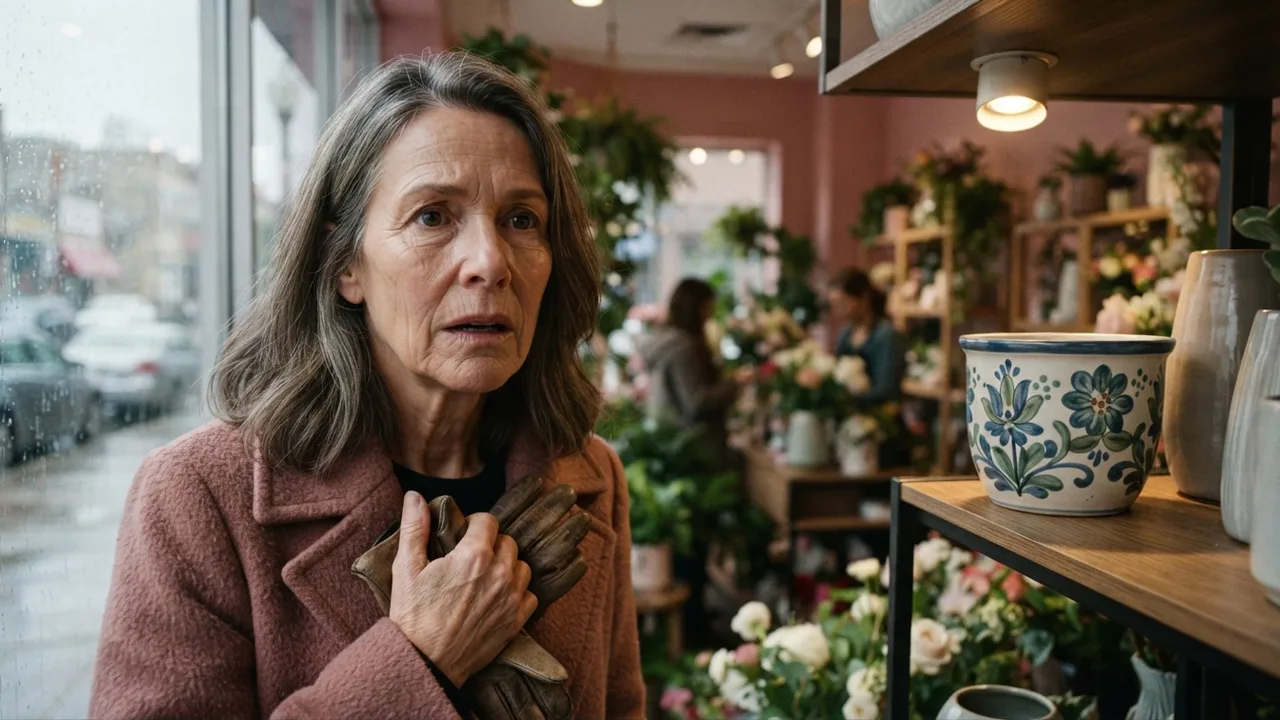
The first pot of heirloom petunias died overnight, the blossoms shriveling like old tissue paper, and I knew my new rival had finally drawn blood. Estelle Morrison's committee would choose the Summer Festival florist on Thursday, and my bid, my reputation and thirty years of Port Blossom Blooms were all riding on stock that had turned to paper in the dark.
I stood in the cooler doorway with a cold bucket handle biting into my palm. The leaves on the dead petunias wore a faint white bloom, like flour dusted on a countertop.
Across the square, Everbloom's window glowed behind its white lacquered frame. Felicity Grove had told the *Port Blossom Gazette* she was going for "a clean, organic aesthetic." Since her ribbon-cutting, my Saturday walk-ins had thinned to a trickle.
Advertisements
I was fifty-eight years old, I had soil under my nails that no scrub brush would shift, and I would not be called a relic by a woman who sold single stems in glass test tubes.
"Somebody got to you," I told the petunias. I carried the bucket to the dumpster as if it were a casket.
---
The committee met in the Town Hall meeting room, under track lights somebody had installed for a slideshow nobody ever watched. I set my showcase arrangements on the long table at nine in the morning. They were delphinium and snapdragon, hydrangea heavy as snowballs, every stem cut and conditioned myself.
By the time Felicity finished her presentation, mine had begun to bow.
"Geneva," Estelle said. She sat very straight in a linen jacket the color of oatmeal. "Are those hydrangeas supposed to be doing that?"
I looked. The heads hung like tired children. The snapdragon leaves had gone mottled, a white powder creeping along the veins.
"They were perfect at seven," I said.
"I'm sure they were." Hollis Venn, who ran the hardware store and sat on every committee in town, studied the ceiling. "It's the lights, maybe."
"It isn't the lights."
Felicity's arrangements stood across from mine, crisp and architectural. One leaf near the back had curled at the tip, and she'd tucked a ribbon over it. I noticed because I notice such things. I didn't think about it long enough.
Estelle folded her hands. "We have to think of the festival, Geneva. Opening night is a showpiece. The committee needs flowers that will hold."
Advertisements
"I've done this festival for thirty years."
"And it has always been lovely," she said, not unkindly. "We're awarding the contract to Everbloom."
I packed my dead flowers back into their buckets while the committee pretended to study its minutes. Felicity touched my elbow on the way out. "I'm sorry," she said. "I know it's awkward."
I looked at her hand until she took it away.
---
That night I called Clarence Doyle from the shop, the phone cord looped around my wrist the way I'd done since before cell phones. Clarence had supplied Port Blossom Blooms since the year I took the lease. He drove over from his place in the next town every Tuesday and Friday and left a ham on my doorstep every Christmas.
"Geneva, honey, slow down," he said. "Tell me again."
"Your stock is diseased. There's a white powder on everything. Hydrangeas, snaps, the petunias. All of it went in a single night."
"Well, you know how it is. This heat off the lake can be a real bear." I heard his chair creak, and I could picture the office behind it, the damp window unit and the filing cabinet where the celadon pot I'd thrown for Dot's birthday sat crowded with cuttings. "But my greenhouses are clean as a whistle. I'd stake my name on it."
"Then what is it?"
I wound the cord tighter until the skin of my wrist went white, and waited.
"Now, I don't like to say this." He took his time with it. "How old is that walk-in of yours? Older than the shop's sign, I'd guess. Those compressors go, and you wouldn't know till the damage was done."
"It was serviced in the fall."
"Sure. And you've had so much on your plate, since Henry. A body can lose track of rotation, dates on the buckets. No shame in it." He chuckled warmly. "You ever think about those folks from Meadowline Floral? They'd take all that off your hands."
I held the receiver until the dial tone buzzed. The letter from Meadowline was in my bottom drawer under the tax folders, where I had put it with its glossy envelope face down.
I did not sleep. I lay in the dark counting my buckets in my head, looking for the one I'd mislabeled, the day I'd skipped the water change. By dawn I had half convinced myself that grief and age had rotted my own business out from under me.
On Monday I paid Orrin Lundgren $500 to crawl around my cooler with a gauge and a flashlight.
"Compressor's fine," he said, wiping his hands on a rag. "Coils clean, door seals tight. This box holds temperature like a church cellar. Whatever's killing your flowers, Geneva, it didn't happen in here."
I wrote the check at the counter, and the pen shook in my fingers. Orrin pretended not to see.
"So it's me," I said, mostly to the register.
"I didn't say that."
"You didn't have to."
---
On Wednesday I crossed the square with a flat of marigolds as an excuse and a speech I'd rehearsed so many times it had worn smooth. I meant to tell Felicity Grove that I knew what she was doing, and that a woman who had to poison a neighbor's petunias to win a contract didn't deserve one.
Everbloom's front door was locked. I went around to the alley, where her back door stood propped open with a paint bucket, and I heard her voice before I saw her.
"Don't tell me it's my ventilation again, Clarence. I paid a man to check every vent in this building."
I stopped with a marigold flat against my hip.
"No, you listen. I have had inventory problems since the week I opened. Everything I buy from you arrives looking beautiful and dies in a day, and every time I call, there's a new reason it's my fault." A pause. "Well, I'm not imagining a white powder on my own aprons."
She hung up. Through the crack of the door I watched her sit on an overturned crate, the phone in her lap, and press the heels of her hands to her eyes. A black apron hung from a nail behind her. Its hem was dusted pale. On the shelf above her sink sat a squat celadon pot of ivy cuttings with the leaves gone white at the edges, and I took it in without thinking, one more sick plant in a shop full of them.
I backed out of that alley as quietly as I'd come in, and I carried the marigolds home again.
I had spent two weeks sure of my enemy. A clear enemy is a comfort, like a fence line, and I had just walked through the fence into open pasture with no landmarks. If Felicity wasn't doing this, then nobody was doing it, and I was simply failing. Or somebody I couldn't picture was.
I let one other thought surface. Two shops, one supplier. I put it down again like a hot pan, because Clarence had left a ham on my porch every Christmas since before Henry died, and a person doesn't think that of a man who does that.
---
The Summer Festival opened Friday evening with a reception at Town Hall. Folding tables wore white paper cloths, and there were trays of fried cheese curds and a sheet cake from the Piggly Wiggly bakery. Somebody's nephew was pouring brandy old-fashioneds into plastic cups. The lake humidity had crept in under the doors and curled everyone's hair.
I almost didn't go. I put on my good green blouse, pinned my silver-blonde hair back with the clip I'd worn to Henry's funeral, and went because a woman who stays home is a woman who agrees.
The centerpiece stood at the far end of the hall on its own table. Felicity had built it tall and loose, with hydrangea, delphinium, trailing ivy and white lisianthus, all of it set in a squat, fat-bellied pot with a celadon glaze.
It took me until the doorway to place it. I had seen that pot on a shelf in Felicity's alley, and before that on Clarence Doyle's filing cabinet.
I had thrown it myself, on my own wheel, for Dot Doyle's birthday. My thumbprint was in the glaze by the rim, and my mark was pressed into the unglazed foot.
I walked down the length of the hall slowly, with a cup of old-fashioned in my hand I never meant to drink. Felicity stood at the table in a navy dress with her hair swept up, flanked by Estelle in her oatmeal linen and by Clarence, polo shirt, company logo over the heart, his weathered face wearing its honest smile.
"Geneva," Estelle said, with a small formal nod.
"Estelle. Felicity." I looked at the flowers and let my face go soft. "That's a handsome pot."
"Isn't it?" Felicity beamed and touched the rim. "Clarence gave it to me when I opened. I think it's the nicest thing anybody in this town has done for me."
Clarence's smile stayed where it was. A smile held that long has been nailed on.
"Clarence, that's the pot I made for Dot," I said, loud enough for Estelle to hear every syllable. "Her birthday, a good while back. That's my thumbprint by the chip."
The nearest conversation faltered. Ansel from the feed store stopped with a cheese curd halfway to his mouth.
Clarence laughed, a beat late. "Geneva, honestly. Dot has dozens of pots. I probably picked that up at a craft fair."
"Felicity, would you turn it over?"
She looked at me for a long moment. Then she set her cup down, lifted the ivy aside and tipped the pot toward the light.
"There's a little G in a circle," she said slowly.
"That's mine."
"You're upset about the contract," Clarence said, "and everybody here understands that. But you can't go around making strange accusations at a party, honey. It's not a good look." He glanced around for allies and found a few nods. "Folks know how hard this year's been on you. Since Henry."
*Confused*, he meant. *Bitter. Old.* I had heard the words coming for three weeks, and now I watched them land on the faces of people I had sold wedding bouquets to.
My hands wanted to shake, so I gave the plastic cup something to do and held it tight. "Look at the foot again, Felicity. The part that isn't glazed."
She bent. "It's furred. It's white, like..." She stopped. "Like the powder on my aprons."
"Clay is porous," I said. "That pot sat in Dot's office in your damp, Clarence, holding cuttings, and whatever grows in that room soaked into it and stayed. Wednesday I saw the ivy on Felicity's shelf through her back door. It had gone white at the edges."
"I thought I'd killed it," Felicity said. "I thought I'd killed everything."
"That's mildew," Clarence said. "Every cellar in Wisconsin has it."
"Then why did you tell her it was her ventilation and tell me it was my cooler?" I turned so the whole table could hear, Ansel and Hollis and the bakery owner and Estelle. "I paid a refrigeration man $500 to say my cooler was sound. I stood in her alley Wednesday and heard her tell you her aprons were dusted white. If it's in every cellar, why does it only turn up in the two shops you supply?"
He opened his mouth and closed it. Sweat had come out along his hairline.
"Come out to the place tomorrow," he said, lower now. "Dot will make coffee. I'll make good on every flat, and we'll sort it quietly. No sense airing this in front of the whole town."
"No. You've had three weeks to do it quietly."
"Geneva."
"I'll say it here, where I'm standing. Your stock killed my hydrangeas, and you let me lie awake thinking it was my own doing."
Nobody spoke. Somewhere behind us a plastic cup hit the floor.
---
Estelle stepped between us. In her years at the front of a classroom she must have broken up a thousand lunchroom fights, and she did it the same way now, by standing still.
"Clarence," she said, crisp as a chalkboard, "the festival is finished with your greenery as of tonight. Send the invoice to me, and it will be paid when it's due and not a day before."
"Estelle, you can't believe—"
"I believe my own eyes."
Felicity set the pot down on the table with both hands. She was shaking, but her voice came out clear. "Consider my account closed, Clarence. All of it."
"You'll have trouble finding a wholesaler this side of Milwaukee," he said. It was the first true thing he'd said all evening, and it hung there with no one to catch it.
She ignored him and turned to me in front of everyone. "I can't fill the rest of the festival with what I have left. Half my cooler is going in the trash tomorrow." She drew a breath. "But maybe we both can."
My throat had gone dry as a seed packet. "I think we can."
She held out her hand and I took it. Her palm was damp and her grip was stronger than I expected.
"I thought it was you," I said, low enough that only she could hear. "For two weeks. I stood in your alley and listened to you on the phone, and I still wasn't sure. I'm sorry."
"I thought you hated me," Felicity said.
"I did, a little. Wrongly."
A laugh broke out of her, short and wet. "Do you have a healthy cooler?"
"I have a healthy cooler. I have a $500 receipt that says so."
Clarence stood a few feet off, holding nothing. People had begun turning away from him one conversation at a time. Hollis Venn found something fascinating in his cup, and Ansel's wife steered Ansel toward the cake.
"Geneva," Clarence said. "Thirty years."
"I know exactly how long," I said. "I've been counting hams."
He flinched, which I had not expected. I hadn't meant it to cut that deep, and I didn't take it back.
"Dot should have that pot," I said. "I'll throw her another, if she'll have one from me."
"She won't."
"Then she won't."
He picked his keys up off the table. At the door he looked back once, and I saw an old man in a polo shirt with no honest smile left to put on. Then he was gone. Out in the lot his truck started, the same rattle that had pulled up to my loading door every Tuesday and Friday since before Henry died.
I sat down on a folding chair beside the cheese curds. My knees weren't mine. Estelle put a cup of water in my hand without a word, and I drank it all.
"I was wrong about her," I said, nodding toward Felicity, who stood tucking ivy back around the pot with fingers that wouldn't quite hold still. "In front of everyone. I walked down that hall so sure of myself, and I'd been wrong about the one thing for two weeks."
"You were right about the one that mattered," Estelle said.
"It doesn't feel like it."
"No," she said. "It wouldn't."
---
I woke Saturday to the lake's gray light and an empty house. Nobody's truck came on Saturdays anyway. I went down to the shop early, turned the sign, and started the day's conditioning with the stock Felicity and I had hauled across the square at midnight in her van and my truck, flat after flat, every healthy stem we could find. Still, for the first time in thirty years, I had no standing order coming Tuesday.
I was stripping leaves from a stem of snapdragon when I heard the front door open.
Felicity came in with a paper cup in each hand, hair twisted into a knot, wearing a plain gray sweatshirt in place of the navy dress. She looked like she hadn't slept either.
"The Kwik Trip on the highway had a line," she said. "I got you a black one. I guessed."
"You guessed right."
She set both cups on the counter beside the pot of petunias I'd potted from my last clean flat, their blossoms wide open to the morning light.
Comments