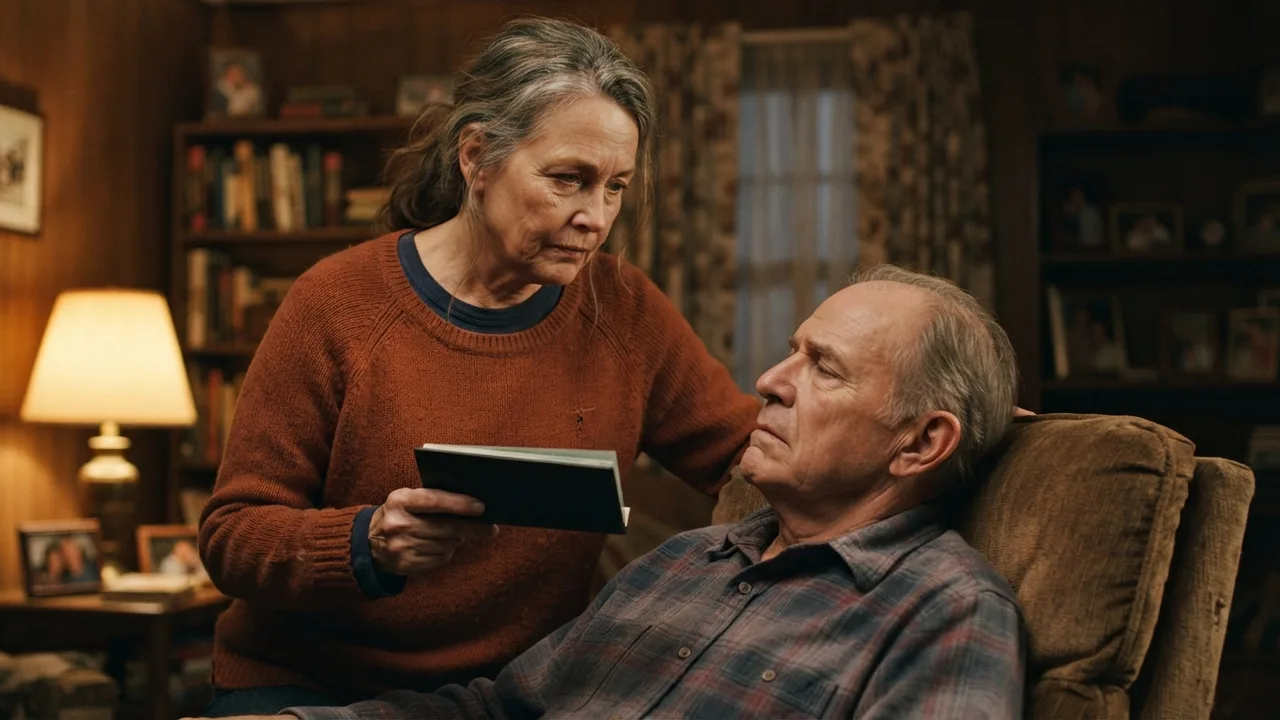
My stepdaughter, Amanda, gave me until Friday to sign the papers that would hand her every financial decision in her father's life, or she would have him declared incompetent.
She said it standing in my kitchen, holding a cup of coffee she had not drunk. Warren sat in the den with the television on low. If I refused, I would lose my say in his care and every dollar the two of us had put away in 28 years of marriage.
"I'm just concerned, Nancy," she said. "Caregiver burnout is real. You've lost weight."
"I weigh what I weighed at Easter."
"You're exhausted. Dad's exhausted. This is in his best interest." She set the cup on the counter. Her phone stayed in her other hand, the screen lit. "Read the packet. Friday."
Advertisements
She left a manila envelope beside the bread box and drove the two hours back to Atlanta. She had written her cell number across the flap in purple ink, as if I had not had it for years. Her heeled boots had clicked across my linoleum the whole visit. They were the wrong shoes for a brick ranch house in Millbrook.
I am a retired nurse. I spent 35 years in geriatrics, and I have sat across from a great many families at a great many bedsides. I know what concern sounds like. Amanda's had a script behind it.
Warren has vascular dementia. Some days he does the crossword in pen and some days he asks me where his mother is. I chart both kinds of days in a spiral notebook by the coffeemaker, because that is what I know how to do.
That evening I sat on the ottoman in front of his recliner. He wore his gray cardigan, though the pollen was thick on the porch rail and the afternoon had reached the eighties.
"Warren, Amanda wants you to sign a power of attorney. Do you understand what that is?"
He picked at a loose thread on his sleeve. "She's just worried, Nan. It's for the best."
"Did you ask her to bring it?"
"It's for the best."
"I'm not angry. I only want to know what you want."
His jaw worked. His eyes went to the lamp, then the window, then the carpet, and never once to me. He had looked at me across every table we ever shared. Now there was a wall in the room, and I had not seen anyone build it.
Advertisements
"She's just worried," he said again, and his hands began to shake.
I stopped asking. I made him a cup of decaf, checked his pill organizer, and helped him to bed. Then I lay awake until the sky went gray, listening to him breathe and getting up twice to check the porch light, which was on both times.
The email came the next morning. The subject line read *For Dad's Protection*. Amanda had copied a lawyer, a Dennis Brightwell of Brightwell & Hale, whose name I had never heard.
I read it at the kitchen table with my reading glasses on and my pulse noted. It listed what she called observed memory lapses. He had called her by his sister's name at Thanksgiving. A burner had been left on. Under that came a second heading: *Financial irregularities in the management of household accounts.*
*Mrs. Jessup's capacity to oversee Mr. Jessup's affairs,* the email said, *will be a matter for the court's consideration.*
I knew the language. I had read it in charts, in the notes people write when they are building a file on somebody. It was not an invitation to talk. Somebody was making a record of me as a neglectful wife.
The phrase *household accounts* stayed with me. Warren had always handled the money. He was a history teacher and he liked a ledger, and I had been glad to hand it over. I did not know one password, one balance, or one bank officer's name.
That afternoon, while he napped, I went into the den to his rolltop desk.
It took me two hours to find the password. I tried birthdays, our anniversary, the name of his first dog, and the street he grew up on. I went through the pigeonholes one envelope at a time, feeling like a thief in my own house. The answer was on a yellow sticky note inside the back cover of *Lee's Lieutenants*, in his small square print.
I logged in on my tablet. The screen showed the balance of our savings, and the number was wrong. It was wrong in the way a vital sign is wrong when you know the patient and you know the number should be higher.
I scrolled back four years. The transfers were not round. They were $4,312.18 and $6,980.07 and $11,206.33, over and over, each one sent to an account known only by a string of digits. There were dozens of them. The bank's page also listed a phone number on file for the security codes it texts before it lets money move, and I copied that onto the back of an envelope, not yet sure why. Added together, the savings were $170,000 lighter than they should have been.
Warren had not been careless. Careless is one transfer. This was a habit, kept up month after month by a man who kept a ledger for fun.
I sat there until the tablet dimmed. In the den the clock ticked, and in the bedroom my husband slept, and I understood that I did not know him as well as I had thought.
Then I did what I had been trained to do, which is to look at the data. Amanda's boutique has an Instagram feed. I had followed it once out of politeness and never opened it again.
I scrolled to the transfer from three months ago and read the amount aloud to the empty room. It was $8,745.50, with cents, which is unusual for a gift. The next morning, a Tuesday, Amanda had posted a photograph of herself in front of an enormous antique French display cabinet with glass doors and gilded carving, in the front window of The Gilded Peach. The caption read: *She's HOME! Estate auction find of the year.*
Estate auction houses keep their results online. It took me part of an afternoon and a pot of coffee to find the listing. The cabinet had gone for a hammer price, plus the buyer's premium, plus crating and freight. The total was $8,745.50.
I took a screenshot. Then I took the rest of the week, between Warren's meals and his walks to the mailbox, matching one transfer after another to a post. A pallet of Italian ceramics. A buying trip to High Point. A new floor for the shop. I wrote them in the spiral notebook, in my nurse's hand, with dates.
On Wednesday Amanda texted: *Family meeting tomorrow evening at your house. Reverend Evans has kindly agreed to mediate. Please have Dad ready.*
I wrote back, *We'll be here.*
She arrived Thursday evening in a camel-colored coat and a cloud of perfume that did not belong in my living room. Reverend Evans came a few minutes behind her in his blazer and collar. He carried a Tupperware of lemon squares from his wife, because that is the kind of man he is.
I seated Warren in his recliner. Reverend Evans took the armchair. Amanda sat on the sofa and arranged her folder on the low table in front of her, and I took the straight-backed chair from the dining room with my tablet in my lap.
"Thank you all for coming," Reverend Evans said. "This is a hard season for a family. I'd like us to listen to each other. Amanda?"
"Thank you, Reverend." She folded her hands. "I love my father very much. I've watched him decline, and I've watched Nancy try to carry it alone. Last month he didn't recognize me in my own car. I'm not saying anyone has done anything wrong. I'm saying the burden is too heavy for one person."
Reverend Evans nodded. "That sounds like love."
"It is. I only want what's in his best interest." She drew a stapled set of papers from the folder and laid them on the table, with a pen on top. "This just lets me handle the paperwork so Nancy can rest. It's a formality."
I did not argue. My blood pressure was steady and my hands were not. I put them to work.
The tablet was already connected to the television by a cable I had bought at the Walmart out on the bypass. I touched the screen, and the first image came up large enough for anyone to read. It was a line from our bank statement.
"This is a transfer of $8,745.50, dated three months ago," I said. "Sent from Warren's savings to an account I did not recognize."
Amanda's eyes went to the screen. The color left her face, and I noted it as I would have noted it on a ward.
I touched the screen again. A photograph filled the television, Amanda in front of the gilded cabinet, smiling.
"This is the shop's Instagram, posted the next morning." I swiped once more. "And this is the auction listing for that cabinet. The final total, with fees and shipping, was $8,745.50."
Nobody spoke. The refrigerator hummed in the next room.
"Dad gave me that money," Amanda said, and she had her color back. "He wanted to invest in my business. It was a gift. You're twisting his generosity into something ugly because you want to cut me out."
"I'm not cutting anyone out. I'm reading numbers."
"Dad." She turned to him, her voice softening into the one she used on the phone. "Tell them. You wanted to help me, didn't you?"
Warren was looking at the television. The cabinet was still on the screen, and he stared at it with his mouth slightly open. His eyes were wet, and he did not look at her or me. He looked ashamed.
He did not answer. I did not wait for him to.
I turned to Reverend Evans. "A gift needs a giver. Warren can't work the bank's website anymore. Some days he can't work the television remote."
"I set it up on his phone," Amanda said. "Of course I helped him. Somebody had to."
"Then you know how it works." I touched the tablet, and the bank's security page came up on the screen. "Before any money leaves that account, the bank texts a code to the number on file. Whoever types in the code is the person approving the transfer."
The number sat in white type in the middle of the screen. I took the envelope from my cardigan pocket, the one with the digits I had copied in the den, and laid it on the table beside the manila envelope Amanda had left at my bread box. The purple ink on that flap ended in the same four numbers. 0142.
"That is Amanda's cell phone," I said. "It isn't Warren's, and it isn't mine."
"I'm his contact." She said it fast. "I put my number in so he wouldn't be bothered with codes. That's called helping."
"Warren can't hold six digits in his head long enough to type them. The code for that cabinet came to your phone. Somebody typed it in, and the next morning you posted the cabinet."
Reverend Evans had not touched a lemon square. "Amanda," he said. "Did you approve these?"
She looked at her father. He kept his eyes on the screen.
"Fine." Her chin came up. "I managed it. He asked me to, and he forgets that he did. Would you rather his money sit there while he can't remember his own name?"
"That is the argument for a power of attorney. You have been acting under one since the first transfer, and you never had the paper."
"You left a burner on, Nancy. It's in my email. Who's looking after him?"
"I left it on one afternoon, and I wrote it in the notebook that morning, with the date. I can get you the page." I kept my hands still on the tablet. "I want to ask about another line in that email. You told Mr. Brightwell there were financial irregularities in the household accounts."
"There were. Obviously."
"Your email came to me before I knew this account's password. I found it afterward, in a book in Warren's desk. He couldn't have shown you anything. Only the person moving the money knew there was something to report, and she wrote it down first, so she'd have a file on me ready for when I looked."
Amanda stood up. She sat down again. Her hand went to her phone and came away empty.
"Nobody needs to make this a scandal at church," she said, lower now. "I'll pay it back. Every cent, once the shop turns around."
"I don't want a scandal. I want the money back, and I want that phone number off the account tonight."
She pulled her coat from the sofa arm and held it in her lap like something she might need in a hurry.
"You'll ruin me."
"The cabinet goes back to the auction house, and what it brings goes into Warren's account. The rest goes on a paper you sign in this room, with a payment due each month."
"And if I won't?"
I woke the tablet again with one finger. "Then these statements go to the bank in the morning, and they ask whose phone it was."
Reverend Evans cleared his throat. "I'll witness it, if it comes to that."
I picked up the power of attorney from the coffee table and turned the last page over. The back was blank. I wrote the terms there in my chart hand, line by line, and held it out with the pen that had been meant for my signature.
Amanda read it without lifting her head. Her mouth moved on one line twice. Then she signed, hard enough that the pen dented the page, and Reverend Evans put his name under hers.
I tore the rest of the papers down the middle, then once more along the fold, so the staple popped and rang against the table.
"You'll call before you drive down from now on," I said. "I'll be the one who answers."
She took her purse from the arm of the sofa and her coat from the hook. She left her folder behind. I heard the screen door close without a slam.
Reverend Evans rose slowly and took my hand in both of his. "I'm sorry, Nancy. I'll see myself out."
"Thank you for coming."
His car pulled away from the curb. The porch light flickered with the moths, and then there were only two of us.
Warren sat very still in the recliner. The clarity that comes to him some evenings had come, and it was the worst possible hour for it. He looked at me for the first time in a week.
"Nan," he said. "I gave her the first ones. She asked, and she cried, and I gave her the first ones."
"I know."
"I didn't keep track after that. I should have told you."
"Yes, you should have."
"Are you going to leave me?"
I had been a nurse for 35 years and a wife for 28. I thought about the question as I would any other patient's, and I answered it truthfully.
"No. But I'll be doing the checkbook from now on."
"All right," he said. "All right, Nan."
He did not ask me to sit beside him, and I did not offer. I filled his glass from the tap and set it on the side table where he could reach it. Then I checked his pill organizer the way I do every night.
Back in the den doorway, the lamp threw a yellow circle on the carpet. Across the room the torn halves of the papers lay where I had dropped them, and beside them the last page, turned face up, with Amanda's signature pressed into it and the pen lying across her name.

Comments