"My mother keeps leaving the sprinklers on all night," my son told the head of our condo association, his voice dripping with a practiced, weary concern.
He was taking apart my home of twenty years in the clubhouse lobby, in front of the one woman who could make it stick. I stood on the other side of the brass mailboxes with a seed catalog in my hand, and neither of them knew I was there.
Gloria Fischer had her arms folded over her gray cardigan. She listened the way she must have listened to eighth graders explaining a broken window.
"I hate bringing it to you, Gloria," Patrick said. "But the walkway floods, somebody slips, and it's a liability for the whole association. I'm only trying to get ahead of it."
Advertisements
"Eileen has always been sharp as a tack," Gloria said.
"She has. That's what makes it so hard to watch."
I slid my mailbox key out of the lock without a sound and left through the side door. The June air outside was heavy as a wet towel, and the grass on the green had that flat, thirsty look it gets before a Bucks County thunderstorm.
I do not own a sprinkler. I stood on my own front step turning that over, and I could not make it mean anything except one thing I did not want to believe.
It had started with the auto-pay.
"Mom, we need to be proactive," Patrick had said, sitting at my kitchen table with his laptop open and his slightly-too-expensive watch catching the light. "I'm just trying to reduce your cognitive load."
I had paid every bill in this house by hand since Leo died, and before that I had watched Leo do it with a pencil behind his ear. But Patrick is a financial consultant, and he said it would take ten minutes. I let him set up the accounts.
A week later an email arrived from the Maplewood Commons Homeowners Association. It said my monthly dues, three hundred and ten dollars, were past due, and a thirty-five dollar late fee had been added.
I had never been late. Not once, not in all the years since the sign at the front gate was repainted.
"Bank glitch," Patrick said when I phoned him. "Happens all the time, Mom. Don't give it another thought."
Advertisements
I gave it a great deal of thought. I lay awake until the birds started in the dogwood, going over my checkbook register line by line, asking myself whether a woman who forgets one thing can be trusted with the rest. By morning I had found nothing wrong with my arithmetic and a good deal wrong with my confidence.
I learned later from Gloria's own mouth, at the mailboxes, that Patrick had called her before I even opened the email. He told her it was another sign I was getting overwhelmed.
The realtor came on a Saturday.
"Just an informal appraisal," Patrick said, holding the front door for a woman in a navy blazer with a tablet and a lanyard. "It's planning for the future, Mom. Nobody's rushing anything."
Her name was Frances Pomeroy, and she shook my hand for about a second and a half. Then she walked past me into my living room and looked up at the ceiling.
"Original carpet?" she asked Patrick.
"Original everything," he said. "A few updates would go a long way. Lighter flooring, new counters. She's got the cabinets Dad put in, so those would go."
"Fifty-five-plus buyers love a turnkey," Frances said. "And the patio, I'll take a look, but they like a clean slab. Low maintenance."
I made a pot of tea and carried it out on a tray. Nobody drank it. They went from the kitchen to the bedroom to the hall closet, and in every room they spoke about my house in the future tense, as if it had already changed hands.
I followed them with the tray still in my hands. Nobody had asked me a question in a quarter of an hour. I felt like a ghost at my own wake, standing by while the mourners discussed what they'd do with the furniture.
Frances stepped out through the slider onto my patio. She looked at the raised beds Leo had built and the tomato cages, and she wrinkled her nose at the mulch. Patrick stayed inside. He stood at the glass with his hands in his pockets.
"We'd clear all that," he said to me, nodding at the garden he had not once walked into. "Give it a nice clean surface."
"Leo built those beds," I said.
"I know, Mom. That's exactly why we need to be proactive about it."
He said *Mom* the way a doctor says a diagnosis. I set the tray down on the counter, and my hands were perfectly steady, which surprised me.
The following Thursday he came to help me sort papers.
I have a gray filing cabinet in the spare room, and Leo labeled every drawer in his square engineer's capitals. Patrick pulled out one folder, thumbed it open, and made a face.
"The Garden file," he said. "Mom, this is full of junk. Receipts, seed packets. We should throw this whole drawer out."
"Your father kept those for a reason."
"Dad kept everything." He laughed and slid the folder back into the drawer, a little carelessly. "I'll deal with it later. Let me take a call, it's a client."
He went out the front door and pulled it nearly closed behind him. I stood in the hall with a dish towel in my hand, and the screen door carried his voice to me whether he meant it to or not.
It was low and sharp, a voice I had never heard him use on me.
"I just need more liquidity before the quarter closes," he said. "No, the asset is right here. I just need to get her to cooperate."
I pushed the door open. He turned, and I watched it happen to his face. The sharpness went out of it and the soft, worried son slid back in, as if somebody had changed a slide in a projector.
"Gotta go, Mike," he said into the phone, and ended the call. "Mom! Didn't hear you come out. Client emergency. There's always something."
"I'm sure there is," I said.
He kissed my cheek and drove away. I stood in the driveway until his taillights turned at the corner of the green.
I had spent weeks grieving the son who was slipping away from me. Standing there I understood that he had already gone, and that I was no longer mourning him but looking at what had replaced him. A cold stillness settled in me, and it was a good deal more useful than the grief had been.
I went back inside, opened the gray cabinet, and took out the Garden folder. The receipt was on top, yellow with age. Leo had laminated it himself at the library the year he retired, because he laminated anything he meant to keep.
The quarterly meeting was held in the clubhouse on a Tuesday evening, with folding chairs in rows and the coffee urn gurgling in the corner. About fifteen of my neighbors had come, since the agenda promised a fight about the summer watering schedules. Norman Tibbet had brought his own mug, and Birdie Kosloski had a bag of pretzel rods.
Patrick sat beside me in a fresh polo shirt. He had asked to come, and I had said yes.
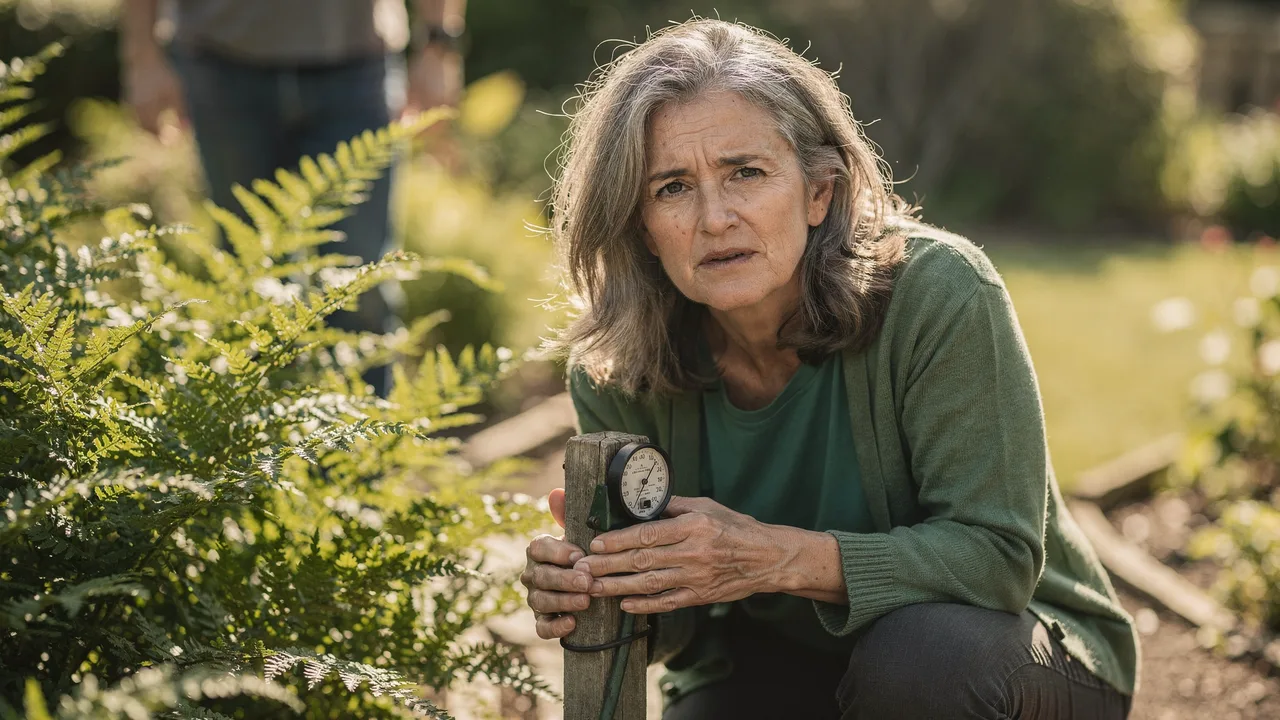
That morning, before the dew burned off, I had knelt in my beds and taken a photograph of the black emitters sitting in the mulch beside the tomatoes. I tucked the phone in my purse next to the laminated receipt.
Gloria stood at the front with her reading glasses on a chain and ran the meeting like a school assembly.
"Item four, water conservation," she said. "The township has reminded us that overnight watering is prohibited. It wastes water and it floods the common walkways. We've had reports of a unit running its system through the night."
She looked straight at me over her glasses. It was a brief look, and it was kind, and it was the worst thing that had happened to me all year.
Patrick stood. He laid his hand on my shoulder, warm and heavy, and I felt every head in the room turn.
"If I may," he said. "I know this is hard to talk about. My mother is a wonderful woman, and she's been through a great deal. Since my father passed, there's been some forgetfulness. The sprinklers are one example, but there are others. That's why I've been so involved."
"Oh, Eileen," Birdie said softly.
"I'm not here to embarrass anyone," Patrick went on. "I'm here because I love her, and caring for an aging parent means making hard decisions before there's a crisis. We're taking it one step at a time."
When he finished he squeezed my shoulder and sat down. Fifteen faces looked at me with pity, which is a heavy thing to be handed in a room with a coffee urn.
I did not look at my son. I looked at Gloria.
"Gloria," I said. "What brand of sprinkler system does the association have on file for my unit?"
She blinked. "I'm sorry?"
"The brand. The model, the installer, whatever the association has on record."
"Eileen, there's no record. Owners' irrigation isn't something we track." She frowned. "Why?"
"Because I don't have one." I stood up, and my voice came out as it always does, plain and unhurried. "I have never had a sprinkler system. Leo and I put in drip irrigation twenty years ago. It runs off a hose bib through a mechanical timer with a white dial. The longest it can run is one hour, and then it clicks off. It cannot run all night. It is physically impossible."
Nobody coughed. The urn gurgled once and went quiet.
Patrick laughed. It was a good laugh, warm and rueful, and he turned in his chair to address the room.
"Mom, you're confused," he said. "Of course you have sprinklers. The little black heads in the mulch? You see them every day. Folks, this is exactly what I'm talking about. She's correcting me on something she's gotten backwards."
His ears had gone red, and a vein stood out above his collar. But he held his smile, and some of the faces turned back toward me, wavering.
I took out my phone and held it up so the people in the back rows could see.
"I took this at seven this morning," I said. "These are not sprinkler heads, Patrick. They are drip emitters. They put out a few drops at a time, right at the roots."
I reached into my purse again and held up the laminated sheet.
"And this is the receipt for the drip irrigation kit, from the hardware store on the pike, dated May 2006. Leo kept it in the Garden file. It's the same file you told me last Thursday was full of junk and ought to be thrown away."
I let the paper hang in the air a moment.
"You told Gloria I was flooding the walkway with sprinklers I do not own. You described a system you never bothered to look at, because you have never once set foot in my garden."
Nobody spoke.
Gloria came down the center aisle with her glasses in her hand. She took the laminated receipt from me, read it from top to bottom, and held it next to the photo on my phone. Then she looked at Patrick, and her face went the way it must have gone when a boy swore he hadn't been in the hall.
"You told me," she said, "in my own kitchen, that she had left the sprinklers running three nights in a row."
"Gloria, I only meant—"
"You told me what you saw, Patrick. What did you see?"
He stood. He pulled his windbreaker off the back of the chair and did not look at me or at anyone else. The folding chair scraped, and then the clubhouse door swung shut behind him on its slow hydraulic arm.
Norman Tibbet cleared his throat. Birdie Kosloski reached over and patted my wrist, once, and went back to her pretzels. Nobody applauded, and I was grateful.
He came to my condo that evening just before dark.
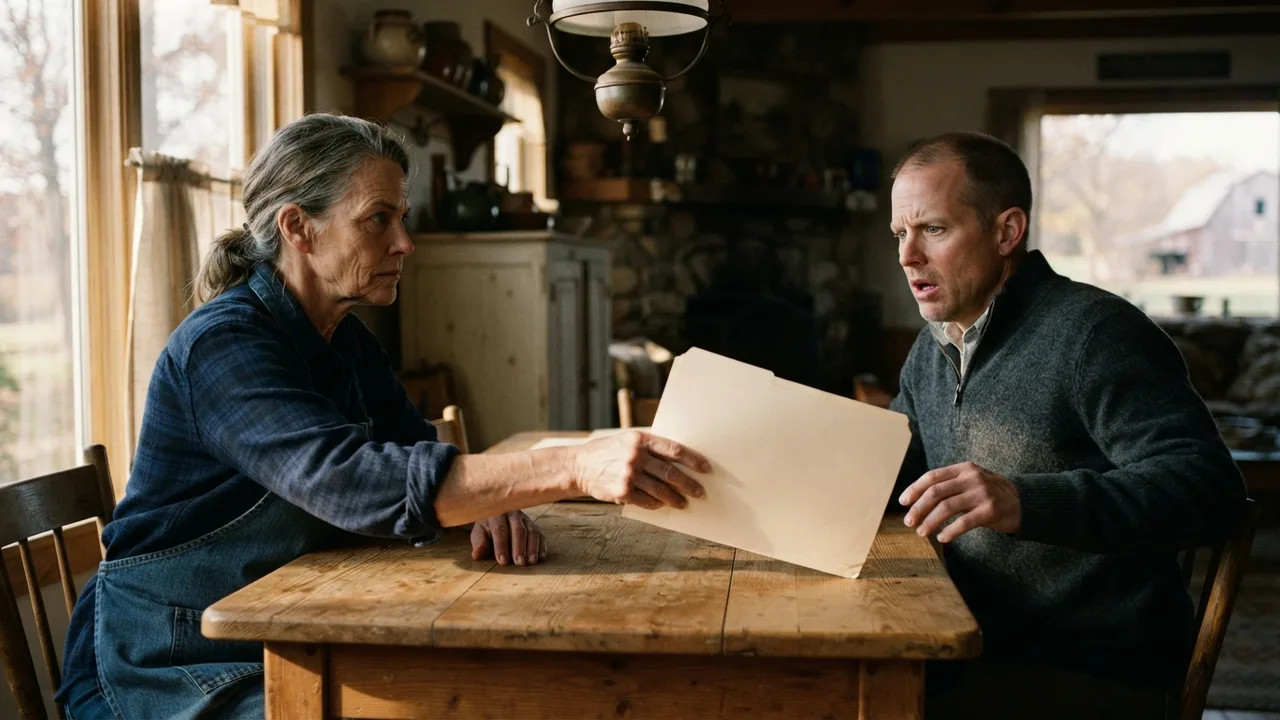
I was at the kitchen table with a cup of decaf and the day's mail when he let himself in with his own key. He did not sit down. He stood by the refrigerator with his arms crossed and the watch turned inward on his wrist.
"You humiliated me in front of the whole community."
"I answered a question about my own sprinklers."
"You could have talked to me first. You made me look like a liar."
"You told a lie, Patrick. I only showed it to them."
"I was worried about you!" His voice cracked, and he lowered it. "Somebody has to be. You're alone out here."
"I heard you in the driveway," I said. "You said you needed liquidity before the quarter closes. You said the asset was right here."
He went still. The refrigerator hummed behind him.
"That was a business call."
"I know what it was." I turned my cup on its saucer. "I don't know how much you owe, and I'm not going to ask tonight. When you're ready to say it to my face, as my son and not as a consultant, I will listen."
"There's nothing to say."
"Then here is what we'll do. You will give me the password to my bank account, the new one you set up. You will not speak for me again, not to Gloria, not to a realtor, not to anyone. And we are not selling this house."
He looked at me for a long moment. I looked back, and I saw a man I had made lunches for, who had once fallen asleep against my arm in the back seat of the car on the way home from the shore.
He took my phone from beside the sugar bowl. He typed the password slowly with one finger, the way Leo used to type. He set the phone down by my cup, and it lit up showing my own balance.
"Mom," he said.
"Good night, Patrick."
The door closed. Headlights swept across the kitchen wall and were gone. I sat there until the decaf was cold, and I found that I could not feel the room the way I had that morning. I had my house and my accounts and my name, and I had lost the boy who once handed me dandelions.
The next morning I went out on the patio in my gardening slacks with a cup of coffee. The sun was warm on my back, and the pavers were already giving off the day's first heat.
I knelt in the mulch by the tomatoes. The soil was dark and damp, and when I pushed my fingers into it the dirt packed itself under my nails. Each emitter had left a small wet circle at the base of its plant, as it had every morning for twenty years.
A hornworm had not found the Better Boys yet. The first green fruit hung heavy on the lowest cluster.
I was home.
I reached over to the spigot, where the hose ran to the old mechanical timer, and turned the white dial to one hour. It began to tick softly, a sound of perfect, reliable order.



Comments