The last time my sister-in-law hugged me was at my husband's mother's funeral, right before she read the will that left us with nothing. I had spent six years inside that house, and the $150,000 Bill and I were counting on for retirement disappeared in one paragraph of legal language.
Deanna had driven down from Springfield in her white Lexus and parked it at the curb in front of Mildred's ranch house, where the church ladies had to walk around it. She wore a charcoal suit that cost more than my washing machine. When the graveside was over and the cousins had gone home, she took my hands in both of hers and held on.
"You've been a rock, Karen," she said. "Let's all sit down."
Advertisements
We sat in Mildred's living room, on the gold sofa with the plastic runner still across the arm. Bill took the chair by the window, the one his mother had used to watch for the mailman. His work boots were polished, and he held his hat on his knee.
Deanna opened a folder. She read in a clear, practiced voice, the one she used on buyers walking through somebody's kitchen. The house, the savings, the contents, all to "my beloved daughter, Deanna Marie Pruitt." The date at the top was from this past spring.
Nobody said anything. The kitchen clock ticked, and the furnace kicked on against the November cold.
"Mom wanted to simplify," Deanna said, closing the folder. "And I want to acknowledge everything you two did."
She took an envelope from her handbag and set it on the coffee table between us. A check was inside, written in her neat, upright hand. Five thousand dollars.
Advertisements
"For your trouble," she said. "Think of it as a gift."
I looked at the number. I had changed that woman's sheets, learned which days she wanted the radio on and which days she wanted silence, and slept on a cot in her den when she was bad. I had given up my work with the home-health agency for it.
"Deanna," Bill said. He cleared his throat. "Well, maybe we should talk about this. I just think Mom always said that money was for us."
Deanna tilted her head. She had a way of doing that, as if she were listening to a small child.
"I hear you, Bill. I do. But Mama had a change of heart, and that's her right." She turned the gentle smile on me. "And Karen, caring for her was what family does. You'd have done the same for your own mother. Let's not make this about money when we're grieving."
I did not say what I wanted to say. I took the envelope, because my hands wanted something to do, and said, "Thank you for the thought."
The word *thought* tasted like a penny.
---
Bill drove us home in the dark, past the Casey's and the dark Dollar General, with the check on the dash between us.
"It's five thousand dollars, Karen," he said at the stop sign on Elm. "It's something. Deanna could've given us nothing."
"She did give us nothing. She gave us a receipt."
"Not with Mama barely in the ground. I don't want a fight with my sister."
"No, you don't."
My voice stayed gentle. I had been saying things gently to that family for six years. Bill parked in our drive, and neither of us moved to open a door.
Sleep didn't come until the gutters started to drip with the first frost. Five thousand dollars, divided over six years, was a figure I could not make myself finish doing. What I knew for sure was that I would never again ask politely for something that was already mine.
---
Deanna called on Wednesday. She said the house needed to be emptied before she listed it, and asked whether I could go through and gather any "personal mementos" for Bill, since I knew the house so well. She would leave a key under the ceramic goose on the porch.
"It's the least I can do," she said.
"I'll go Thursday," I said. I did not tell Bill. He would have said to leave it alone, and I wanted to see that house without anyone watching me.
The place was ten minutes from ours, and I could have driven it in my sleep. The smell of Mildred's Jergens lotion still hung in the hall. I started with the guest room, because it was the one room I had never been asked to clean. Mildred kept it shut, and she kept the key to it in her housecoat pocket.
The closet door stuck. When I pulled it, a cardboard box slid onto my foot.
The closet was packed floor to ceiling. QVC boxes, Home Shopping Network boxes, a few with tape still sealed and a few with the packing slips on top. I opened one with my house keys. Inside was a set of copper cookware, never used, still wrapped in tissue. Another held a collector's plate with a painted cardinal on it, and beneath that were five more plates, each in its own sleeve.
Then a third box. A velvet case held a necklace with the price tag still on the clasp.
I sat down on the edge of the guest bed. I had signed for dozens of these boxes and carried them in from the porch, and Mildred had always told me they were "just towels and such." I had put them in the guest room myself because she asked me to, and then I had never looked.
It was pity I felt first, for a woman alone in that house with a television and a phone number to call. After that came something colder. A closet like this cost money, and Mildred had lived on a pension and Social Security. I was standing in a family secret, and I had opened it with my own house key.
I taped the boxes shut and put them back in order. At home I told Bill I had found nothing but sweaters.
He believed me, and that was the worst of it.
---
I could not see Mildred's bank accounts. I could not see her mail, which Deanna had forwarded to Springfield. What I had was the logbook.
It was a black-and-white composition book from Walmart, the third of its kind. I kept every one in the cabinet over my refrigerator, since the agency had trained me to chart everything and I had never learned to stop. Doctor visits, her blood pressure readings, which mornings she was sharp and which she wasn't, who visited and how long they stayed. Because the deliveries interrupted the day, I had logged every one of them. *QVC, 2 boxes, signed K.H. HSN, 1 box, signed K.H.*
I spread the books across my kitchen table and copied the dates onto my own wall calendar from the hardware store, the one with the pictures of barns. Then I marked Deanna's visits. She came the first Sunday of every month with a pint of Andy's custard and left within the hour.
The pattern came up off the page like a watermark. In the days after each of her visits, the boxes doubled. I remembered Deanna in the doorway, her coat still on, saying, "Mama, treat yourself. You deserve it."
I sat with a cold cup of coffee until the light went out of the window.
The next morning I called Lorraine Ames, who lived next door to Mildred and had brought a casserole to the house every Christmas. I asked her whether she had ever seen Deanna take Mildred to the bank.
Lorraine took a long time to answer.
"Oh, Karen, I wouldn't know about that."
"The Lexus was in the drive that day in April. I thought you might have seen them leave."
"I don't keep track of people's comings and goings." She laughed, and it was a thin, bad laugh. "I've got a pie in the oven. You take care now."
She hung up before I could thank her. I had known Lorraine for nearly as long as I had known the house, and I understood from the way she said it that she had seen something and been told not to talk. I put down the phone and did not call her back, and I knew I would never be invited in for coffee on her porch again.
The logbook had been a record of care. Now it was something else, and I did not want to pick it up.
---
The remembrance lunch was set for a Sunday, once the cousins from Joplin could drive in. Deanna hosted it at the house, naturally. She had ordered ham and funeral potatoes from the Hy-Vee, set the good china on the dining table, and put out a framed photograph of Mildred at forty with a perm and a hopeful smile.
I brought the logbook in my purse. Bill didn't know what was in it.
By one o'clock, a dozen people stood in the living room with paper plates. Pastor Dave Chenoweth had his coffee in one hand and a deviled egg in the other. Lorraine Ames sat on the far side of the room and would not look at me.
Deanna tapped a spoon against a glass of sweet tea.
"I want to thank you all for being here," she said. Her voice caught at precisely the right spot. "Mama lived a frugal, simple life. She didn't need a lot. She loved her church, her kitchen, and her family. To Mama."
"To Mildred," the room murmured.
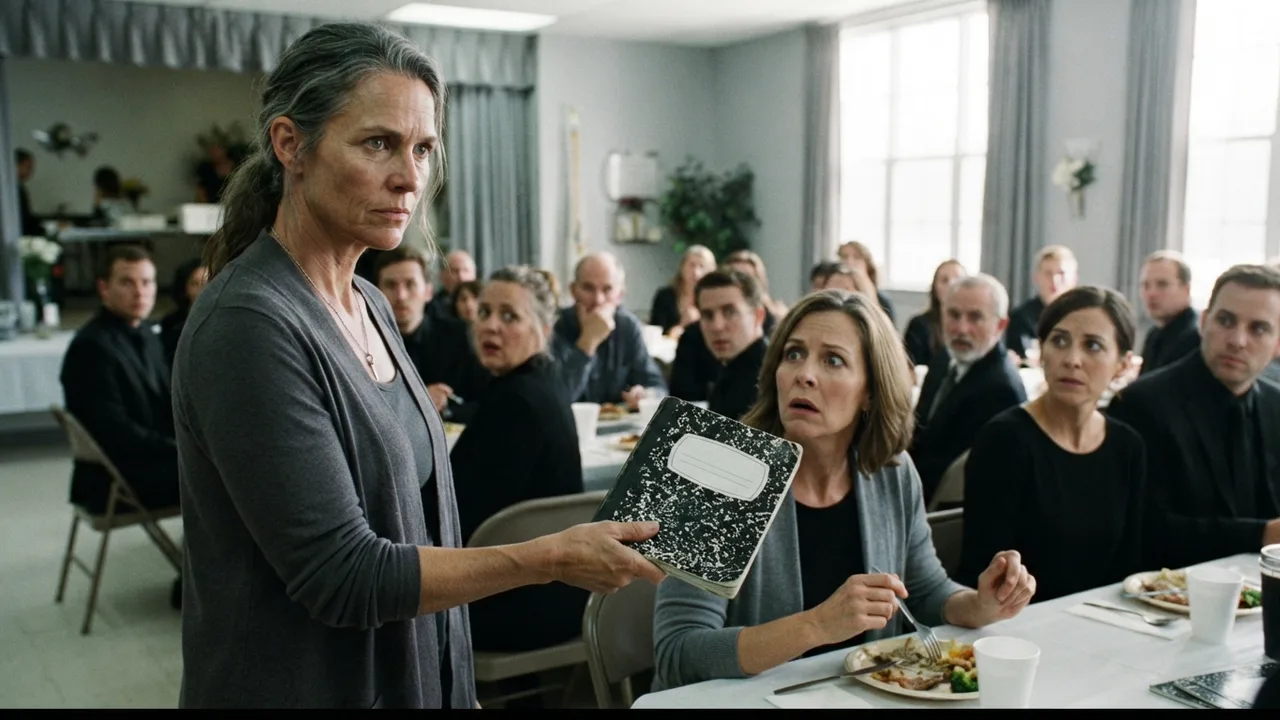
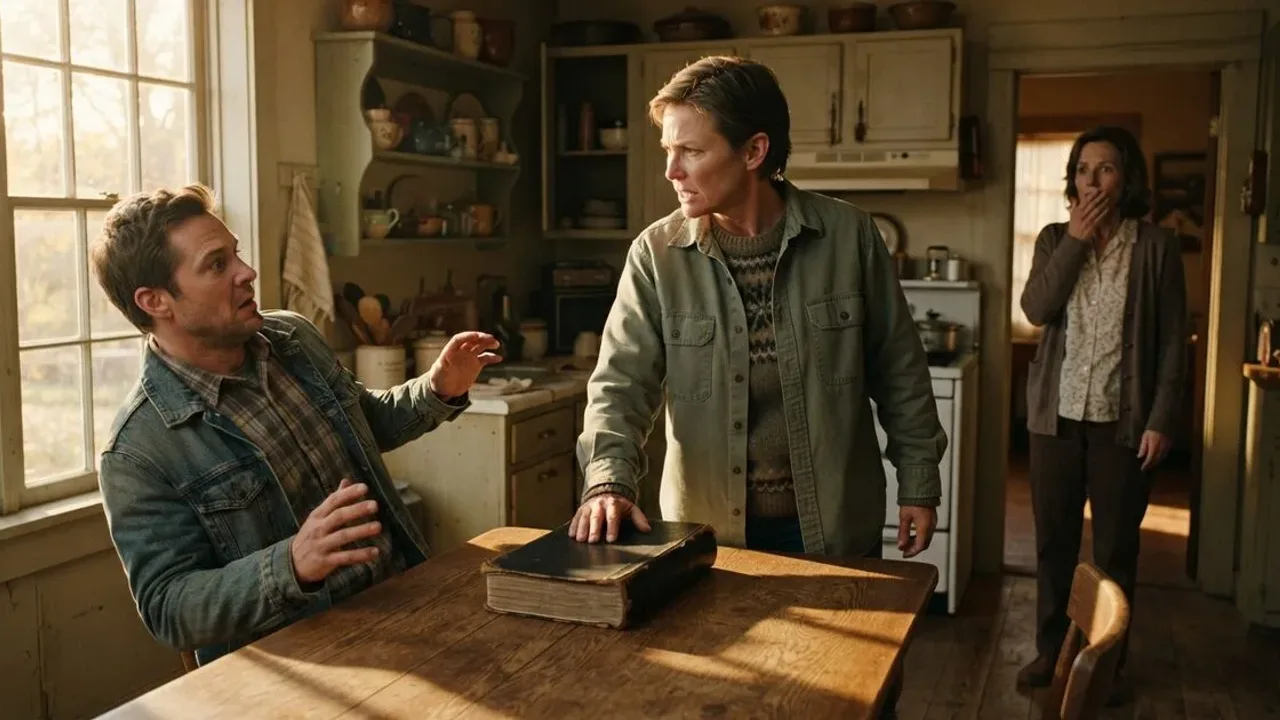
I stood up. My knees were stiff from the folding chair. I took the composition book out of my purse and held it in front of me, the way I used to hold a chart at the foot of a bed.
"Mildred was a lot of things," I said, "but she wasn't simple."
Pastor Dave lowered his coffee.
"I'm not going to take long. I kept a log of everything in this house for six years. In the last year of her life, Mildred received 287 packages from QVC and the Home Shopping Network. I know, because I signed for them."
Nobody moved. Somebody's fork touched a plate.
"Every one is written down, with the date. The deliveries went up every month in the days after a certain visitor came. I'm not saying anything about that. I'm reading you what's written down."
Deanna laughed. It was a light, practiced laugh, and she turned to the room with her palms open.
"My mother had her little hobbies. Karen, honey, you're grieving. This is hardly the time or the place."
"The fact is, it's the only place," I said.
Her voice sharpened. I noticed her thumbnail dig into her glass.
"You are trying to turn this into something ugly and financial. You're embarrassing your husband in front of his mother's friends. Sit down."
I stayed on my feet. I turned a page, found the line, and looked her in the eye.
"On April 12th, you took your mother to open a new credit card. On April 19th, seven boxes arrived. After that the statements started coming to the house, and I saw them on the hall table before you started taking them back to Springfield."
Deanna's mouth opened and closed.
I turned to Bill. He stood by the china cabinet with his plate hanging forgotten at his side.
"This isn't about a hobby, Bill. It's about debt. And the deal Deanna made to hide it."
He took the logbook out of my hand. I let him. He read the page with his finger moving down the margin, and I watched him recognize my handwriting, the slanted sevens I put a line through, the K.H. at the end of every entry. His jaw moved. He had gone pale in the face, and a vein stood out at his temple.
He closed the book and stepped up beside me, close enough that our sleeves touched.
"Deanna," he said. His voice shook and then held. "Tell us what you did."
Nobody ate. Pastor Dave set his coffee on the mantel and began, very quietly, to collect coats. Deanna's lipstick looked suddenly too bright against her face. She did not say it was a lie. She said, "Not here, Bill," and everyone in that room heard what that meant.
---
By evening the casserole dishes were washed and stacked. The last car pulled out of the drive, and Lorraine's porch light went off next door.
We sat in Mildred's kitchen under the yellow light, with the floral wallpaper curling at the seam by the stove. I had hung those curtains myself. Deanna sat across from us with her handbag in her lap. She had taken her earrings off and set them next to the sugar bowl, and I saw that without them she looked like her mother.
"How much?" Bill said.
"Nearly forty thousand." She stared at the table. "Mama never saw the statements. She thought she'd paid them off. I told her I would handle it after she was gone, and she signed whatever I put in front of her."
"You told her to keep ordering," I said.
"I told her to be happy." Her voice cracked on it. "She was so lonely, Karen. You know that."
"I do know it. I was there."
She flinched. I had not raised my voice and did not need to.
Deanna lifted her chin and tried to put her old voice back on. It didn't fit anymore.
"Here is what I'll do. The savings go first to the debt, every dollar of it, so nobody comes after the house. The remaining $110,000 goes to the two of you, in a check, this week. We sell the house and split the proceeds fifty-fifty. That's what Dad and Mama always intended, whatever the paper says."
"The paper says what you made it say," Bill said.
"Yes." She nodded slowly. "You'll get your money."
Bill reached across the table and pulled the envelope with the $5,000 check out of his shirt pocket. He tore it in half and laid the halves beside her earrings.
Deanna looked at them. Then she looked at me.
"You've ruined her," she said. "Everyone in town will be telling it. The boxes in the closet. Mama on the television at three in the morning."
"I know."
"You could have come to me in private."
"I did, on the day you handed me a check. You called it a gift."
She stood up and put her earrings back in, one and then the other, with a care that made my throat ache. She did not hug me, and she did not say good night. The Lexus started in the drive and took its headlights down the road toward the highway.
Bill sat quietly for a while. Then he put his big hand over mine on the table.
"I should've stood up at the start," he said.
"You stood up when it counted."
"It took a lot of dates."
"It usually does," I said.
---
On Monday morning I sat at my own kitchen table, in my own house, with a mug of Folgers going cold at my elbow. The radio was off. Bill had gone to the hardware store, and the quiet felt different from the quiet in Mildred's den.
I held the composition book in my left hand. The cover was soft at the corners from being carried and the spine was coming loose. It had bought me this peace, and it had cost Mildred her last privacy and me a neighbor and a sister-in-law. A dozen people in Chapel Springs would tell the story of the closet at their kitchen tables for years, and some of them would tell it kindly.
With my right hand I opened the new planner I had bought for the coming year, the one with the cardinal on the cover. The pages were white and smooth. Nothing was written on any of them, not a doctor's appointment or a delivery or a name that was not mine.
The logbook went down on the table beside it, and I uncapped a pen.
The planner lay open in front of me, waiting for me to fill it with my own life and not someone else's.
Comments