The first time Clay Tremaine lied to me, it was about a box of expired bandages. The second time, it cost the children of Cabot twenty-eight thousand dollars out of the Happy Smiles dental van fund.
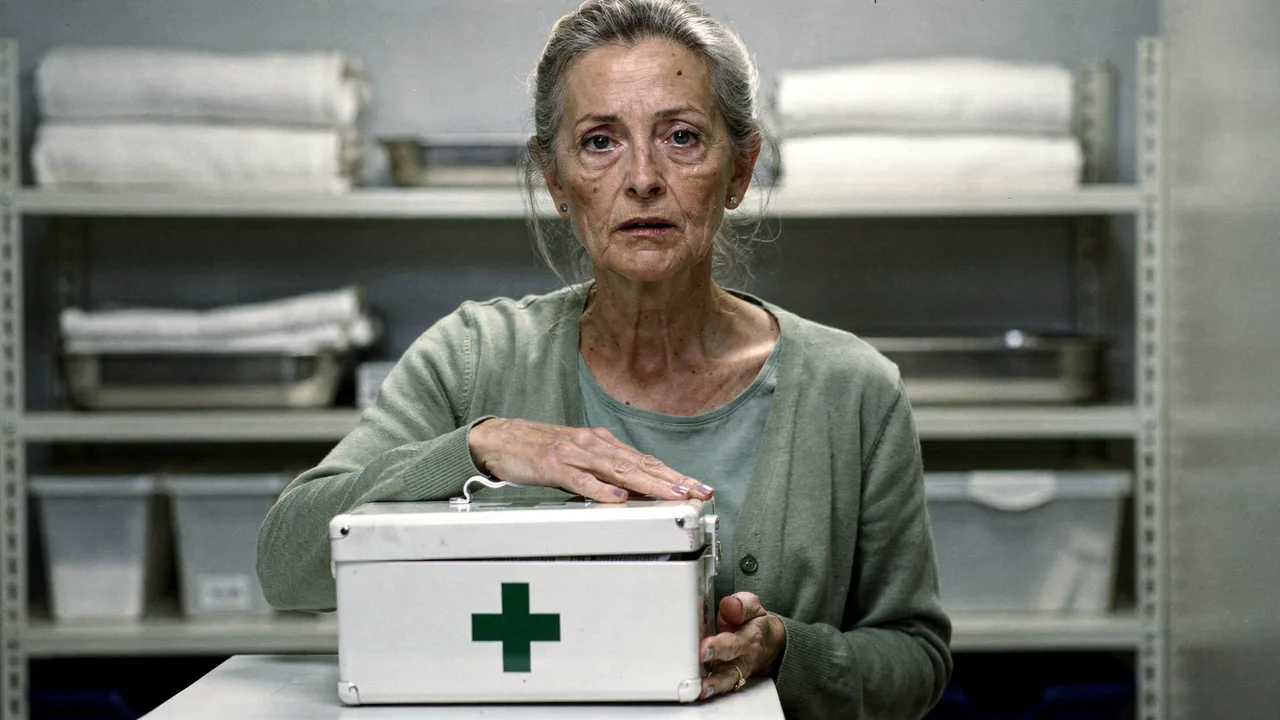
I found the bandages on a Tuesday, doing the shelf check I had done at the Cabot Community Wellness Clinic since the year I retired from the school district. The date was printed on the end flap, last spring. I carried the box down the hall to what used to be my office.
"Mr. Tremaine, these are expired."
He looked up from a monitor the size of a cafeteria tray. He had a suit on that would have cost me a month of groceries. "I had the whole closet audited. Everything on those shelves is current."
Advertisements
"Then somebody should tell the box."
He laughed, warm and easy, and rubbed his left earlobe. I had watched children rub an ear like that while telling me they'd eaten a good breakfast. "A stray, Elinor. I'll have it tossed."
"I'll toss it. I'd like to know who audited."
"We're moving past the clipboards." He tapped the screen. "Your inventory binders, the quarterly reports in triplicate. It's all very antiquated. Future-proofing means one system, one dashboard."
"The binders have never been wrong."
"That's what makes them a liability. Only you can read them."
He said it kindly. That was the worst part.
By Friday my desk was in the supply closet. He had it wedged between the gauze and the paper gowns, under a bare bulb, because the office was going to be his "communications hub." There was a ring light in there now, on a stand, pointed at nobody.
Dr. Sharma stuck her head into the closet that afternoon, her hair coming out of its bun. "Elinor, do we have any more of the children's liquid pain reliever?"
"Second shelf, behind the gowns. I moved it when I moved."
"He moved you in here?" She looked at the desk, then at my sensible shoes pressed against a carton of exam gloves. "I'll talk to him."
"Don't. You have a waiting room."
She didn't argue. She had a waiting room.
I did the quarterly report anyway, the old way, at the closet desk with a ledger and a pencil. The bank statements came in the mail on the second Monday of October, and I went down them line by line, as I always did.
Advertisements
The line was in September. HealthForward Solutions LLC. Twenty-eight thousand dollars, drawn from the restricted Happy Smiles fund.
I knew that fund. Donors gave it for a van that would drive to the elementary schools and clean children's teeth. Nobody had told me about any van purchase, any lease, or any company by that name.
I walked into the hub with the statement. Clay was reclined in his chair with his shoes off, which I noted.
"What is HealthForward Solutions?"
"Ah." He slid open a drawer and handed me a single sheet. It was glossy, with a logo of a green leaf and a heartbeat line. "Digital Outreach Platform Integration. We're building a portal so families can book dental screenings from their phones."
"There are no line items."
"It's a flat-fee engagement."
"This came out of the dental van fund. That money is restricted."
"It's in service of the dental mission, Elinor." He smiled, and it was the smile of a man handing a lollipop to a child at the end of a shot. "Please don't worry about it. Finance is a lot to carry. Let the new systems carry it."
I folded the statement and went back to the closet. My hands were steady. My ears were hot, though, and I stood for a moment with my back to the shelf until they cooled.
Three days later Howard Jeffries called me at home. He was the clinic's board chair and had been my husband's closest friend, and I could hear him easing into the conversation the way he used to ease a customer toward a cheaper drill.
"Now, Elinor. Clay's concerned you're struggling to adapt to the modern financial systems."
"Did he say that word?"
I slid the soup pot off the burner and stood holding the lid.
"He said it kindly. He thinks maybe you'd be more comfortable with fewer responsibilities."
"Howard, I've found twenty-eight thousand dollars gone from the dental fund."
"I'm sure it's just a misunderstanding."
"Then you'll look at the statement."
He cleared his throat, and I heard a chair creak on his end.
"Let's talk Saturday," he said. "Come by the house."
Saturday I found him on his back porch, stacking split maple against the rail with the first frost still silvering the yard. He didn't look at me when I set the statement on the stack. He looked at the woodpile.
"I've seen it," he said. "Clay walked me through the invoice."
"It has no line items."
He squared a log against its neighbor, then squared it again.
"These tech outfits don't do line items. Elinor, he came with a résumé a yard long. He's put the clinic on Facebook. We've had donors write in who haven't written in since the nineties."
"The fund is restricted."
"You need to trust the new leadership." He picked up a split log, set it down, picked it up again. "I've known you forty years. I'm asking you to let this one go."
"You're asking me to be quiet."
"I'm asking you to be reasonable."
He still wasn't looking at me. I put the statement back in my purse and drove home along Route 215 with the heater on, past a church with a sign that said FALL SUPPER, with nobody to say it to.
That night I sat at my kitchen table with my reading glasses and my late husband's laptop, which I had used mostly for recipes. I learned what a registered agent was. I learned that Delaware, which lets a person hide behind a company, will still tell anyone who asks when the company was born.
HealthForward Solutions LLC, formed in Delaware on July 1st of this year. No other officers listed. No address but a mailbox service.
I did not sleep that night, or the next. On the second night I found an archive site that keeps old copies of web pages the way I keep old nursing logs, and I typed in the name of the company.
There were two versions saved from two years back. The company had a different state on it then. Oregon.
The "About Us" page had a photo of a man in a blue blazer, smiling a smile I had watched across a desk for three weeks. The caption said: Clayton Trumble, Founder and CEO.
Same leaf. Same heartbeat line. The left eyebrow rode a little higher than the right, as it did when Clay lied to me about the bandages.
I took a picture of the screen with my phone, then a screenshot, then another picture of the screenshot, because forty years of paperwork teaches you to want two copies. Then I washed the teakettle, since nothing else needed doing, and sat there until it was light.
The donor appreciation reception was held the last Thursday of October in the community room at the town hall. There was a folding table of Cabot cheddar cubes, two bottles of Vermont red and one of white, a tray of crackers from Hannaford, and a stack of paper plates with pumpkins on them. About twenty donors had come, most of them in barn coats over good sweaters.
I had come early to carry the folding tables, and Gus, the custodian, had pointed out a gray code in the corner of the projector screen. Any phone could cast to it with that code, he said, if the speaker's laptop quit.
Clay stood at the podium with a clicker in his hand and a projector humming behind him. His slides were handsome. One showed the clinic building with a glowing blue ring around it. Another said "Access 2.0."
I sat in the third row with my purse in my lap. Howard sat in the front row with a plastic cup of wine he hadn't touched, and Dr. Sharma stood at the back, hands in the pockets of her cardigan, still in her scrubs.
"In closing," Clay said, "the future is a partnership between our donors and our technology. Questions?"
A woman in a green fleece asked about the portal. Clay talked for some time about "synergy." Then I stood up.
I didn't raise my voice. I never needed to in a school hallway.
"Mr. Tremaine, could you tell us more about your relationship with HealthForward Solutions?"
The room did what a room does, which is turn. Clay's smile stayed where it was, but his thumb moved on the clicker.
"Elinor, our longtime volunteer," he said, to the donors. "Elinor handles the paper records, and the transition has been difficult. That's a vendor we use for outreach. We can take that offline."
"I'd rather take it online."
I took out my phone. The gray code sat in the corner of the wall, where it had sat through every one of his slides, and I typed it in. The blue ring around the clinic vanished.
The screenshot filled the wall. The leaf, the heartbeat line, the blue blazer, the smile.
"This page is from an archived copy of the HealthForward Solutions website," I said. "Two years ago. The founder and chief executive is named Clayton Trumble."
Somebody in the back said, "Oh my."
Clay didn't move for what felt like a long time. A pale line came up along his jaw.
"This is ridiculous." He found his voice, and it was loud. "That's a doctored photo. Anyone can make a picture. This is a personal attack from a volunteer who is resistant to change and is clearly confused."
He turned to the front row. "Howard. Are you going to let her sabotage this event?"
Howard half-rose, one palm lifted in the old soothing gesture. "Now, Elinor—"
"I'm not confused," I said.
I looked at Howard. Then I looked at the donors: the green fleece by the aisle, the man with the cane, the couple who had given the first thousand dollars to the van.
"The invoice Mr. Tremaine showed me is dated September 15th. It bills for an integration completed over the past year. The Delaware company that sent it was registered on July 1st. It didn't exist for most of the work it billed for. And the dental van fund, Howard, as you know, is a restricted fund."
I opened my purse and took out the bank statement.
"We paid twenty-eight thousand dollars for a lie. This is the transfer."
I held it up. My hand did not shake. I saw it not shaking, and I was glad of that and nothing else.
Nobody coughed. The projector fan was the only sound in the room, and then Dr. Sharma set down her cup in the back, and that was loud too.
Clay rubbed his left earlobe. "All right." He wet his lips. "Say I did work under that name before. That's called a track record. The platform is real, and the money is sitting in that account, every dollar. It's a bridge, Elinor. The portal goes live in the spring."
"Then it can come back tonight."
"Tonight?" His laugh had nothing in it. "Banks don't work that way."
"Howard, you have the clinic's account on your phone. You pay the board's insurance from it."
Howard's hand went to his jacket pocket before he decided to let it.
"Elinor, maybe the board should sit down with Mr. Tremaine privately," he said. "Tomorrow, with cooler heads."
"I did private, Howard. I did it on your porch."
He closed his mouth. I turned back to the podium.
"Send it back, Mr. Tremaine. All twenty-eight thousand, into the clinic account. Howard will tell us when it lands."
"And if I don't?"
"Then these folks can ask you themselves. They have all evening. There's cheese."
The man with the cane shifted his weight and kept his eyes on Clay. Clay looked at him, then at the questioner by the aisle, then at the screen where his own face smiled in a blue blazer. He took out his phone.
His thumb was not steady. It took him two tries to get past the first screen, and a text came in with a code that he had to read twice before he typed it. He turned the phone around and held it out to me without looking up. I read the screen, because I trust what I see, and it said the transfer was sent.
In the front row Howard stared at his own phone.
"It's here," he said. His voice had gone small. "Twenty-eight thousand. It's posted."
A woman near the cheese table let out a breath. I kept my eyes on Clay.
"Now the keys and the card," I said. "Howard, you'll need a pen. There's one in my purse."
"You can't dismiss me." Clay's voice cracked on it. "You're a volunteer."
"I'm the one who's read every statement this clinic has had in forty years. Howard is the chair, and he'll sign beneath you. Won't you, Howard?"
Howard looked at me for a long moment, and then at the keys on the podium, and I watched him decide.
"I will," he said.
I tore the back page off a donor program and set it on the podium with the pen. "Write this. 'I resign as director of the Cabot Community Wellness Clinic, effective tonight.' Then sign it and date it."
Clay wrote slowly. When he finished, he set down the pen, dug a ring of keys from his jacket and a black card from his wallet, and laid them next to the page. Howard signed under him. His signature was crooked.
Clay picked up his coat. He left his laptop. He went out through the side door onto the loading dock, and it clicked shut behind him.
Howard stood holding the program page like a man holding somebody else's baby.
"I should have listened on my porch," he said, quietly.
"Yes. You should have."
"What do you want done, Elinor?"
I had not known I would be asked. I found I had the answer ready, the way I used to have the ice pack ready.
"My desk goes back in my office. The ring light goes in the closet. The binders come out again, and the van fund gets its own account with two signatures. Mine is one of them."
"Done," he said. "All of it."
He held the door for me on the way out, as he had at my husband's funeral. I did not thank him. It cost me more to walk past him than it had to stand up.
The donors left in murmurs. A few touched my sleeve. The woman in the fleece said, "Thank you for catching that," and a man I had known thirty years looked at me as if he had never seen me before and said, "Elinor. Well." I understood I would hear that at the post office, at Hannaford, and in the pew at church, and that I would not be allowed to go back to being the woman who kept the binders.
My knees did not give out until the room was empty. Then I sat down in the third row for a minute, and Dr. Sharma came up the aisle with a trash bag and held it open while I stacked pumpkin plates.
"You could have told me," she said.
"I didn't know who to tell."
"They'll want you to run the finances."
"They've got the finances. I'm running the binders."
She almost smiled. We worked in silence, the cups first, then the plates, then the cheese tray, which she wrapped in plastic for the clinic fridge. Someone had left the white first aid kit with the green cross open on the end of the table.
A half-used sleeve of bandages lay on top. I turned it over and read the date printed on the side. Then I dropped it in the bag, neatly, with the plates.

Comments