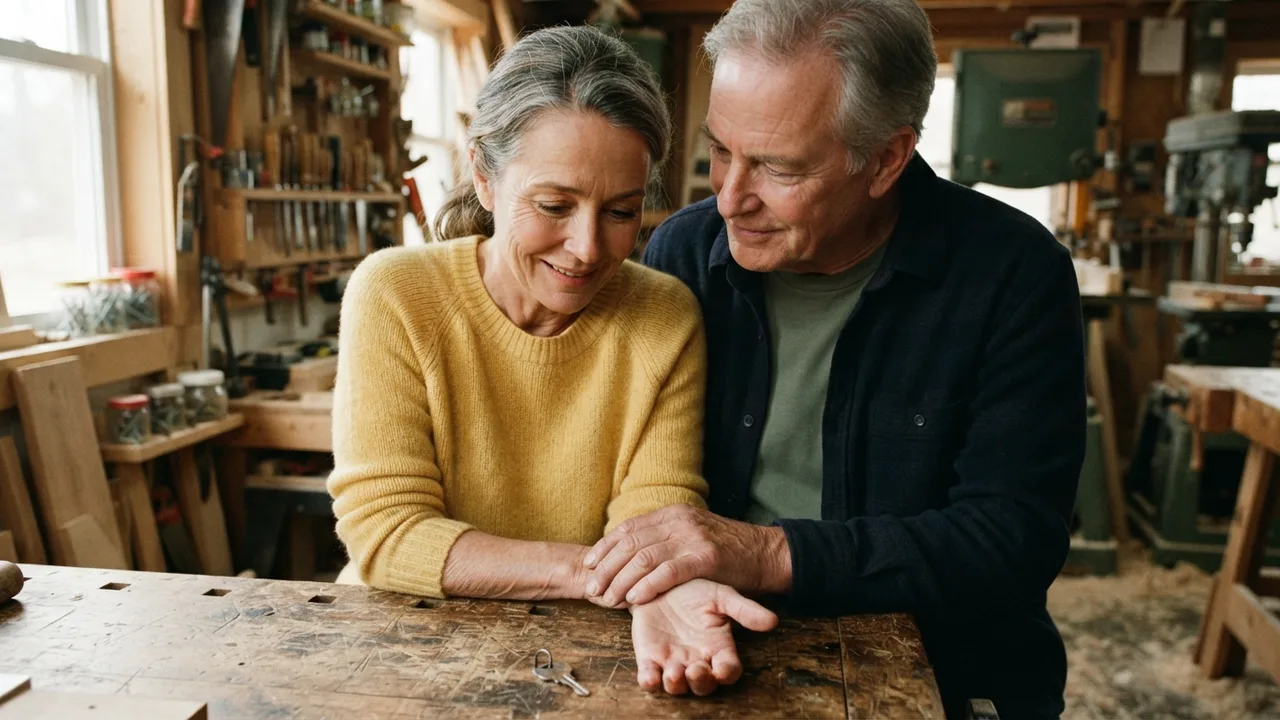
The first time Peter's daughter told me I was a thief, he had just given me the key to his house.
It sat in my palm, still warm from his pocket, a brass Schlage with a green plastic tag. "Margaret's desk needs your hands," Peter said. "Come and go as you like."
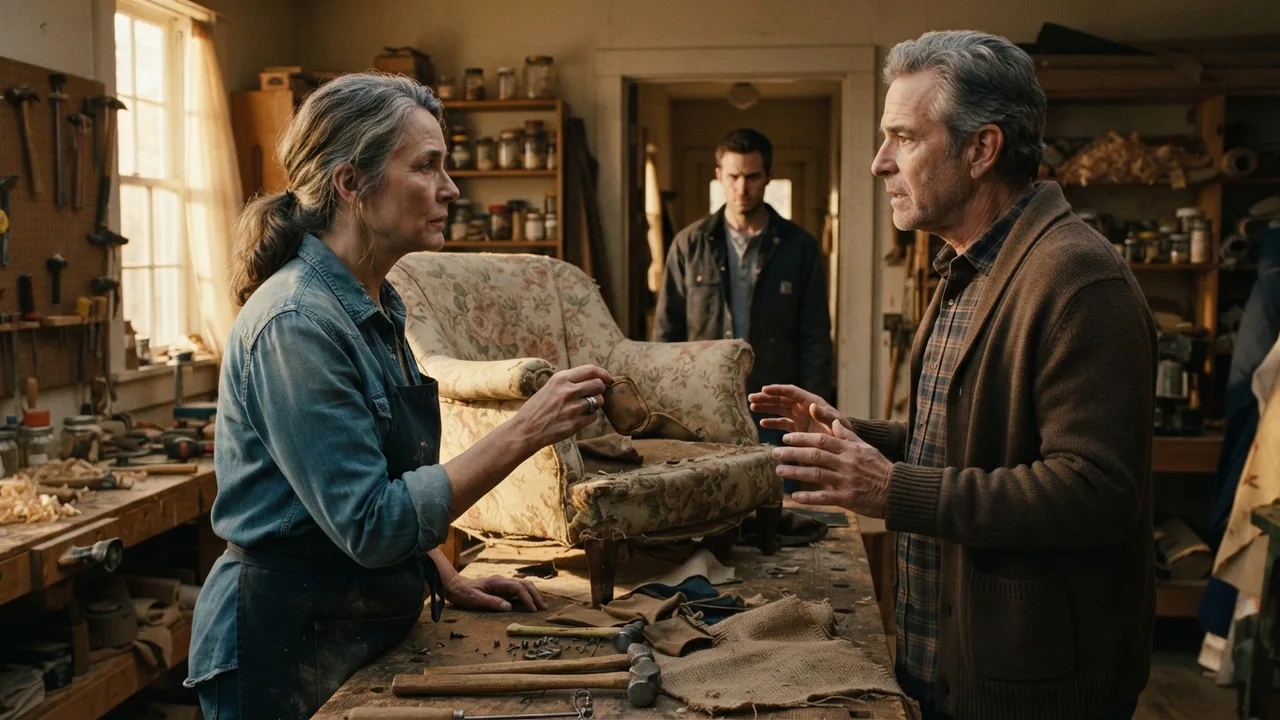
Alicia stood in the front hall of his craftsman with her car keys in her fist. "Dad, that desk is worth more than my Audi. And you're handing the house over to a woman who sands things for a living."
"Alicia," Peter said.
"I'm only saying what it is." She turned to me, and her smile had no give in it. "A key first, then the desk, then a signature on something. There's a word for people who work that way. Thief. I hope you'll forgive the directness."
Advertisements
I closed my fingers around the key. The brass bit into my palm.
"It's a fair thing to worry about," I said. "I'd want to know who was in my father's house, too."
"Good," Alicia said. "Then we understand each other."
We did not. But I carried the desk out to my truck anyway, with Peter holding the porch door and the Columbia going silver behind him under the October drizzle.
I am fifty-eight. When my husband died, my world shrank to the size of a converted garage on Exeter Street, and I let it. Sawdust, tung oil, a radio tuned to the Portland public station, and a lunch I ate standing up.
Then Peter Lindquist brought me a cracked piano bench and stayed forty minutes to tell me about the Lewis and Clark winter at Fort Clatsop. A retired history professor, tweed on a Saturday, reading glasses pushed up into gray hair.
Four months later he was the first person in three years who made the walls of my life move outward.
Alicia looked at me like a line item she planned to strike.
She came to the workshop on Thursday, unannounced, in a camel coat that had never met a drizzle it couldn't beat. She walked a slow circle around the desk, which sat on my bench with its drawers pulled and stacked.
"Flame mahogany," she said. "Do you know what Dad's insurance appraiser said? I had it looked at."
Advertisements
"I didn't know that."
"Of course not." She ran one lacquered nail along the writing surface. I resisted the urge to catch her wrist. "Dad's gotten very sentimental. Everything's Mom's now. Mom's desk, Mom's quilt, Mom's old Buick. It's a challenge, honestly. For the family."
"He loved her."
"He's *forgetting* things, Nola. That's a different thing from loving." She picked up one of my brass pulls, weighed it, set it down. "I run a business. I know what things are worth. I'd just hate to see anyone take advantage of that kind of confusion."
She left a smell of expensive vanilla in the shop. I opened the garage door and let the rain in to clear it.
That night I stood over the desk, and for the first time in years I felt like an intruder in my own workshop.
I started the real work on Saturday. A secretary like that is built in layers, with a veneer face laid over a pine carcass, and every layer tells you what has happened to it. This one was American Empire, probably 1840s, with a drop front and a row of small drawers behind it.
One drawer, the top left, was locked. The brass escutcheon around the keyhole was original, dark with a hundred and eighty years of hands.
I called Peter that evening. "There's a locked drawer. Do you have the key?"
"Oh, Lord. No." He laughed, the soft one. "Margaret kept it somewhere. I've turned the house over twice. If it's a problem, you can have my blessing to pick it."
"I'll work around it. It's not going anywhere."
I covered the desk with a cotton sheet and went home to a can of chowder and a restless sleep.
Monday morning, the drawer was open.
I mean it was *forced.* The shop had been locked, but I had let Alicia, or someone, in the side door on the weekend when I ran to Fred Meyer for steel wool and left the latch off for ten minutes. I knew it before I understood it. Wood tells you things.
The splinters around the lock were bright, nearly blond. Old breaks go gray, then brown, from years of oil and air and thumbs. These hadn't had time to darken. Someone had levered a flat blade under the lip of the drawer front, and the pine behind the veneer had given in a fan of pale fibers.
They had tried to hide it. A smear of pinkish putty filled the worst of it, pressed in by a thumb, the color of a bandage against red-brown mahogany. The brass had fresh scratches, a bright chatter of them above the keyhole.
I stood very still. Then I opened the drawer.
Behind a false back, in a shallow slot the crowbar had missed, a manila folder lay flat. Four loan agreements. Four lenders with names like Coastline Capital Solutions, all of them high-interest personal loans, all in Peter's name, all signed in his small slanted hand.
I did the addition twice on the back of a sanding-grit envelope. Sixty thousand dollars.
I did not sleep that night. I lay on my side of the bed, which I still thought of as my side, and listened to the rain, and tried to decide whether I had the right to know any of this.
If I told Peter, I was a woman who had gone through his dead wife's desk. If I stayed quiet, I was holding a thing that could swallow him.
Alicia's voice kept running underneath: *confusion, forgetting, taking advantage.* The papers I had found seemed to make her case for her.
Tuesday I slid the folder into my handbag and drove to his house. We sat in the sunroom with tea, and I came at it sideways.
"Peter, are things all right? With money, I mean."
He set his cup down. "Why would you ask me that?"
"Because I care what happens to you. And because I've seen—"
"I don't discuss my finances, Nola." The professor's courtesy went thin and hard, like a veneer lifting. "I'm not a child. I'd thank you to remember that."
"I didn't say—"
"I'm tired. I think we'll leave it there."
He walked me to the door. He did not kiss me. The drizzle followed me down the steps.
Alicia called at nine that night. I knew who it was before I picked up, from the way the phone buzzed against the bench.
"Dad told me you've been *interrogating* him." Her words came fast and crisp. "Snooping. Trying to get a grip on his assets. Do you think I don't see how this works?"
"Alicia, I've done nothing but—"
"You are a tradesperson he hired. Nothing more. You fix chairs. And you are going to finish that desk, and carry it back, and stay out of my family's business."
"Your father invited me into—"
"My father is confused!" The line clicked off.
I sat on the shop stool with my hand shaking against the bench, and for a long minute I made a plan. Finish the desk. Return it. Pack up my small hopes and walk away from the whole splintered mess, because I was fifty-eight and had already been through enough.
I did not make the plan stick. But I did not unmake it, either.
Peter's birthday dinner was Saturday at The Osprey's Nest, a waterfront place with white tablecloths and a window onto the Astoria-Megler Bridge. He called to ask me. His voice was careful, like a man testing a joint he suspected was loose.
"I'd like you there, Nola. Please. I was short with you."
I said yes. I brought the manila folder zipped inside my handbag, meaning to put it in his hands in private. I wore my good gray sweater and my mother's pearl studs.
We had a private table at the back. Peter sat at the head, Alicia at his right in silk the color of cream, and Scott beside her, looking tired in a good suit. I sat across from Scott. Peter's chair creaked when he leaned toward me, and I patted his sleeve.
Through the entrées, Alicia was a pleasure. She asked about my son in Colorado. She laughed in the right places. Scott said, "Well, Alicia feels this has been a good year," and Alicia squeezed his wrist.
Then the cobbler came, marionberry and still steaming, with a candle stuck in Peter's. Alicia rose with her champagne flute.
"To Dad," she said. "To your health, and to your good judgment. May both stay with you for a very long time."
Peter smiled, a little puzzled. Scott looked at his plate.
"And Nola." Alicia turned the flute toward me. "We're all so worried about Dad giving away priceless family heirlooms. He's not thinking clearly. I think you can understand how that looks."
My handbag sat by my plate on the tablecloth. A corner of the manila folder showed at the zipper, and I didn't move it.
I had one choice about how to say it, and I made it the way I'd make a cut: once, and clean.
"The desk is a beautiful piece," I said. "American Empire, flame mahogany. And someone forced the top left drawer on Saturday, with a flat blade."
The table went quiet. A busboy passed behind us and went out again.
"The splinters are still pale," I said. "Old damage goes gray. Someone filled the worst of it with pink putty and pressed it in with a thumb."
Alicia gave one dry laugh. "Dad lost the key and did it himself. He's always forgetting things." She turned to him, bright, certain. "Tell her, Dad."
Peter looked at her and said nothing.
"I never said the drawer was locked," I said. "I said forced. You're the one who brought up a key."
"Everyone knows old desks have locked drawers."
She lifted her flute and drank, and the candle on Peter's cobbler leaned in her breath.
"There's a print in that putty," I said. "A thumb, with a crescent cut across the top where a long nail dug in. I checked it Monday against my own thumb, and mine is blunt. Hold up yours, Alicia."
Her right hand went under the tablecloth.
"Putty is putty," she said. "Anyone has a thumb."
"Not with that nail."
Her hand stayed where it was. Across from me, Scott put down his fork.
He had finally lifted his eyes. "Alicia," he said.
She rounded on me, and the stem of her flute rang against the plate. "You went through my mother's desk! There's a folder hanging out of your purse. Who's the thief here?"
"I went through it. I'll own that." I slid the folder out and laid it beside Peter's cobbler. "Four loans in your father's name, from lenders like Coastline Capital. They were in a slot behind a false back, a pencil's width past where the blade stopped. I can't tell you who hid them. I can tell you the desk was leaving the house on my truck, and somebody wanted this out before it went."
"Bridge loans," Alicia said. "For the shop. Dad knew. I explained it all."
"Then you'd have copies in your office, and no reason to pry a drawer open in an empty workshop." I squared the folder against the edge of the plate. "A bridge you have to hide isn't a bridge."
Scott pushed his chair back an inch. "You told me it was the bank," he said. "Not Coastline anything."
"Scott, stop."
He didn't. He sat looking at the folder as if it might change its mind.
I turned to Peter. "You needn't answer tonight. Here's what I'd do, if it were mine to do. Don't sign, don't pay, don't argue. Monday morning you call each lender with this folder open on your kitchen table and Alicia beside you, and you ask who applied, and from what address."
"And if the answers come back mine?" Peter said.
"Then I owe you an apology and a very good desk."
"You've known him four months," Alicia said.
Nobody answered her. Peter's chair legs scraped the floor as he stood, and he held the rail until his hands stopped shaking.
"Get your coats, both of you," he said. "We're going home."
Alicia stopped in the doorway with her coat over her arm. Her face had lost its polish, and what was left was aimed at me like a plumb line.
"I hope you're proud," she said.
I said nothing. There wasn't a joint in the world I could have fit to that.
Peter walked me to his Volvo and asked if I'd take him to my workshop, because he couldn't sit in his own house tonight. In the shop I switched on the gooseneck lamp. The desk sat in its yellow cone with the drawer hanging open, the putty pink as a Band-Aid, and I had been so proud of how I'd seen it.
I wasn't now. I'd meet that glare at the Safeway, at the post office, on Commercial Street past her shop window.
Peter laid something on the bench beside my chisels and my tin of wax. A small silver key, the bow worked into a scroll.
"It was in the jewelry box in her old room," he said. "Margaret gave her that box. I found it this afternoon, before dinner, and I didn't want to understand it."
"You looked where you could stand to look."
"Yes." He put his hand over mine. "I'm sorry it cost you a quiet life."
"It'll cost you more."
"I know. Let's fix it together."
I didn't answer. I looked at the scarred wood under the lamp, and the little silver key lay on it with its bit toward the lock.

Comments