The certified letter from the bank wasn't addressed to Richard Hammond, Certified Financial Planner. It was addressed to Richard Hammond, defendant, in a foreclosure proceeding on a house we paid off years ago.
I stood at the end of our driveway in Kingwood, Texas, with the rest of the mail pressed against my chest and read the phrase "notice of acceleration" until the letters quit lining up into words.
Then I carried it inside, laid it on the kitchen island square to the edge, and started supper, because that is what I do when a seam pulls crooked. I finish the row. Then I look at it.
Advertisements
Richard came in at six, poured his bourbon, and asked what smelled good.
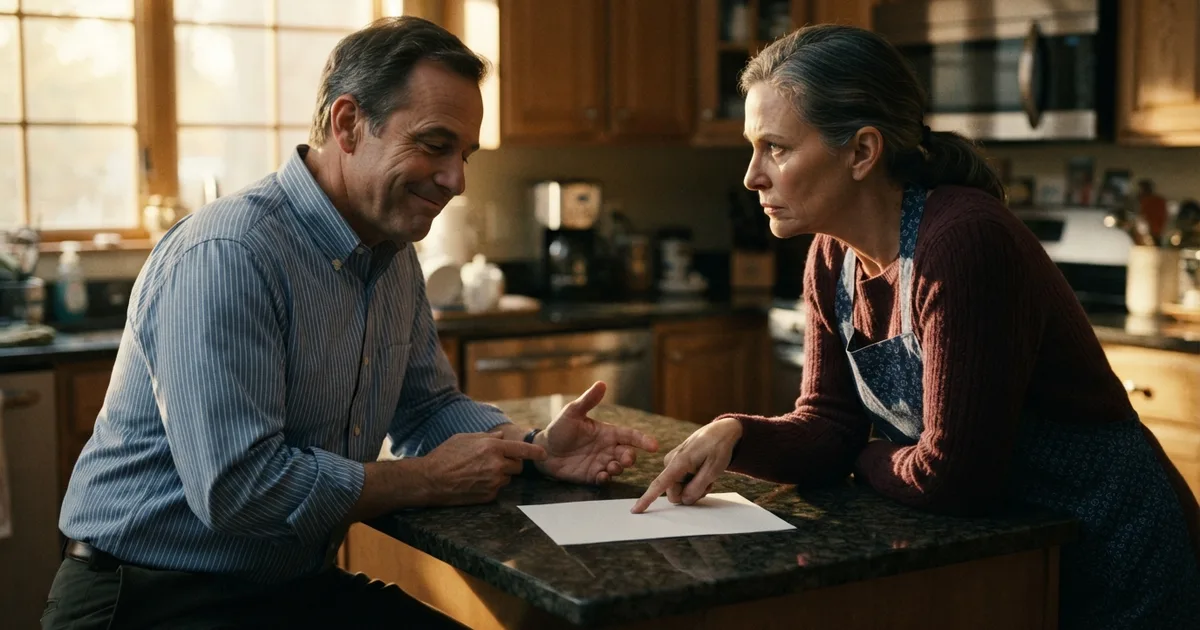
I slid the letter across the granite.
He picked it up. He read the whole thing standing there with his weight on one heel, reading glasses pushed up on his forehead, the way he read everything that came into this house before deciding what it meant.
Then he laughed.
"Sylvia, this is a phantom lien. Their software spits these out."
"It says foreclosure."
"It says what a computer typed. I'll call Doug at the bank Monday morning." He patted my shoulder twice, the way you pat a dog that has barked at the mailman. "Don't worry your pretty head about it."
I looked at the envelope. It had his name typed on it twice, in two different fonts.
"Monday," I said.
"Monday."
He took his drink to the study and closed the door. I stood at the sink with the water running and my hands under it until the water went cold.
Advertisements
That night I lay awake and listened to the air conditioner cycle. Somewhere past midnight I got up, went downstairs, and ironed a stack of fat quarters I'd already ironed once.
Monday came and went.
Tuesday, I asked. He said Doug was out of the office.
Wednesday, I walked past the study and heard him on the phone, low, with the door locked. I kept walking. In our house you keep walking.
Thursday I made a H-E-B run and came home to find him at the kitchen table with the laptop angled away from the doorway.
"Everything all right?" I asked, setting down the Blue Bell.
"Bureaucracy," he said. "Nothing I can't handle."
I put the ice cream in the freezer. I have handled the household budget to the penny since before either of our children was born, and I know what a man's shoulders look like when he is carrying something he intends to keep carrying.
That evening I tried to log into the business account for Kingwood Comforts, my little Etsy shop.
Access denied.
I sat back in the chair and looked at the login screen for a long moment. Richard set that account up years ago and insisted on managing it, since he was the one who understood that sort of thing. I had never once needed to open it myself.
Now I needed to.
"Did you change the password?" I asked him at breakfast.
"On what?"
"The shop account."
"Oh. Security update. Everyone's doing it." He turned a page of the Houston Chronicle. "You don't need to be in there. There's nothing in there but thread money."
Jenna called that afternoon while I was pinning a border.
"Mom? You sound like you're in the garage."
"Utility room. The light's better."
"Is Dad okay? He's been strange. He forgot my birthday dinner."
"Your father has a lot on his mind."
"He's retired, Mom."
"Yes," I said. "He is."
"Has he said anything to you about money? Anything odd?"
I set the pin down in the cushion. "Not a word. And I've asked twice, which is twice more than I should have had to."
Jenna was quiet. "That's not like him."
"No," I said. "It isn't."
I hung up and sat with the phone in my lap. Down the hall, the study door clicked shut again.
I will tell you the part I am not proud of. I went looking. I started with the file cabinet in the upstairs hall, the one with the tax folders from years nobody opens anymore.
Behind the folder marked for the year we bought the boat, there was a folded index card in Richard's handwriting. A username. A password. For my own shop.
I took it downstairs and typed it in.
The account opened.
There was a credit card attached to it that I had never seen, never applied for, never signed anything for. Twelve purchases in the last month alone, none of them mine.
I clicked into the statements. My thumb hovered over the mouse. Then I clicked again.
Cash advances. Wire transfers, one after another, to trading platforms with names I did not recognize, names that sounded like racehorses. Page after page of the same two words, margin call, going back through the spring, back through the winter, back further than I wanted to count.
The balance sat there at the bottom of the screen in bold black type, over two hundred fifty thousand dollars, and I understood then that the paid-off house was not paid off. It had been opened up like a seam ripper had gone through it.
He had hidden all of it behind the one thing in my life he never took seriously.
I sat in that chair for a long time. Then I stood up and got the legal pad.
I spent the weekend at the dining room table. I printed every statement, laid them in date order across the wood, and wrote the amounts on the pad in my own handwriting, because numbers I copy down are numbers I understand.
Richard asked what I was working on. I told him a commission quilt, and he said that was nice and went back to the study.
Sunday night I had eleven pages. I squared the stack, wrapped it in a rubber band, and put it in my sewing basket under the rotary cutter.
Then I got the graph paper out.
I need to explain something about my work. I do not do fussy appliqué. I do piecing. Thousands of small squares, cut and sewn, four patches to a block, blocks to a top. It is arithmetic you can hold. That is the whole appeal of it.
So I sat down with my colored pencils and I designed.
Green for the client money. Blue for what we had saved for ourselves. Red for the rest.
For three weeks I sewed in the evenings, after the dishes, with the machine humming and Richard asleep in his chair in front of the news. He never once asked to see it. He assumed.
He did ask me twice more about the letter. Both times he told me it was in hand. Both times he said it the way you say a line you have practiced in the car.
I let him.
The retirement party was at the Kingwood Country Club, a ten-minute drive from our house. Private room, buffet dinner, about twenty guests. His old colleagues from the Houston firm. Friends we have had since the kids were small.
Michael drove in from The Woodlands and Jenna came straight from school in Atascocita, and both of them hugged me in the parking lot like I was the one being celebrated.
"Dad looks great," Michael said.
"Yes," I said, and took his arm.
The quilt was in a garment box in the back seat. I carried it in myself.
Dinner went the way those dinners go. Prime rib, green beans with almonds, a cheesecake with a golf club piped on top in chocolate. Then Richard stood and raised his glass, and the room went quiet because he has always known how to hold a room.
"Thirty-nine years of prudent stewardship," he said. "That's what I gave my clients. That's what I gave this firm. And I want to thank every one of you."
Glasses up.
"And I want to thank my wife, Sylvia, who ably managed the home front so I could focus on the numbers." He tipped his glass at me. "Sweetheart, I couldn't have done a single day of it without you."
Everyone laughed and drank. A man at the end of the table said hear, hear.
I let the applause run out.
Then I stood up.
"I have a gift," I said.
Richard smiled, the way he smiles at me when I do something he finds charming. He sat down and folded his arms.
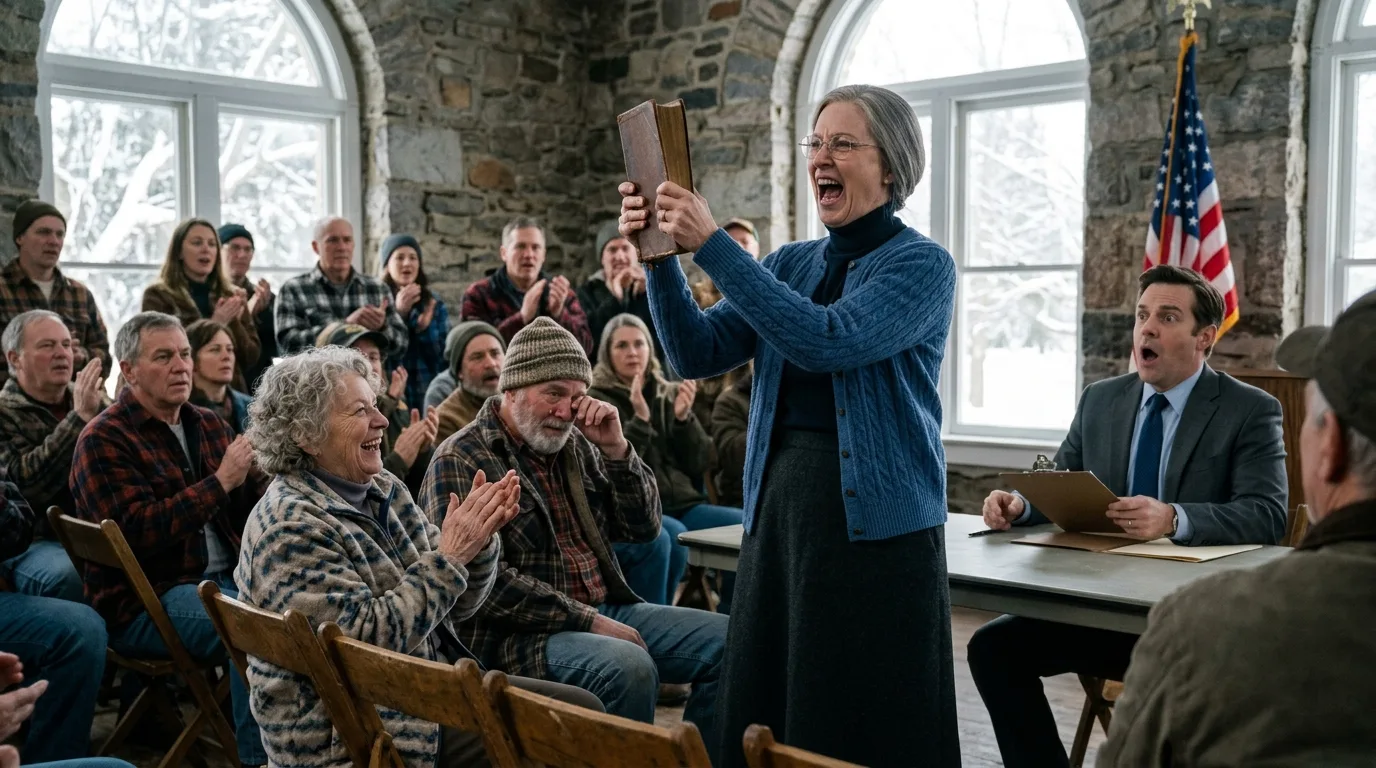
I lifted the box from under my chair, unwrapped it on the tablecloth, and stood there with the quilt held up by its corners so the whole top hung open to the room.
It was eight feet square. Green squares by the thousands across three quarters of it, deep and even, the way a portfolio looks when it is working the way it was promised to work. Blue squares along the border, hundreds of them, laid in straight even rows.
And down in the lower right corner, between the blue and the green, a jagged patch of bright red, sewn in squares cut deliberately crooked and off grain so the pattern tore open like a wound in the pattern.
Nobody said anything. Someone's fork touched a plate.
Richard had gone still in his chair.
"I wanted to make something that represented your career," I said. "So I did."
I turned the quilt slightly so the red patch faced the table.
"The green is the money our clients invested wisely. The blue is what we put away for ourselves, over the years, a little at a time."
Jenna was staring at the quilt with her glass halfway to her mouth.
"And these," I said, and touched the red, "represent the two hundred eighty-five thousand dollars you took out of our house and lost on something called a Forex margin call. In the last six months."
The room did not move.
"Which does not count the six hundred thousand before that."
A woman near the window put her napkin down on the table, folded, the way you do at a funeral.
Richard's face had gone the color of the tablecloth. He said my name. Just my name, twice, low, like a man reaching for a light switch in a dark room.
I kept my voice at the volume I use for a guild meeting.
"There's a certified letter on our kitchen island, addressed to you as the defendant," I said. "I've read it. I understand every figure in it. I want you to know that before you decide what to say to these people."
One of his old colleagues, a man named Patel who had been Richard's assistant years ago, looked down at his plate and stayed there.
"Now," I said. "Happy retirement, Richard."
I folded the quilt along the center seam, then in quarters, then in eighths, so the edges came together straight. I laid it over the back of an empty chair.
Then I picked up my purse and walked out through the lobby and across the parking lot, and I sat in the car with the engine off until Jenna came out and got in the passenger seat without asking.
"He told everybody it was a misunderstanding," she said.
"I know."
"He told Michael it was a stress issue and he'd get help."
"I know."
She put her hand over mine on the gear shift. Neither of us said anything else the whole way home.
Two weeks later, the kitchen table was covered. My spreadsheet was in a neat pile on the left with the bank folder next to it, and the right half was buried in fabric swatches for the next project, which was already half-designed in my head.
Michael had come in from The Woodlands with a coffee and a legal pad of his own.
The short sale had taken nine days of phone calls. I had called the bank every morning at nine, and by the end of it I understood the numbers better than the woman on the other end of the line did, and I told her so, politely, twice.
"The bank will allow a short sale to clear the debt," I told them. They had heard it already. I said it again anyway, because saying it out loud makes a thing real. "I've told your father he needs to sign the realtor's agreement by Friday."
Michael nodded slowly. "And if he doesn't?"
"Then I'll call the bank back and tell them he didn't," I said. "And they'll deal with him instead of me. Either way, the house sells."
Jenna got up and filled the kettle. She opened the cabinet and found the tea and then stood there with the tin in her hand.
"Do you want sugar?" she asked.
"One," I said.
She made two cups. Michael watched her set them down and then watched the top of the table, where my rotary ruler lay across a stack of graph paper.
The sign goes up next week. It's already in the realtor's trunk.
"Mom," Michael said. "What are you going to do now?"
I picked up the legal pad that was under the ruler. The page on top was not a quilt pattern. It was a page with a name written across the top in my drafting pencil, Kingwood Comforts Custom Quilts, and beneath it a list in two columns, one for what I would charge and one for what it would cost me, and under that a third column I had labeled, in smaller letters, what I would not do anymore.
Jenna leaned in to look. Michael waited.
I laid the pen against the ruler and drew a line under the title, straight and firm, all the way across the page.
On the table next to the ruler was the paperwork for the new LLC, one page, filed with the county, registered in one name only, Sylvia Hammond.

Comments