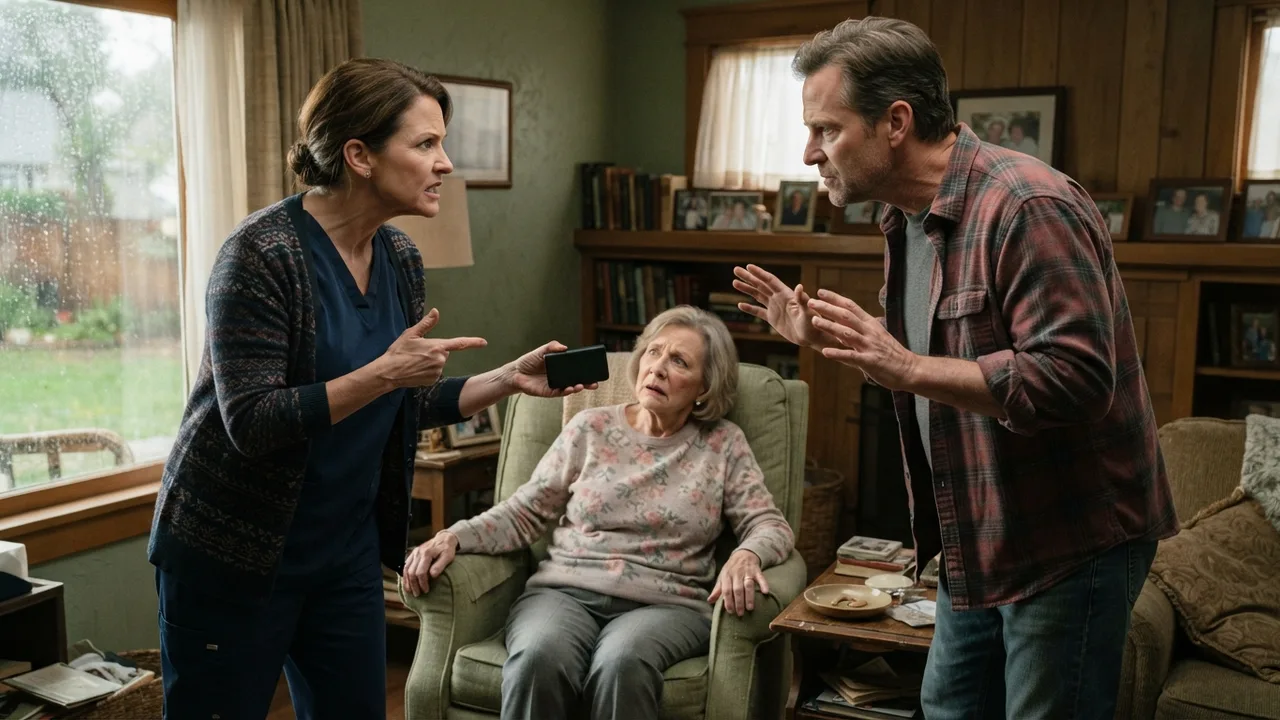
The first thing I did when I visited my mother was check the batteries in her hearing aids, and for the sixth week in a row, they were dead.
Roger had been "helping" with her bills since he took over her checkbook. The house I grew up in, along with her savings, came to around $450,000, and every dead battery moved that money a little closer to my brother's hands.
I am Valerie Beaumont. I spent forty years as a nurse at Island Hospital, most of them in hospice, sitting with people who could no longer say what they needed. I know what neglect looks like when it is dressed up as care. I did not expect to find it in my mother's living room.
Advertisements
She sat in her chair by the window in a good cardigan and her pearl earrings, the television captions running and the volume loud enough to rattle the picture frames. Fifty years in that rambler on the Anacortes side of the island, and she still dressed for company when no one was coming.
"Mom, it's Valerie," I said, and she watched my mouth.
"You'll have to speak up, honey."
The aids sat in their dish on the end table. I opened the little doors and set the first battery against my tester. It was a gray plastic thing the size of a matchbox, and its screen showed a red empty bar.
I had bought a card of the premium batteries at the Safeway on Commercial Avenue, eleven dollars and change. I peeled the tabs off two of them and slid them in. The tester showed green.
"What are you doing to those?" Mom said.
Advertisements
"Fresh batteries, Mom. Try them."
She was fitting the second one into her ear when the front door opened. Roger came in shaking rain off a jacket that cost more than my washing machine, his dark hair still perfect after the drive down from Bellingham.
"Val! Playing nurse again?"
"They were dead, Roger."
"They're always dead." He kissed Mom on the top of the head and she beamed at him, though he hadn't said a word she could hear. "She forgets to take the old ones out at night, Val. They die fast."
"I put these in myself last week."
"And she probably slept in them." He laughed and squeezed my shoulder. "You worry too much. I've got it under control."
Mom turned toward me, and her voice came out sharp and too loud, the way it does when she can't hear herself.
"Stop fussing over me like one of your patients, Valerie. I'm not dying."
I put the card of batteries in my purse and said nothing. The word *dying* sat in the room after she said it, and neither of them noticed what it had cost me.
I wrote it down that night at my kitchen table, the way I used to chart a shift. Batteries tested dead on arrival. Replaced. Tested green. Roger present within ten minutes of my arrival, which meant he had been watching for my car. Gus slept on my feet while I wrote.
By my next visit, the new batteries were dead too.
I held the tester under the kitchen light and watched the red bar. A battery of that kind does not die between one Sunday and the next. Someone had been leaving the little doors open overnight, or running the aids until they gave out, or doing something else I couldn't prove with a drugstore gadget.
Mom was at the kitchen table when I came in, her coffee gone cold, and she did not look up. Her hands shook against the saucer.
"I know what you've been doing," she said.
"Mom, I can't hear you well. Hold on." I set the aids on the table and found the whiteboard on the refrigerator, the one where she once wrote her grocery lists. Out of old habit I wrote in block capitals. WHAT HAVE I BEEN DOING?
She read it and her chin came up.
"Looking at those places. The nicest ones, with the lobbies and the fountains." Her voice cracked in the middle. "Roger told me. He said you think I can't manage on my own."
"I have never looked up a place like that," I said, and then I was shouting it, because she was leaning toward me with her good ear cocked and nothing coming through. "Mom, never! Not once!"
"Don't yell at me in my own kitchen!"
I lowered my voice and my hands, the way I had with a thousand frightened families. I wrote it on the board instead. I HAVE NEVER LOOKED AT ANY PLACE. NOT ONCE. I LOVE YOU. She stared at the board a long moment and then at me, and I saw her decide whom to believe. It took her too long.
"Roger said you had a brochure," she said.
"Where is it?"
She looked around the kitchen as if the brochure might be on the counter. It wasn't.
I put fresh batteries in her aids, tested them, and watched her ears take them in. She nodded and said she could hear the refrigerator. Then she went to lie down, and I washed her cup and saucer and let myself out.
I lay awake that night with the wet November wind working at the cottage windows. Roger had not only disabled the one thing that kept her connected. He had stood in the silence he made and filled it with me, a daughter who wanted her locked away and her money counted. My own mother had looked at me across her kitchen as if I were a stranger with a clipboard.
At three in the morning I got up and sat on the back step with Gus, in the damp garden, until the cold told me to go in.
Roger called the next afternoon. His voice came down the phone sweet as syrup, which is how it always sounded when he wanted something.
"Val, sweetheart, good news. I'm taking Mom to see someone about getting her affairs in order. Wills, all the boring stuff. You don't need to trouble yourself."
"Who's the someone, Roger?"
"A lawyer. Very good. New in town."
"What's her name, and what time?"
"Oh, afternoon-ish. I'll text you when we know." He laughed. "Honestly, Val, you sound like you're taking a history. Go work in your garden."
He hung up. The text never came.
There are only so many estate attorneys in Anacortes. I took out the phone book I keep for the power outages and started at the top. The first office had no Iris Beaumont on the calendar. The second receptionist put me on hold long enough for me to hear a stranger's radio, and then said no.
For the third call I used my hospice voice, brisk and a little bored. "Hello, I'm calling to confirm Iris Beaumont's appointment with her son."
Paper rustled. "Yes, Mrs. Iris Beaumont, with Ms. Wu. Tomorrow at two. Conference room."
"Thank you. And that's for the will?"
"The will and a durable power of attorney. Ms. Wu likes to have both signed in one sitting."
I thanked her and set the phone on the counter. My face was hot. I had just lied to a stranger to learn where my own mother would be sitting, because my brother had decided I was not family enough to be told. Gus put his chin on my shoe. I wrote the time on the back of my hand, which I had not done since nursing school.
Cynthia Wu's office was downtown, a pale modern building where everything reflected something else. Glass walls, a glass table, gray carpet that gave back no sound. It did not look like a place where anyone's mother had ever been understood.
I arrived early and sat in the lobby with my purse on my lap. Roger came through the door at five minutes to two with Mom on his arm, her good coat buttoned wrong, her pearl earrings in.
He saw me and stopped.
"Val. What are you doing here?"
"Sitting with Mom."
"This is private."
"It's her will, Roger. I'd like to be there for it."
Mom looked from his face to mine and pulled at his sleeve. "What's she saying? What's going on?"
"NOTHING, MOM," he said, loud and slow. "VAL WANTS TO SIT IN. IS THAT OKAY?"
She waved a hand, tired already. "Oh, let her. She'll only fuss."
A woman in a charcoal suit opened the conference room door and looked us over with the calm of someone who has seen families come apart over a lot less than a house. She was in her late forties, and she shook my hand like she meant it.
"Cynthia Wu."
"Valerie Beaumont. Iris's daughter."
"Mr. Beaumont mentioned you might have concerns about her care." Her eyes held mine a second longer than polite. "Please, sit."
We sat on one side of a polished table that showed me my own gray hair. Ms. Wu laid out two stacks of paper with colored tabs where signatures went. Roger pulled his chair close to Mom and uncapped a fat black pen.
Ms. Wu spoke directly to my mother. "Mrs. Beaumont, I need to be certain you understand what these documents do."
Mom smiled politely and said nothing, because she had heard nothing.
"SHE HEARS BETTER WHEN I REPEAT," Roger said, too cheerfully. He turned and put his mouth near her ear. "MOM. THIS JUST LETS ME HELP WITH THE BILLS. SIGN HERE, AND HERE."
The pen was already in his hand, held out to her. Her fingers, trembling, came up to take it.
Stop never left my mouth. Forty years at bedsides had taught me that when a room is full of noise, the quietest action in it carries the farthest.
Out of my purse came the sealed package of batteries and the little gray tester, and I set them on the glass table between the contracts and Roger's elbow. The click was small and distinct.
"Valerie," Roger said, low, through his smile. "Not now."
I peeled the tab off one battery and touched it to the tester. The screen showed a solid green bar, and I turned it so Ms. Wu could see. Then I reached for my mother's ear.
"Mom, may I?"
She looked at me, confused, and nodded. I slid the hearing aid out and opened its tiny door. The battery inside tested empty, and I held up the screen so everyone could see the red. I set a new battery in its place, closed the door, and fitted the aid back behind her ear. She held very still, as people do when you touch them with care.
Roger leaned toward Ms. Wu, one hand lifted to shield his mouth. He thought the aid was still dead. He thought he was alone with his lawyer.
"She gets confused," he whispered. "It's better this way. It's just a formality."
The hearing aid gave its small rising chirp.
I watched my mother's eyes. They had been soft and vague all afternoon, and now they widened, and the vagueness drained out of them like water out of a basin. She had heard him. Every word of it had gone straight into her.
She turned her head slowly and looked at her son.
"What did you just say?"
Her voice was quiet and clear, the voice of a woman who taught fourth grade for thirty years and could still stop a classroom without raising it. Roger's smile stayed on his face a moment after the rest of him had gone.
"Mom, I only meant—"
"I asked what you said, Roger. I heard you. I can hear you." She laid the pen down on the contract, very gently. "You told that woman I'm confused."
No one in the room moved. The only sound was the radiator ticking under the window. Roger opened his mouth and nothing came out of it, and I saw him look at the door, and at me, and at the table where the green light still glowed on my tester.
Ms. Wu squared the unsigned papers against the table and slid them back into their folder. She did it slowly, with both hands, like a woman putting something fragile away.
"I believe," she said, looking only at my mother, "that we should postpone this. Perhaps you'd like to schedule a time to speak with me alone, Mrs. Beaumont."
"Now, wait," Roger said. "Cynthia, she's had a shock. This is exactly what I meant. She isn't herself."
Mom lifted one hand off the table, a small gesture, no higher than her shoulder. Roger stopped talking.
She looked at me. Her eyes were wet and furious and old.
"Take me home, Valerie."
I took her arm. She was lighter than I remembered, the bones in her wrist like a bird's. Ms. Wu held the door and did not say anything, and Roger stayed where he was with the pen rolling slowly toward the edge of the glass.
The drive was silent. Rain slid sideways across the windshield on Commercial Avenue, and the wipers beat their slow count against it. Mom kept her face turned to the window and her purse in both hands. I did not speak, because there was nothing I could say that her new ears would not hear.
At her house she went in ahead of me and stood in the kitchen with her coat still on. She did not turn the television up. She sat down at the table where she had accused me, and I put the kettle on, and we waited for it without a word.
When I left, she was still sitting there. The refrigerator hummed in the quiet, and she could hear it.
A week later my phone rang while I was kneeling in the garden with my hands in cold dirt, pulling the last of the bindweed before the frost. Gus lifted his head from the porch. I pulled off a glove and answered.
I did not shout. I did not lean into the phone or repeat myself or say my own name three times the way I had for years, waiting for the thin edge of her understanding to catch.
"Valerie?"
Her voice was quiet and clear, and there was a sorrow in it so plain that I sat back on my heels in the wet.
"Yes, Mom. I'm here."
"Roger came by yesterday," she said. "I made him leave his key on the table."
I closed my eyes. She breathed on the other end, small and steady, and I let her.
We had not fixed it. We might never. A mother does not stop being a mother to her son because of one whisper, and she does not stop grieving him either, and the part of her that trusted me had cracked on a kitchen afternoon and would not close all at once. I knew that. I had charted worse recoveries.
But she was home, and her checkbook was in her own drawer, and she was safe.
"I wanted to hear you," she said. "That's all. I just wanted to hear you say it."
"I'm here, Mom."
"Valerie," she said again, at the ordinary volume of one person talking to another, and I knelt in my garden with the dirt drying on my knuckles and listened to my name.

Comments