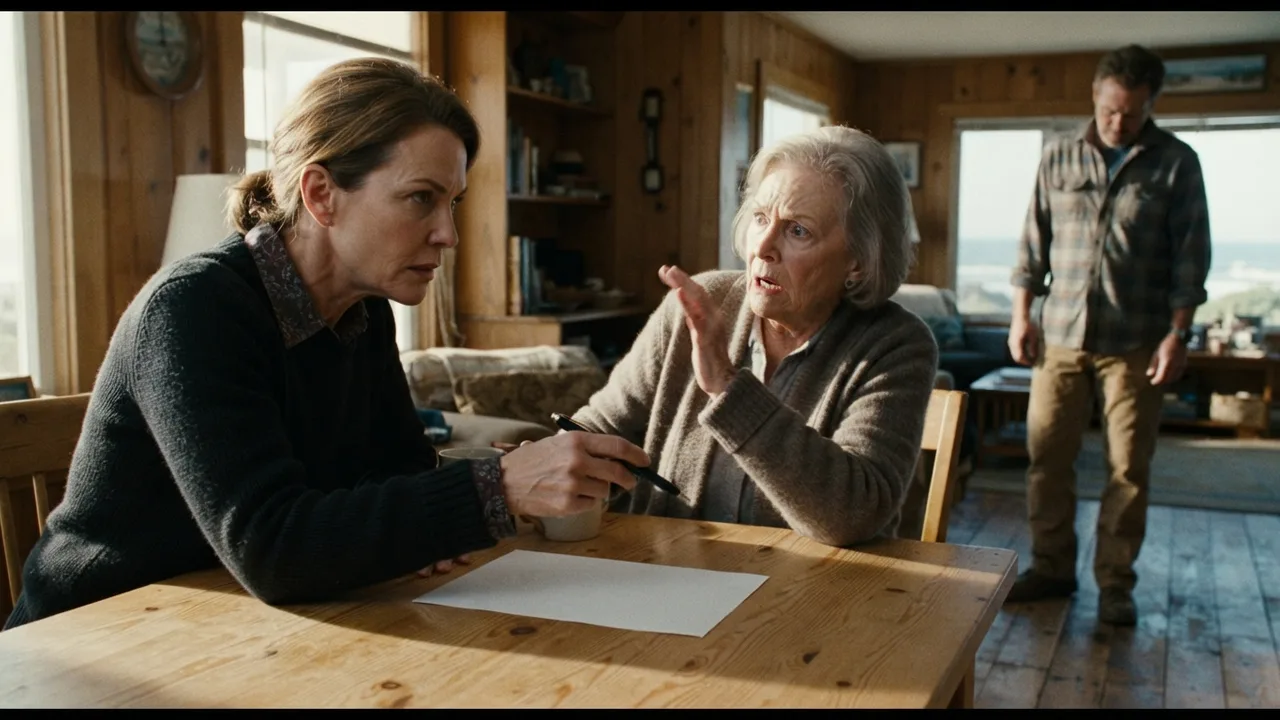
The day my husband's mother listed our beach house for sale, she told me he'd wanted her to have it all along, that his last real act on this earth was to write me out of his will.
"Four hundred fifty thousand dollars, Gloria," Loretta said over the phone. "That's what the agent expects it to bring. Daniel would be pleased to see it put to use."
I was standing in the back of Tidewater Blooms with a bucket of white ranunculus against my hip. Cold water ran down my wrist and into my apron, and I let it.
Advertisements
"It's our house, Loretta."
"It was. Then he signed the codicil, and now it's mine. You've read it, dear. Several times, I imagine."
I had. A single page, produced by her lawyer three weeks after we buried Daniel, with my name struck from the Fripp Island cottage and hers typed in. Mark's name sat under the word *Witness*. Daniel's signature sat above it.
Six months a widow, and I had assumed the cottage was the one thing the grief couldn't take. Daniel and I had bought it when Julia was in grade school. He built the porch swing himself. I had scattered half of his ashes off the dock there, because he asked me to.
"He wouldn't do that to me," I said.
"Men do many things at the end that their wives don't expect." She let that settle. "The agent's sign goes up Friday."
She hung up first. I set the ranunculus in the sink and watched the petals float, pale as paper cups.
Advertisements
---
Julia drove down from Charleston that evening in her work suit, the gray one with the sharp shoulders, and sat on my kitchen stool like a woman about to deliver a diagnosis. Evan was on speaker from his apartment in Columbia, eating something crunchy.
"Tell me the truth," I said. "Can we fight it?"
"You can try." Julia pulled a legal pad from her bag and didn't write anything on it. "Mom, a codicil that's been witnessed and notarized is presumed valid. To overturn it, I need proof of fraud or undue influence. Not a feeling."
"I've got a feeling the size of Beaufort County," Evan said.
"A feeling doesn't clear probate, Ev."
Evan stopped crunching. I turned the sugar bowl on the counter so its handle faced the wall.
"What about a handwriting expert?" I asked.
"Thousands of dollars. Maybe more than we have between us." She rubbed the bridge of her nose. "And even then, it's an opinion against Grandmother's opinion, with Uncle Mark swearing he watched Dad sign. A judge would need a reason to doubt him. We don't have one."
I picked up my cold cup and put it down again.
"Mark would never lie for her."
Julia looked at me the way I look at a rose that has already dropped its petals on the way to the customer.
"Mom. Mark has never once said no to her."
After she left, I sat at the table until the tea in my cup went cold. I'd had one hope all week, and it was a lawyer in a gray suit. She had just told me, kindly, that the hope was a lie I was telling myself.
Nobody was coming to help me. I went to bed with the lamp on.
---
Loretta called again on Tuesday.
"I'll want your things out of the cottage by the end of the week. The appraiser comes Thursday." Her voice was warm syrup over a hard biscuit. "Take whatever's sentimental. I won't be unreasonable."
"You're evicting me from my own house."
"I'm asking you to collect your belongings from my property. There's a difference, and you'll feel better once you accept it."
I drove out to Fripp Thursday morning with a stack of flattened boxes from the Publix loading dock. The causeway was gray and the marsh grass lay flat in the wind. A pickup I didn't know sat in the gravel drive beside Loretta's long silver Buick.
She was standing in my kitchen.
She wore her pearl earrings and a cream linen jacket, at a beach cottage, and she was talking to a man with a clipboard and a tape measure. My coffee mugs hung on their hooks over her shoulder. The shell wind chime Evan made in fourth grade turned in the window.
"And this wall comes down," Loretta was saying, tapping the one between the kitchen and the sunroom. "Open it all up. White cabinets, quartz. And that dreadful porch swing goes in the first week."
"Daniel built that swing," I said from the doorway.
She turned slowly, and her smile had the tight, waxy perfection of a calla lily.
"Gloria, dear, you're early, and this is Mr. Teague, who has come to look at the house."
"The house," the man said, and gave me an uncomfortable half nod. He had the decency to look at his clipboard.
I walked past them both with my boxes like a delivery girl at the wrong door. In the hall closet I found the quilt my mother made. In the bedroom, Daniel's reading glasses were still folded on the nightstand, on the book he never finished. I was a stranger in my own bedroom, listening to her heels click across the pine floor and a stranger's tape measure snapping back into its case.
I didn't cry until I was in the sunroom, alone, with my face turned toward the glass.
---
Daniel's desk sat in the corner of the sunroom, a scarred oak thing he'd bought at an estate sale in Beaufort. I started with the drawers because they were easier than the bedroom. Rubber bands. Seed packets. A tide table from two summers back.
In the shallow center drawer, under a stack of birthday cards, lay his pen.
It was a heavy green-barreled fountain pen his father had given him when he made partner at the surveyor's office, and I hadn't seen it since the hospital. I uncapped it. The nib was crusted at the tip, dark and glossy, the exact shade of a mallard's neck. Teal-black.
He mixed that ink himself in a jar on the kitchen counter, two bottles together, a splash of one and a careful tilt of the other, and he never wrote anything that mattered with any other. Our mortgage papers. Julia's college loan. The card he wrote me on our twentieth anniversary. Every one of them in that deep green-black, the loops of his *D* leaning like a cattail in wind.
I stood very still with the pen in my hand.
Then I drove home with the boxes in the backseat, took my copy of the codicil out of the folder in my bedroom drawer, and carried it to the window over the sink.
Daniel's signature sat above the line. Blue. A thin, flat, lifeless ballpoint blue, the kind of ink you find in a hotel pen chained to a desk. The loops were right, or close to right. They had been drawn slowly by somebody looking at a model.
I called Mark before I could talk myself out of it.
"Well, hey, Gloria," he said, too quickly. "I mean, I'm kind of in the middle of something."
"I won't keep you. I only want to ask about the day Daniel signed. Do you remember how it went? Where you were sitting?"
"Well, I mean, it was a hard time. Everybody's memory is, you know." Papers rustled on his end. "I've got a client waiting. I'll call you."
"Mark, did he use his own pen?"
The click came before I'd finished the question.
I stood at the sink holding a dead phone, and understood two things at once. Mark was hiding something. And I had just told the other side exactly where to look.
---
Loretta held Easter dinner at her house every year, and every year the whole family came, because nobody had ever found the courage to do otherwise. The house on Paris Avenue sat above the river, white columns and black shutters, and she kept the dining room the way some women keep a church.
Julia drove down with Evan. We went in together, the three of us, in our good clothes, and Evan carried the lilies I'd brought. Easter lilies, white as bone china. Loretta took them at the door and handed them to the housekeeper without looking down.
"Gloria. How lovely. They'll be dead by Tuesday."
Dinner was ham glazed with brown sugar and pineapple, deviled eggs on the cut-glass tray, green beans that had been cooked since morning. Mark sat across from me and pushed a roll around his plate. He had come in a navy suit that hung from his shoulders as if it still wore the hanger. He did not look at me once.
Nobody mentioned the cottage. Nobody mentioned Daniel's chair, which sat empty at the foot of the table with a place setting in front of it because Loretta insisted.
The pecan pie came out. Loretta cut it herself, the knife making small, exact sounds against the plate.
"Mother, this is wonderful," Mark said, which was the only thing he'd said in an hour.
"Of course it is."
When the plates were cleared and the coffee poured, I reached into my handbag and set a small leather book on the white tablecloth, between the sugar bowl and the cream.
---
"What's that?" Loretta said.
"Daniel's gardening journal." I opened it near the back, where a pressed hellebore bloom was tucked in as a bookmark. "He kept it from the time we bought the cottage. I thought you might like to see his last entry. He wrote about the Lenten roses."
I turned the book toward her.
"Look at his hand, Loretta. Look how he pressed down on the *L*. He wrote that one a few weeks before the end."
She glanced at it. A muscle moved in her jaw.
"Sentimental nonsense."
"It's very beautiful nonsense." I took the folded copy of the codicil from my bag and laid it beside the journal, the signatures side by side. "I was thinking about that last week. How busy he was, near the end. He signed this entry. He signed a letter to Evan. Evan, would you read it?"
"I've got it right here," my son said, and put his phone on the table with the photo open. The ink on the screen was green-black, thick and shining.
"All of it with his fountain pen," I said. "You know the one, Loretta. His father's. With that special ink he mixed himself."
The room had gone very quiet. Julia's fork lay on her plate where she'd set it down.
"But when he signed away the house he'd promised his children," I said, and I kept my voice soft, soft as a petal falling, "he used a cheap blue ballpoint. I can't picture it. I tried all week."
I turned my head and looked across the table.
"Mark, you were there. Did he have to borrow yours?"
---
Everyone looked at Mark.
His face lost its color, and it went in stages, like a tide pulling out. He looked at his mother, whose eyes had gone hard as black walnuts. He looked at Julia and Evan, who were leaning toward him with their whole bodies. His mouth worked.
"Well, I mean," he said. "It was a long day. He was, you know. He was very."
"Mark," Loretta said.
"Mother, I can't." His hands came up off the tablecloth and shook in the air. "I can't do it anymore. I haven't slept since."
"Mark. Sit up."
"He didn't sign it." He said it to the pie plate, in a whisper that carried to every corner of that room. "He was too weak to hold a spoon, Gloria. I sat in the hall while she did it. Mother wrote it herself. She made me put my name under hers."
Evan pushed back from the table. Julia's hand found mine under the cloth, cool and quick.
I waited for Loretta to collapse, because I'd rehearsed that moment in the bathroom mirror a dozen times. She didn't. She laid her napkin beside her plate, straightened her spine against the chair until the pearls rose on her collarbone, and looked at me like a woman reviewing a florist's invoice.
"Of course I did," she said. Her voice was ice on a windowpane. "Daniel would have wanted me to have it. That house belongs to a Caldwell, Gloria. Not to the girl from the flower shop."
"I was his wife for thirty years."
"You were convenient for thirty years."
Nobody breathed. In the foyer, the grandfather clock went on ticking, indifferent, and I watched the last of my husband's family come apart across the good china without a single plate being broken.
Mark was crying into his hands. Loretta did not look at him.
---
A week later Julia came down on a Saturday, with a folder and a bag of boiled peanuts from the stand on Ribaut Road, and we sat at my kitchen table with the window open to the smell of cut grass.
"Mark went to a notary on Monday," she said. "Four pages, signed and sealed. He told it all. The ballpoint, the hallway, what she said to him."
"Did he say anything else?"
"He said he's sorry. He said it to me about six times." She slid the folder across. "Grandmother's attorney called me Tuesday. He's a careful man. He told her that if Mark's statement ever left the room, she'd face fraud charges and a front-page story in the *Island Packet*. She'd have to concede."
"Did she argue?"
"Not that I heard." Julia's mouth twisted. "She doesn't argue when she's lost. She just stops speaking to the person who beat her."
The papers were three pages. Loretta's name was typed at the bottom of the last one and the signature line above it was empty. On the first page, in paragraphs that had never once been warm, she relinquished any claim to the property on Fripp Island and returned the deed to me, as Daniel's original will required.
"She signs by Monday," Julia said. "Mom. You won."
"Did I?"
My daughter peeled a peanut and didn't answer, which was the most honest thing she could have done.
Mark hadn't spoken to his mother since Easter. He'd sent me a card with a pressed daisy glued to the front, badly, as if a child had done it. Evan and Julia would never sit at that long table again. I knew, with the same plain certainty that I knew my own address, that I would never set foot in that house on Paris Avenue as long as I lived, and that Daniel's mother would die in it with her columns and her pearls and no one to carry in her lilies.
I had the cottage. I had nobody on the other side of it.
---
The following Sunday I drove out alone, the causeway silver under a low sky, the marsh going green at the edges. The agent's sign was gone from the yard. Someone, Mark, I think, had pulled it up and leaned it against the shed with the post still wet.
I unlocked the door and the cottage breathed out its old air: salt, cedar, the faint sweetness of the soap Daniel kept by the sink. My quilt was back on the bed where I had remade it. His reading glasses sat on the nightstand, folded.
I took the wind chime down from the kitchen window and hung it on a hook on the porch.
Then I went out and stood on the boards Daniel had laid. The swing creaked once in the wind and was still. The tide was out, leaving the flats the color of wet slate, and a heron stood in the shallows as if it had been placed there.
In my pocket was the pen. I'd bought a new bottle of black and a new bottle of teal that morning at the stationery shop in Beaufort, and at my own kitchen counter I had mixed them in a jam jar the way I'd watched him do it for thirty years, a splash of one, a careful tilt of the other. It took me three tries to get the shade.
I drew the pen out and uncapped it in the salt light.
The nib shone, wet and dark and green as a mallard's neck, and a single bead of ink gathered at its tip and held.

Comments