"My father isn't making sound financial decisions anymore," Brendan said over the phone, his voice smooth with false concern. "And frankly, Elena, his 'investment' in your olive trees is our primary issue."
I stood in the packing shed with a clipboard against my hip, watching dust turn in a slant of light. Brendan wanted his father's checkbook, and he had decided I was the one holding the pen. I had never taken one dollar from Arthur Hadley.
"Brendan, Arthur bought a drip line," I said. "He didn't buy me."
"Ma'am, I'd ask you to hear the concern behind this. We're talking about leveraging assets and mitigating risk. At his age—"
"At his age he still cuts a dovetail you could float a boat on."
"I'll be in touch," he said, and the call ended.
Advertisements
I set the phone on a stack of harvest crates and wiped my palms on my jeans. They had gone damp.
My name is Elena Cervantes. I'm 65, and for the last five years I've managed the Cielo Verde Olive Grove in Sonoma Valley. It's quiet work, pruning and netting and pressing, and after my husband died I believed it would be the whole of my life.
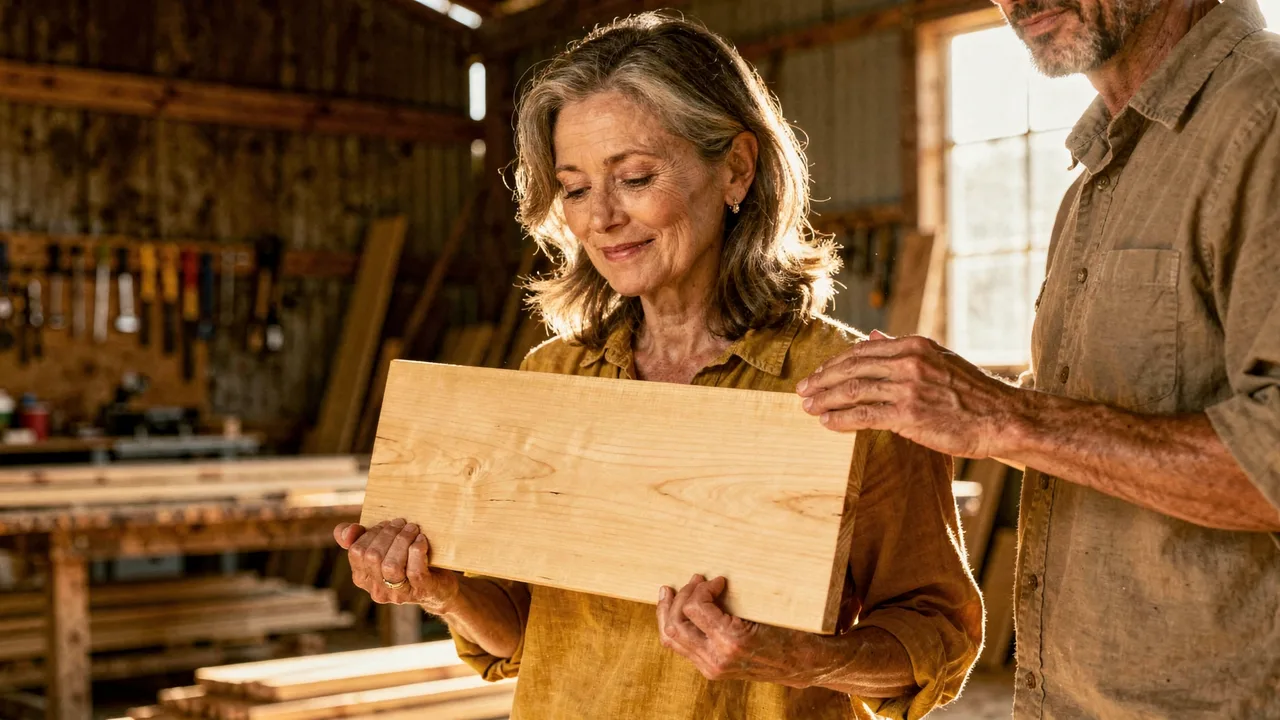
Then, six months ago, a tall, stooped man in a feed-store cap came to ask whether he could haul off the limbs I'd cut from the old Mission trees. He was a retired cabinetmaker, a widower named Arthur Hadley. He held a chunk of olive wood to his nose like a man sniffing bread.
He smelled of sawdust and lemon oil. He talked about grain the way other men talk about weather, and for the first time in a decade I wasn't lonely.
His son thought I was a gold digger. Brendan had never said it to my face, which was how I knew he meant it.
He came out to the grove that Saturday without calling. Arthur and I were mending the roadside fence where the deer push through, and Hector's crew was stringing harvest nets in the rows behind us. The grass had gone the color of straw, and the whole valley smelled of dry leaf and dust.
A silver SUV pulled onto the gravel. Brendan stepped out in loafers that had never met dirt.
Advertisements
"Dad! There you are."
"Brendan." Arthur straightened slowly, one hand at his back. "You're a long way from Santa Rosa."
"I wanted to see the famous irrigation system." He said it loudly, the way you speak to a room. He walked straight to the valve box and tapped it with his shoe. "Ma'am, what did this run? Because I saw the invoice. Thousands of dollars. For trees that give what, a few cases of oil?"
Behind me, the nets stopped moving. I heard Hector's ladder creak and go still.
"The system is paid for," I said. "It's saving us water in a dry year."
"Dad, did she ask you to buy it?"
"I offered," Arthur said.
"You offered." Brendan shook his head and smiled at the workers, as if they were in on it. "Dad also forgot the reservation for Mom's anniversary dinner. I'm just saying, folks. Let's all be careful about who's making these decisions."
Nobody answered. A mockingbird went on in the oak by the road.
I put down my fence pliers. My face was burning, and I made myself walk to the shed instead of saying what I wanted to say. Rosa from the press crew studied her boots as I passed. In five years nobody had ever looked at me with pity on my own land.
A few days later Arthur sat at my office desk with the green ledger and the laptop, sorting five years of receipts I'd been ashamed of. He had offered to put my records in order. I had given him my login the same afternoon he gave me his, because he said a man who keeps another person's books ought to be able to see his own in return.
His phone lit up on the blotter. He glanced at the screen, and his mouth went thin.
"Brendan," he said, and answered.
Brendan's voice came out of the phone loud enough to reach me across the room. I heard "significant withdrawals." I heard "your responsibility to the family" and then "we need to get ahead of this, Dad, before it's out of your hands."
"I understand," Arthur said. Then, "Not now."
He set the phone face-down and sat looking at it. The color had gone out of him, leaving his face the shade of unsanded pine.
"Arthur?"
"It's nothing, Elena. Family business." He closed the laptop. "I should get home and oil that bench."
He left before the afternoon light turned gold. He didn't kiss my cheek at the door, and he had done it every day since spring.
I lay awake that night listening to the irrigation timer click on and off in the dark. Withdrawals. What withdrawals? He had told me once, vaguely, that he had "projects," a lathe, some work on the shop. I had not asked, because asking felt like counting his money.
I asked myself now whether a man who stopped answering a plain question was hiding something. It was a long night.
On Thursday I was at Arthur's house, a low gray bungalow with the workshop out back, when the mail carrier came up the walk with a clipboard.
"Certified," he said. "Arthur Hadley? I need a signature."
Arthur signed with his big careful hand and carried the envelope to the kitchen table. I stood at the sink drying a colander. He read it standing, then sat down as if his knees had been cut.
"What is it?"
He slid it across to me. The letterhead said Marcus Bell, Attorney at Law, and the letter went on in polite paragraphs. It requested that Arthur Hadley submit to a competency evaluation, as a preliminary step to a petition by his son for power of attorney over his financial affairs.
I read it to the end. My hands were steady, which surprised me.
"Arthur, this is serious."
"He's my son," he said. "It's a misunderstanding."
"A misunderstanding doesn't come on letterhead."
"He's worried. That's all it is." He folded the letter into a small square and pressed it flat with his thumb, the way he'd press a veneer. "I won't fight my own boy, Elena. I won't."
I looked at his hands, the hands that had made cabinets for half the valley, shaking against the oilcloth. He was not going to defend himself. He didn't know how to do it against his child.
I drove back to the grove with the windows down. The light had gone amber, the olive leaves silver and green, and I understood that hoping this would blow over was a luxury I'd lost. If I did nothing, Brendan would win.
That night I sat at my kitchen table with Arthur's login on a slip of paper and began to trace his statements, one entry at a time. It took the whole of the following week.
The irrigation supplier's invoice was a modest sum, paid once. But a larger payment from the same week went out to Northgate Properties, LLC. I searched the state business registry on my laptop, with the refrigerator humming behind me. The manager listed was Brendan Hadley.
Another entry, a wire for five thousand dollars, went to the Sonoma County Tax Assessor. The memo line named a parcel on Fourth Street.
I printed both. I put them in a manila folder and wrote nothing on the tab.
Brendan called on Monday to announce a family summit at The Fig Tree on Saturday evening, "to talk things through before the lawyers get more involved." Arthur said he'd go. I told him I was going with him.
The private room at The Fig Tree had linen napkins and a window full of vines. The duck was thirty-four dollars on the menu in the hall. Brendan sat at the head of the table in a navy jacket and a watch that cost more than my truck, and Kimberly sat beside him in a designer dress a season out of date, turning her wedding ring.
Arthur took the chair across from them, slumped, his big hands in his lap. I sat next to him with the folder on my knees.
"Thank you all for coming," Brendan said. "Dad, I love you. Everything I'm doing comes from that."
"Brendan—" his wife began.
"Let me finish, honey." He put a hand on her arm and kept his eyes on me. "Ma'am, I don't doubt your intentions. But Dad is vulnerable. We're talking about undue influence, and frankly, some cognitive decline. Dad, you spent twelve thousand on an irrigation system for another person's grove. And five more on a lathe for a shop you hardly use."
He looked at his father with perfect sorrow.
"Is that what a clear mind does?"
Arthur said nothing. A busboy poured water and left. The door closed behind him.
I opened the folder.
"That's not quite right, Brendan," I said.
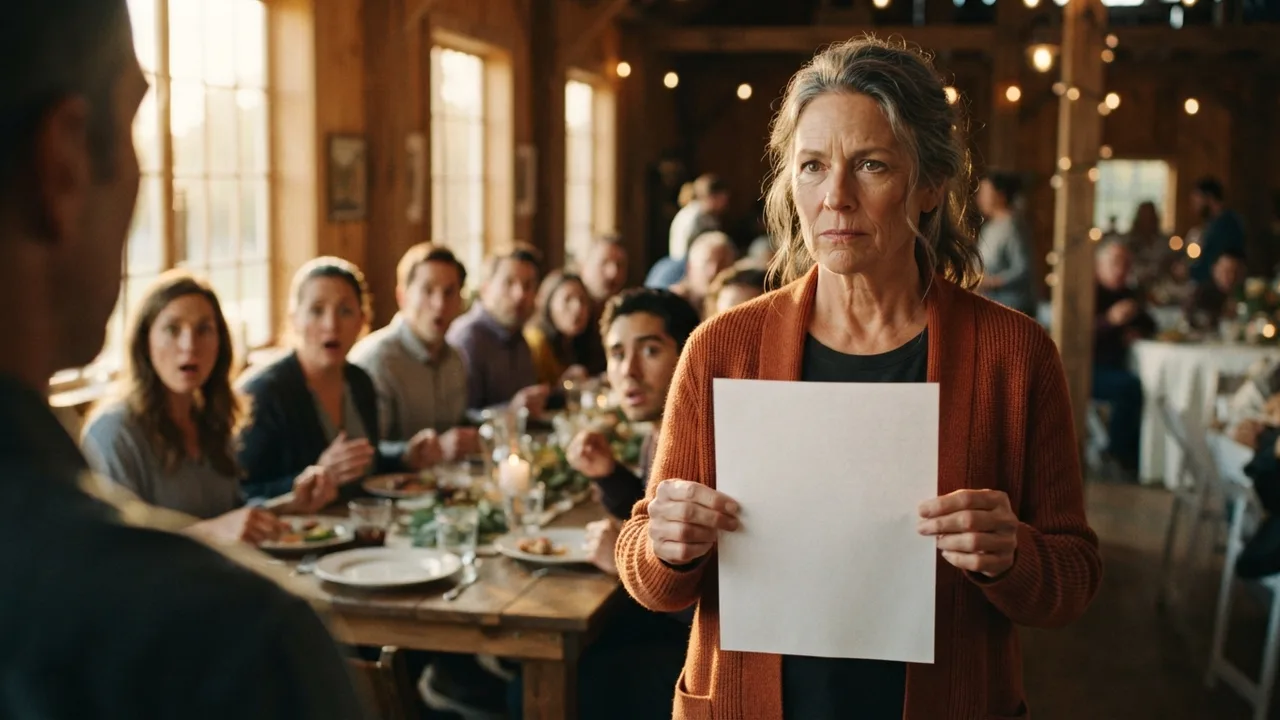
He frowned. I laid the first printed statement on the white cloth and turned it so he could read it.
"The irrigation invoice was paid once, and it came to a fraction of what you said. The twelve thousand dollars from that same week went to Northgate Properties, LLC." I touched the line. "Is that your company?"
Nobody moved. His wife's fork was in her hand, and she didn't lower it.
I placed the second page beside the first.
"And this payment of five thousand dollars wasn't for a lathe. It was a wire to the Sonoma County Tax Assessor, for the delinquent property taxes on the Northgate condo development on Fourth Street."
Brendan's neck went red, then his ears. He kept his smile a moment too long.
"This is insane," he said. "You've been spying on him? Going through his private finances?"
"He gave me the access himself."
"A man in his condition will give anybody anything." He swung toward his father. "Dad, do you see? This is exactly what I've been talking about. She's manipulating you and twisting everything." He turned to his wife. "Kimberly. Tell him."
She looked at her plate. The ring had stopped turning.
The room was quiet enough to hear the ice settle in the glasses.
Arthur's hand moved toward the pages. I covered it with mine for a moment, and he let it go back to his lap.
I drew out a third sheet, the one I had made at my kitchen table in my own handwriting, a column of dates and amounts.
"These are the transfers out of Arthur's savings," I said. "Northgate. The county. A contractor in Petaluma. The bank that holds your construction loan. A hundred and fifty thousand dollars, Brendan, and he sent every bit of it because you told him it was a bridge for a few weeks."
"It's a loan," Brendan said. "Family helps family. He offered."
"He offered the way he offered the drip line. Somebody he loved was short of water."
"And you?" He leaned across the cloth. "Let's talk about what you get, ma'am. A widower with a paid-off house and a pension."
"Nothing," I said.
I took the last sheet from the folder, the grove's invoice stapled to the canceled check, and set it in front of him.
"That is the only dollar of Arthur's that ever touched Cielo Verde, and he paid the supplier directly. If you want it written that I have no claim on anything he owns, I'll sign it tonight, here, in front of your wife."
I had not planned to say that last part. It left my own hands bare, and I felt it go.
"Brendan," Kimberly said. Her voice was small. "You told me it was the investors."
"It's a bridge, Kim." He turned back to the table, and the smile came again, softer. "Dad, give me until spring. The units close, and you get every cent back with interest. That letter is housekeeping. Nobody is calling you a fool."
"Mr. Bell called him one on letterhead," I said.
Arthur stared at his hands. They had started to shake again, and he pressed them between his knees. He opened his mouth and nothing came out of it. I knew that silence. It belonged to a father who had never once learned to tell his child no.
So I said it for him.
"Arthur, you don't have to. I will, if you'll let me."
He nodded, barely.
I squared the three pages and turned to Brendan.
"Here is how this goes. Not another payment, starting tonight. Monday at nine I drive your father to his bank, and he takes your name and every company of yours off his accounts. At ten you call Mr. Bell and withdraw that letter, in writing."
"And if I don't?"
"Then the evaluation goes ahead, with a doctor Arthur picks himself. He walks in carrying these pages, and the doctor can see who has been keeping his books straight."
"You can't speak for him."
"No," I said. "That's why I'm asking him." I turned in my chair. "Arthur, is that what you want?"
He took so long that the ice shifted again in the glasses. A drop slid down the side of his water goblet and dripped onto the cloth.
Then he lifted his head.
"Monday," he said. "Nine o'clock." His voice cracked on the second word. "Son, I'm done."
Brendan looked around the table for one ally and found the napkins and the vines at the window. His wife pushed back her chair.
"I'm calling that bank myself in the morning," she said. "My name is on those papers too. I'll drive myself home."
She left. The door swung shut behind her, and Brendan stared at it.
"You've cost him his son," he said to me, very quietly.
It landed. I let it, because it was partly true.
"I know what it costs," I said. "I would have given a great deal for it not to be me sitting here."
Arthur stood. He didn't offer his hand. I gathered the pages into the folder, since I would need them Monday, and followed him past the bar and the hostess stand into a parking lot that smelled of cut grass and sprinklers.
In the cab of my truck, under the dome light, his shoulders moved once, and he turned his face to the window. We were halfway up the hill before he spoke.
"You said it for me."
"You couldn't."
"I'd have gotten there, Elena."
"In the spring," I said. "After the units didn't close."
He didn't answer. My hands on the wheel were not as steady as they had been in his kitchen. I had won, and I had stood in a restaurant and handed a gentle man the shape of his own son, and the easy mornings between us were gone.
At the cottage I turned on the porch lamp and poured two glasses of water we didn't drink. We sat in the old chairs looking down at the olive trees, dark now, their leaves faintly gray where the moon touched them. A dog barked somewhere on the road.
Arthur's phone buzzed on the little table. The screen said *Brendan*. He watched it until it went dark.
"I'll wear the good shirt Monday," he said.
"I'll drive."
His hand found the arm of my chair and stayed there, not quite touching mine. I left it where it was.
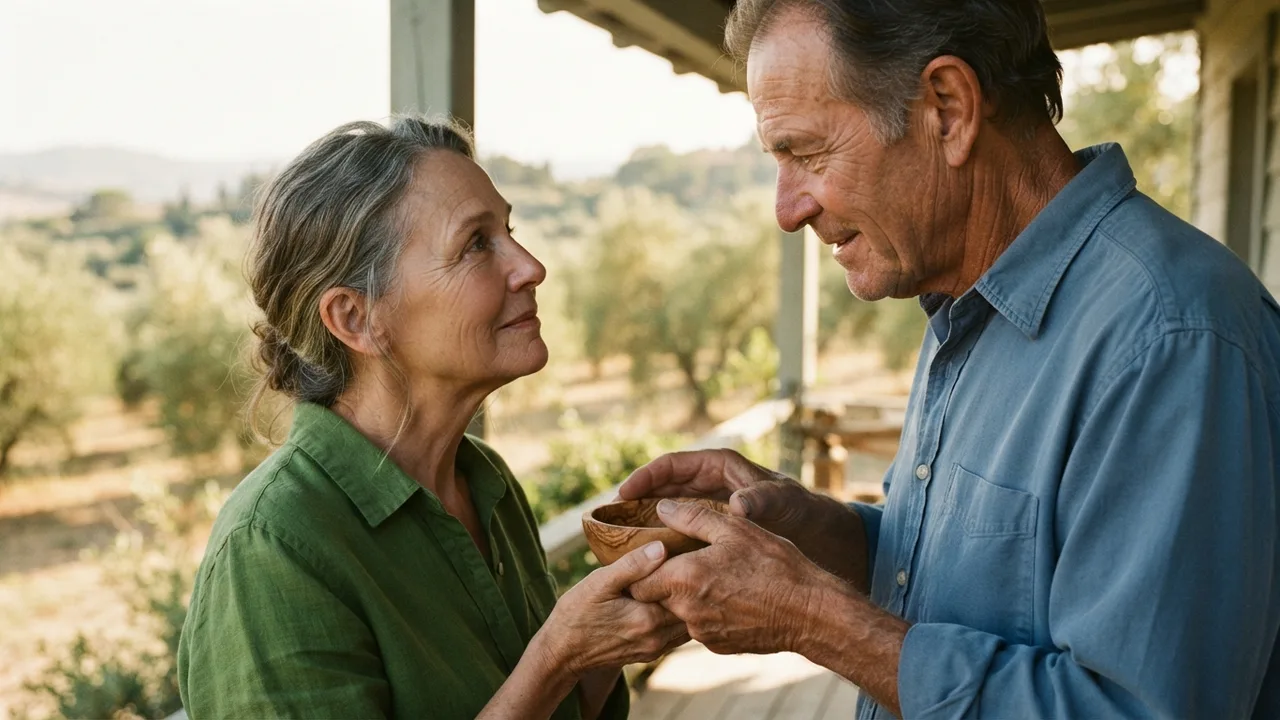
Beside the glasses sat the little bowl he had carved for me when we first started keeping company, pale olive wood with a dark ribbon in the grain. He picked it up and turned it under the lamp, his thumb moving over the rim. Then he set it in my hands, and the wood was warm from his palm.

Comments