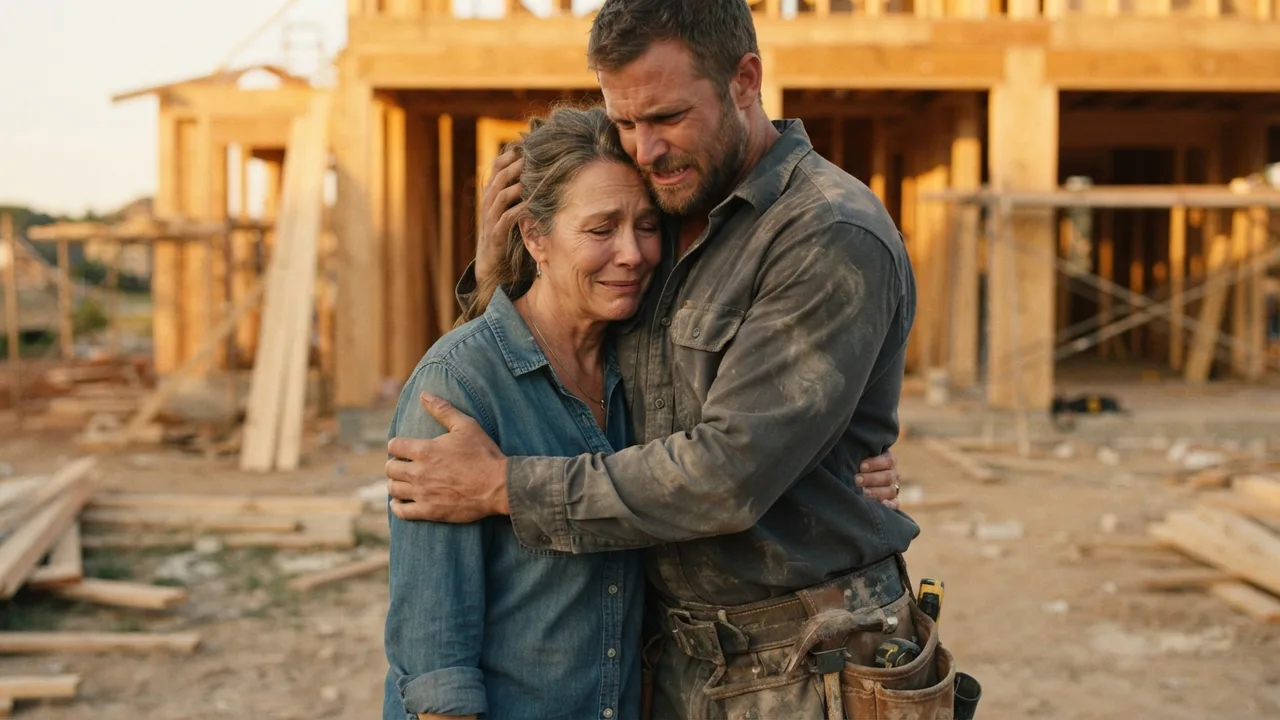
"Our son needs us," my husband Gareth said, sliding the withdrawal form for a hundred thousand dollars across the kitchen table.
It was a Tuesday, and the wind off the Laramie plains was rattling the storm window over the sink. Our retirement savings had started at four hundred fifty thousand dollars, and every cent of it sat in accounts I had never once logged into.
"How bad is it?" I asked.
"Bankruptcy bad. He's behind with suppliers, the bank is leaning on him, and he's too proud to say it." Gareth tapped the signature line. "He'll never ask us, Bron. So we don't wait for him to."
I had run that house for thirty-eight years. I knew the price of a gallon of milk at Safeway down to the cent, and which week the coupon envelope ran thin. Gareth had always handled the big money, the investments, the statements that came in thick envelopes. I had never minded. It had felt like a division of labor, and the arrangement had worked.
Advertisements
He held out a pen. It was a cheap blue ballpoint from the bank, the kind with a chewed cap.
"It's a loan," he said. "He'll pay it back."
I signed. The pen skipped on the second letter of my name, and I had to go over it.
Gareth folded the form into his shirt pocket and kissed the top of my head. He smelled of coffee and cold air. Then he went out to the garage, and I sat with my hands around a mug that had gone lukewarm.
That evening I called Rhys. I told myself I only wanted to offer some sympathy, a mother's voice in a hard week.
"Hey, Mom." He was outside; I could hear a nail gun somewhere behind him. His voice was tight, the way it got when he was holding something down.
"Your dad told me things are rough," I said.
"Dad worries." A pause, and the nail gun stopped. "I'm behind on a lumber bill. Forty thousand, with Cheyenne Lumber. They've been decent about terms, but it's a pain."
"Forty thousand is a lot, honey."
"It's a lot when it's all stacked up at once. It's not the end of the world." He blew out a breath. "I've got two closings coming. I just need people to stop calling me like I'm going under."
Advertisements
"Is anyone calling you like that?"
"Dad. Every other day, checking on me." He laughed, short and sour. "I'm thirty-four, Mom. I know how to run a job."
I heard it plainly then. He was frustrated and he was proud, but he was not afraid. A man who was about to lose everything did not sound like that.
"I know you do," I said. "Call me Sunday?"
"Sure. Love you."
I stood in the hallway with the phone in my hand and the numbers started turning over. A forty-thousand-dollar bill, and my husband had just taken out a hundred thousand.
I didn't sleep. I lay on my side of the bed listening to Gareth breathe, and every time I closed my eyes I saw the form, and my own wobbly signature, and the amount.
On Thursday, Gareth went out to the garage to look for a socket wrench he swore I had moved. His laptop sat open on the kitchen counter beside the fruit bowl. I had walked over to wipe the counter, nothing more.
An email preview sat in the corner of the screen.
*High Plains Timber Co. — Delivery confirmed for Friday. Custom-milled peeled logs, second load. Site contact: G. Davies.*
I stood with the dishrag dripping on my wrist.
Rhys bought from Cheyenne Lumber. He had said so himself two days before. He built tract houses with stick framing, and nobody wanted peeled logs on a subdivision lot in a Laramie spring.
The garage door banged. I stepped back from the counter and was at the sink, running water over nothing, by the time Gareth came in holding the wrench.
"Found it. Right where I left it," he said.
"Good," I said.
He took the laptop into the den and closed the door.
I waited until he drove to the hardware store. Then I sat in the car in our driveway and looked up High Plains Timber on my phone. Their website was all golden light and big stone fireplaces. *Custom-milled logs for luxury lodges and legacy homes.* A gallery of hunting lodges with elk-antler chandeliers. A price list that said *inquire*, which in my experience meant more than I would ever want to pay.
I scrolled until I found a contact page. It listed a yard in Wyoming, and a delivery map with a pin I could not make out. I called the number from my own phone and put on the voice I used for pharmacies.
"I'm calling to confirm a delivery for Davies. I'm afraid I've lost the address."
"Sure, hon." Keys clicked. "Off Vedauwoo Road, the gated lot past the second cattle guard. Is that the one?"
"That's the one. Thank you."
I put the phone face down on the passenger seat and sat there until my hands stopped shaking. Worry had been a heavy thing, but it had at least been clean. This was something else, sour and low in my stomach, and it did not go away when I swallowed.
Friday I told Gareth I was driving to the Walmart in Cheyenne for a prescription pickup. He barely looked up from the sports page.
I took Interstate 80 east and turned off at the Vedauwoo exit. The granite there stands in tumbled stacks, pink and gray, and the wind had cleared the sky so hard it hurt to look at. Past the second cattle guard I found a gate standing open and a gravel track climbing between aspens that had not yet leafed out.
I stopped well back and left the engine running. My brakes made their usual grinding sound as I let the car settle.
Beyond the white trunks a frame stood against the sky. It was enormous, with a peaked roof line and a wall of bare timber uprights facing the rocks. Two stories at least, and a porch deep enough to park a truck under. A crane arm sat folded beside it, and stacks of golden logs lay on cribbing in the dirt.
Rhys's biggest house had a garage and three bedrooms. This was a lodge.
Gareth's white pickup was parked by the porch footings. He stood on the plywood subfloor with a heavyset man in a canvas coat, both of them bent over a roll of blueprints. The wind kept lifting the corners, and the other man weighed them down with a thermos. Gareth pointed at something, then swept his arm across the whole view of the rocks like a man showing off a bride.
I knew that gesture. I had watched him do it at every ribbon-cutting and every job walk for thirty-eight years. He did it when he was proud.
I lifted my phone and took the picture. I took it twice, because my first one caught the aspen branches. The second was clear: Gareth, the blueprints, the frame, his truck with its dented tailgate.
Then I backed down the track, turned around in a gap in the sagebrush, and drove home with both hands on the wheel.
There was no more wondering to be done. I had the picture, and I understood that the picture changed what I owed him. I did not feel like crying, which surprised me. I felt like making a list.
On Saturday morning I met Rhys at the coffee place on Grand Avenue, in the back booth by the pastry case. I ordered him a breakfast burrito because he had that thin look he got when he skipped meals.
"You want my statements?" he said. "Why?"
"I want to understand the debt. Your father handles everything and I'd like to know what I'm being asked to help with."
"Mom, I'm not asking for help."
"I know. Humor me."
He looked at me for a while. He had my eyes, everybody said so, and I watched them go careful.
"Is Dad okay?" he asked.
"Your father is fine," I said. "Will you send me the profit-and-loss and the supplier list?"
He sent them from his phone that afternoon, and I printed them at the library, ten cents a page. At the kitchen table that night, with Gareth asleep in front of the television, I built my own summary sheet in a folder. Everything on it was Rhys's real numbers except one line, which I typed in myself: *High Plains Timber Co. — $95,000.*
It looked ordinary there, between the lumber yard and the concrete supplier. I stared at it for a long time and then put the sheet back in the folder.
On Sunday Gareth set a new form on the counter. This one was for a hundred fifty thousand dollars.
"Rhys needs it by Monday," he said. "I want us to do this properly. As a family. Meet me at his site Monday morning, the three of us, and we'll all sign off together."
"Together," I said.
"So he sees we're behind him."
"All right, Gareth."
He studied my face and I let him. I had stood in front of school principals and insurance adjusters, and I could keep a face still.
Rhys's development sat on the north edge of town, where the new streets ended in dirt and survey stakes with pink flags. The house he picked for us was a half-finished two-story, studs and subfloor and rolls of house wrap flapping in the open doorways. The whole place smelled of raw pine. Rhys had set up a plywood sheet on two sawhorses in the front room, with a stack of folding chairs by the wall.
Gareth was already there in his good canvas jacket. Rhys stood beside him with a pencil behind his ear and sawdust in the creases of his sleeves.
"Mom," he said. "Dad says you've got paperwork."
"I do."
Gareth cleared his throat. He stood at the head of the makeshift table and put both hands on it, and I recognized the posture from a hundred job meetings.
"Family sticks together," he said. "That's all this is. Thirty-eight years your mother and I have built something, and Rhys is the best part of it. When he's down, we hold him up. That's what money's for."
"Dad," Rhys said, uncomfortable.
"No, let me finish." Gareth slid the form across the plywood toward me, then the pen. It was another cheap blue ballpoint. "Bron. It's one more signature and we're done."
I looked at the form. Then I opened my bag instead and took out the folder.
"Before I sign, I want to go through something," I said. "I asked Rhys for his business statements. I wanted to understand the debt I was being asked to pay."
Gareth's jaw moved. "Bron, there's no need for that."
"There is for me." I opened the folder and laid the summary sheet on the plywood, squared to the edge. "I made a spreadsheet. It's not fancy."
Rhys leaned over to look. Gareth did not move at all.
I put my finger on the line I had typed. "Gareth, before I sign away the rest of our money, can you explain this one charge on Rhys's books? The big one. Ninety-five thousand dollars to High Plains Timber Co.? It seems to be the source of the whole problem."
Gareth frowned. It was a good frown, creased and puzzled, and for half a second I almost doubted myself.
"You must be reading it wrong, Bron," he said. "Let me see."
"Mom." Rhys straightened up. "I've never used High Plains Timber. I can't afford them. I buy everything from Cheyenne Lumber."
Nobody spoke. A strip of house wrap snapped in the wind behind us.
Gareth recovered fast. I had to give him that, because he had always been fast.
"See?" He turned to me, patient, a husband managing a tired wife. "You're getting things mixed up. It's the stress, honey. It's been a hard month. Just sign the form and we'll go through the books later."
"No," I said. "I'm not mixed up."
I took out my phone, found the photo, and turned the screen toward both of them.
"Is this your building site, Gareth? The one High Plains Timber delivers to?"
Rhys took the phone out of my hand. He looked at the screen for a long moment, and then he looked at his father, and then back at the screen. The color left his face by degrees.
"That's Vedauwoo," he said.
"Rhys, give me that," Gareth said.
"That's a lodge." Rhys's voice cracked on the word. "That's a hundred-thousand-dollar frame, easy. That's you, standing on it."
Gareth held up both palms. "It's an investment. It's for all of us. It's going to double what we put in, and I was going to tell your mother when it was ready, as a surprise."
"A surprise," I said.
"I earned this, Bron. Forty years on other men's jobs. I wanted something with my name on it."
"Then you would have told me. You'd have put the plans on the kitchen table and asked."
"You'd have said no."
"Yes," I said. "I would have."
Rhys set the phone down on the plywood very carefully, as if it might go off. "You told her I was going under," he said. "You told Mom I was about to go bankrupt. You used me?"
"Rhys—"
"I called you last week to ask about a bid. You said you'd been worried sick about me." He laughed, and it was not a good sound. "I thought you meant it."
Gareth looked from his son to me and back, and nothing came out of his mouth. It was the first time in thirty-eight years I had seen him without a next sentence.
I picked up the withdrawal form from the plywood. It was a single sheet, a little damp at one corner from the cold, and the printed signature line was blank.
"I'm not signing this," I said. "And Monday morning, you and I are going to the bank. We're going to split what is left of our savings. My half goes into a new account, in my name only."
"Bronwyn, you can't just—"
"I can. It's my name on the accounts too. I checked."
"Bron, think about what you're doing to us."
"I have been thinking about it since Thursday."
Gareth took a step toward me, one hand out. Rhys moved between us before I had finished seeing it, and he put his shoulders square to his father, as tall as Gareth now, and a good deal quieter.
"You heard her," Rhys said.
Gareth stood there a moment, breathing through his nose. Then he lowered his hand and looked at the floor, at the sawdust and the chalk lines.
"I'll be at the bank at nine," he said, so low I almost missed it.
"Nine," I said.
I folded the form once and picked up my folder. Rhys walked me to the door of the half-built house, and out on the dirt he put his arms around me hard, the way he had at nine years old after a bad day. His shirt was gritty with sawdust. I did not say anything and neither did he.
Behind us I could hear Gareth in the front room, dragging a folding chair across the subfloor. I did not turn around. I did not know yet whether I would be sleeping in my own bed that night, or what I would say if he came to find me there.
At my car I opened the passenger door and the glove compartment. The tire gauge lay where it always lay, worn silver, a thing I had carried through twenty years of Wyoming winters. I set the unsigned form beside it, closed the little door, and heard it click.
Comments