
My husband told me he slipped on a patch of spilled boat wax at the hardware store, but the first thing I noticed when I picked him up from urgent care was the dry cleaning tag still stapled to his coat.
Before the week was out he wanted me to sign my parents' lake cottage over to a realtor, all $250,000 of it, so we could keep the lights on.
He was waiting on the bench outside the Port Haven clinic, one hand pressed to the small of his back. When my headlights hit him he stood up in stages, like a man unfolding a lawn chair.
"Two o'clock," Gerrit said, easing into the passenger seat. "Lakeshore Hardware. The marine aisle. I went down hard, Elise."
Advertisements
"Two o'clock this afternoon? You waited until now to get looked at?"
"I thought I could walk it off. Sat in the truck a while." He breathed out through his teeth. "Then I couldn't turn the key."
"So who drove the truck here?"
"I did. Don't fuss."
I fussed anyway, because fussing is my living. I get paid to lift people out of bathtubs and read the tightness around their mouths. His grimace came a half second after each bump in the road, as if he were waiting for the bump to tell him when.
The tag hung off his collar, a pink square with a ticket number. Brouwer's Cleaners, on Main. I had not known the coat was at Brouwer's.
"When did you take your coat in?" I asked.
"Last week. Eyes on the road, hon."
At home I settled him in the recliner with a pillow behind his knees and the heating pad plugged in. The discharge sheet said rest and no lifting. I made tea he didn't drink and told myself that a woman who sees pain for a living should believe the pain in her own house.
Wednesday I did his laundry. I check pockets out of habit, since a tissue can ruin a whole load.
His work pants held a receipt folded into a tight square. Speedway, in Dorrance. Regular unleaded, paid in cash, the coffee at two forty-nine. Tuesday's date. 1:40 PM.
I knew Dorrance. I had driven there for a client in the spring, and it was eighty miles of two-lane and grain elevators that ate my whole morning.
Advertisements
I sat down on the closed lid of the dryer with the paper in my fingers.
Gerrit said he had gone down at two o'clock in Port Haven. A man cannot buy gas eighty miles east at twenty to two and be on his back beside the boat wax twenty minutes later. I turned the numbers over the way I would turn over a client's story about a missed medication, looking for the soft place.
I found no soft place. Just the paper.
That night I lay beside him and listened to him sleep. He slept easily, flat on his back, which is a position his spine had supposedly forbidden. I counted the ceiling cracks until the window went gray.
Thursday morning I called Lakeshore Hardware and asked for the manager. I said my husband had taken a fall on Tuesday and I wanted to file an incident report for the insurance.
"Prosser," the man said. "Ma'am, I'm sorry to hear that. But I was on the floor all day Tuesday, and nobody reported a fall. Not one."
"He said it was the marine aisle. Boat wax."
"We waxed that whole section Tuesday morning, early. Policy is we rope it off until it's bone dry, and that was eleven o'clock. After that there was no wet floor and no spill. I'd have heard." He cleared his throat. "Is he all right?"
"He's resting," I said. "Thank you, Mr. Prosser."
I hung up and stood in the kitchen with the phone against my chest. I did not feel clever. I felt like I had gone through his wallet.
I told Gerrit at supper, because I have never been able to hold a thing back from him. That was the whole of my marriage, really. I told him about the receipt and the call, and I watched his face.
His fork went down. "You called the store? Behind my back?"
"I called about the report. They say nobody fell, Gerrit. And there's a gas receipt from Dorrance, dated Tuesday, stamped 1:40 in the afternoon."
"That's from some other day. It was in the truck." His voice climbed, and he winced late, a beat after the shout. "Do you hear yourself? I'm lying here wrecked and you're checking up on me like a parole officer."
"I only asked."
"You're confused, Elise. You've been running yourself ragged, and I've been watching it." Now he went soft, which was worse. "I know it's a lot for you right now. That's what worries me."
He took his plate to the sink himself and left it there, and then he did not speak to me for two days. We passed in the hall like boarders. I cooked and he ate. I changed the heating pad cover and he let me, staring over my shoulder at the television.
I would like to say I held my head up. What I did was check my own memory, line by line, for the places where I might have gotten confused.
Saturday afternoon Simon's Civic pulled in, and I knew from the speed of it that his father had called him.
My son came through the back door in his gray hoodie, smelling of fryer oil from the double he had worked the night before. He kissed my cheek, and then he looked at me with his head tilted. It was the look I give a client's daughter at the door.
"Mom. Sit down with us a minute?"
We sat at the kitchen table, the three of us. Gerrit lowered himself into his chair with a hiss and arranged his back against a cushion.
"Joan Kuiper can see us Monday morning," Gerrit said. "A power of attorney, so you're not carrying all this alone. And the listing paperwork for the cottage."
"We have not discussed listing the cottage."
"We're discussing it now. The doctor says months, Elise. I can't work. I can't hold a wrench."
"Mom, Dad's in pain," Simon said. "We need to do this for him."
I looked at my son's hands, cracked at the knuckles from hot water, folded on the table the way mine fold.
"Simon, there's a gas receipt from a Speedway in Dorrance, stamped Tuesday afternoon, 1:40. Dorrance is eighty miles from here. He says he fell at two, at Lakeshore Hardware. And the manager there says no one fell."
Simon glanced at his father. Gerrit shook his head slowly, sadly, like a man hearing a bad diagnosis about someone he loves.
"She's been up nights," Gerrit said. "I keep telling her."
"Mom." Simon put his hand over mine and patted it. "You're doing too much. Let us take some of it. Okay?"
The pat was the thing. It was the gentlest, kindest thing he could have done, and it opened a cold space in my chest, because he had stopped hearing me. He was hearing a tired woman.
"I'll come Monday and listen," I said. "That's all I'm promising."
"That's all we're asking," Gerrit said.
Simon hugged me at the door and held on a moment too long. Then he drove back toward Grand Rapids, and the house got very quiet.
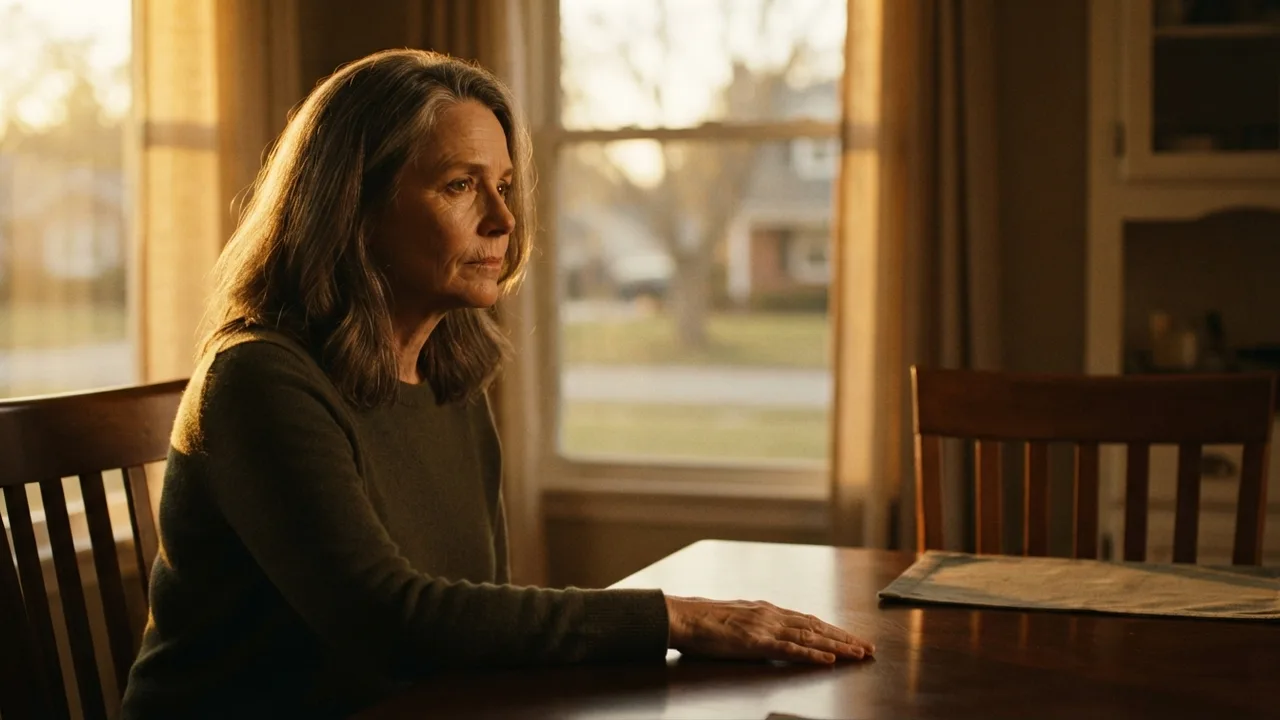
That night I waited until Gerrit's breathing went slow upstairs. I took the laptop to the kitchen table and logged in to the joint account, which I had not opened since the roof money went in.
The checking was ordinary. I scrolled to Tuesday.
11:50 AM. Brouwer's Cleaners, Port Haven. A debit card swipe.
Right below it: 3:15 PM. ATM withdrawal, $500. The location field read Greektown Casino, Detroit.
I looked at that line for a long time. I looked until the letters stopped being letters.
Then I opened the savings account, the one I had been told was covering our cushion. The balance wouldn't have paid for a tank of gas at that Speedway. Month after month, withdrawal after withdrawal, all the way back to the spring.
The coat. The coat had gone to the cleaner's and come back in the truck, and he had worn it to the casino, and he had worn it home to the clinic because he never thought to take off the tag. Eighty miles to Dorrance and eighty more past it. He had been at the machines when he said he lay on the floor of a hardware store.
I had spent twenty-eight years watching other people's bodies for the small lies. I had never once watched his.
I put my forehead against my folded arms and stayed there. I did not cry. I sat in the kitchen where I had fed him and our son for a quarter century, and I felt the marriage go, quietly, the way a pilot light goes out.
Then I got up and sent the statement to the printer in the hall.
Joan Kuiper's office was on Water Street, above the bank, with a conference table polished enough to show the ceiling lights. Out the window the marina boats sat shrink-wrapped in white for the winter.
Gerrit had driven the truck himself. "A short drive, if I sit just right," he told Simon, and Simon nodded as if that made sense. I noticed it. I noticed everything.
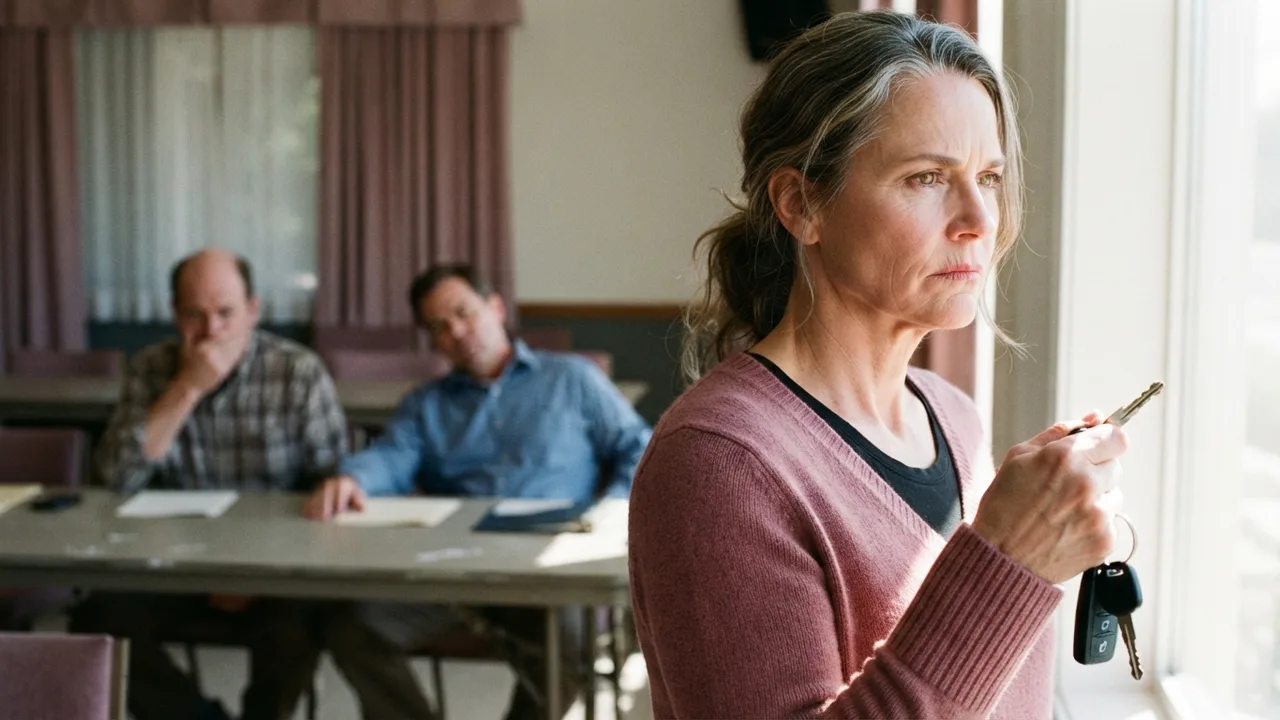
He came in with a cane I had never seen before, found a cushioned chair, and lowered himself by degrees. Simon pulled out my chair like I was ninety.
Joan was a brisk woman in reading glasses who had drawn up my parents' will. She laid two folders in front of me, flagged with yellow tabs where my name went.
"Gerrit tells me you've had a hard few days, Elise," she said. "This first one is a durable power of attorney. The second is a listing agreement for the lake property. Gerrit would like everything in place before the roads get bad."
"It's not what I want," Gerrit said, to the table. "It's what I have to do. I can't stand to see her carry it."
"Dad," Simon said quietly.
"I'm all right, son." He rubbed his lower back and let out a breath that shook a little at the end. It was a good performance. I had to give him that.
Joan slid the pen across to me. It was a heavy one, with the firm's name on the barrel.
I did not touch it.
"Gerrit," I said, "tell Joan when you fell, and where."
He blinked. "Tuesday. Two in the afternoon. Lakeshore Hardware, here in Port Haven. You know all this."
"Two o'clock. At the hardware store."
"Elise, honestly."
I took the single sheet out of my purse, unfolded it, and laid it on the polished wood between us. I turned it so it faced him, and Joan, and Simon.
"That's our checking account for Tuesday," I said. "The first line is Brouwer's Cleaners, Port Haven, eleven-fifty in the morning. The second is a cash withdrawal at a machine inside Greektown Casino in Detroit. Three-fifteen in the afternoon."
Nobody spoke. Joan took off her glasses and put them on again.
"That's a bank error," Gerrit said. His eyes slid over the page without landing. "Those systems are a mess. Or you're reading the dates wrong."
"The date is Tuesday."
"See?" He turned toward Joan with his palms up, wounded and gentle. "This is what I've been telling everybody. You're getting confused, honey." Then, to our son: "Simon, talk to your mother. She isn't making any sense."
Simon had gone very still, his eyes on the page.
I did not argue. I looked at my son, who was twenty-six and tired and had wanted so badly to fix something.
"Simon, you're a cook," I said. "You understand timing. Ask your father how he fell in the hardware store here at two o'clock and took cash out of a machine in Detroit at a quarter past three. That's 160 miles in seventy-five minutes. With a back that was supposedly too hurt for him to turn a key."
Simon read it once. His brow pulled down, and his lips moved over the times.
"The receipt," he said slowly. "The gas. Dorrance, twenty minutes before he says he fell. That's east of here, on the way to..." He stopped.
He lifted his eyes to his father. I watched his face come apart, the way you can watch a plate slide off a counter and know there is no catching it.
"Dad?"
Gerrit opened his mouth. He found the cane and gripped it, then let it go. For a moment the grimace stayed on his face, half a beat late, with nothing left behind it.
"Simon," he said. "Son, listen."
"Did you fall?"
The room waited. Out on Water Street a truck downshifted at the light.
"No," Gerrit said.
Simon sat back, hard, as if he had been pushed.
"I had a bad stretch," Gerrit said to the table. His voice had changed, flatter and older. "At the casino. It was supposed to be one night, to get even. The savings are gone, all of it. And there's a man in Detroit who wants the rest."
"You faked a fall," Simon said. "You let Mom think she was losing her mind."
"I needed the cottage, that's all. A few weeks and I'd have put it right." He turned to me then, and the soft voice came back one last time. "Elise, we've been married a lifetime. Think about what we'd be throwing away. A loan, really. It's practically a loan."
"You tried to take my parents' house out from under me," I said. "And you told our son I was sick."
"For your own good, I..."
"No."
I turned to Joan, who had not moved a muscle.
"I will not be selling my cottage," I said clearly. "And I will not be signing anything else. Not today, and not after."
Joan nodded once and drew both folders back across the table. She closed them one over the other.
"Gerrit," I said, "pack your bags. I want you gone by the time I get home."
He looked at me as though there were a second page I could still turn over. There wasn't. He pushed himself up from the chair without the cane, and without a single wince, and I saw Simon see it.
"I'll go with him," Simon said. His voice cracked on the last word. "To get his things. Mom, I'm so sorry."
"I know you are. Call me tonight."
"I will."
He did not reach for my hand, and I did not offer it. That would come later, or it wouldn't. He walked behind his father out into the hall, and I listened to their two sets of steps go down the stairs, one slow and one fast.
Joan put the pen back in its tray. "I'm sorry, Elise."
"So am I."
I sat in the Meijer parking lot for a long while before I drove home. A woman loaded bags of apples into her trunk, and a boy chased a cart across the asphalt, and the sky over the lake was the flat gray it gets in October.
When I turned into our drive, the truck was gone.
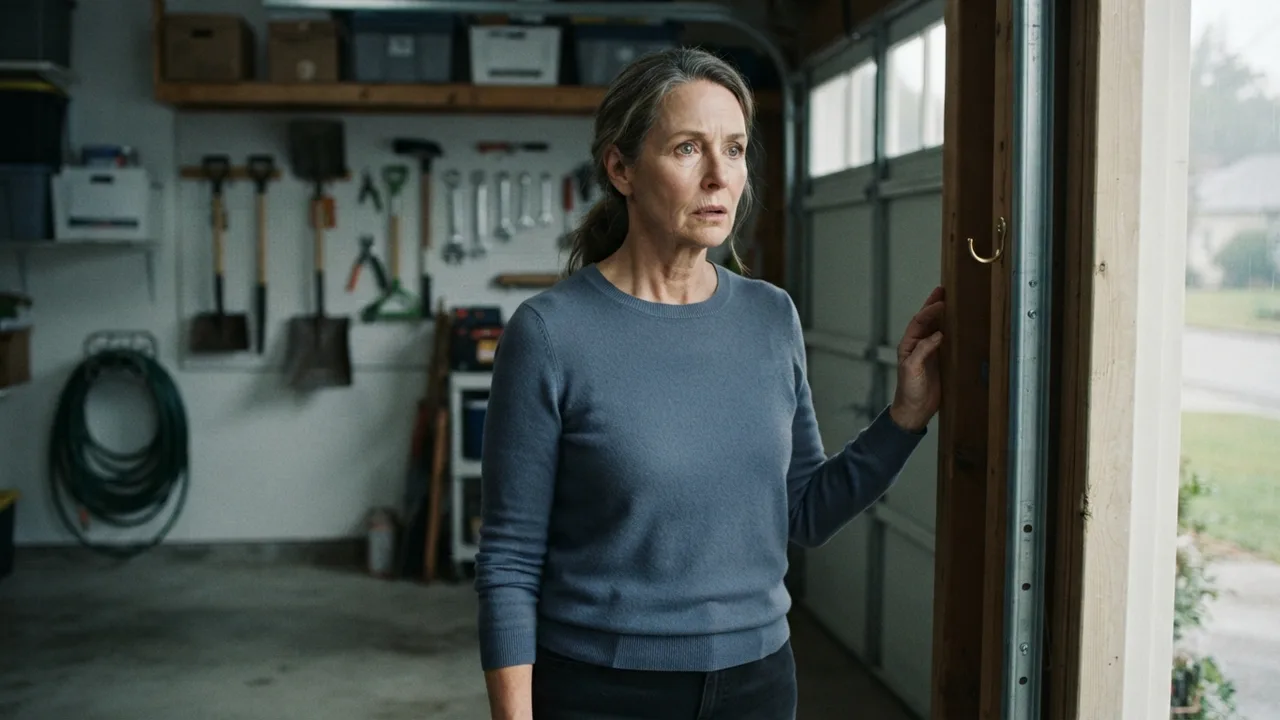
The garage door stood open. His side of the concrete was bare, a pale rectangle with a few dry leaves blown into it. On my side, where I park, there was a small, dark patch the size of a saucer. A spot of oil, from my own car, that I had never looked down to see.
I got out and stood over it for a long moment.
Then I went into the house to find a rag, and I cleaned it up myself.

Comments