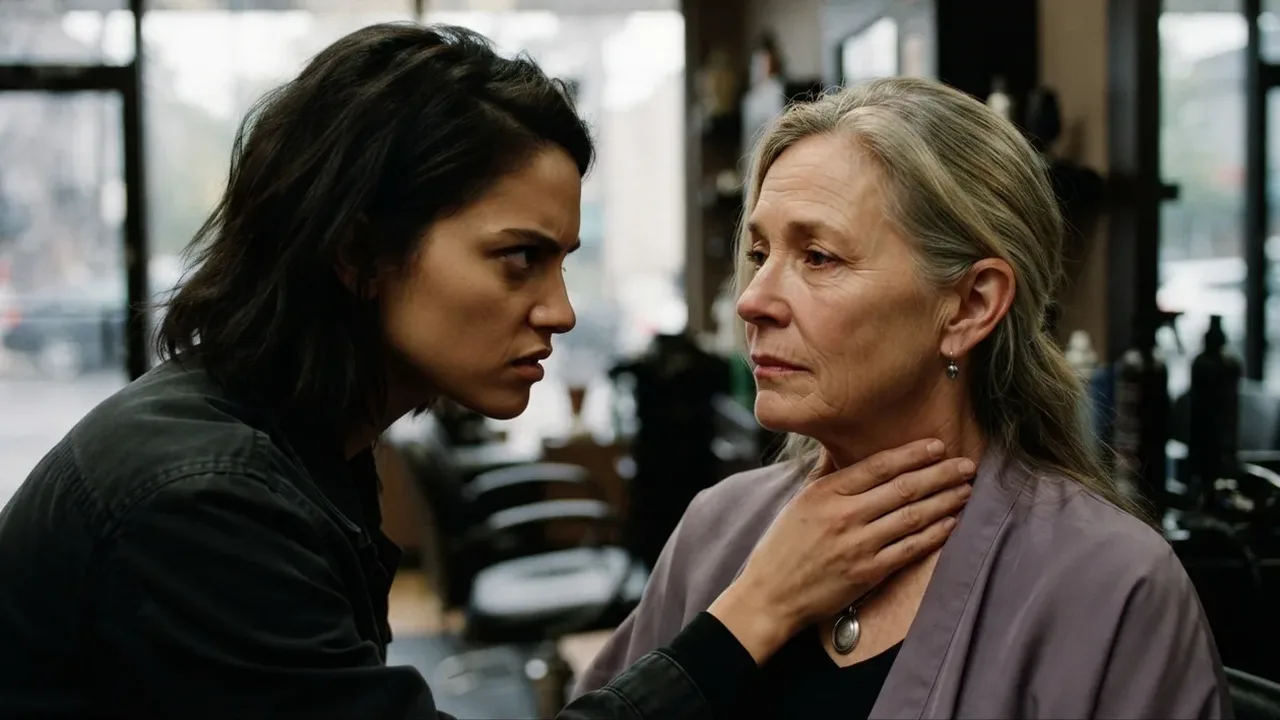
The first time his daughter told me to stay away from him, she did it in my styling chair with a head full of foils and a voice as cold as the chemical smell in the air.
"Stay away from my father, Joanne. He isn't in a position to be anybody's second chance."
I had spent ten years alone above my own salon, and Clark Webster was the first man since my husband who had made me feel like my life had a second chapter. Now his daughter was telling me to close the book.
I kept my hands moving. That's the rule of the trade: when a client says something ugly, you keep folding foil.
"Mrs. Pratt," I said, "I'm going to assume you're tired."
Advertisements
"I'm Bethany. And I'm not tired, I'm serious." She sat very straight, as if she'd practiced the posture in a mirror. Her blazer hung on my coat hook and her expensive handbag sat in her lap like a shield. The cuticles on both thumbs were bitten raw, which didn't match the rest of her at all.
"Your father is sixty-two years old," I said.
"I know exactly how old he is."
I rinsed her, toned her, and blew out her hair. She paid in cash, tipped forty dollars, and didn't say goodbye. I put the tip in the drawer and felt like I'd been paid to keep quiet.
I'm Joanne Russo. I'm fifty-eight, and I've run The Cutting Room for thirty years, long enough to have cut the hair of half the town at their first communion and again at their divorce. My life has been my work and my friends, quiet and steady, with Fiona O'Connell from the library on my chair every sixth Thursday.
Clark came in on a gray morning in April, tall, with thick white hair that did not need a thing. I told him so. He booked another appointment anyway.
He took me to dinner at Café Luna, the place with the blue awning on the square. He pulled out my chair. He had been a civil engineer and he explained to me, with a salt shaker and a butter knife, how the old railroad trestle outside town stayed up. I hadn't laughed that much since before Dennis got sick.
Advertisements
His daughter, apparently, had other plans.
She called the salon the Thursday before our second dinner. I was ringing up a customer, and Rosa at the front desk held out the phone with her eyebrows up.
"This is Bethany Pratt," the voice said. "My father can't make dinner Saturday. He's over-exerted himself, and he needs to rest."
"Is he ill?"
"He's resting. I'll tell him you called." She hung up before I could answer.
I stood there holding the receiver while Mrs. Alvarado waited with her credit card out. Then I went upstairs on my break and called Clark's house myself.
He picked up on the fourth ring, cheerful as a robin.
"Joanne! What a nice surprise."
"Clark, are you all right? Bethany called to cancel Saturday. She said you were worn out."
"Cancel? I've been in the garden since breakfast putting in tomatoes." He sounded honestly puzzled. "Bethany did that? Oh, dear, she's overprotective, Joanne, and her mother was the same way. I'm so sorry."
"Saturday, then?"
"Saturday, the place with the awning. Café Luna." He said the name slowly, as though he were setting it down on a shelf where he could find it again.
I hung up and sat on the edge of my bed. I didn't sleep that night. I lay there composing speeches to Bethany Pratt, and every one of them started with the word *sabotage*.
Saturday he was waiting outside in his good flannel, holding a small velvet pouch.
"I have something for you," he said, after the waiter had brought the bread. "It's been in the family for ages."
Inside was a silver locket on a fine chain, oval, heavy for its size, the front worn soft with age and etched with tiny leaves. It was the loveliest thing a man had ever handed me.
"It belonged to my great-aunt Lucia," he said. "She came over from Italy on a ship. Or it was my grandmother's sister. No, wait. A cousin of my grandmother's, I think. The point is she came from near Naples and wanted it to go to a woman with good sense."
"My people were from Calabria," I said.
"Then it's meant to be." He beamed. A minute later he asked where my family was from, and I told him again, and he listened to the whole answer with the same bright interest.
I noticed that. I put it down to nerves. A man of sixty-two can tell a story twice.
I wore the locket to work on Monday. By ten o'clock Bethany was standing in my doorway in a navy blazer, looking at my throat.
"Where did you get that?"
"Good morning to you too."
"That was my mother's." Her voice cracked on *mother's* and she pulled it back into line. "My father gave it to her for their anniversary. He shouldn't have given it to you. I need it back."
The salon had gone quiet. Rosa stopped sweeping, and a woman under the dryer lifted the hood.
"He told me it was his great-aunt's," I said. "From Italy."
"He's confused about a lot of things right now."
"Funny. He didn't sound confused when he told me you canceled our dinner behind his back."
Her jaw worked. "Joanne, I'm asking you nicely."
"And I'm telling you no. A gift is a gift." I opened the door for her. "I think you'd better go."
She stood a moment longer, looking at me the way you look at a toddler walking toward a stove. Then she left.
I told Fiona that afternoon, over the counter, while she waited for her toner to set. She turned the problem over the way she turns a book to read the spine.
"Did you ask Clark about it?"
"Clark wouldn't lie to me."
"I didn't say he would." Her colorful scarf slid off one shoulder and she fixed it. "I only asked if you had asked."
I hadn't. I was too busy being angry on his behalf, and it felt better than being afraid.
The review went up that Wednesday.
Fiona found it before I did. She came in on her lunch hour, took off her glasses, and slid her phone across the desk without a word.
One star. *Unprofessional. The owner gets involved in private family matters. I would not trust her with your hair or your privacy.*
The name on it was B. Pratt.
By Friday, two regulars had canceled and one had rescheduled "until things settle down." Mrs. Alvarado, who'd had her perm done by me for twenty-two years, called to say she was sure it was nothing but her sister-in-law had read it. In Dos Robles, you can lose a business without losing a single customer to an argument, only to a rumor.
"Don't go in swinging," Fiona said, as we stood in the doorway of The Cutting Room that Saturday evening, with the marine layer coming in off the coast and the whole town heading toward the Community Center for Literary Lights.
"I won't."
I did.
The hall was loud with a hundred conversations and the scrape of folding chairs. Fiona's library volunteers had strung lights across the rafters and set out a buffet of tri-tip, pinto beans, and garlic bread, with a silent auction table along the wall and a banner reading *Every Page Turns a Light On*. I wore my good green dress, and I wore the locket outside it where anyone could see.
Clark came in a few minutes after me in his navy blazer. He kissed my cheek and went to get us plates.
That's when I saw her. Bethany was across the hall by the coffee urn, talking with Fiona and Dolores Vance, who ran the Rotary breakfast and had never in her life kept a secret. My phone was in my hand with the review still open on the screen.
I crossed the room in what felt like four strides.
"Bethany." I made my voice carry. A couple at the next table stopped chewing. "We need to talk about this. This lie you posted about my business. It stops now."
Dolores took a step back. Fiona said, "Joanne," very quietly.
"Just like your lies about this locket." I lifted it off my collarbone and held it up. "Tell them. Tell them what you told me."
Bethany didn't rise to it. Up close she looked worn down to the thread, with shadows under her eyes that makeup hadn't covered, and the bitten thumbs were back.
"Joanne, please," she said. "Don't do this here."
"Why not here? You did it in public."
"I know. I'm sorry about the review. I was angry and I wrote it at two in the morning." She glanced at Dolores, then back at me. "Please. Let's step outside."
"No. You called me a liar and a thief to my face, and you're going to say it to my friends."
"I never called you a thief."
"You said it was your mother's!"
Something went out of her face then, some last bit of trying. She set her coffee cup on the table, carefully, as if it might break.
"You want the truth about the locket?" she said. "Fine. Open it. Read the inscription on the inside."
I laughed, a short mean sound. "It's a locket, not a diary."
"Open it."
My fingers were clumsy on the clasp. It was a tiny thing, and the hinge was stiff with years, and I had to use my thumbnail, the good one I'd had done on Tuesday. It gave with a small click.
The engraving was so fine I had to tilt it toward the string lights.
*To my Margaret, 25 years of sunshine. C.W. 1999.*
I read it once. I felt my face go cold from the forehead down.
"Margaret," I said, to nobody.
"My mother," Bethany said. "She died before he ever walked into your shop."
Behind me, a plate clinked on a table. Clark had come up, balancing two helpings of tri-tip, with his white hair combed neat and that gentle, pleased look on his face. He looked at his daughter, tight as wire, and then at me, holding the open locket in my palm.
He smiled and patted my arm.
"Margaret, there you are," he said. "I was getting worried."
Nobody moved. Dolores Vance, who could talk the paint off a wall, had her hand over her mouth. Fiona's glasses had slipped down her nose and she let them stay.
Clark's smile held a moment longer. Then a flicker went across his eyes, a man reaching for a stair that wasn't there, and he looked down at the two plates in his hands as though somebody had given them to him.
"Dad." Bethany took the plates from him as gently as you'd take a sleeping baby's bottle. "Come sit with me. I'll find you some of that cake."
"Is something wrong?"
"Not a thing. Come on."
She led him toward the chairs by the wall. Halfway there she looked back at me, only once, and in that look there was no victory at all. There was just a tired woman who had run out of ways to say it.
I stood with the locket open in my hand. Fiona's arm came around my shoulders and I let her steer me out the side door into the cold, where the fog had settled over the parking lot and every car wore a film of damp.
"Did you know?" I asked her.
"No." Fiona's voice was shaking. "Joanne, no. I swear."
We sat on the curb. I looked at the little engraved sentence for a long time. Twenty-five years of sunshine, and a man who couldn't tell me from the woman who'd gotten them.
Three days later I sat in Clark's living room on a plaid sofa I'd admired the first time he invited me in. The craftsman house was quiet, with the afternoon light coming through the front window and a tray of Bethany's iced tea sweating on the coffee table. Clark sat in his armchair with his hands folded. Bethany perched on the arm of the sofa, not quite sitting, with the stiff look of someone running on coffee and nothing else.
"I took the review down this morning," she said, before anyone could speak. "I should never have posted it. I should have just told you."
"You tried," I said. "In my chair, in my shop, on the phone. I wasn't listening."
"I wasn't saying it right. Dad asked me not to tell anyone yet, and I kept thinking if you'd just back off before it got serious." Her thumb found its cuticle. "I didn't want you to end up like me. I didn't want you taking this on without knowing."
I took the locket out of my purse and set it on the coffee table between us. It made a small click against the glass.
Clark looked at it, then at me. His eyes were clear that day, very clear, and that was almost the hardest part.
"I gave you Margaret's locket," he said.
"You did."
"I told you a story about Lucia." He shook his head slowly. "There is a Lucia. There really was. But I think I told it wrong."
"It was a good story."
"I knew something was happening, Joanne." His voice was careful. "Some mornings I know exactly. I didn't want to be a man you pitied. I wanted one more good year first." He paused. "That was selfish of me."
"It was human of you." My throat had gone thick. "Clark, you're a wonderful man. I'm going to treasure every minute of the time we had. I mean that."
He nodded, slowly, as though he'd already read the last page of this conversation.
"But I can't be what you're going to need," I said. "I'd want to be. I'm not sure I'd be good enough at it, and Bethany shouldn't have to do it alone *and* worry about me. She's got enough on her plate."
"No." He reached over, and I took his hand. It was warm and dry and trembling a little. "No, you shouldn't. You've buried one husband already."
I couldn't answer that.
Bethany had turned toward the window. When she turned back her eyes were wet, but she kept her chin up the way she'd done in my chair.
"Thank you," she said softly. "I mean it. And for what it's worth, he was happier these last few months than I've seen him in years. He talked about you every Sunday. He sat up straighter."
"I'm sorry I called you a liar in front of Dolores Vance."
"I'm sorry I wrote the review." She almost smiled. "We can both sit with it."
Clark lifted the locket from the table and held it out, not to me but to his daughter. "Margaret would want you to have it, Bethie."
She took it. Her fingers closed around it and stayed closed.
I walked out to my car alone, got in, and sat there with the engine off. The Safeway bag from that morning was still on the passenger seat with two lemons rolling around in the bottom.
On Tuesday morning I opened The Cutting Room at nine, as I had every Tuesday for thirty years. Mrs. Alvarado was in my chair at ten for her perm. Her sister-in-law had apparently read the review again and found it was gone, and Mrs. Alvarado said not a word about it. She only said she'd missed my rollers.
Two other regulars rebooked by noon. Fiona dropped off a lemon bar from the library bake sale and stood a minute without trying to talk. I was grateful for that.
By four I was finishing a trim on a college kid home for the weekend, a clean taper he'd asked for. I brushed the clippings off his neck, took the cape, and rang him up for the thirty-two dollars. Then I got the broom and swept the hair into a pile near the base of the chair, the way I do at the close of every day.
My hand went to my throat.
The skin there was bare and a little cool, where the chain had rested. I stood with my fingers in the empty place, looking up, and caught my own eye in the long mirror, my gray bob still sharp, my mouth set.
I took my hand down, tucked the broom under my arm, and went back to work.

Comments