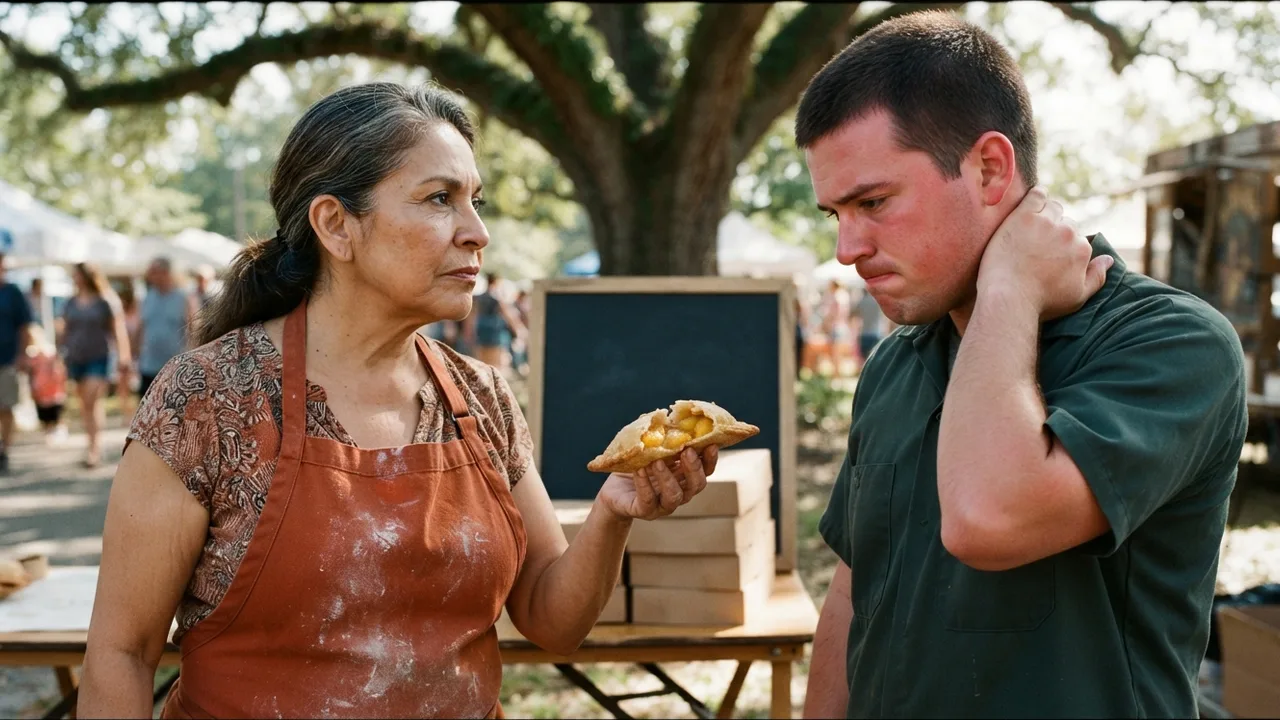
Gene Marek laid the comment card on my folding table, between the cash box and the chalkboard, and said, "Charo, that's two. One more, and the board can give your corner to somebody else."
Empty pie boxes stood in a tower at my elbow, and I was adding one more. It was the 1 o'clock close on the last Saturday of September, and the sun had finally moved off the courthouse lawn and left the live oak's shade to the rest of us.
I set the box down and looked at the card. Green felt-tip, block capitals, pressed hard enough to dent the paper.
"Read it to me," I said.
Gene cleared his throat. He is a retired ag teacher and he reads aloud like one. "'She shorted me ten dollars in change and argued about it. Somebody at this stand is getting confused.'"
Advertisements
Beside us, Darlene Hruska stopped screwing lids onto honey jars. "Lord, Charo."
"I count change out loud, Gene," I said. "Every bill, every time. Ask anybody on this square."
"Now. I'm not saying a thing. I'm reading what was in the box." He turned the card over as if the back might help. "Same green as the first one."
The first one had come the week before: *PEACH PIE RAW IN THE MIDDLE. THIS STAND IS NOT WHAT IT USED TO BE.* I had cut thirty-six pies in half that Saturday and handed the halves out to anyone who would take one. That was $144 of pies stacked in a box and given away, and my pride went out with them.
Nineteen years I had stood on that corner. I fried peach, apple and chocolate, four dollars apiece, and nobody had ever once said my crust was wet.
"Let me keep it," I said. "Both of them."
Gene looked at the card, then at me. "Till the meeting," he said, and set it in my hand.
His fingers shook a little. He kept the key to that box on a ring with his truck keys, and I watched him tuck the ring back in his pocket as if it had gotten heavier.
On Monday morning Odessa Lenz called from First Methodist. She is a kind woman, and she was kind about it.
Advertisements
"Charo, honey, we've decided to get something from the H-E-B bakery for the bazaar this year. Nothing against you. We just want to be safe."
"Safe," I said.
"Well, with all this talk. About you being tired. Or confused."
Twenty dozen pies for the October 24 bazaar, at two-fifty each. Six hundred dollars, gone before I finished my coffee.
Flour still dusted my forearms when I hung up and stood at the counter. The talk was not about my pies anymore. It was about my head.
Tuesday Gene called again, and this time he did not start with "Now."
"Charo, I have to tell you something, and I'd rather you heard it from me. Kristen Tobolka put in a written bid for Stall 1 for next year. Twelve hundred dollars. It goes on the agenda for the October 13 renewal meeting."
"Twelve hundred," I said. "I pay six-fifty."
"That's the grandfathered fee. I know." He breathed out. "Charo, the insurance and the porta-johns run nine thousand a year."
Arguing would not change the number. I hung up, took the bylaws out of the drawer where I had kept them for nineteen years without opening them, and read them at the kitchen table until my husband turned off the porch light.
Section 6(b). Three written complaints in one season gave the board cause to reassign a stall.
At three that night I woke and went out to the truck and counted my change bag. I counted it again at the table, and a third time before the first sale on Saturday.
On October 3, Lester Pavlik, who had bought a peach pie from me most weeks since the Bush administration, took his change and did not move on.
"You feeling all right, Charo?"
"I feel fine, Lester."
"Well. Good." He tucked the pie under his arm. "People say you might be tired."
"People should buy a pie and mind their own."
He laughed, because he was supposed to. He did not meet my eye on the way out.
Later that morning Kristen Tobolka came around the courthouse with a kolache in a paper napkin. She is tall and quick, with powdered sugar down her apron and her ponytail pulled through a ball cap. I had watched her hands for two seasons. They were always moving.
"Miss Charo! Sausage and jalapeño, still warm." She held it out, and her voice carried to the honey stall, the pepper man and the lady selling tamales. "Nobody would blame you for slowing down, you know. Nobody at all."
Darlene's jar clinked on the table behind me.
I took the napkin. "I'll tell you what, Kristen. I'll eat this at my own pace."
She smiled and said, "Ooh, good one," half a beat late, and walked back the way she had come. Three vendors found something to do with their hands.
That night I laid the two green cards side by side on the kitchen table, under the light, and made myself think it through.
Gene needed the money. He would never say so, but he did. And Darlene had eyed the shade on my corner every Saturday since she set up beside me, and she had laughed about it with me more than once. I did not want to write her name in my head. I wrote it anyway, with a pencil, on the back of an envelope, under Gene's.
Then I tore the envelope up and burned it in the sink, and sat there with the smell of it until after midnight.
On Thursday, October 8, at fourteen minutes past nine, I picked up my phone and typed to Kristen: *Trying apricot-jalapeño Saturday. Tell me honest, too much?*
She answered before I set the phone down. *Ooh brave! Save me one.*
At twenty past, I wrote to Gene: *Trying a fig pie Saturday, just to see.* He sent back a thumbs-up and *Fig's good. Be careful of the sugar.*
At twenty-six past, I wrote to Darlene: *Buttermilk pie Saturday. Don't tell a soul.* She wrote, *Buttermilk! Lord, Charo. Save me a slice.*
Then I rolled out the dough for Saturday. Peach, apple and chocolate, the same as always.
At seven that Saturday morning Gene carried the pine box out to the info table at the gazebo and set it down empty, in plain sight across the lawn from my corner. He rattled the padlock and gave me a nod.
The price list came off my cash box and went face down on the table. I sharpened a pencil on the edge of the table.
Darlene set a cinnamon coffee at my elbow. "Something new, I hear?" she said, laughing.
"Who told you that?"
"Nobody. You've got a look." She patted my arm and went back to her honey.
My face went warm, and I did not answer.
At 7:45 Gene walked the row with his phone and photographed my chalkboard. The board said peach, apple and chocolate, and he did not look at it twice.
Between sales I watched the slot. A girl in a church-camp shirt put a coin in the donation jar and walked off. A man dropped a flyer on the table and picked it back up. Nobody touched the box.
At 11:40 Kristen Tobolka came around the courthouse with her head down. She went to the gazebo, put something folded through the slot, and walked straight back.
On the back of the price list I wrote it down. *Kristen — 11:40 — one folded card.* My pencil lead broke on the last word.
At one o'clock Gene unlocked the box with the key from his ring. He took out a single green card and stood at the info table with it, reading aloud.
"Charo," he said, in front of the info table and the three vendors standing there, "that's three. It's on Tuesday's agenda."
"I heard, Gene."
Darlene put a hand on my shoulder. I let her, and I felt like a thief doing it.
Nobody helped me load the truck. Vendors I had known for ten years found their own tailgates very interesting, and nobody said goodbye.
The Pecan Hollow Community Center smelled of burned coffee. It is two blocks off the square, with a drop ceiling and folding chairs set out in rows.
By seven on Tuesday evening, about twenty vendors sat in those chairs. The board sat at a long table in front: Gene, the retired ag teacher, the retired county extension agent, the bank branch manager, Ingrid Bauer, the Lutheran pastor's wife with her minute book, and Darlene at the end with her bandanna folded in her lap.
Kristen sat two rows up from me with a folder.
Gene read item four from the agenda. "'Stall 1: complaints under 6(b) and the competing bid.'" Then he read the three cards into the record, word for word, the way he reads everything when he is uneasy.
The third one said: "'Bought the new apricot-jalapeno pie at 9 this morning. Raw dough in the middle. Threw it out. Third time I've heard this about this stand.'"
Kristen spoke for her bid. She was gentle about it. She said fresh blood, and rotation, and that nobody wanted to embarrass Miss Charo, who had given so much to the square.
Then she sat down and looked at her folder.
I stood up. I have never once stood up at a meeting, and my knees told me so.
"Gene, will you pull up your seven-forty-five photo of my board from the tenth? The one on the market page."
He turned his laptop around. There was my chalkboard, with the time stamped in the corner and three pies written on it in my hand: peach, apple, chocolate.
"Nobody bought an apricot-jalapeño pie on Saturday," I said. "There was never one to buy. I have never fried one in my life."
The room shifted. Chairs creaked.
"Charo's been talking up some new pie all over the square for two weeks," Kristen said. "Half the market's heard about it."
"Then tell me who."
"Well. Lots of people."
I held up my phone, open to the thread from Thursday at 9:14. "I wrote to one person about that pie. 'Trying apricot-jalapeño Saturday. Tell me honest, too much?' She wrote back, 'Ooh brave! Save me one.'"
Kristen stood. "That's the whole point, y'all. She can't keep her own flavors straight. Nobody wants to say it because she's been here forever."
"Sit down, Kristen," Gene said, mildly. She did not.
"So she lied to me to set people up. That's the kind of person who's held the best corner for nineteen years on a grandfathered fee. Let's just put Stall 1 in rotation and drop the whole thing."
"I never said those words out loud to a living soul," I said. "Name one person who heard me."
Kristen's mouth opened. Nothing came.
"Now," Gene said. He took off his glasses. "I'll ask the room. Has anyone here ever heard Charo Villalba mention an apricot-jalapeño pie?"
He waited. Nobody raised a hand. A man in the back studied his boots.
"Then I'm not in rotation," I said. "The card says somebody bought it. Nobody bought it. It didn't exist."
Turning over the price list, I read the line I had penciled in. "Saturday, 11:40. 'Kristen — one folded card.' The box sat on the info table from seven until one, in plain sight of my corner. That is the only name on the list."
"That was a note," Kristen said quickly. "Asking for a trash can by Stall 22."
Gene did not hurry. He took the green card from his folder and laid it beside my price list on the table.
"Now. There was one card in that box at one o'clock," he said. "This one."
No one coughed. The coffee urn ticked as it cooled.
"I'm not confused," I said. My own voice was quieter than I expected. "I told three people three different pies on Thursday night, on purpose, because one of the three was writing these cards. I told Gene fig. I told Darlene buttermilk. I told Kristen apricot-jalapeño."
Next I turned the phone so the board could see all three threads, with their times and their answers. Then I walked it up the table and handed it to Ingrid Bauer.
"For the minutes," I said.
She read, and her pen moved.
Darlene had not made a sound. She looked at me, and she said only one word.
"Buttermilk."
Her face had gone very still and formal, the way it does when she is hurt. I had put her on a list. Everybody in that room knew it now, and so did I.
Gene tapped the table with his pen. "Now. I move that the third card be struck from the record as false and as Kristen's own. I move that the first two be struck with it, as unsupported."
He looked at the room. "I want to say why and how far this goes. Nobody signed those two cards, and nobody has come forward. The first one was answered when Charo cut thirty-six pies in half in front of the whole square and every one was cooked through. And no buyer has ever come to Charo or to me about ten dollars. The board is not ruling on who wrote those two. It is ruling only that unsigned cards nobody will stand behind cannot take a vendor's corner."
The extension agent seconded it. The vote went four to nothing. Darlene abstained as a party.
Gene opened the bylaws to 6(c) and read it aloud, every word, even the commas. A vendor found to have filed a false complaint forfeits her deposit and the remaining Saturdays of the season.
"That's the hundred and fifty dollars," he said, "and October 17 through November 21, Kristen. The board also refuses your bid for Stall 1."
He slid her bid paper back across the table. Kristen folded it in half and put it in her purse. She did not apologize.
"Gene," I said, "may I speak?"
"You may."
"I'd ask the board not to take Stall 22 from her for next year. She has a note on that trailer, and I know what a slow Saturday costs."
The bank manager nodded slowly. Gene looked down the table and got three nods back. "Stall 22 stays hers. And Stall 1 is renewed to Rosario Villalba for 2027, at its usual fee."
Kristen stood with her purse against her chest. "Six Saturdays is real money to me."
"Twenty dozen pies was six hundred dollars to me," I said.
She went out through the glass door and let it close on its own.
The vendors began to stack chairs, loudly, so as not to look at anybody. Darlene stayed where she was until the room was mostly empty. Then she came and stood in front of me with her bandanna in her fist.
"You could have asked me, Charo."
"If I'd asked, I'd have had to believe you or not." My hands were not steady, so I held my purse strap. "I couldn't stand either one."
She said nothing. A folding chair folded behind her.
"I'm sorry, Darlene," I said, loud enough for the two men by the urn. "I'm sorry I put you on that list."
She nodded once. She did not hug me, and I did not ask.
The next Saturday the live oak dropped a few early leaves across my table, and the morning was already warm.
On the chalkboard, in my own hand, went peach, apple and chocolate. Then, under them, a fourth line I had never written in nineteen years.
*Fig.*
Darlene came in at seven with two cinnamon coffees and set mine down by the cash box. She did not say anything. She stood there with her own cup and waited.
"Thank you," I said.
"There it is." She pulled the lid off hers. "Buttermilk next week, or don't bother."
"I don't make buttermilk."
"I know you don't." She almost smiled, and she went to her honey.
From my corner Stall 22 was out of sight. The courthouse stood in the way, as it always had, but I knew it was empty. The man who used to buy kolaches for his kids came around the corner of the courthouse, looked at the chalkboard, and put down his four dollars for a fig.
I counted his change out loud, and he waited for every bill.
At one o'clock Gene Marek came across the grass with a card in his hand. He laid it on my folding table, between the cash box and the chalkboard, in the same place the other one had been.
It said, in blue ink: *Stall 1 — R. Villalba.*
Comments