My children started treating me like a child the day I told them I was having dinner with a man who wasn't their father. By the time spring was ending, Brendan held every password I owned, and he had a power-of-attorney form with my name typed across the top.
It began on a Sunday, on the phone, with Brendan's silence.
"Who is he, Mom?" he finally asked.
"His name is Dominic Peretti. He's a retired contractor who built the raised beds for the garden club. He lost his wife before I lost your father."
"And you're having dinner with him."
"Thursday. At the supper club out on the highway."
Paige came on the line then, softer, the way she always did when her brother had finished being firm. "Isn't it kind of soon, Mom? It's only been a year."
Advertisements
"I know exactly how long it's been, honey."
Neither of them said anything else about it. On Tuesday, Brendan showed up at my kitchen table with his laptop and a bag of Hy-Vee cookies, as if cookies made it a social call.
"I want to help you tidy up your accounts," he said. "You've got the checking, the savings, the electric, the water, the card. It's scattered. For long-term stability, it all ought to live in one place."
"I've paid those bills by hand for thirty years."
"And you've done it beautifully. This is just prudent."
I watched his fingers move. He typed my passwords as I read them off the index card from my recipe tin, and then he typed a second set of numbers into a second screen that I couldn't see.
"What's that one?"
"Alerts. Every deposit and withdrawal pings your phone, so you'll catch anything strange." He smiled. "And mine too, so I can keep an extra eye on things for you, Mom."
I did not say no. I have wondered since why I didn't, and the only answer I have is that I was raised to let a child finish his sentence.
That night my phone chirped when the electric company drew its payment. I lay in bed and pictured the same chirp in Brendan's pocket, across town, in his modern house with the three-car garage, and I didn't sleep until the wind quit rattling the screen door.
Advertisements
Dominic came Saturday to fix the back door. It had squealed for a year, and I'd only noticed because Robert used to say he'd get to it.
He knelt on the mat with a screwdriver and a little can of oil, moving the way he always did, slow and deliberate, as though the door might change its mind. I stood holding the hinge pin in a dish towel and watching his weathered hands.
"There," he said, and swung the door. It opened without a sound.
"I could kiss you," I said, and felt my face go warm. Then the front doorbell rang, and rang again.
Brendan stood on my porch in his office clothes, though it was a weekend. He looked past me at Dominic, at the screwdriver, at the oil can sitting on my counter.
"Mr. Peretti," he said.
"Dominic is fine." Dominic stood and wiped his hand on his jeans before offering it.
Brendan looked at the hand. He shook it for exactly as long as it took to be polite. "I'll call you Mr. Peretti until I know you better."
"That's fair," Dominic said, mild as milk.
Brendan stayed ten minutes. He checked my thermostat, asked whether I'd locked the garage, and left without once sitting down.
He called at suppertime. Dominic was at my sink rinsing the oil off his hands, and I answered without thinking and put the phone to my ear.
"Mom, I want you to hear this from me. I ran a background check on Peretti."
My stomach went cold. "You did what?"
"You can't be too careful. He's clean, I'll tell you that. But a man shows up in a widow's life with a toolbox, you ask questions."
Dominic had turned off the water. He didn't look at me, and that was worse than if he had.
"Brendan, I'm hanging up now," I said, and I did. My hand shook a little as I set the phone on the counter.
"Daphne—"
"I'm so sorry. I had no idea he'd do that."
He dried his hands one finger at a time. "Your boy's frightened. I'd probably do the same." He paused. "For the record, I've got one speeding ticket outside Lexington, and I've never owed anybody a dime."
I laughed, and then I had to turn toward the window, because the laugh came out crooked.
The family meeting was the next Sunday, after church, at Brendan's house. Paige had brought lemon bars on a paper plate and set them out on a dining table the size of a boat.
A folder sat at my place, pale blue, with yellow flags sticking out of the pages.
"We just want to go over some things," Brendan said. "Durable power of attorney. It means if you were ever unable to manage, I could step in without any court process."
"Unable to manage."
"Illness. An accident. Or being taken advantage of." He slid a pen across to me. "It's a safeguard."
I looked at the flags. Each one said SIGN HERE in a neat capital hand that wasn't Brendan's. Somebody had gone through those pages ahead of time and marked where my name would go.
"Paige?"
My daughter was peeling the paper liner from a lemon bar in tiny strips. "It's just a precaution, Mom," she said, not looking up. "To protect you from being taken advantage of. By anyone."
"By anyone," I said. "Meaning Dominic."
"Meaning anyone," Brendan said.
Something rearranged itself behind my ribs. They weren't worried about a stranger. They had sat down together, the two of them, and decided I was a house to be managed, and the lemon bars were part of the plan.
"I'll give you my answer Saturday," I said. "At the arboretum, after the pavilion dedication. Bring the folder."
"Mom, there's no reason to wait."
"There is. I have a ribbon to stand next to." I stood and buttoned my cardigan. "I raised you both to respect a person's time, Brendan. Please respect mine."
On Monday I called the credit union where Robert and I had banked since before either child could walk. Not Brendan's bank. Mine.
A woman named Renata took me through the identity questions, my mother's maiden name, the street I grew up on, and I answered every one without notes.
"I'd like everything listed under my name and my late husband's," I said. "Everything. Please read it to me."
She read. Checking, savings, a certificate of deposit. Then she slowed down.
"And there's a home equity line of credit, opened against the house on your street. It's in Mr. Calder's name. The current balance is eighty-seven thousand four hundred dollars."
I held the pen over the back of a Hy-Vee receipt. The ink wouldn't come.
"Say that once more, please."
She said it once more. I wrote the figure down with my left hand steadying my right.
When the call ended I sat in Robert's recliner, which I hadn't sat in since the funeral. I thought about his Thursday drives, the ones he called "getting out for air," and the gas receipts I'd never questioned, and the shine on his shoes when he came home too quiet. A decade of Thursdays opened up in my mind like a drawer I'd never been told was there.
I waited until Friday to tell Dominic, on my porch, with two cups of coffee going cold between us. I told him all of it, the line of credit, the folder, the yellow flags, and what I suspected my children knew.
He was quiet for so long that a mourning dove walked the whole length of the railing.
"Do you want me to go?" he asked. "This is family business."
"I want you to stay."
"Then I'll stay." He turned his cup in his hands. "Daphne, there are people whose whole job is this. Nonprofit counselors who sit down with a family and a pile of paper. You don't have to carry it by yourself, and you don't have to hand it to anybody who'd keep it from you."
He found the website on his old flip phone's bigger cousin, and I booked the appointment myself, typing my own name. The confirmation came back for Tuesday, and I read it standing up in my kitchen with my coat still on.
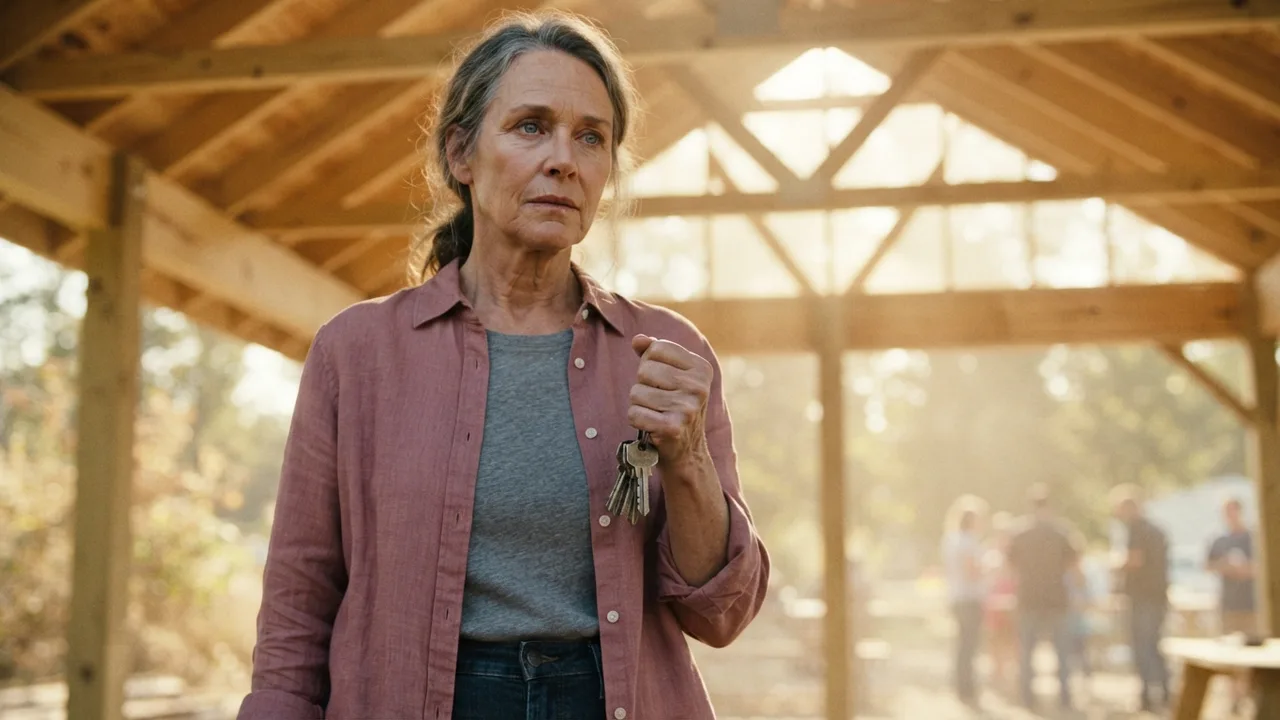
Saturday afternoon the wind came across the Yanney Heritage Park Arboretum the way it does in Nebraska in late spring, warm and in a hurry, flattening the grass and tugging the program sheets out of people's hands.
The pavilion stood at the end of the gravel path, new cedar posts and a shingled roof, raw and handsome. The garden club had raised its cost one bake sale and one raffle ticket at a time, and I had counted a great many of those dollars in my own kitchen.
Hattie Zeman, who chaired the committee, was testing a microphone. Volunteers in green aprons arranged folding chairs. Dominic stood by the lilac hedge in his good flannel, a respectful distance off, hat in his hands.
Brendan and Paige arrived together. Brendan carried the blue folder under his arm.
"Walk with me," I said.
We stopped behind the pavilion, where the posts blocked the wind, close enough that I could hear the chairs scraping on the gravel.
"I won't be signing any papers," I said.
Brendan took a breath and settled into his office voice. "Mom, I understand this feels like a lot, but when you consider the long-term picture, and the risk of a mistake that can't be undone, a relationship at this stage of your life—"
"Brendan." I didn't raise my voice. "I know you're worried about the money. I called the credit union myself this week."
He stopped as if he'd walked into a pane of glass.
I took out my phone and held the screen toward them. It wasn't a statement. It was a plain white email with a confirmation number and a time.
"This is an appointment with a certified debt counselor. The credit union told me about the balance of $87,400 on the home equity line your father took out. So I made this appointment for us."
Paige made a small sound. Brendan stared at the screen, and I watched his jaw move.
"Whoever you spoke to had no business reading that to you," he said at last. "Those numbers are out of context. I've been managing the paydown. I have it handled."
"With what, Brendan?"
"With a plan." His eyes went to the folder, and he gripped it harder. "Which you'd know about if you'd sign the form instead of running off to the bank."
"I didn't run. I walked into my own accounts and asked a question."
Paige was crying now, her hand over her mouth. "We were trying to protect you, Mom!" she said. "We didn't want you to have to know that about Dad. We were going to pay it back ourselves, every cent, without you ever having to worry."
"Every cent from where?" I asked gently.
She shook her head, and her shoulders went.
"Who else knows?" Brendan said suddenly, turning it on me. "Who have you been telling? A man you met this winter, and you hand him our family's business before you hand it to us?"
I looked over his shoulder. Dominic hadn't moved from the lilacs, though he must have seen Paige's face. He stayed where he was, as he'd promised.
"I told Dominic everything yesterday," I said. "He helped me find the counselor. He sat on my porch and listened, and then he asked me whether I wanted him to leave, and he waited for my answer."
Brendan opened his mouth and closed it.
"Protecting me would have been telling me the truth," I said. "You decided I was too weak to handle my own life, and you wrote it into a folder with yellow flags. That wasn't protection, Brendan. It was judgment."
The wind caught the corner of the folder and lifted it against his arm. He didn't seem to notice.
I looked at my son, who had his father's straight shoulders and was holding them like a man afraid they'd come loose, and at my daughter, who had stopped crying into her hand and was only breathing. They were twenty-eight and twenty-five, and for one moment they were both six, standing in my kitchen over a broken lamp.
"The three of us will go to that appointment on Tuesday," I said, and my voice left no room anywhere. "We will deal with your father's debt as a family. But my finances, my house, and who I have dinner with are my decisions. This is over."
Brendan gave one stiff nod. His eyes were on the gravel.
"I'm sorry, Mom," Paige whispered.
"I know you are." I held out my hand to Brendan, palm up, and after a moment he understood and gave me the folder. I carried it to the green trash barrel by the bike rack and dropped it in, and the lid clanged in the wind.
When I came back, they had gone toward the parking lot without a word, side by side but not touching, a foot of gravel and wind between their shoulders, Paige's good shoes crunching out of step with Brendan's.
I stood under the new roof and looked up at the rafters, at cedar so fresh it still bore the pencil marks of the men who had cut it. Somewhere behind me Hattie said something into the microphone and a few folding chairs scraped.
Robert had sat at our table most Thursday nights, eating pot roast and asking about my garden, and I would never be able to remember that table without the drawer opening under it. That was gone, and I had traded it for a Tuesday morning and a stranger's spreadsheet. Brendan would call, I knew, because he was my son, and Paige would too, but the easy sound of their voices was gone and I couldn't pretend it wasn't.
Dominic came across the grass in his slow way, hat tucked under his arm. He didn't say anything. He took my hand in his rough, warm one, and I squeezed it back, hard, looking at the solid new pavilion meant for the whole town to gather in, and I felt the deep crack running through my own family.
Comments