"Your system is a dinosaur, Theresa," my new boss said on his first day, tapping his tablet. "It's time for an extinction-level event."
He meant my files. Thirty years of triplicate permits, each one the only proof of what this county had ever spread on its roads, and he wanted them boxed for shredding by Friday.
I had two years left before my pension was full. Preston Hayes had an expensive watch, a smile that stopped below his eyes, and the authority to sign my termination.
I am the Permit Coordinator for the Leelanau County Road Commission. Every contractor who has touched a county road since before Preston finished college has gone through my desk. The white copy goes to the contractor, the yellow to the file, the pink to me.
Advertisements
It is not glamorous work. It is the reason nothing gets spread on the ground above our water table without a signed certification behind it.
Preston called that a bottleneck. He said it the first week, and again in the staff meeting where I lost the argument about Northline Aggregates.
"Northline's bid came in well under Hollis Salt," he told the eleven of us around the table. "We're talking real savings. Theresa has a hold on their permit. Theresa, walk us through the hold."
"The material safety data sheet was not appended to the file," I said. "Ordinance 11-B requires a hardcopy sheet and a chemical certification before any de-icing material is accepted at the depot."
"They uploaded a PDF."
"A PDF is not a certification, Preston. It is a picture of a form."
Somebody coughed. Doris from the front desk studied her coffee. Walt Kowalski, the depot foreman, who had trained half the drivers in the county, looked at me and then at the table.
"It's redundant," Preston said, and he smiled at the room as if inviting it to agree. "We have a digital approval. I'm overriding the hold. Let's streamline the workflow, people."
He did, with two taps. My hold, which I had written in my own hand on pink paper, disappeared from the screen.
I sat through the rest of the meeting with my pen capped. In thirty years, nobody had ever overridden me in front of the whole office.
Advertisements
That afternoon I wrote a formal request, on paper, for the chemical certification on Northline's road salt before their first delivery. I made three copies and put one in Preston's inbox, one in the file, and one in my cardigan pocket.
He answered on Monday morning with a Performance Improvement Plan. It was printed, because I had told Doris I would not accept anything else.
"Failing to adapt to new digital protocols," Preston read aloud from his copy, leaning against his desk. "And creating departmental bottlenecks. Those are the two findings."
"Findings require evidence," I said. "What is the evidence?"
"Your request, Theresa. Your request is the evidence."
"And the timeline for improvement?"
"Thirty days. Then we revisit your position." He tapped his tablet. "I'd hate for it to come to that. Your pension date is what, two years out?"
I did not give him the answer. I took my copy, folded it once along the crease, and walked to the filing room to sit among the cabinets he wanted to throw away.
For a week I did not sleep. I lay beside Calvin in the dark and went through the numbers in my head: the pension schedule, the mortgage, the garden I had planned to spend my retirement tending.
On the sixth night, Calvin put down his book on his side of the bed.
"You've turned over forty times," he said. "Tell me what's in the file, Theresa."
So I told him at the kitchen table at two in the morning, with the porch light on and a pot of decaf going cold. I told him about Northline and the missing certification and the PIP.
He listened the way he used to listen to eighth graders explaining why they hadn't read the chapter.
"If the salt is clean," he said, "you lose your job for asking a question. If it isn't, what does it do to the lake?"
"It goes into the ground and then into the water table. It takes a long time to come back out."
"Then you already know what you're going to do." He refilled my cup. "I only want to hear the plan, so I can tell you if it's a good one."
I did not have a plan until Tuesday.
On Tuesday I was driving home from the Meijer on Front Street with a rotisserie chicken on the passenger seat. At dusk I saw three gray dump trucks with Northline's logo turning through the gate of the county depot.
The delivery schedule on Preston's calendar said Wednesday, during business hours. Nobody from the Road Commission was there to receive them. No inspector, no weigh ticket, no chain of custody.
I sat in the Meijer lot with the engine running and went through what I knew. The salt would be dumped in a bay. Once it was mixed with the stock from Hollis, no sample would ever be clean again.
Then I drove home, put the chicken in the refrigerator, and went to the cedar box on my dresser. In it was the emergency key to the depot's side door, issued to me in the winter I had been on call for ice storms. I had not used it in twelve years.
Calvin watched me take a clean canning jar from the pantry shelf.
"Do you want me to drive?"
"No. If I am caught, one of us should still have a job to go back to. You don't have one."
"That's fair," he said, and he did not smile, and he handed me a flashlight.
The depot is five minutes from the office. I cut the headlights before the gravel lot and walked to the side door with my reading glasses swinging on their chain.
The key turned. The reader beside the door gave one small green blink, and I understood that it was logging me.
Inside, the bays smelled of cold concrete. Bay two held the Hollis salt, the coarse gray-white I had inspected every autumn for three decades. Bay four held a new pile, finer and oddly bright.
I filled the jar from the middle of the pile, not the surface. I capped it, taped the seal, and wrote on the label the date, the time, the bay, and my signature. Then I stood a moment and understood that I had just taken county property without authorization.
Out I went, the trowel back in my coat pocket. I did not look at the cameras. In the morning I found that Walt had hung a chain across bay four, though I had told him nothing.
"Cold snap's late," he said when I came by. "No reason to spread anything from that pile till somebody tells me it's good."
"Thank you, Walt."
"I didn't do anything," he said, and he went back to his coffee.
The lab was in Grand Rapids, a long drive down with the jar buckled into the passenger seat. The woman at the intake window told me that expedited analysis was $350, and I paid it with my debit card. She handed me a receipt stamped with that day's date.
Calvin and I had planned to spend that money on a new greenhouse door.
The results came by email Saturday morning. I printed six copies at the library, because my home printer is old and I did not trust it with this.
I read the page standing in the library lot with my glasses on. The anti-caking agent, a cyanide-based compound that has no business anywhere near a county road, stood at three times the legal limit.
I sat in the car for some time. Then I put the pages in a folder and drove home to iron my good blue blouse.
The Board of Commissioners meets quarterly in the main chamber of the county courthouse, under the old oak paneling and the flag nobody has replaced since the nineties. That Monday evening there were a dozen citizens in the folding chairs, mostly farmers and one reporter from the weekly paper. Calvin sat in the third row in his tweed jacket, a book closed on his knee.
Preston stood at the podium with a slide on the screen behind him that said, in a clean white font, PAPERLESS: 31% FASTER.
"Efficiency," he told the board, "is a mindset. We have retired outdated workflows, and I'm proud of what that's delivering for the taxpayer."
Margaret Dearborn sat at the center of the dais in a gray suit, listening with her whole face. She is sixty-five, owns a cherry orchard, and has never in my hearing raised her voice. When she speaks, people stop talking.
When he finished, she said, "We'll open the floor to public comment."
I stood. My knees were steady, which surprised me. I walked to the microphone with the folder under my arm.
"Theresa Somerville, Permit Coordinator, Road Commission," I said. "I have a procedural question for Mr. Hayes."
Preston gave the board a small, patient smile. "Of course, Theresa."
"Mr. Hayes, could you please confirm for the board that the de-icing salt provided by the new contractor, Northline Aggregates, has been certified as watershed-safe under county ordinance 11-B?"
"All digital approvals are in order," he said easily. "I'd note for the board that Mrs. Somerville is currently subject to a performance plan. She has struggled with the transition."
A few of the farmers shifted in their seats.
"I did not ask about the digital approvals," I said. "A digital signature does not certify a physical substance. Ordinance 11-B requires a laboratory certification of the material itself, and there is none in the file."
"It's in the system, Theresa."
"It is not."
I walked to the dais and set a copy of the lab report in front of Margaret Dearborn, then one in front of each commissioner. My hand was quite steady, and I noticed that with distant interest.
"This analysis of the salt delivered last Tuesday," I said into the microphone, "shows cyanide-based anti-caking agents at three times the legal limit."
The room went silent.
Margaret Dearborn picked up the page. She read it from the top, and she did not hurry, and nobody in the chamber made a sound while she did.
Preston found his voice first.
"This is inadmissible," he said, and the smoothness had gone out of it. "It's unverified. It's a stunt from a disgruntled employee who is facing disciplinary action. She probably contaminated the sample herself."
"Mr. Hayes," Margaret said, without looking up.
"And I'd like the board to ask how she got it." He turned toward me. "She broke the law. She trespassed on county property."
Margaret Dearborn was the one I looked at.
"I did enter the depot after hours," I said. "I have the receipt for the lab test, dated the day after the delivery. I also have my emergency key, which, until last Tuesday, had not been used in twelve years. The access log will show that."
A breath, and my eyes stayed on her.
"I took the risk because the safety of our water is not a bottleneck."
Margaret Dearborn lowered the report. She looked at me, then at Preston's flushed face, and then back at me, as if he were a piece of furniture that had started talking.
"Mrs. Somerville," she said. "Is this the only pile of salt at the depot?"
"No, ma'am. The safe salt from our long-term supplier, Hollis, is in bay two. The Northline salt is quarantined in bay four."
"Quarantined by whom?"
"By the foreman, Walter Kowalski. He hung a chain across it on Wednesday morning. Nothing from that pile has been spread."
Margaret nodded once, slowly, and I saw her settle something.
"Commissioners," she said, "I move that the Northline contract be suspended effective tonight. I will have the depot secured and a full independent audit opened tomorrow, including every certification Mr. Hayes has signed since he arrived."
"Margaret," Preston began. "This is premature."
"Sit down, Mr. Hayes."
He sat. The color had left his face all at once, like water running out of a basin.
Nobody applauded. A farmer in the back row took off his seed cap and held it in both hands. Calvin got up from the third row, crossed the aisle, and stood beside me without a word until the chairs began to scrape.
In the parking lot he held my hand, and neither of us said anything for a while. A woman I had known since church came over to tell me she was glad I had spoken, and I thanked her and found I wanted only to be home.
At the car I told Calvin what was sitting on me.
"I used to be a person who followed the form, Cal. Now I am a person who goes into a depot at night with a canning jar."
"You are a person who followed the form for thirty years," he said, "and then found the form had been stolen. I think the jar was the next procedure."
Preston Hayes resigned by email on Wednesday. On Thursday afternoon, Doris carried his boxed personal things down to the lobby, and the tablet was left on his desk with the screen dark.
A week after the meeting I sat in his old office. Margaret Dearborn had asked me to come in, and I had agreed to occupy the room only until the board made up its mind. The cabinets he had condemned were back against the wall of the hallway outside, still smelling faintly of the dumpster where Walt's men had rescued them.
Margaret sat across the desk with her coat folded over her knee.
"The audit has found what you'd expect," she said. "I won't go into it. The point is that we need someone in this chair who reads the fine print. I'd like you to stay on, Theresa, as Interim Director."
I looked at my hands. My retirement was in the drawer at home: a pension schedule, a seed catalog with the corners folded, a greenhouse door I had priced at the hardware store.
"I had a date in mind," I said.
"You did," Margaret said.
"I was going to disappear quietly into my garden. I was not planning on having my name in the weekly paper."
"I'm sorry for that," Margaret said, and I believed her. "I will not pretend it doesn't cost you."
Outside the window, a few flakes came down, small and dry, the first of the season. They landed on the glass and did not melt right away.
"Through the winter," I said. "Someone needs to make sure the right trucks are on the road."
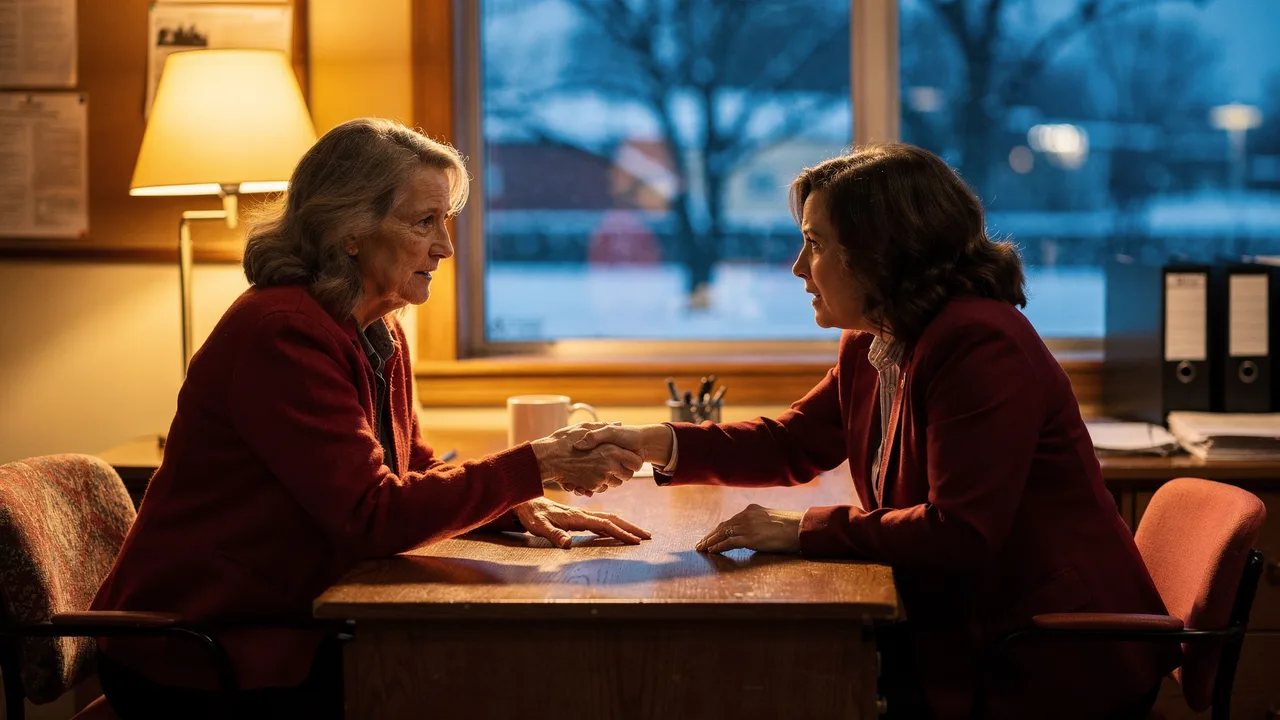
"Then through the winter," Margaret said, and she held out her hand across the desk. I shook it.
My first act was to open the purchase order that Doris had left in a paper folder, because I had asked her to. It was an emergency delivery from Hollis Salt, and I read every line of it, checked the certification number against my old file, and signed my name at the bottom in blue ink.
At noon I drove to the depot. Walt had the chain off bay two, and the men I had known for decades were loading their trucks from the coarse gray-white pile. One of them, Dennis, whose father I had also known, lifted two fingers from his steering wheel as he passed me.
By late afternoon I was back at the window of my new office. The light was going blue, and the forecast promised a hard freeze by evening.
The first truck came down the road past the courthouse, blue and county-marked, with the amber light turning on its roof. Its spreader spun, and behind it a line of dark salt unrolled across the pavement, and the snow along that line began to loosen.


Comments